On the afternoon of March 14, 1932, George Eastman sat alone in his second-floor bedroom at 900 East Avenue in Rochester, New York. The 77-year-old founder of Kodak had just signed a codicil to his will in the presence of his lawyer, his doctor, and a few trusted witnesses. He had been polite, lucid, and even cracked a small dry joke. Then the heavy oak door clicked shut, sealing him off from the world.
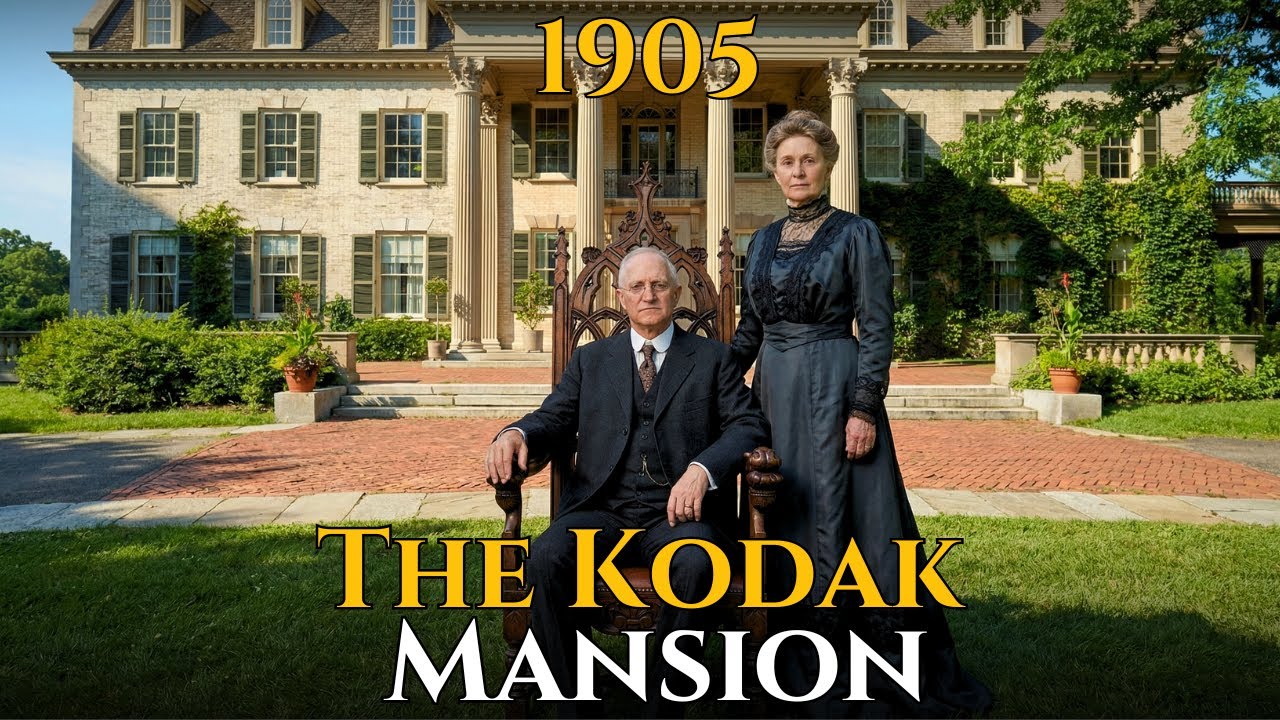
Eastman had built the largest estate in the city, a 50-room Georgian Revival mansion that symbolized American success. He had democratized photography, placing the power to freeze time into the hands of ordinary people. But on this gray Monday afternoon, the atmosphere inside was not one of triumph. It was one of quiet, terrifying finality.
For two years, Eastman had been fighting a private war against his own body. He suffered from a degenerative spinal condition that was slowly stealing his balance, his strength, and his independence. He shuffled when he walked and required assistance to stand. For a man who had built his entire life on independence and control, creeping invalidism was a fate worse than death.
He had watched his mother, Maria, wither away in helplessness in this very house. He had spent years at her bedside, watching her become a prisoner in her own failing body. He had made a silent vow then that he would never let that happen to him. He would not be spoon-fed.
He would not be an object of pity. He stood up from his chair, walked to his desk, and picked up a fountain pen. On a yellow legal pad, he wrote a final message to the world with a firm hand. It was brief: “To my friends, my work is done.
Why wait? ” He signed his initials with a flourish, placed the pen down, and aligned it perfectly with the edge of the pad. He opened his nightstand drawer. Inside lay a Luger automatic pistol, a souvenir from a trip to Africa, and a wet towel.
Even in suicide, he was precise. He did not want to leave a mess for the maid. He lay down on his bed, adjusted the pillows, placed the folded towel over his heart, and pressed the muzzle of the Luger against it. With the same steady hand that had signed checks and shaken the hands of presidents, he pulled the trigger.
The sound was a dull thud, muffled by the heavy fabrics. Downstairs, the servants heard a noise like a heavy book falling flat onto the floor. They did not come running immediately, but as the silence stretched longer than usual, unease crept through the hallways. When they finally entered the room, the man who had revolutionized the way humanity saw itself was gone.
The irony was almost literary. At the exact second Eastman pressed the trigger, millions of people around the globe were using his invention. In Paris, a father photographed his daughter in the park. In London, a tourist captured Big Ben.
In Tokyo, a family preserved the memory of a wedding. He had created a machine that defeated time, giving the world the ability to capture moments and keep them forever. But in his own bedroom, surrounded by the wealth those memories had purchased, he could not find a reason to capture one more day. To understand how he reached this cold decision, one must rewind the film.
Born in 1854 in Waterville, New York, Eastman’s family moved to Rochester when he was young. His father died when George was seven, leaving the family penniless. His mother took in boarders to make ends meet. Eastman dropped out of school at 14 to work as an office boy for an insurance company, earning three dollars a week.
He was serious, driven, and obsessed with financial security. The spark that changed the world happened almost by accident. At age 24, Eastman planned a trip to Santo Domingo and bought photography equipment to document it. The pile of glass plates, heavy tripod, and tent was so large it required a packhorse to carry.
He never took the trip. Instead, he became obsessed with one question: how do I make this smaller and easier? For three years, he experimented in his mother’s kitchen at night after working all day at the bank. He mixed emulsions in the sink and cooked gelatin on the stove.
He invented a machine to coat dry plates, then moved to paper, and finally arrived at transparent film. In 1888, he unleashed his masterpiece upon the world. He called it the Kodak, a name he made up because he liked the letter K. It was a small, simple box preloaded with a roll of film capable of taking 100 pictures.
When the roll was finished, you mailed the entire camera back to the factory in Rochester. They developed the film, printed the pictures, reloaded the camera, and mailed it back. The marketing slogan he wrote echoed down through history: “You press the button, we do the rest. ”
Photography suddenly belonged to everyone.
The Kodak spread rapidly. By 1896, the 100,000th camera had been manufactured. Kodak Park became a city within a city, with its own fire department, power plant, and railroad. Eastman became one of the wealthiest men in America, standing shoulder to shoulder with Rockefeller, Ford, and Carnegie.
Unlike the hated robber barons, he was viewed differently. He paid his workers well and gave them stock options, a revolutionary idea. He believed that if the company prospered, the people who built it should prosper too. In 1905, he began construction on the estate at 900 East Avenue.
It was a 35,000-square-foot mansion with 50 rooms, 12 bathrooms, an elevator, a central vacuuming system, and a telephone switchboard. The interior was filled with the finest teak from India, marble from Italy, and velvet from France. But the heart of the house was the music room, featuring one of the largest private pipe organs in America. Eastman loved music but could not play an instrument or read a note.
He hired a private organist to play for him every morning while he ate breakfast alone. He never married and never had children. The only great romance of his life was his mother. He built the mansion as a palace for her, but Maria was already old and frail.
In 1907, just two years after the house was finished, she died. Eastman broke down and wept like a child. He told a friend, “When my mother died, the light went out of my life. ” He kept her room exactly as she had left it.
Her clothes hung in the closet. Her sewing kit sat on the table. For the next 25 years, he lived in the house with her ghost. He tried to fill the void with rigid social rituals.
He hosted Sunday evening musicales, inviting the elite of Rochester society. Guests arrived at precise times and were seated in the conservatory while the organist played Wagner, Beethoven, and Bach. Eastman sat in the center, surrounded by friends yet always slightly apart. He was a generous but awkward host, cooking lemon meringue pies in an attempt to find connection through food.
But once the guests left, the silence rushed back in. He turned to philanthropy to find purpose, donating over $100 million to universities, hospitals, and dental clinics. He reasoned that a rich man who dies rich dies disgraced. He gave to MIT, the Tuskegee Institute, and the University of Rochester.
But philanthropy is a cold substitute for family. You cannot hug a university. A hospital wing will not hold your hand when you are dying. By the early 1930s, his health was failing.
The spinal condition made walking difficult. He shuffled through the grand hallways, leaning on furniture for support. Every step was a reminder of what he was losing. The mansion with its long corridors and grand staircases became an obstacle course.
He looked around his 50 rooms and realized the house offered him no comfort, only memories of a mother who was gone and a life largely spent at a desk. The final days were a study in deliberate, cold courage. He organized his affairs with the precision of a master accountant. He reviewed his trusts, updated his philanthropic commitments, and ensured his niece was provided for.
On March 14, he met with his lawyers one last time. When they left, he retreated to his bedroom and enacted his final plan. The news of his death struck the world like a thunderclap. Flags were lowered to half-mast across the country.
Editorials praised his genius, generosity, and vision. The New York Times ran the headline on the front page. The city of Rochester went into mourning. Today, the mansion at 900 East Avenue is a museum.
Visitors can walk through the halls where he paced in pain, see the desk where he wrote the note, and stand in the dining room where he ate alone. The legacy of George Eastman is complex. He made the world brighter, clearer, and more documented. But his end serves as a dark reminder that you cannot patent happiness or manufacture a cure for loneliness.
The Kodak King was just a man in pajamas, asking a question that still hangs in the air: when the work is done and the house is empty, what is left? George Eastman could not find an answer, so he stopped asking.