The building still stands—110 stories of black steel and glass cutting the Chicago skyline. It hasn’t been called the Sears Tower since 2009, when the naming rights were sold off in a quiet transaction that barely made the news. But the company that built it, the company that needed the tallest building in the world just to hold its ambition, is gone. At its peak, Sears operated 850 stores and employed 350,000 people.
One out of every $100 spent in the American economy passed through a Sears register. The company sold appliances, tools, clothes, tires, and insurance. Twenty-three million people carried the Sears credit card, the largest in retail. For most of the 20th century, there was no second place—there was Sears, and then there was everyone else.
When the company finally filed for bankruptcy, it owed $18 billion, and nearly all of it traced back to a single decision made decades earlier. It began in 1886, when Richard Sears, a railroad station agent, started selling watches by mail. Within ten years, that side business had become the most important retail company in America—not because of the watches, but because of what came after them. Sears recognized that millions of rural families were trapped.
The local general store was their only option, and prices were whatever the owner decided. Sears printed a catalog with fixed prices and a money-back guarantee, delivered by mail. By the mid-1890s, the catalog ran over 500 pages, offering everything from plows to petticoats to parlor furniture, all cheaper than anything available within fifty miles. For families on the prairie, it wasn’t a sales brochure; it was an escape hatch.
Starting in 1908, customers could turn to the back of the catalog and order a house—not a blueprint, but a house in a box. Twelve thousand pieces of lumber, nails, shingles, plumbing, and wiring, shipped by rail and assembled by the family that bought it. More than 70,000 of those homes went up across the country, and some are still lived in today. By mid-century, Sears had built something extraordinary: a catalog reaching every zip code, warehouses and shipping that delivered in days, a credit system woven into every transaction, and customer data on millions of households.
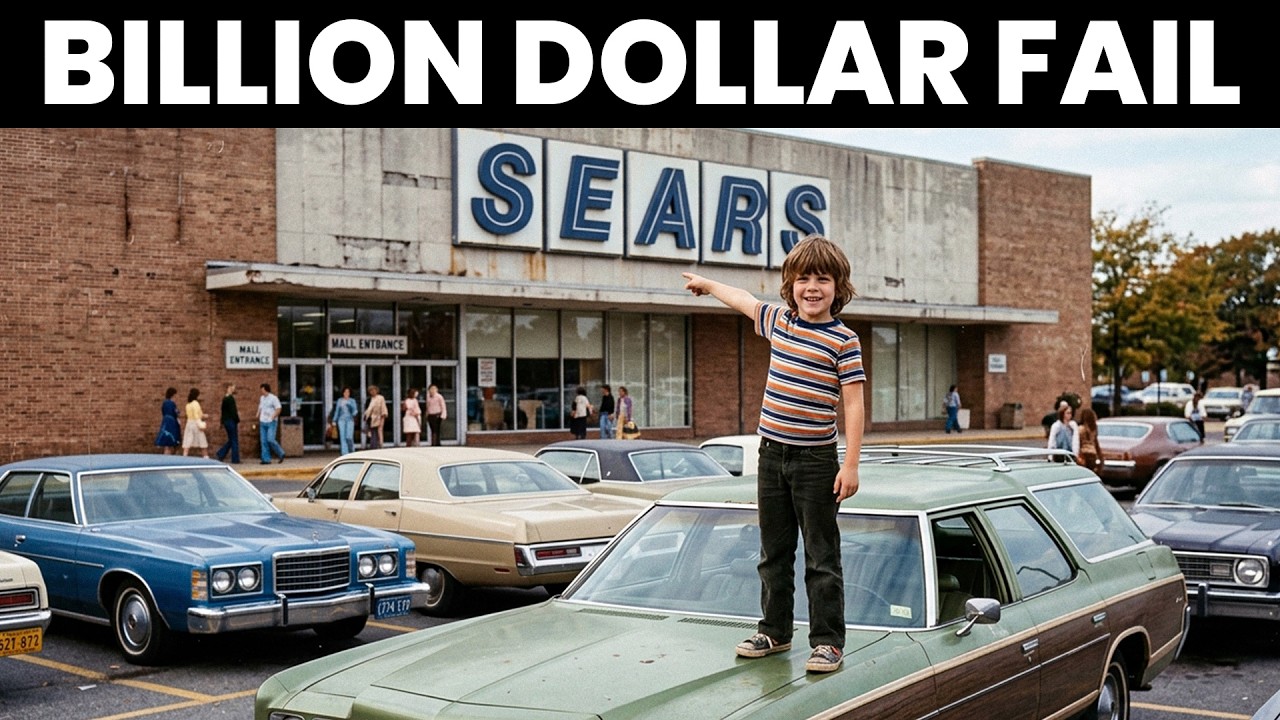
That was the business model that would one day make Amazon the most valuable company on Earth—except Sears had it running sixty years earlier, with a printing press and the US Postal Service. By the 1960s, Sears was more than a store; it was a place families grew up in. Over 700 locations dotted the country, and in most towns, Sears was the biggest thing in the mall—or the reason the mall existed at all. The parking lot alone told you what kind of place you were entering.
Rows of station wagons, a father carrying a boxed Kenmore to the tailgate with both hands. Inside, the Craftsman section had steel drawers you could pull open and feel the heft of a ratchet set that would outlive you. The Kenmore floor had washers and dryers lined up like tanks, each one carrying the unspoken promise that it would still be running when your kids left for college. DieHard batteries started cars on January mornings when nothing else would turn over.
Craftsman hand tools came with a lifetime guarantee, and Sears honored it year after year—no receipt required, no argument. These brands weren’t marketing; they were a contract between the company and the customer. And for decades, Sears kept its end. Every September, the fall catalog arrived, thick as a brick—the wish book.
Kids commandeered it the moment it hit the table, dog-earing pages and circling items in marker. The portrait studio in the back of the store saw every family at least once. And all of it ran on the Sears card—23 million households, the biggest retail credit card in the country. Every purchase tracked, every buying pattern mapped.
Sears knew what American families spent, what they needed, and when they’d need it again. No other retailer had anything close to that kind of intelligence. In 1973, the company put a stamp on all of it: the Sears Tower, 110 stories in downtown Chicago, the tallest building on the planet. It was a steel and glass declaration that this company answered to no one.
But the view from the top floor can make you forget what’s happening on the ground. And in 1981, the men in that tower stopped looking down. In a single week in October 1981, Sears spent nearly $800 million on two acquisitions: Dean Witter Reynolds, one of the largest stock brokerages on Wall Street, and Coldwell Banker, the biggest real estate brokerage in the country. Combined with Allstate Insurance, which they already owned, and the Discover credit card, which they would launch a few years later, the strategy was clear—Sears wanted to become a financial services empire.
Buy your socks, buy your stocks, take out a mortgage, all under the same roof. They built more than 300 financial service counters inside their stores, brokerage desks wedged between the tool department and the lawnmower aisle. And almost immediately, the plan fell apart. The in-store branches underperformed Dean Witter’s own stand-alone offices.
Customers weren’t interested. The promised crossover—millions of Sears shoppers becoming investment clients—never materialized. Four years in, the financial centers were still losing money. But the real price wasn’t what the brokerage desks cost; it was what the stores lost.
Every dollar and every executive hour that went into financial services was a dollar and an hour that didn’t go into keeping Sears the best retailer in the country. And that vacuum was about to be filled. In 1981, the year Sears decided to become a bank, Walmart had about 300 stores. By 1990, Walmart was the number one retailer in America—nine years.
Sears had held that title for decades and lost it because they were studying balance sheets from Dean Witter instead of foot traffic in their own aisles. Target moved into the space above Sears with better design and cleaner stores. Home Depot went after the Craftsman loyalists with deeper inventory and knowledgeable staff. Best Buy pulled the electronics and appliance customers who used to count on Kenmore.
Department by department, Sears was outflanked by companies that were paying attention. Sears, still running brokerage counters nobody asked for, couldn’t see it happening. By 1992, the company admitted the financial services experiment had failed. They unloaded Dean Witter, Coldwell Banker, and eventually Allstate.
A full decade was wasted, and the retail business they returned to was no longer theirs. Then came the wound that still stings the most. In 1993, Sears killed the catalog—the wish book, the foundation the entire company had been built on—and shut it down. The warehouses were closed, the distribution routes were scrapped, and nothing was built to replace it.
What makes the decision even harder to understand is that Sears had already seen the future coming. In the 1980s, they helped launch Prodigy, one of the first online services in America. Customers could shop, read the news, send messages, and buy products from home over a computer screen. Sears had experimented with the basic idea behind online shopping almost a decade before Amazon existed.
They had the customers, the warehouses, the delivery network, and the trust. But instead of building on that advantage, they walked away from it. One year later, Jeff Bezos started Amazon out of a garage. Sears already had everything Amazon would spend two decades building: the logistics, the reach, the customer trust.
If they had moved the catalog onto a screen, the history of American retail would have had a completely different ending. Instead, they handed that future away and got nothing in return. In 2003, they sold the credit card business. Twenty-three million accounts and three decades of household purchase data went to Citigroup for $6 billion—the richest customer data set any retailer had ever built, gone for a one-time payout spent within a few years.
In 2005, hedge fund manager Eddie Lampert merged Sears with Kmart, a discount chain barely out of its own bankruptcy. On a spreadsheet, it looked like scale: 5,600 stores across the country. On the ground, it was two damaged brands propping each other up and calling it a strategy. Lampert didn’t invest in the stores; he extracted from them.
He created a system that made different Sears departments compete against each other like rival businesses. The appliance division fought the clothing division for floor space. The tool department fought for marketing money. Cash that should have gone into renovations went into stock buybacks.
Maintenance was gutted. Staff was slashed. Ceiling tiles went yellow. Floors cracked.
Fitting rooms sat unattended. Shelves that once held the most trusted names in American retail were half empty. The Craftsman brand was sold off. Kenmore was licensed out.
DieHard followed. The names that had meant something to three generations of American families were stripped away and scattered. Under Lampert, Sears Holdings lost more than $10 billion. The store count collapsed from 5,600 to barely a thousand.
Over 200,000 jobs disappeared. On October 15, 2018, Sears filed for Chapter 11 bankruptcy with $18 billion in debt. When the final clearance sales began, longtime customers walked through stores they didn’t recognize—shelves stripped, lights half off. Some of them just stood in the aisles for a moment, not buying anything, with the look of someone who had come to pay their respects.
What went away when Sears went away wasn’t just a retailer. It was the store where a working family could outfit an entire life under one roof: the washing machine for the new house, the tools for the garage, the coat for the kid who’d outgrown last year’s, the portrait on the wall, the catalog for Christmas—all of it on a card they’d pay off a little at a time, because the store trusted them the same way they trusted the store. Craftsman tools and Kenmore appliances are still sold today, made by different companies. The names are the same, but the promise behind them—the lifetime guarantee, the no-questions replacement, the sense that someone actually stood behind what they sold—doesn’t exist anymore.
The labels survived. What they used to mean didn’t. Sears didn’t lose to the competition. It lost to its own executives.
In 1981, they decided that selling to American families wasn’t enough; they wanted Wall Street margins. By the time they gave that up, the families had found somewhere else to go. The tower still stands in Chicago under a different name, and from a distance it looks the same. That’s the thing about Sears—the structures lasted.
The buildings, the tools, the houses—everything the company built with its hands survived. Everything its executives decided with their ambition didn’t.






