On the evening of October 9, 1980, Eleanor Hayes stepped onto her porch in Marwick, North Carolina, to turn on the light she never let go dark. She was thirty-four years old, a fourth-grade teacher married to her high school sweetheart, and a woman known for small rituals: watering geraniums before coffee, checking the porch light twice before bed, and bringing covered dishes to an elderly widower who had once taught her. Her husband Daniel worked the second shift at the textile mill that night. He kissed her goodbye at 5:30 while she stood at the stove.
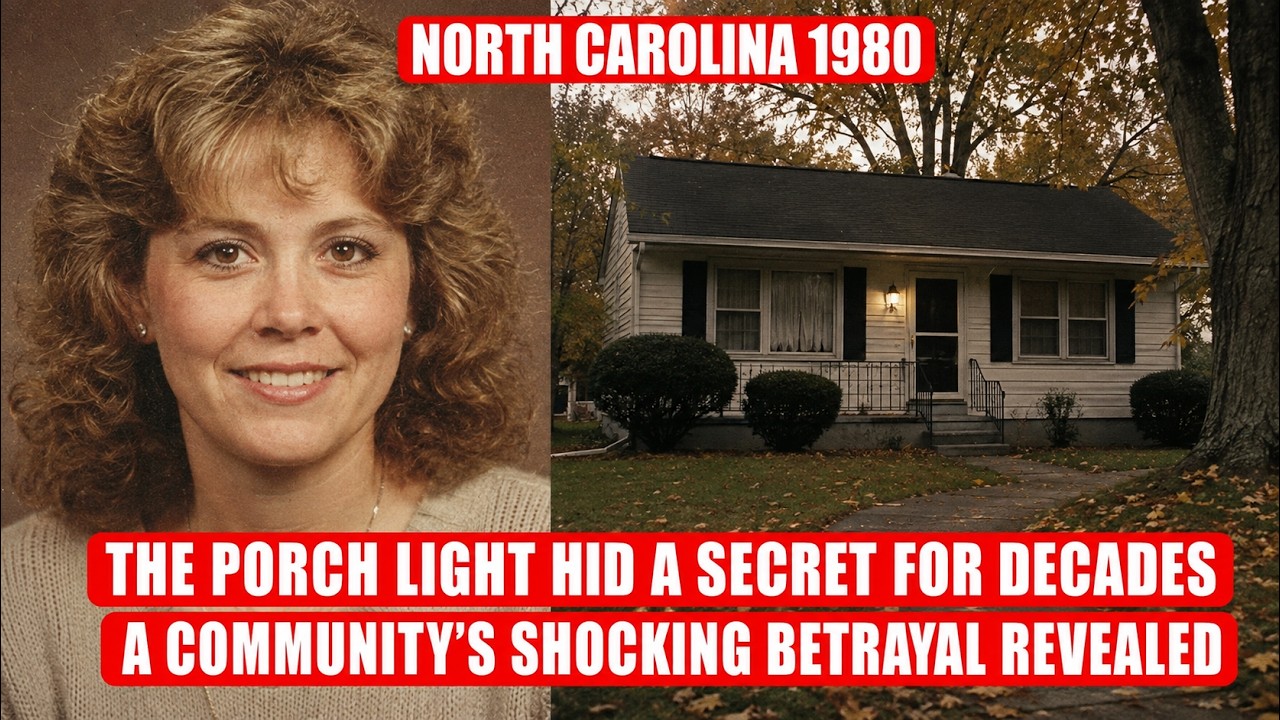
It was the last time he saw her. When Daniel came home at 1:15 in the morning, the porch light was off. In sixteen years of marriage, that had never happened. Inside, the house told a strange story.
Flour and two cans of peaches sat on the counter. A pot of cold soup waited on the stove, the burner switched off. A single bowl was set out on the table. Her purse hung by the door, her car keys lay in their dish, her practical brown loafers sat by the back step.
Everything was where it should be. Everything except Eleanor. He searched the house, the yard, then drove through town knocking on doors at two in the morning. By 3 a.
m. he stood in the Caldwell County Sheriff’s Office, soaked from sudden rain, repeating the same words: she is gone. The first deputy to take the report assumed she had walked off after a domestic argument and would return by morning. Rain began falling around midnight and washed the gravel driveway clean.
By the time anyone treated the disappearance as more than a misunderstanding, two days had passed. Evidence surfaced by accident. On the morning of October 11, a neighbor walking her dog noticed something pale caught in the hedge along the Hayes property. It was Eleanor’s cardigan, missing a button, with her worn paperback of poems still in the pocket.
Forty feet away, pressed into soft earth at the tree line, was a single set of tire tracks that did not match any vehicle the family owned. The case finally became real, and Detective Raymond Cole took it over. He was thirty-eight, the only investigator in the county with formal homicide training, and a father of three daughters. He interviewed every teacher, neighbor, and parent connected to Eleanor.
He had the tire tracks matched to a light pickup common in the county. He canvassed every household within a mile. And he kept returning to one detail that did not fit: the porch light. Eleanor never let it go dark.
If she had walked out willingly, the light would have been on. Someone had turned it off, someone who knew a lit porch invited attention and a dark one did not. Cole pushed the state lab to examine the cardigan. The report listed foreign fibers and a hair that was not Eleanor’s, but in 1980, a hair without a root and without a suspect was a dead end.
A partial print lifted from the recovered button matched no one. Cole wrote in the margin of his own report a line a future investigator would read decades later: Keep this. Someday the science will catch up. Suspicion moved like water through a small town.
It settled first on Daniel until the mill produced eleven witnesses placing him on the floor all evening. It moved to a drifter, cleared by an alibi in another state. It brushed against a troubled father, a deliveryman, a substitute teacher Eleanor had once reported for drinking. Each lead collapsed.
What Cole did not know was that the answer had already sat across the table from him in his interview room, answered his questions politely, expressed its sorrow, and walked out the door. Cole worked the case for nine years, past the point his captain told him to let it go, past the point the file was marked inactive, past his own retirement. He kept a copy in his garage and visited Daniel Hayes every October on the anniversary. The two men would sit on the porch in silence.
Cole died in 2004 with the case unsolved. People who knew him said it was the one weight he never put down. The years changed Marwick. The mill closed in 1994, and the town thinned.
Eleanor’s students grew up and moved away. Daniel never remarried. He kept the house exactly as it had been, geraniums and all, and every evening at dusk he walked out and turned on the porch light the way she always had. Eleanor’s younger sister Ruth became the keeper of the question no one else would speak aloud.
She wrote letters to the state bureau of investigation. She called the sheriff’s office every year on October 9. When DNA testing made headlines in the 1990s, she called about that too. The answer was always the same: the evidence was degraded, the case was cold, nothing could be done.
Ruth grew older waiting. Her hair went gray, then white. She buried her own husband. Still, every October, she made the call.
In the spring of 2021, a man named Harlon Webb died in Marwick at eighty-one. He had been one of the town’s most respected men for most of his life: owner of Webb’s Hardware on Main Street for over thirty years, a deacon at the Baptist church, a volunteer fireman, a sponsor of the little league team. Half the town turned out for his funeral. At the reception afterward, his daughter, loosened by grief, told an old family friend that her father had never been the same after that woman went missing in 1980.
The teacher. He used to wake up shouting about a porch light. The old family friend was Ruth’s nephew. By nightfall, Ruth had made a phone call she had waited forty-one years to make.
The deputy who answered was Carla Mendez, a cold case investigator who had inherited Cole’s files and had read his notes so many times she could recite them. Mendez went into the evidence archive that same week and pulled the box that had sat untouched since Cole packed it away. Inside were the cardigan, the missing button, and the tire track casts. Mendez did two things.
She sent the cardigan to the state lab, where forensic technology that did not exist in 1980 could now isolate a profile from skin cells left on fabric four decades earlier. And she went looking for the records of Webb’s Hardware, which had closed in 1996. She found them water damaged and half rotted in a basement that had flooded twice. But in a ledger from October 1980, in handwriting that had survived, was an entry that stopped her cold.
On October 10, the day after Eleanor vanished, someone had purchased in cash a quantity of quicklime and a roll of heavy canvas tarp. The buyer’s account was Webb’s own. The lab results came back six weeks later. The DNA recovered from the collar of Eleanor Hayes’s cardigan, where a hand would have gripped it, was a match to Harlon Webb.
Once they knew where to look, the rest came apart quickly. Webb had owned a light pickup in 1980, the exact make the tire casts pointed to. He had sold it in 1981 and bought a new one with cash, a purchase several people remembered. And a detail no one had connected became sickeningly clear.
Two weeks before she disappeared, Eleanor had reported that a man had been parking outside the school in the afternoons, watching the children leave. She had described the truck to Detective Cole but had not known the man’s name. Without a plate number, Cole could not act. The man in the truck was Harlon Webb.
Eleanor had told the friendly hardware store owner everyone in town adored that she meant to report it. He had come to her house that evening. She had let him in because he was Harlon Webb, who sponsored the little league team. When he left, he had turned off the porch light behind him.
Because Webb was dead, there would be no arrest, no trial. But in October 2021, forty-one years almost to the day after Eleanor walked out to her porch, the Caldwell County Sheriff’s Office held a press conference and announced that the disappearance and murder of Eleanor Hayes had been solved. The shock that ran through Marwick was not the shock of a stranger’s evil. It was the deeper shock of realizing how completely evil can wear the face of a friend.
Investigators acting on the ledger and on Webb’s known property holdings searched a patch of ground behind a barn the family had owned in 1980 and sold long ago. Beneath four decades of soil, they recovered the remains of Eleanor Hayes. Daniel Hayes did not live to hear it. He had died in 2015, the porch light still burning every night to the end.
But Ruth was there, standing at the edge of that field, watching them bring her sister back into the light. Eleanor Hayes was laid to rest in the spring of 2022 in the Marwick cemetery, beside the husband who had left a light on for her every night of his life. Her former students, now in their fifties, came from across the country to fill the church. They remembered the butterscotch candies, the poems, the way she knelt to their eye level.
The fourth-grade classroom she taught in for eleven years was dedicated in her name. Ruth, asked how she had kept going for forty-one years without an answer, said she had simply refused to believe that a life as good as her sister’s could vanish without leaving a single thread for someone to pull. The thread was a porch light, a hardware ledger, and a sentence spoken in grief at a funeral.
It took four decades, but the thread held.






