In November 2025, investigators in Elmira, New York, stood at a gravesite that had not been disturbed in over two decades. Buried there was a man who had lived his whole life in that city. A husband, a father, and a truck driver familiar to those in his circle. For 62 years, his name had never been linked to the case they were about to reopen.
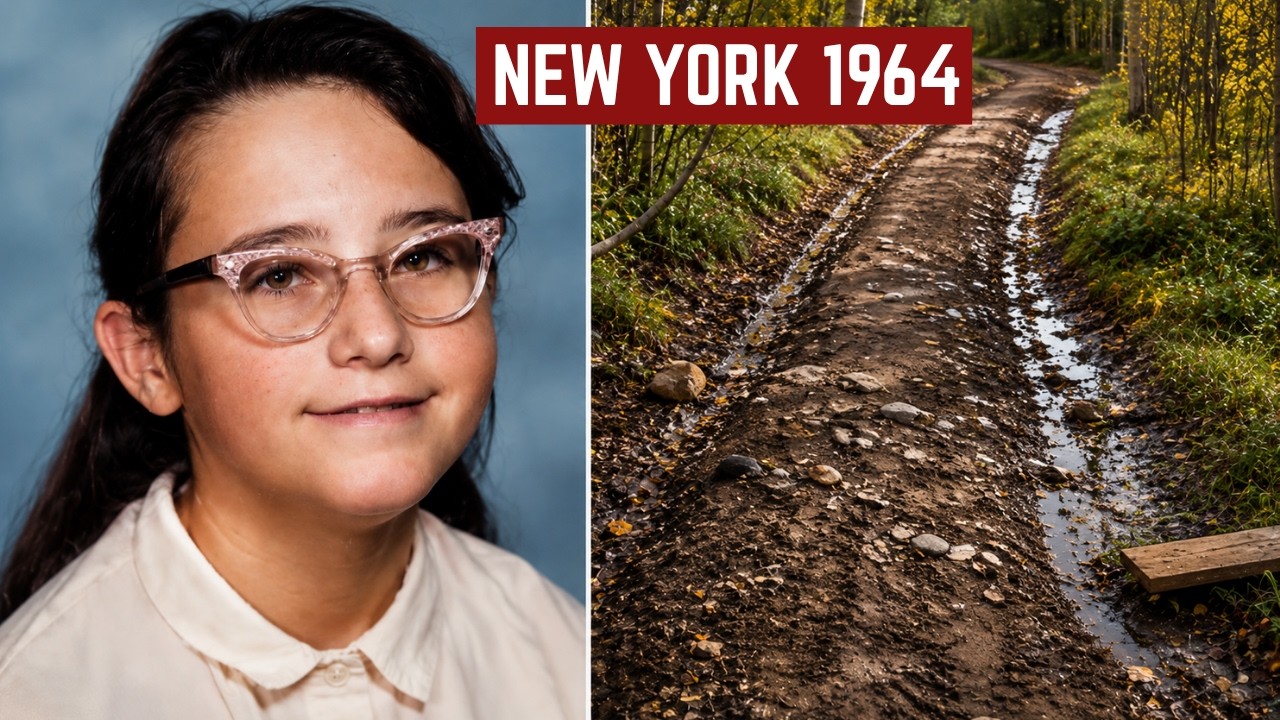
They thought his remains might at last provide the answer to a question Elmira had been asking since 1964. Who was responsible for the murder of 12-year-old Mary Theresa Simpson? Mary Theresa Simpson was born in Elmira, New York, in 1951. She grew up with her parents, Ellsworth and Rose Simpson, and three siblings.
In May 1963, her parents separated, and Mary went to live with her father on North Main Street. Family members recalled her as quiet and reserved around strangers. With close family and friends, she was different. Energetic, cheerful, and full of life.
She was a Girl Scout, and her teachers remembered her as a dedicated and popular student. She took dance lessons with her sister Linda and spent summer afternoons on roller skates. Sunday, March 15, 1964, began as an ordinary day. Shortly after 3 p.
m., Mary left her father’s apartment to visit relatives around Elmira. By early evening, she was heading home. Along the way, she stopped to say goodbye to two cousins and her aunt near a store in the neighborhood.
They were the last people who knew her to see her alive. Around 6:30 p.m., a witness saw her near the intersection of East Market and Harriet Streets, walking in the direction of home.
After that moment, there were no more confirmed sightings. By 10:30 p.m., Mary had not returned.
Her father called the Elmira Police Department to report her missing. The gap between that street corner and her doorstep remained the only information investigators had. Whatever happened to Mary Theresa Simpson occurred somewhere during those missing hours. Four days passed without a trace.
Then, on Thursday, March 19, 1964, a man searching a wooded area off Combs Hill Road in Southport, about seven miles from her home, made a horrifying discovery. Mary’s body was found partially hidden under branches and stones. A missing person case became a murder investigation. An autopsy determined that Mary had been strangled and assaulted.
Investigators concluded the attack occurred at or near the location where her body was found. The Elmira Police Department responded with everything it had. Officers canvassed the area around East Market and Harriet Streets, retracing the route Mary should have taken home. They interviewed relatives, neighbors, classmates, and anyone known to have been nearby that Sunday evening.
By October 1964, nearly 300 people had been interviewed. Despite the scale of the effort, no suspect emerged. There was no confession, no physical evidence clearly pointing to anyone. The case remained open, unsolved, without a suspect.
As the years passed, the investigation never officially closed, but progress stopped entirely. The local radio station WELM and the Elmira Star-Gazette offered a $1,000 reward for information leading to an arrest. No new leads emerged. Investigators continued working the case quietly, reviewing old statements and re-interviewing people whose accounts had changed over time.
By the early 2000s, the case file had grown to nearly 6,000 pages. Researchers from the Russell Sage College Criminal Investigation Resource Center, led by director Christina Lane, were brought in to organize and review the file page by page. Their work revealed gaps no one had realized existed. Some evidence had been sent for testing over the decades, but results had never been clearly recorded.
The review confirmed what investigators feared. The name they needed appeared nowhere. Yet another piece of evidence had remained in storage all that time, waiting for science to catch up. By 2003, forensic science had changed.
A preserved clipping of Mary’s clothing was sent to the New York State Police crime lab. Technicians found biological material that had survived for nearly 40 years. They extracted a DNA profile and entered it into CODIS, the national database used to match evidence against convicted offenders and known suspects. The search returned no results.
A second attempt in 2014 used newer technology focusing specifically on male DNA. The results were more precise, but again, no match was found. The problem was that database searches could only identify someone already in the system. If the man responsible had never been arrested or convicted of something requiring his DNA to be entered, there was nothing to compare against.
The answer would not come from a database at all. It would come from family. In 2022, Sergeant William Goodwin obtained a grant from the nonprofit Season of Justice and worked alongside the FBI to conduct a different kind of test. This was not another database search but a genetic genealogy profile designed to identify relatives rather than the man himself.
Genetic genealogy compares DNA against public genealogy databases built by ordinary people researching their family trees. If the man had never been caught, his family might still be findable. But very little sample remained, only about 0.4 nanograms, an amount invisible to the naked eye.
DNA testing consumes the sample as it runs. There would be no second chance if this attempt failed. FBI Special Agent Kenneth Jensen packed the sample in dry ice and shipped it to Othram, a Texas laboratory specializing in building genetic profiles from extremely limited DNA. Then a snowstorm shut down the FedEx hub in Memphis, Tennessee, leaving the package stuck in a facility without power.
Jensen contacted FBI agents in Memphis. An agent searched the closed facility, found the package, and stored it in an FBI freezer until shipping resumed. The sample arrived in Texas intact. Othram analysts successfully built a usable genetic profile, something that had never existed for this case before.
The FBI began constructing family trees. Birth records, marriage records, and obituaries were all verified against age and location. The process took nearly three years. In 2025, the family tree work led investigators to a living man.
He was not a suspect. His significance came from something else entirely, the possibility that the unknown man behind Mary’s case was his biological father. Investigators approached him and explained why they needed his help. He agreed to provide a cheek swab.
The results confirmed a paternal relationship. The DNA found on Mary’s clothing belonged to this man’s biological father. That single result narrowed the search to one person. A local man in his early thirties at the time of the crime.
He had lived in Elmira his whole life. He worked, and he had started his own family. He had died in 2004, more than two decades earlier, long before DNA and genetic genealogy could link his name to a 12-year-old girl. He had never been interviewed.
He had never been listed as a suspect. He had never appeared once in 6,000 pages of police files. His name was Alfred Raymond Murray Jr. Murray was born in Elmira in 1931 and lived in the city for nearly his entire life.
During the Korean War he served in the United States Army. He drove trucks for a living. He was a married man and a father of three, and by 1964 he already had two grandchildren. Old newspaper archives hinted at some link to an earlier case involving children, dating back to his teenage years.
At the time his identity was made public, police characterized his record as pointing to repeated involvement in offenses against children across the decades. It is still unclear whether any of those allegations ever led to a conviction. In November 2025, armed with a court order from Chemung County, the Elmira Police made ready to carry out something the department had never done before in its entire history: dig up a grave in search of evidence. The National Center for Missing and Exploited Children helped pay for the operation and arranged for a certified forensic anthropologist from Detroit to supervise it.
Murray’s remains were lifted out with great care. Biological samples were taken at the gravesite and shipped to the New York State crime lab. Once there, technicians ran the fresh samples side by side against the DNA profile that had been kept from Mary’s clothing since 1964. Within a matter of weeks, the results came back.
The DNA taken from Mary’s clothing was a match for Alfred Raymond Murray Jr. The odds that it could have matched an unrelated person by chance were put at less than one in 320 billion. On February 10, 2026, the Elmira Police, the FBI, prosecutors and members of Mary’s family came together at the Chemung County District Attorney’s office. Police Chief Kristen Thorn was the first to speak to those assembled.
She informed reporters that investigators had pushed the case as far as it could go and had formally identified Alfred Raymond Murray Jr. as the person responsible for Mary Theresa Simpson’s death. The Elmira Police Department officially shut the case. Thorn further confirmed that, had Murray still been living, prosecutors would have sought to charge him with murder.
Yet he had passed away in 2004, more than twenty years before his name was tied to the case. Investigators then turned to a detail that had baffled them from the very beginning. No documented link between Mary and Murray had ever surfaced. No mutual acquaintances, no earlier contact of any kind.
Judging from everything contained in the case file, they concluded the attack was in all likelihood a crime of opportunity. A stranger caught in the wrong place on an ordinary Sunday evening. Sitting in the room that day was Mary’s sister, Linda Galpin, who is now 78. Their mother, Rose, had died never learning who was to blame.
Once the announcement was over, Linda expressed her gratitude to the investigators for their efforts. She said she wished her mother could have been there in the room to hear it as well. Certain questions stay precisely where they stood at the outset. Nobody ever established how the paths of Mary and Alfred Murray actually crossed on the evening of March 15, 1964.
The hours separating her last sighting from her disappearance are still unaccounted for. Investigators have a name now, but they still lack any account of what took place during those hours. The case demonstrates why it required 62 years just to arrive at this point. Back in 1964, DNA did not yet exist as an investigative tool.
The genetic genealogy method that ultimately cracked this case has only been around for a few years, and it hinged entirely on one relative deciding, for reasons that had nothing to do with Mary, to submit a DNA test. Had that person not made that choice, the case might remain stuck exactly where it sat in 2014. A name cannot undo six decades of not knowing. It cannot let Mary’s parents hear the answer while they were still alive.
Still, for the first time, the family at last had certainty. Elmira police confirmed that what may rank among the oldest murder cases in American history solved through DNA had come to its conclusion. For Linda Galpin, the announcement brought an end to a wait of more than 60 years. She had been 16 when her little sister vanished.
After all those years, she finally knew the truth of what had become of Mary Theresa Simpson.
