On a cold December morning in 2000, Mike Williams loaded his truck, hitched his boat trailer, and drove toward Lake Seminole for a duck hunt before celebrating his sixth anniversary that evening. He never came home. His truck was found beside a boat ramp, his boat drifting unmanned, his camouflage hat recovered from the water. There was no body, no blood, no sign of struggle.
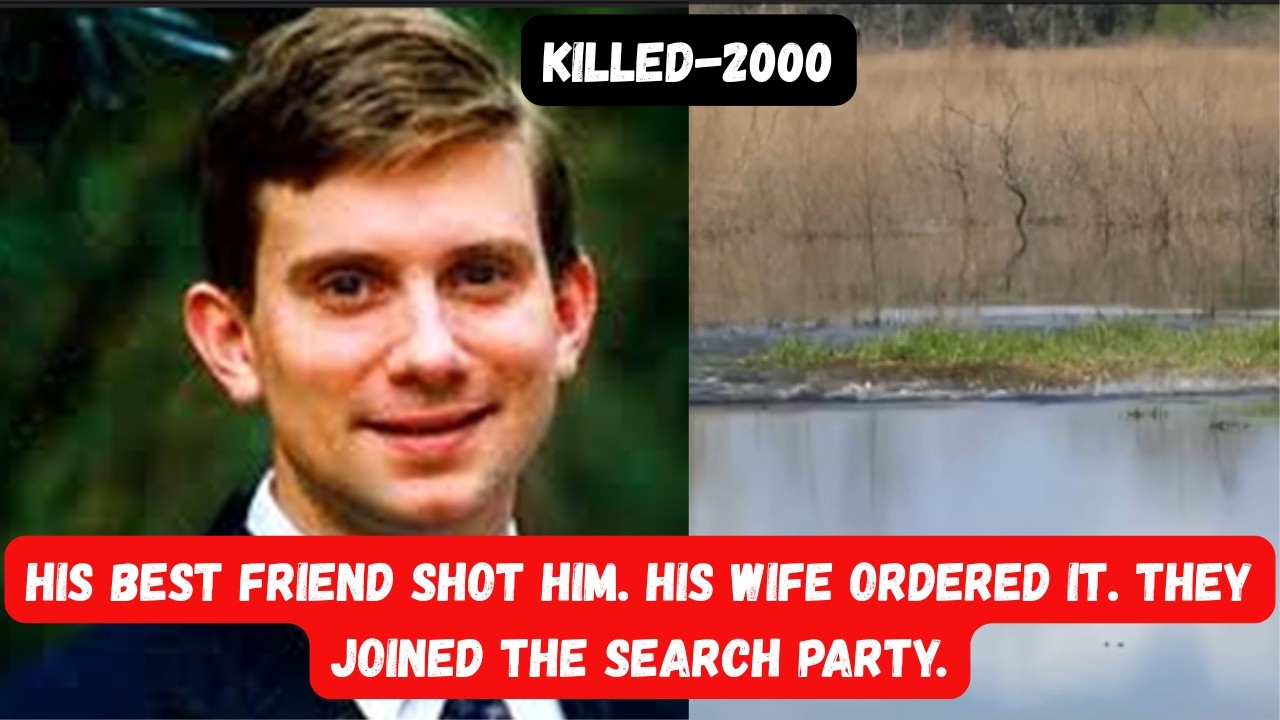
The official conclusion was that Williams had fallen overboard in his waders and been consumed by the lake’s alligators. Florida lakes typically returned drowning victims, but Williams’ body did not surface. The alligator explanation answered the uncomfortable question of why. It was also completely wrong.
Mike Williams was not the kind of man who made enemies. He was a Florida State graduate and real estate appraiser in Tallahassee, building a quiet life with his high school sweetheart Denise, whom he had married in 1994. They had a young daughter, a home, planned another child, and looked forward to a cruise that spring. He was meticulous about firearm safety, keeping his guns locked at his workplace rather than at home because he did not want them near his child.
He also never wore his waders in the boat. Any experienced hunter knew that chest-high waders filled with water and pulled a man under. Mike preached this constantly. Someone else put those waders on him.
Six months after his disappearance, a pair of waders surfaced in the lake, followed two days later by his hunting jacket, license, and flashlight. They were in remarkably good condition for items that had supposedly spent half a year submerged. The private search team noted this unsettling detail, but without a body or forensic evidence, questions did not gain traction. What the recovered items did provide was legal ammunition for Denise Williams.
She argued that they constituted sufficient proof of death, and a judge agreed. Williams was declared dead six months after vanishing. The death certificate cited accidental drowning. The insurance policies paid out 1.
5 million dollars. Those policies mattered. Months before his disappearance, Brian Winchester, Mike’s best friend since high school, had sold him several of them. Brian worked in insurance and knew exactly what they were worth.
Within a year of Mike’s declaration of death, Brian divorced his wife Kathy, then began a relationship with Denise. They married in 2005 and moved into Mike’s house on Centennial Oaks Circle, the home where his daughter had grown up. The man who killed Mike Williams moved into his home and married the woman who ordered it. What they did not account for was Sheryl Williams, Mike’s mother.
From the moment her son vanished, she knew the official story was wrong. She knew Mike did not wear his waders in the boat. She knew he took safety seriously. She knew he had been planning for the future.
So she wrote letters to the governor of Florida. Every single day. By the time the case was reopened, she had written more than 2,600 letters. She told anyone who would listen that her son had been murdered, that the people responsible were known, that the investigation had failed him.
In 2004, the Florida Department of Law Enforcement reopened the case. The reason was biological. Alligators in Florida do not feed during winter months. The December cold slowed their metabolism.
They did not actively hunt. The alligator theory, the foundation of the official conclusion for four years, had a fundamental problem. Investigators privately expressed their gut feeling that Mike did not die in Lake Seminole, but feeling is not evidence. The case stalled again.
Meanwhile, the Winchester marriage was rotting. A marriage built on a shared secret requires constant maintenance. When that marriage began to fail, the secret did not disappear. It became a weapon.
By 2012, Brian and Denise had separated. By 2015, Denise filed for divorce. Brian contested it. What happened next cracked the case wide open.
On the morning of August 5th, 2016, Denise Williams opened her car door and found Brian Winchester in the back seat, holding a gun. What followed was a kidnapping. Brian forced her to drive at gunpoint through Tallahassee, making demands she refused. Denise eventually escaped and reported the kidnapping.
Brian was arrested, charged, and in December 2016, sentenced to 20 years in prison. He thought that was the end. It was the beginning. Law enforcement had a man in custody with a documented history of violence, connected to a 17-year-old unsolved disappearance, married to the victim’s widow.
They asked questions. Brian made a calculation. The kidnapping conviction was not going away, but prosecutors had something he wanted: immunity. If he told them everything, where Mike’s body was, how it happened, who was involved, the state would not charge him with Mike’s murder.
He would serve his 20 years for kidnapping, but nothing more. Brian took the deal. Then he talked. On the morning of December 16th, 2000, Brian did not stay home.
He went with Mike to Lake Seminole. He had arranged the trip, positioned himself as his friend’s companion. Out on the water, Brian told Mike he wanted to show him a secret spot. Mike stood to look.
Brian pushed him overboard. He had persuaded Mike to wear his waders before leaving the bank, violating every safety habit Mike practiced. The waders filled with water and dragged him under. But Mike did not drown.
He grabbed a tree stump and pulled himself partially out of the water. Brian took out his shotgun and fired a single shot. Mike Williams was gone. Brian pulled the body back into the boat, returned to the bank, and loaded it into the back of his Suburban under a tarp.
He pushed Mike’s boat back out onto the water, left the truck and trailer at the ramp, and drove 60 miles in the opposite direction to a remote marshy area called Carr Lake, ten minutes from his own home. He buried Mike Williams under six feet of mud. Then he drove back to Lake Seminole, joined the search party, stood among friends and law enforcement, and spent days pretending to look for his friend. Brian told investigators everything: the affair with Denise, which had begun years before Mike’s death; the conversations about their situation; the planning.
Divorce was never an option for Denise. She was a devout Baptist, did not want to split custody of her daughter, did not want to divide the life she had built. There had even been an earlier discussion about staging a boating accident that would kill both Mike and Brian’s wife Kathy. Brian refused that version because he did not want to kill the mother of his child.
So only Mike died. Armed with the confession and the location, investigators launched what the Florida Department of Law Enforcement would describe as the most extensive excavation operation in the agency’s history. In October 2017, nearly 18 years after Mike Williams disappeared, they found him. His remains were recovered from beneath six feet of mud near the boat landing at Carr Lake.
His shirt, his wedding ring, his gloves were there. The forensic evidence matched every detail of Brian’s confession. Mike Williams was brought home. On May 8th, 2018, Denise Williams was arrested and charged with first-degree murder, conspiracy to commit first-degree murder, and accessory after the fact.
Investigators believed she had coordinated with Brian to plant the recovered items in the lake, timed to surface so she could petition for an accelerated death declaration and access the insurance policies faster. She had not simply stood by while Mike was murdered. She had managed the aftermath for 17 years. Mike Williams was given a public funeral in May 2018.
Sheryl Williams buried her son at last. The trial began in December 2018. Brian Winchester took the stand as the prosecution’s key witness, describing Denise as his partner in the crime. He used a specific phrase: the two of them were like Bonnie and Clyde.
Denise did not testify. After eight hours of deliberation, the jury returned unanimous guilty verdicts on all three counts. In February 2019, Denise Williams was sentenced to life in prison. Sheryl Williams sat in that courtroom and watched a jury tell her she had been right.
Then the appeals court intervened. In November 2020, the First District Court of Appeals overturned the first-degree murder conviction. The evidence, the court ruled, was sufficient for conspiracy but not to prove that Denise had directly participated in carrying out the killing itself. Brian had pulled the trigger.
Brian had driven the body to Carr Lake. Denise’s life sentence was gone. She was resentenced in September 2021 to 30 years. The judge stated from the bench that he did not find her to be a relatively minor participant.
The evidence showed she could have stopped the murder. She had chosen otherwise. Brian Winchester is currently serving his 20-year sentence for the kidnapping that accidentally broke the case open. He received immunity for his role in the murder.
He will not serve a single additional day for killing his best friend. Sheryl Williams got the truth. She did not get everything. Denise had withheld access to Mike’s daughter, Cheryl’s only grandchild, for the entirety of that child’s childhood.
The little girl her son had kept his guns away from grew up without her father. No one in this case got everything. But after 17 years of being told the truth was something other than what she knew it to be, the truth alone was enormous.






