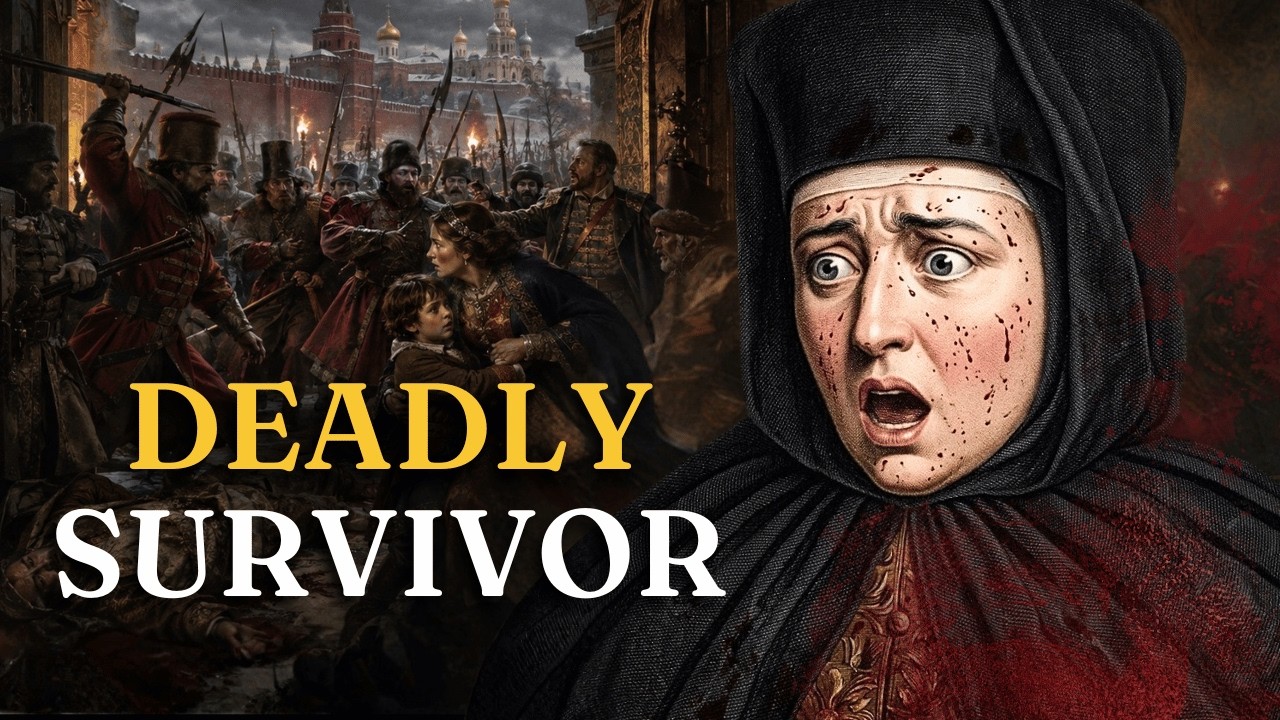
In 1682, Natalya Naryshkina watched a mutinous army slaughter her family on the steps of the Kremlin. Her ten-year-old son had just been crowned tsar, but that victory ignited the most violent dynastic conflict in Russia. Stripped of all authority, she was forced into exile while her bitter rival seized absolute control of the state. She lost her government, her protectors, and her position, yet she secured the only weapon that mattered: keeping Peter alive and on the throne.
She survived destruction by waiting in the shadows until her son grew ruthless enough to reclaim the empire. The trap that nearly destroyed her had been set decades earlier, built on the legacy of the woman she replaced. Maria Miloslavskaya, the first wife of Tsar Alexis, bore thirteen children. Through that prolific marriage, the Miloslavsky family spent two decades embedding itself in the foundations of the Russian state.
Loyal uncles and cousins commanded regiments, collected taxes, and controlled the levers of Moscow’s bureaucracy. They expected this dominance to pass smoothly to the next generation through Maria’s two sons, Feodor and Ivan. By marrying Natalya, Alexis did not simply take a bride. He activated a dormant political faction.
The moment the crown was placed on Natalya’s head, the Naryshkin family rose from minor nobility to the heart of imperial power. That sudden ascent was an existential threat to the Miloslavskys, whose survival required the complete marginalization of their rivals. In 1672, Natalya fulfilled her primary biological duty. She gave birth to a healthy son, Peter.
In a stable monarchy, a third son would simply wait his turn. In seventeenth-century Russia, the physical frailty of the heir apparent invited regency, and regency invited coup. Feodor, the designated heir, was intelligent but physically weak, suffering from scurvy and chronic pain. Ivan was severely disabled, nearly blind and prone to seizures.
Peter, by contrast, was large, vigorous, and strong. The Miloslavskys looked at the energetic infant and saw an instrument of their future destruction. Natalya surrounded Peter with loyal guards, inspected his food, and watched the corridors with growing paranoia. For four years, the tension held.
Alexis’s authority acted as an impenetrable shield. In January 1676, that shield collapsed. The death of Tsar Alexis was sudden, and the political coup that followed was brutally efficient. The crown passed to the eldest surviving son, Feodor III, who was fourteen, physically incapacitated, but legally untouchable.
He was a Miloslavsky. The transition was immediate and comprehensive. Men who had been pushed aside by Natalya’s marriage stormed back into the palace, hungry for revenge. Natalya’s status deteriorated within hours.
She was stripped of her title as ruling tsarina and reclassified as a mere tsar’s widow. Artamon Matveyev, the architect of her rise and the only man with enough bureaucratic influence to protect her, was accused of sorcery and treason. Without trial, he was stripped of his fortune and exiled to Pustozyorsk, a frozen outpost in the far north of Russia. The message was unmistakable.
The shield was gone. The Miloslavskys then systematically purged Natalya’s brothers and loyalists from every influential position in the army and government. Natalya watched from the isolation of her chambers as the entire apparatus that supported her was dismantled piece by piece. She was left alone with four-year-old Peter, no political capital, no financial independence, no military support.
She learned the survival tactics of the defeated. She swallowed her pride, spoke in carefully measured tones, and appeared as non-threatening as possible. She had to convince the Miloslavskys that she harbored no ambitions for her son, that Peter was merely a boy playing with wooden swords. The only thing keeping Peter alive was the fragile respect Feodor III still held for his father’s lineage, and the fact that the open assassination of a royal prince might provoke a rebellion among the traditional boyars.
For six arduous years, from 1676 to 1682, Natalya lived as a ghost within the Kremlin walls. She was confined to the terem, the traditional women’s quarters, cut off from influence and the outside world. Her days were marked by silence and acute suspicion. Feodor was a sickly teenager slowly dying, and the entire court knew it.
Natalya’s survival depended entirely on the timing of that teenager’s death. She focused completely on Peter’s physical growth and education, shielding him from the court’s toxic intrigues. She knew that when the moment came, Peter’s only political asset would be his vitality, a stark contrast to his brother’s severe disabilities. On April 27, 1682, the anticipated crisis arrived.
Feodor III died at the age of twenty, leaving no heir. Under primogeniture, sixteen-year-old Ivan Miloslavsky was the legitimate successor. But Ivan was nearly blind, suffered from severe speech impediments, and was prone to debilitating seizures. He was biologically incapable of ruling.
The alternative was ten-year-old Peter Naryshkin, full of life, intelligence, and health. The decision fell to the council of boyars and Patriarch Joachim of the Orthodox Church. They chose Peter out of self-interest. A severely disabled tsar like Ivan would require a permanent regency, likely controlled by his formidable older sister, Sophia Alekseyevna, and the entrenched Miloslavsky clan.
The boyars wanted to break that monopoly. A ten-year-old tsar meant a regency controlled by his mother, a woman they considered politically isolated and easy to manipulate. That same day, the patriarch ascended the Kremlin balcony and proclaimed Peter the sole tsar of Russia. For Natalya, the reversal was stunning.
In a matter of hours, the six-year nightmare ended. She was no longer a marginalized widow. She was the regent of the Russian throne. The Naryshkins flooded back to the capital.
Natalya immediately sent horsemen to the frozen north with orders to release Artamon Matveyev from his long exile. It seemed she had achieved complete victory without bloodshed. But this victory was a fatal illusion. Natalya misunderstood the nature of Russian power.
She believed that controlling the boyar council and possessing the patriarch’s legal decree guaranteed the throne. She failed to realize that in a system lacking institutional stability, legal legitimacy is worthless without military support. In the women’s quarters, Sophia Alekseyevna understood this perfectly. At twenty-four, highly educated and exceptionally intelligent, she saw her doom approaching.
In Russian royal tradition, princesses did not marry foreign monarchs or their own subjects. Their only fate was the convent. With Peter on the throne and Natalya in power, Sophia’s permanent exile to a monastery was inevitable. The system left her no legal recourse, no dignified exit.
It cornered a brilliant and desperate woman, leaving her only one option: burn the entire system down. Sophia bypassed the boyar council and the patriarch. She went directly to the only entity in Moscow that held a monopoly on organized violence: the streltsy, the elite musketeer regiments. Over twenty thousand heavily armed men.
They were not just guards but a hereditary military class, running businesses and living in separate districts. In the spring of 1682, they were a powder keg. They had not received their pay for months. Their commanders were brutally corrupt.
Sophia did not create their anger. She simply turned it into a weapon. Her agents spread a deadly narrative: the corrupt boyars who stole their wages were the same ones who had illegally bypassed the legitimate heir, Ivan. Then came the final spark.
They spread a rumor that the Naryshkins had strangled the young tsar Ivan to secure Peter’s throne. On May 15, 1682, the drums of the streltsy regiments began to beat across Moscow. Thousands of armed men marched on the Kremlin, dragging cannons through the muddy streets. They stormed the Kremlin walls without resistance.
The traditional structures of the Russian state evaporated before raw, organized violence. The mob flooded into Cathedral Square, screaming for Naryshkin blood and demanding to see the young tsar Ivan, whom they claimed was murdered. Inside, Natalya was trapped in the palace. Artamon Matveyev, freshly returned, still believed in the authority of the state.
He advised confronting the crowd, believing that presenting the living Ivan would expose the lie. Natalya stepped out onto the Red Porch, holding the hands of her ten-year-old Peter and sixteen-year-old Ivan. The sight of the two boys standing side by side momentarily stunned the front ranks. Ivan was clearly alive.
For a fleeting moment, it seemed the crisis might end. But the systematic cruelty of a military coup is that once the mechanism of violence is released, truth cannot stop it. The streltsy had not marched merely to avenge Ivan. They had marched to liquidate the elite.
A voice from the crowd shouted an insult at Matveyev. The old statesman stepped forward to calm them. In a flash of horrifying violence, the front rank surged up the stairs, seized Matveyev, and threw him over the railing. He fell onto a forest of upright spears, his body torn apart before it even hit the stones.
The Red Porch became a stage for a brutal massacre. The crowds flooded into the palace corridors. Natalya dragged Peter and fled to the inner chambers. The streltsy systematically hunted anyone connected to the Naryshkin faction, dragging nobles from hiding places and hurling them from windows.
For three days, the streltsy controlled the Kremlin. They handed Natalya a list of Naryshkin relatives to surrender for execution. Among them was her favorite brother, Ivan Naryshkin. The mob threatened to burn down the entire palace and kill Peter if he was not handed over.
To save her son’s life, Natalya was forced to personally surrender her brother to the executioners. He was dragged to the square, tortured for hours, and hacked to death. When the blood finally dried on the Kremlin stones, the political realities of Russia had been violently rewritten. The streltsy dictated the new terms of the state.
They demanded that Ivan and Peter rule jointly as co-tsars, with Ivan recognized as the senior monarch. Since neither was capable of ruling alone, they demanded that Sophia Alekseyevna be appointed regent with absolute executive authority. Natalya Naryshkina was utterly defeated. In a matter of weeks, she had touched the pinnacle of absolute power, only to find her family slaughtered, her mentor destroyed, and her status erased.
Yet her defeat was not complete. The streltsy did not kill Peter. They demanded power, money, and revenge, but they did not dare commit royal murder against a boy recognized by the Church. Natalya lost the regency.
She lost her family. But she still held the most powerful card in the Russian Empire. Peter was still breathing, and his name was still on the throne. She realized she could not win a war of swords.
She would have to win a war of attrition. She would take her traumatized son, withdraw from the blood-soaked halls of the Kremlin, and wait until the boy became a man. Natalya was forced to live alongside the architects of her family’s destruction, walking past the same guards who had planted their spears in her brother’s chest. She had to bow her head to Sophia, the woman who had mobilized the mob to seize the state.
She recognized that remaining within the stifling walls of the Kremlin was a daily invitation to assassination. Sophia controlled the judiciary, the treasury, and the palace guard. The only rational strategy was withdrawal. Under the pretext of needing fresh air and mourning, Natalya requested permission to leave the capital with Peter.
She moved to Preobrazhenskoye, a traditional royal estate just outside Moscow. Sophia granted the request with quiet relief, believing that out of sight meant out of power. She drastically underestimated the tactical advantage of distance. Within Moscow, the tsar was treated as a near-divine idol, wrapped in heavy jeweled robes, confined to dark incense-filled rooms, forbidden from walking on bare ground.
His education consisted of rote memorization of religious texts under conservative priests. Natalya broke this mold completely. At Preobrazhenskoye, Peter wore simple clothes, ran through the fields, and mixed with local boys, servants, and the sons of minor nobles. She did not interfere when Peter developed a pathological obsession with war.
The trauma of 1682 had permanently reshaped his developing mind. At ten years old, he learned that titles, laws, and divine right were worthless before a mob with sharp steel. Power was violence. To survive, he needed his own.
Peter began forming what the Kremlin initially dismissed as toy regiments, the poteshnye voiska. He recruited village boys, but it was no child’s game. Under Natalya’s watchful and permissive eye, Peter demanded real guns, artillery, and gunpowder from state arsenals. Because he was officially tsar, the Moscow bureaucracy complied.
Natalya watched from her palace as her son built an army in the mud, hiring foreign mercenaries from the nearby German Quarter to train his troops in modern Western tactics. This posed a deep ideological conflict for Natalya. She was a traditional Russian noblewoman, deeply rooted in the closed Orthodox culture of old Moscow. Yet she did not stop Peter.
She funded his games, protected his independence, and swallowed her own traditional objections. Her logic was rooted in the absolute pragmatism of the survivor. She knew the traditional Russian military structure, the streltsy, was thoroughly corrupt and permanently loyal to Sophia. If Peter wanted to reclaim his throne, he could not rely on the existing establishment.
He needed an alternative power base, fanatically loyal to him alone. She was forging a weapon she barely understood, only because she knew she would eventually need it to cut off Sophia’s head. While Natalya practiced the discipline of agonizing patience in the countryside, Sophia was being slowly crushed by the weight of her success in Moscow. Her regency was a lesson in administrative efficiency, but it was built on a constitutional time bomb.
She ruled an empire effectively, but entirely in the names of her brothers. Her authority was borrowed in essence. Every passing day brought Peter closer to adulthood, and therefore closer to her own obsolescence. To counter this inevitable erosion of legitimacy, Sophia tried to transform her status from regent to absolute ruler, granting herself royal titles and placing her image on coins.
But the deeply patriarchal Russian system resisted. A woman could hold power in emergencies, but she could not institutionalize it. Sophia realized the only way to permanently cement her authority was to achieve undeniable military glory. She entrusted this task to her chief ally, Prince Vasily Golitsyn.
In 1687 and 1689, Golitsyn led massive Russian armies south to conquer the Crimean Khanate. Both campaigns were catastrophic failures, not defeated by Tatar cavalry but by the supply difficulties of the harsh southern steppes. Tens of thousands of Russian soldiers died of starvation and disease without fighting a single decisive battle. The Crimean disasters wounded Sophia’s regime severely.
The nobility began to smell weakness. The streltsy themselves, who suffered in the miserable southern campaigns, became restless and resentful. From self-imposed exile at Preobrazhenskoye, Natalya watched the Kremlin foundations crack. She knew the time for passive waiting was over.
In early 1689, Peter was sixteen. In the political theology of seventeenth-century Russia, a tsar’s transition from minor to adult was not defined by a specific birth date. It was defined by marriage. A married tsar was a man who had established his own household.
By definition, a married tsar no longer needed a regent. Natalya arranged a marriage for Peter to Yevdokia Lopukhina, a calculated political move. The Lopukhin family was large, deeply conservative, and widely respected, with deep roots in the military and civil bureaucracy. By marrying Peter to Yevdokia, Natalya bound her son, whose strange obsession with foreigners alienated the traditional elite, to a fortress of Muscovite respectability.
She also gained a vast network of new allies with a vested interest in seeing Peter fully control the state. When the wedding took place in January 1689, the political shockwave hit the Kremlin with devastating force. Sophia immediately understood what Natalya had done. The marriage was a peaceful declaration of war.
It legally voided the very justification for Sophia’s regency. Peter was now a man. Constitutionally, Sophia’s mandate had expired. The tension between Moscow and Preobrazhenskoye escalated from cold war to imminent armed confrontation.
Sophia knew she could not simply hand over power. Surrender meant placing her life and her entire clan at the mercy of a young man who had watched them slaughter his family seven years earlier. She intensified her efforts, pouring money and vodka into the Moscow streltsy regiments, desperately trying to ignite the same frenzy that had secured her power in 1682. She needed another riot.
She needed the army to march on Preobrazhenskoye and eliminate the Naryshkin threat for good. At Preobrazhenskoye, Natalya and Peter prepared for attack. The toy regiments, now armed, trained, and fiercely loyal, fortified the estate. The crisis finally erupted in the suffocating heat of August 1689.
At midnight on August 7, two sympathetic streltsy officers rode from Moscow and arrived at Preobrazhenskoye under cover of darkness. They carried a terrifying, unverified report. Shaklovity, Sophia’s ruthless commander, had mobilized the regiments. An armed mob was marching on the estate with orders to drag Peter from his bed and execute him.
What followed was a stark testament to how deeply the trauma of 1682 had scarred the young tsar. Peter, seventeen years old and towering in stature, had the outward appearance of a commander of a well-trained modern militia. But when the warning reached his chambers, the facade of the confident military leader evaporated in an instant. The teenage tsar suffered a catastrophic psychological regression.
He did not rally his troops. He did not order the perimeter fortified. Succumbing to blind, crushing panic, he jumped from his bed in his nightclothes and ran barefoot into the surrounding forest. He hid in the dark woods, weeping uncontrollably, until his servants found him and brought him a horse and clothes.
Accompanied by a handful of bodyguards, the Tsar of Russia fled into the night, riding recklessly toward the Trinity Monastery of St. Sergius, an impregnable religious fortress forty miles north of Moscow. If Peter’s reaction was defined by paralyzing trauma, Natalya’s was defined by pure pragmatism. When she was awakened and told her son had fled into the forest in terror, she did not panic.
She had spent seven years preparing for this moment. A tsar running naked in the woods looked like a coward, but a tsar operating from a secure, armed fortress looked like a sovereign establishing an alternative capital. Natalya took command of the estate immediately. She ordered Peter’s pregnant wife, Yevdokia, his sister, and the backbone of the Naryshkin faction into carriages.
Most importantly, she mobilized the Preobrazhensky and Semyonovsky regiments. She loaded the artillery, secured ammunition, and organized a disciplined, heavily armed convoy to march north and join her son. By the time Natalya reached the Trinity Monastery the next morning, she had transformed Peter’s humiliating panic-stricken flight into a brilliant strategic repositioning. The monastery was not just a church but a formidable stone fortress that had historically withstood harsh sieges.
Its thick walls, deep wells, and elevated position neutralized the streltsy’s numerical superiority. Over the next four weeks, Russia was split between two capitals. Sophia sat in the Kremlin controlling the traditional state apparatus and most of the army. Peter and Natalya sat behind the walls of Trinity, holding the undeniable legal mandate of the crown.
The ensuing confrontation was a bloodless struggle fought entirely through written decrees and agonizing calculations of aristocratic self-interest. Natalya and Peter struck first. They drafted letters to the streltsy colonels and leading boyars in Moscow, ordering them to appear at Trinity immediately. The decrees bore the seal of the legitimate tsar.
Disobeying them was high treason, punishable by death and confiscation of family wealth. In the Kremlin, Sophia recognized the deadly danger. If military leaders left Moscow to answer Peter’s summons, her regime would evaporate. She issued counter-orders forbidding anyone from leaving the capital, threatening execution.
Guards were placed at Moscow’s gates to enforce the blockade. Russia’s political elite was caught in a fatal pincer. If they went to Trinity and Sophia held power, they would be executed as traitors. If they stayed in Moscow and Peter prevailed, they would be executed as rebels.
The first decisive crack in Sophia’s regime came in the spiritual realm. Sophia dispatched her most important political asset, Patriarch Joachim, to negotiate a truce and persuade Peter to return to the Kremlin. It was a fatal miscalculation. Joachim was a hardline conservative who fiercely resented Sophia’s progressive, Western-leaning allies, and he possessed a ruthless survival instinct.
When he arrived at Trinity, he looked at Peter’s well-armed, fiercely loyal regiments and the impregnable walls. He calculated the odds and simply never returned to Moscow. Joachim publicly declared his absolute loyalty to Tsar Peter. The patriarch’s defection shattered the moral and legal foundation of Sophia’s government.
The message to the Russian elite was unmistakable. God had abandoned the Kremlin. The dam broke. The nobility, seeing the empire’s spiritual leader choose Peter, realized Sophia’s ship was sinking.
The risk assessment flipped. Staying in Moscow was no longer the safe option. Under cover of darkness, the most powerful aristocratic families in Russia slipped away from Sophia’s guards and headed north to Trinity. The final killing blow came from the very weapon Sophia had relied on to seize power: the streltsy.
When they saw the nobles and the patriarch defecting, they realized they were on the wrong side of history. To save their own lives, the streltsy executed a brutal and flawless betrayal. They marched to the Kremlin, ignored Sophia’s orders, seized her commander-in-chief, Feodor Shaklovity, chained him, dragged him from the city, and delivered him directly to the gates of Trinity as a sacrifice of submission to Peter. Shaklovity was tortured, forced to confess to conspiring against the tsar, and publicly beheaded.
His execution signaled that Peter and Natalya possessed both the physical capacity and the ruthless will to enforce their authority. Sophia’s collapse was total. Desperate, stripped of her army, church, and nobility, she attempted to leave Moscow and travel to Trinity to negotiate surrender terms. She had not gone halfway when Peter’s cavalry intercepted her.
She was treated not as a head of state but as a prisoner. She was ordered to turn her carriage around and return to Moscow to await judgment. The system that had elevated Sophia provided no honorable exit for a defeated regent. She could not be exiled abroad.
She could not be allowed to retire to a country estate where she might become a rallying point for future rebellions. The systemic solution was erasure. Sophia was forced to surrender all her titles and wealth. Under heavy guard, she was escorted to the Novodevichy Convent on the outskirts of Moscow.
The massive wooden gates closed behind her, and armed soldiers were stationed around the perimeter with orders to execute anyone attempting to communicate with the former regent. She was not killed, but she was buried alive politically and socially. In late September 1689, Natalya Naryshkina returned to the Kremlin. The physical journey from Trinity back to the capital was a triumphant royal procession.
Crowds lined the roads cheering, and the boyars who had abandoned Sophia rode beside the victorious Naryshkin carriages. But for Natalya, passing once again through the massive Kremlin gates was profoundly haunting. Seven years had passed since the stones of Cathedral Square had been soaked in the blood of her mentor and her brothers. She had left the palace as a terrified, powerless hostage, clutching a traumatized boy.
She returned as the ruling mother of the Russian Empire, walking beside a seventeen-year-old sovereign who had just proven his ability to break the spine of his enemies. Natalya had achieved the impossible. She survived the bloodiest factional purge of her generation, endured a humiliating and grueling internal exile, and skillfully guided her son through a fatal constitutional crisis without igniting a civil war. With Sophia imprisoned in the convent and Ivan marginalized to a purely ceremonial role, all the reins of the Russian state were handed to Natalya and her surviving relatives.
The Naryshkin uncles and cousins returned from exile to take control of the highest ministries and the treasury. The court was purged of Miloslavsky sympathizers. Peter, having secured his survival, showed little interest in the tedious bureaucratic realities of ruling an empire. He was deeply relieved to hand state administration to his mother.
He immediately returned to his military games, building ships on nearby lakes, and his boisterous circle in the German Quarter. For the next five years, Natalya Naryshkina was the de facto ruler of Russia. She presided over land distribution, managed factional disputes within the boyar council, and maintained the fragile alliance with the Orthodox Church. She reestablished the traditional, deeply conservative rhythm of the Muscovite court.
But as Natalya sat at the center of the power she had spent her life securing, a new and troubling reality began to take shape. The son she had sacrificed everything to protect was rapidly transforming into a monarch she barely recognized. The trauma of 1682, the exile at Preobrazhenskoye, and the immersion in foreign mercenary culture had not prepared Peter to survive within the system. It had planted in him a deep, instinctive hatred of the system itself.
Natalya fought a brutal war of attrition to place Peter at the head of the traditional Russian world, only to realize that the tsar she had forged intended to tear that world down. For Natalya, the Streltsy massacre was a terrifying malfunction of the traditional Muscovite order. Her solution was to repair the machine, place the correct biological heirs in the proper seats of power, and restore the rigid, conservative hierarchy blessed by God in the Kremlin. She found safety in old ways, allying closely with Patriarch Joachim, imposing strict Orthodox morality, and restoring the suffocating court protocols.
Peter drew the opposite conclusion. He did not see 1682 as a malfunction of the system. He saw the system itself as a fatal disease. The Kremlin was not a sanctuary.
It was a slaughterhouse. He had no interest in running old Russia. He wanted to dismantle it entirely. From 1689 to 1694, a strange dual government existed.
Natalya sat in the Kremlin functioning as the de facto ruler, managing the treasury, issuing decrees, and running the sprawling bureaucracy. She surrounded herself with her surviving brothers, particularly Lev Naryshkin. Her administration was characterized by extreme nepotism. Modern historians often criticize Natalya’s brief rule as reactionary and corrupt, but this criticism ignores the brutal reality of survival under seventeenth-century absolutism.
In a state lacking a constitution or independent judiciary, blood was the only reliable currency. Merit was a luxury that politicians living under constant threat of assassination could not afford. Natalya did not appoint her brothers because she thought they were administrative geniuses. She appointed them because they were the only men in Russia biologically guaranteed not to kill her son.
While Natalya ran this conservative, defensive administration, Peter abandoned the capital physically and intellectually. He spent his days in the German Quarter, drinking heavily, smoking tobacco, and conversing with Dutch and Scottish mercenaries. He poured his fortune into building ships on Lake Pleshcheyevo, obsessed with mathematics, navigation, and modern artillery. Mother and son were operating in different centuries.
Natalya wrote to Peter repeatedly, begging him to return to Moscow for religious ceremonies and act like a traditional Orthodox tsar. Peter largely ignored her pleas. He loved his mother deeply, knowing she had protected him with her life, but he had no respect for the culture she represented. Natalya was forced to watch as the son she had saved systematically dismantled the cultural boundaries she considered sacred.
She had fought to make him master of the Kremlin, but he preferred the company of foreign shipbuilders in muddy shipyards. She was a woman exhausted by survival. She had no grand vision for a modern European Russian Empire. Her political horizon extended only to keeping the Naryshkin family alive and Peter on the throne.
On February 4, 1694, Natalya Naryshkina died after a brief and severe illness. She was forty-two years old. She had spent twenty-three years inside the toxic system of the Russian court, outliving her husband, her mentor, her brothers, and her political rivals. Her death was a seismic event for Peter.
The young tsar, who usually projected an aura of hyper-masculine toughness, was said to have broken down. He wept uncontrollably at her funeral. Despite their significant ideological differences, Natalya was the only person on earth who had stood unconditionally between Peter and the executioner’s axe. Her death also acted as a crucial historical catalyst.
Its removal severed the last tie binding Peter to the old Muscovite world. As long as she was alive, out of respect and filial duty, Peter tolerated the conservative boyars and the domineering influence of the Orthodox clergy. The moment the earth settled over Natalya’s grave, old Russia died with her. Within a few years of her death, Peter launched the Great Embassy, traveling incognito through Western Europe to study shipbuilding and military tactics.
When the streltsy attempted one final desperate rebellion in 1698, Peter did not hide in a monastery as he had in 1689. He returned to Moscow and personally oversaw the torture, execution, and hanging of over a thousand guardsmen, finally eliminating the institution that had traumatized his childhood. He forced the boyars to shave their sacred beards, banned traditional Russian dress, and moved the capital entirely outside Moscow, building a new European city on the Baltic marshes: St. Petersburg.
He would eventually establish a modern military empire, but he could only do so after the departure of the mother who represented his past. The struggle between Natalya Naryshkina and Sophia Alekseyevna is often reduced to a simplistic moral fable. Popular history tends to portray Sophia as the evil, power-hungry usurper and Natalya as the noble, suffering mother. Some revisionist accounts instead depict Sophia as a brilliant, progressive female statesman unjustly overthrown by Natalya’s reactionary and cruel faction.
Both narratives fundamentally fail to understand the systemic mechanisms of Russian autocracy. The conflict was never a clash of personalities. It was a structural inevitability. The root cause of the crisis was royal polygamy combined with the absence of institutional succession laws.
When Tsar Alexis married Natalya while the children of his first wife were still alive, he unknowingly detonated a geopolitical time bomb. The system allowed no dignified retirement for the previous wife’s family. The political, financial, and physical survival of the Miloslavsky family required the absolute marginalization of the Naryshkins, and vice versa. There was no common ground.
Sophia did not seize power because she was evil by nature. She seized it because the alternative was imprisonment in a convent and watching her family systematically stripped of its wealth. Natalya did not fight Sophia because she was inherently ambitious. She fought because if Sophia’s system became permanent, Peter would likely be quietly killed to secure the Miloslavsky dynasty.
They were two intelligent, capable women trapped in an arena designed by the patriarchal structure of the state. The system forced them into a zero-sum game of biological survival. Sophia used the army to compensate for her lack of legal legitimacy. Natalya used time and her son’s undeniable legal status to compensate for her lack of military force.
Was Natalya Naryshkina cruel? The historical record requires careful assessment. She actively promoted her family’s position, enjoying the immense wealth and privilege that accompanied her marriage to the tsar. During her brief administration from 1689 to 1694, she firmly consolidated Naryshkin control over the state machinery, showing little mercy to the remnants of the Miloslavsky faction.
But unlike her son, Natalya did not engage in theatrical mass violence. She did not order displays of rotting corpses in Red Square. Her cruelty was entirely defensive. It was the calculated, cold pragmatism of a mother who understood that in the Kremlin, hesitation was synonymous with suicide.
She played the brutal game of Muscovite politics according to the strict rules imposed by her environment, and she won. Natalya’s ultimate legacy does not lie in the decrees she issued or the churches she patronized during her five years of actual rule. Her historical weight rests entirely on her endurance. She survived the psychological devastation of the 1682 Streltsy uprising.
She watched her brothers being slaughtered and her world erased, yet she did not break. She outlasted Sophia’s stifling years of regency, accepting her humiliating exile at Preobrazhenskoye without provoking a fatal confrontation. She understood the supreme strategic value of patience. Sophia’s power was a desperate race, dependent on military bribes and temporary alliances.
Natalya’s was a marathon, guaranteed by the simple, undeniable biology of her son’s maturation. Natalya lost the Kremlin, lost her allies, lost her protectors. But she never lost the narrative of legitimacy. By keeping Peter alive, keeping him out of Sophia’s direct reach, and carefully guiding him toward the marriage that declared his legal adulthood, she outmaneuvered the most powerful politician of the era.
She proved that a royal mother did not need to lead an army to win a civil war. She only needed to keep the legitimate heir breathing long enough for the enemy’s system to collapse under its own weight. History is rarely forged in clean victories. Natalya Naryshkina’s life is a testament to the extreme limits of human endurance within a system designed to crush the weak.
She did not attain power through a clear path of triumph. She was plucked from obscurity by a minister’s strategic calculation, thrown into a bloody factional war she did not start, and forced to watch the physical dismemberment of her family. For seven years, she was a queen without a kingdom, living in the shadow of a brilliant and merciless rival who controlled the state. Yet her story confirms a profound truth about the nature of power.
Temporary defeats do not dictate final outcomes. Sophia led the regiments, negotiated treaties with foreign empires, and minted coins bearing her image. But her power was an elaborate, terrifying illusion built on the sandy foundation of regency. Natalya’s power was built on solid rock.
She had the boy. Natalya never saw the Russian Empire. She never saw the Baltic fleet, the defeat of the Swedish army, or the rise of St. Petersburg.
She belonged entirely to the dark, closed, blood-soaked Muscovite world. But the sprawling, formidable Russia of the eighteenth century would not have existed without her. She was the vital, unbroken bridge over an abyss of political chaos. Through quiet resilience, agonizing patience, and a perfect understanding of political timing, she ensured that the architect of that future lived to see the morning light.
In the ruthless calculations of the Russian court, that was the only victory that mattered.






