The whisper of the news spread slowly through a country still emerging from lockdown. On Friday, July 17th, 2020, Princess Beatrice was married. There had been no grand announcement, no crowds gathered behind barriers, no television cameras tracking a carriage procession. Just a brief leak, then an official confirmation, and a story that unfolded in fragments over the following days.
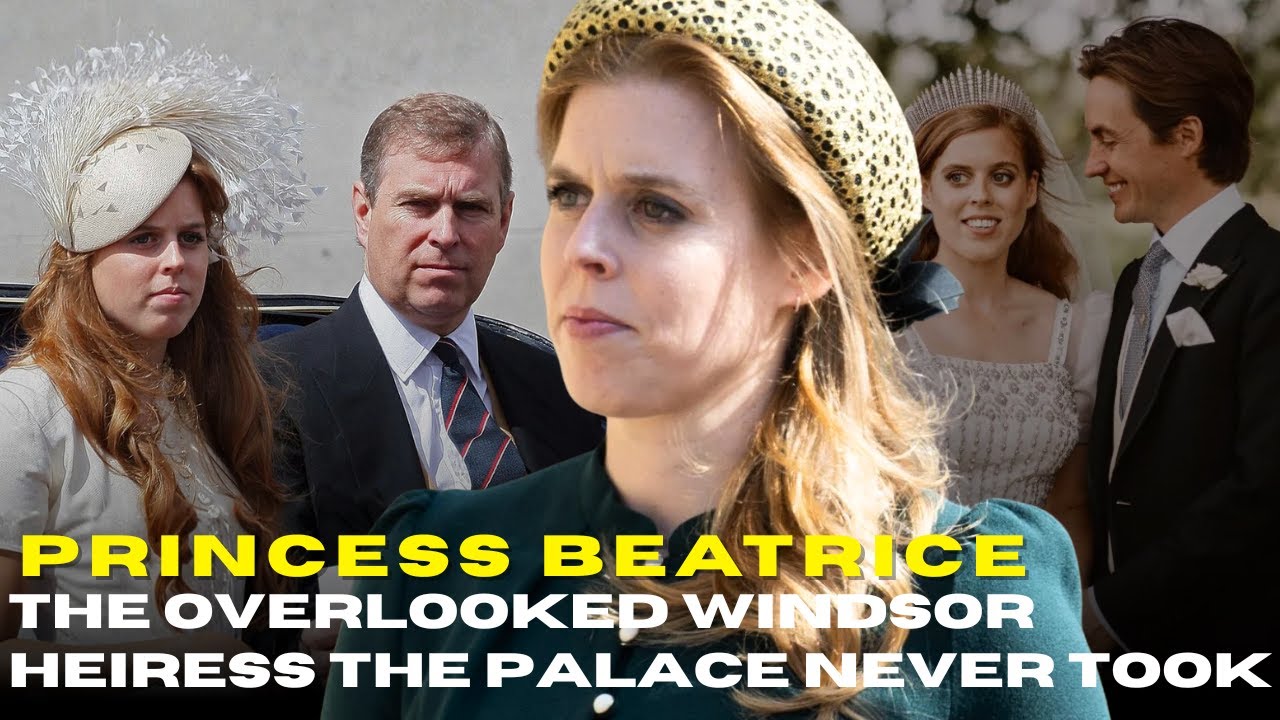
The ceremony had taken place at the Royal Chapel of All Saints in Windsor Great Park, a small, almost rural chapel tucked away on the grounds, not the grand St. George’s Chapel where her sister and cousin had married in front of the world. This was a private place, her family’s church, on the estate of Royal Lodge, the home where she had grown up. Fewer than twenty guests attended, the closest family only.
The Queen was there. Prince Philip was there, in one of his last public appearances before his death. So were her parents, Prince Andrew and Sarah Ferguson, her sister Eugenie and her husband, and Edoardo’s parents. And one more figure, walking in the wedding party as best man and page boy: a three-year-old boy named Christopher Woolf, Edoardo’s son.
In a single gesture, Beatrice had shattered centuries of royal convention, making the child of her new husband the center of their celebration. She was not just becoming a wife. She was publicly, proudly becoming a stepmother. The questions that followed were predictable.
How had a woman whose entire life had been a public spectacle managed to marry in total secrecy? How had a princess, mocked for years as useless, sidelined by her own family, pulled this off? The answers lay in choices so deliberate, so symbolic, that they transformed a quiet family wedding into a statement of profound personal meaning. Beatrice did not wear a new designer gown.
She wore an old dress, a borrowed dress, from her grandmother. It was a vintage Norman Hartnell creation of ivory peau de soie taffeta and organza, a gown the Queen herself had worn in the 1960s, most notably to the film premiere of Lawrence of Arabia in 1962 and the state opening of Parliament in 1966. With the help of the Queen’s dressmaker, it was altered slightly, sheer organza puff sleeves added, a modern touch to a historic garment. And on her head, she wore the Queen Mary fringe tiara, the exact tiara her grandmother, then Princess Elizabeth, had worn on her own wedding day in 1947, the tiara that famously snapped on the Queen’s wedding morning and had to be rushed by police escort to the royal jewelers for an emergency repair.
It was a tiara of continuity, of endurance, of direct lineage. Princess Anne had worn it. Diana never did. Kate never did.
Meghan never did. For the Queen to lend it to Beatrice was an act of immeasurable weight, a public anointment of a granddaughter the rest of the family had spent years sidelining. Then, after the ceremony, the palace released the photos. They showed Beatrice and Edoardo emerging from a floral archway, radiant.
They showed the couple, socially distanced, smiling with the Queen and Prince Philip. But no official photo featured Prince Andrew. He had been there, walking his daughter in, taking part in the private family moments. But Beatrice, understanding that a smiling image of her disgraced father would be a disaster, had kept him out of the frame.
She had managed to be loyal to both of her conflicting worlds. To understand how she arrived at that moment, you have to go back to the world she was born into. The year was 1988, and the House of Windsor was at its peak. The Queen’s son Andrew, the hero of the Falklands, had married Sarah Ferguson in a spectacular wedding that the public had embraced as a true love match.
Fergie was a breath of fresh air, relaxed and modern. When Princess Beatrice was born that August, she was seen as the symbol of the happy Yorks, proof that the monarchy could evolve. But the foundation was built on sand. In 1992, the Queen’s annus horribilis, the fairy tale exploded.
Beatrice was four years old when photographs of her mother, topless and having her toes kissed by an American financial advisor, were splashed across every front page. The humiliation was total. The tabloids screamed “Duchess of Pork. ” Sarah was a national disgrace, exiled from Balmoral.
Beatrice’s childhood was not a family so much as a war zone. Her parents divorced in 1996, but in one of the strangest arrangements in royal history, they continued to live together at Royal Lodge, calling themselves the world’s happiest divorced couple. For Beatrice, this created a bizarre fortress: the York family against the world. Her inheritance was not a crown.
It was scandal. As she entered her twenties, that question defined her: what exactly was she? The decision to strip her of her security detail was not just logistical, it was a symbolic public downgrading. It was a clear message from her uncle, Prince Charles, on his mission for a slimmed-down monarchy.
In that slimmed-down version, there was no room for Prince Andrew’s daughters. They became early examples of what a slimmed-down monarchy would look like. Beatrice was pushed into a position no modern British princess had ever faced. She was not Princess Anne, the hardest-working royal with a packed schedule of official duties.
Nor was she Zara Tindall, Anne’s daughter, who had renounced her title at birth to pursue an Olympic career and become a respected equestrian. Beatrice was trapped in the middle. She had the title but no role. She had the recognition but no respect.
So she tried to do what other wealthy, well-connected young people do. She tried to build a career. It was a sincere, if naive, attempt to find a path in a world not designed for her. First came the odd jobs.
She worked at Selfridges, reportedly as a personal shopper, though it was more a work experience stint than a real job. Then a volunteer position at the Foreign Office press office. Then came her internship at Sony Pictures, which was fine until the infamous Sony hack of 2014, when thousands of internal emails leaked to the world. Some of Beatrice’s were among them, and they were embarrassingly normal.
They showed her doing intern tasks, coordinating appointments, looking up information on Wikipedia for her boss, even discussing Crealy, a Peppa Pig family farm event. The Daily Mail seized on them. Instead of showing a hard worker, the story was spun as royal princess does menial tasks. The humiliation struck again.
Even when she tried to do a normal job, the world conspired to mock her for it. Frustrated with the relentless scrutiny of the British tabloids, she did what many wealthy Europeans do when they feel suffocated. She moved to America. New York, the city of ambition and anonymity, beckoned.
This was where she took on her most controversial role, a job at Afiniti, an American software company specializing in artificial intelligence. On paper, it looked perfect. She was named vice president of partnerships and strategy, an impressive, vague corporate title that implied high-level meetings and important deals. This was her chance to be taken seriously, to be a global businesswoman.
But the old question lingered, unspoken but understood by all. Was she hired for her intellect or her bloodline? She had a degree in history and history of ideas from Goldsmiths, University of London. But was it the degree that landed her a vice presidency, or her royal address book?
The company’s CEO, Zia Chishti, was a polished, if later controversial, figure. Having a British princess on his executive team was an undeniable PR coup. She was a door opener. She could get Chishti into rooms that money alone couldn’t buy.
And this was the trap. Beatrice could not separate Beatrice from Princess Beatrice. The conflict exploded when she attended a state event as a member of the royal family and took a selfie with her CEO, posting it online. To her, it may have been a proud moment.
Look, I’m working. But to critics, it was a severe conflict of interest, an abuse of a state event to promote her private commercial employer. She was slammed again. The Daily Mail dubbed her Princess Greedtrice, another cruel nickname to add to the list.
She couldn’t win. She was criticized for not working, and then criticized for cashing in on her title when she did. She was a flawed product, a princess who couldn’t be used for royal duties, but also couldn’t be sold in the commercial world without causing outrage. Trapped in this professional limbo, her social life became the focus.
And for most of her twenties, that social life revolved around one man, Dave Clark. Dave Clark was an American, a handsome executive at Richard Branson’s space tourism company, Virgin Galactic. He was six years her senior, and Prince William himself had introduced them at a birthday party. They were together for a decade, ten years, a significant period spanning her entire tumultuous twenties.
He was her stability, an outsider unburdened by the stifling rules of the British aristocracy. Together, they were a social power couple, central to what the press called the Gloss Posse, a group of young aristocrats and wealthy heirs. They vacationed in St. Barts.
They attended parties in New York, rubbing shoulders with Karlie Kloss, Ashton Kutcher, and Demi Moore. To the public, this looked bad. This was Princess Useless living a jet-set life, partying around the world while her cousin William was training to be king and her other cousin Harry was serving in the army in Afghanistan. The perception was that she was lazy, a party girl, a symbol of pointless privilege.
The truth, as always, was probably more complex. She was doing what any twenty-five-year-old with her means would do. The difference was that her every action was scrutinized through the lens of her title. That ten-year relationship seemed to be the only stable thing in her life.
And then, in 2016, it ended, abruptly and publicly. Reports circulated that Beatrice had given an ultimatum. She was twenty-eight, and she wanted to get married. Ten years was a long time to wait.
She wanted a commitment, and Dave Clark, for whatever reason, wasn’t ready. So he left. It was a devastating blow, a failure that was not just personal but deeply public. She had gambled a decade on a relationship that went nowhere.
She had bet everything on this normal man who had gotten her out of her gilded cage. And now she was alone at twenty-eight, and her future looked blurrier than ever. 2016 was a critical year. She had just broken up with her long-term love.
Her career at Afiniti was still a controversial and ambiguous subject. And meanwhile, her younger sister Eugenie was in a happy, stable relationship with Jack Brooksbank, a liquor brand manager. For the first time, the path of the York sisters seemed to be diverging. Eugenie, always seen as the more rebellious, artistic one, now seemed stable.
She had a respected job in the art world and a solid relationship. Beatrice, the good, responsible older sister, was now the lost one. And all this time, the shadow of her parents loomed. Her father, Prince Andrew, was still flying around the world as the UK’s special representative for trade, earning the nickname Air Miles Andy.
But rumors of his relationship with a convicted sex offender, Jeffrey Epstein, were beginning to surface, no longer as whispers but as serious questions in the press. Her mother, Sarah Ferguson, was still in a relentless battle for relevance and solvency, writing children’s books, fronting Weight Watchers, even starring in a bizarre reality series on Oprah Winfrey’s network called Finding Sarah, a docu-series about her trying to find herself after years of scandal. Beatrice was stuck between these two people. Her loyalty, forged in her childhood fortress of the York family, remained unshakable.
She was constantly photographed by their side, smiling, maintaining the “happiest divorced couple in the world” image. She was frequently criticized for this. Why did she continue to appear next to a mother who always seemed to be monetizing her royal connections? Why was she so close to a father whose associations were becoming increasingly questionable?
The answer was simple and tragic. They were all she had. They were her tripod, as Sarah often said. The firm had cast her out.
The press mocked her. The public despised her. Only mother, father, and Eugenie were constants. Her loyalty was her anchor, but it was also a heavy stone dragging her down with their scandals.
So, in 2017, she was twenty-nine, single, with a precarious career and a scandalous family. She was at rock bottom. She had failed at being a royal. She had failed at being a normal person.
It was in this moment of desperation that she began to do something truly new. She stopped trying to be anything for anyone else. She began to talk about a subject she had kept silent about her entire life: her dyslexia. This wasn’t a PR move.
It was too personal, too specific. She became a patron for the Made by Dyslexia organization. She began to give speeches, not as a princess, but as a woman who had struggled her whole life to read a page. She spoke of feeling stupid at school, of feeling like the slow one in the class.
She admitted that even then she misspelled simple words and struggled with reading aloud. This was a subtle but profound shift. For the first time, she wasn’t trying to hide her flaws or pretend to be perfect. She was using her own hidden struggle to help others.
She wasn’t doing this for the firm. She was doing this for herself. It was the first authentic act the public had ever seen from her, and it changed everything. It gave her a purpose that had nothing to do with her parents or her title.
It gave her a voice. A quiet confidence began to grow, a confidence that didn’t come from wearing a ridiculous hat, but from owning her own story. And it was in this new, vulnerable but authentic state that the two biggest events of her life were about to collide. A new love and an old scandal that would explode, threatening to destroy everything she had just started to build.
In the fall of 2018, at a mutual friend’s party, she was reintroduced to a man named Edoardo Mapelli Mozzi. Edo, as he’s known, was not a stranger. He was a family friend of many years, the stepson of Christopher Shale, a late Conservative politician and a close friend of Beatrice’s parents. They had known each other since they were children.
But now, they were looking at each other as adults, adults who had been through the wringer. Edo was not Dave Clark. He was not a polished American executive. He was an Italian self-made millionaire, a wildly successful property developer who had founded his own development and interior design company, Banda.
He was serious, ambitious, and intensely private. But he also came with what the tabloids call baggage. Edoardo had a young son, Christopher Woolf, or Wolfie, from a previous relationship with a glamorous Chinese-American architect, Dara Huang. In fact, he and Dara had been engaged and living together when their relationship broke down.
The situation was complicated, but the thirty-year-old Beatrice was no longer the naive twenty-two-year-old. She wasn’t looking for a simple fairy tale. She was looking for a partner. And in Edo, she found a man who, like her, understood the complexities of families.
Their romance bloomed quickly and intensely, but entirely out of the public eye. This was Beatrice’s first adult move. She kept her most precious thing private. No St.
Bart’s paparazzi shots, no club appearances, just a serious, quietly built relationship. Most importantly, she wasn’t just falling for Edo. She was falling for his son. She actively embraced the role of stepmother.
For a woman who had spent her life in a nominally broken but bizarrely close family, the idea of a blended family wasn’t scary. It seemed normal. She understood better than anyone that families could be messy, complex, and defined by love, not by convention. This was a courageous choice.
She was choosing a man with a past and a child. For a British princess, this was unprecedented. Just one generation prior, her uncle Prince Charles couldn’t marry the woman he loved because she wasn’t a virgin. And now Beatrice, granddaughter of the Queen, was openly dating and falling in love with a man who had a child with another woman.
It showed how much the royals had changed, but it also showed how much Beatrice had changed. She had chosen her personal happiness over a conventional fit. In September 2019, on a romantic trip to Italy, Edoardo proposed. The couple announced their engagement to the world.
The photos, taken by her sister Eugenie, showed a radiant Beatrice, overwhelmed with happiness. The ring was stunning. The families on both sides were delighted. Finally, after a decade of ridicule and romantic failure, Beatrice was having her moment.
She had found her man. She was going to have the royal wedding she had always dreamed of. The press, for the first time in years, was kind to her. They praised her mature choice, Edo’s success, and the beauty of their love.
She was thirty-one years old, and her life was finally on track. That was September 2019. And just two months later, in November 2019, her father walked into a BBC studio and detonated the bomb that destroyed everything. The Jeffrey Epstein storm had been simmering for years.
Prince Andrew’s connection to the American billionaire sex offender had long been a sore spot for Buckingham Palace. Andrew had befriended Epstein after Epstein’s first conviction for soliciting a minor. There were photos, infamously that photo, Andrew with his arm around the bare waist of a seventeen-year-old Virginia Giuffre, with Epstein’s associate Ghislaine Maxwell smiling in the background. Andrew had consistently denied all wrongdoing.
The palace had stamped out the stories. But in the summer of 2019, everything changed. Jeffrey Epstein was arrested on federal sex trafficking charges. And in August 2019, he died in a New York jail cell, ruled a suicide.
Epstein’s death blew the doors open. His victims, no longer fearing his retribution, began to speak out. And Virginia Giuffre’s name reemerged, this time in a television interview where she graphically detailed her allegations of being forced to have sex with Prince Andrew three times when she was a minor. The royal family was reeling.
The Queen’s credibility was being threatened by her own favorite son. Andrew, cornered and desperate to clear his name, decided to make an unprecedented move. He agreed to a long, no-holds-barred interview with BBC’s Newsnight, to be conducted by journalist Emily Maitlis. This was the context immediately following Beatrice’s engagement.
Her life’s greatest happiness was running parallel to her father’s worst nightmare. And here is the most tragic part of the story. According to multiple sources, it was Beatrice and her mother, Sarah Ferguson, who encouraged Andrew to do the interview. How could two intelligent, media-savvy women possibly agree to an idea that would later be described as the worst public suicide in television history?
The answer lies in the very psychological fortress they had built for thirty years, the York family. Inside Royal Lodge, the world operated on a different set of rules. They were a closed unit, us against the world. They had survived the toe-sucking scandal.
They had survived the press ridicule. They had survived being ostracized by the firm. They believed they knew better. And most importantly, they believed him.
Beatrice loved her father. To her, he wasn’t Air Miles Andy or a man who associated with sex offenders. He was papa, the warm, loving father who had always been there for her. From inside that bubble, their logic seemed sound.
They believed he was innocent. They believed that if the British public could just hear the truth from his own mouth, with his sincerity and authority, it would all go away. Perhaps desperately, they also wanted to clear the decks before Beatrice’s wedding. They didn’t want her day to be overshadowed by the scandal.
They wanted to end it. So Beatrice reportedly attended the prep meeting at Buckingham Palace with Emily Maitlis. She sat there supporting her father as they mapped out the strategy for him to tell his truth. They had made a catastrophic miscalculation.
They had underestimated the public’s fury, and they had vastly overestimated her father’s persuasiveness. The interview aired on November 16th, 2019. It wasn’t just a disaster, it was a reputational disaster. In forty-five minutes, Prince Andrew completely destroyed his remaining reputation.
He showed no remorse. He expressed no empathy for Epstein’s victims. He offered bizarre, unverifiable alibis about being at a Pizza Express in Woking and a medical condition that made him unable to sweat. He came across as arrogant, out of touch, and completely unaware of the gravity of the allegations.
The backlash was immediate and brutal. Within days, charities, universities, and military units were cutting ties with him. Sponsors of his Pitch at Palace program pulled out in droves. Just four days after the interview, Prince Andrew, the Queen’s favorite son, was effectively fired by his own mother.
He was forced to step back from public duties for the foreseeable future. In effect, he was banished from public life. And Beatrice, newly engaged, was trapped in the wreckage. The original plan had been for a grand royal wedding.
Beatrice, as a granddaughter of the Queen, was entitled to it, just as her sister Eugenie had enjoyed a lavish wedding at Windsor Castle. There had been talk of a carriage procession, a ceremony at St. George’s Chapel, a reception hosted by the Queen. It was her chance to finally have her moment, to be celebrated as a royal bride.
But after the Newsnight interview, that idea was dead. The British public was furious. The idea of Prince Andrew, a public disgrace, walking his daughter down the aisle in a massive public event was unthinkable. The tabloids, which had been briefly kind to her, now turned vicious.
“Andrew’s toxicity could cancel Bea’s wedding,” the headlines screamed. “Beatrice forced to scale back wedding over father’s shame. ” She was collateral damage. Her dream wedding was being destroyed by the very man she had tried to support.
They tried to salvage it. Instead of Windsor Castle, they announced a far more modest plan. A ceremony in May 2020 at the Chapel Royal, St. James’s Palace, with a private reception in the gardens of Buckingham Palace.
It was a significant downgrade. It felt like a concession of defeat. And even then, the question of who would pay for security sparked a national debate. Beatrice faced an impossible choice.
Have a public wedding and be booed, or have no wedding at all. She was besieged. She was seen looking gaunt at events. She attended her father’s birthday party just after the scandal, an act of defiant loyalty that stunned royal commentators.
Her loyalty, once her anchor, was now the rock drowning her. She could not publicly denounce her father. He was her papa. But by standing by him, she appeared to be condoning his arrogance and his horrific associations.
She was trapped between a daughter’s love and the world’s judgment. And just when it seemed things couldn’t get worse, an outside force unrelated to royalty or scandal delivered the final blow. In March 2020, the COVID-19 pandemic exploded. Britain and the rest of the world went into lockdown.
Gatherings were banned. Weddings across the country were canceled. Princess Beatrice’s re-planned modest royal wedding in May 2020 was officially canceled. Not because of her father’s scandal, though that was the real reason it had been scaled back, but because of a global virus.
For Beatrice, it must have felt like a bizarre and cruel end to her dream. After a decade of waiting, after finding a complex but true love, after enduring her father’s humiliation, now even a simple ceremony was being denied to her by a pandemic. Let’s pause to picture her situation in the spring of 2020. She was thirty-one.
Her grand wedding plan, already downgraded to a modest event due to her father’s shame, was now completely erased. She was locked in her home. Her father was an outcast, the most politically toxic royal in Britain at that moment. The press had moved from mocking her to ignoring her, which was perhaps worse.
Her future, both personal and professional, was a blank void. For a woman who had spent her entire life trying to find her place, this seemed to be the end. A quiet failure. But the world had underestimated Beatrice of York, and more importantly, her grandmother.
Amid the silence of the lockdown, another plan began to form. A plan born not of desperation, but of a radical acceptance. Beatrice had spent her entire life trying to perform her role as princess, with the ridiculous hats, the vague jobs, the efforts to be seen on the balcony. Every public attempt had failed.
What if she stopped trying? What if instead of fighting for a grand royal wedding the public didn’t want and circumstances wouldn’t allow, she simply got married? It wasn’t just a COVID wedding. It was a deeply personal and strategic act.
It was a rejection of the idea that her life had to be a public spectacle. It was a refusal to engage with the very tabloid machine that had tormented her and her family since she was four years old. It was a decision to reclaim her own narrative by doing it in total secrecy. And on that Friday in July 2020, she did what she had never managed to do before.
She outsmarted everyone. The public’s reaction, for the first time in Beatrice’s life, was near universal warmth. People didn’t see a freeloader princess having a lavish wedding. They saw a woman who had endured so much, a scandalous family, a canceled wedding, a pandemic, and had found a way to have her moment of happiness with grace, humility, and profound meaning.
They saw the borrowed dress and the historic tiara, and they understood the message. They saw a grandmother’s love. They saw a beautiful bride who had finally found her happiness. It was a complete reversal.
In one day, by choosing privacy over spectacle, meaning over pageantry, Beatrice had won back her story. This wedding wasn’t just a ceremony. It was her transformation from a caricature to a real woman. Her new life began quickly.
She and Edoardo settled down. In September 2021, they welcomed their first child, a daughter named Sienna Elizabeth Mapelli Mozzi. The middle name was no coincidence. Elizabeth.
It was a public, permanent thank you to the woman, the grandmother, the queen who had stood by her when no one else would. Beatrice also embraced her new role as stepmother to Wolfie. She was photographed taking Wolfie to school, looking like any other London mother in a puffer jacket and sneakers. The blended family became her new authentic brand, relatable, modern, and completely removed from royal squabbles.
She continued her work at Afiniti, but it was no longer the focus of scrutiny. Her style changed. Gone were the desperate fashion attempts. In their place was the appropriate, elegant style of a working mother.
She had found her place. She had built a new fortress, not the reactive, insular York family, but a family of her own built on love, privacy, and adult choices. She had won. She had found peace.
But the problem with old monsters is that they never truly die. Beatrice had built her happy home on a geological fault line. Just beneath the surface, her father’s problem had not gone away. It was only gathering strength.
The civil case in America against Prince Andrew from Virginia Giuffre was gaining traction. The lawsuit was filed just one month before Sienna was born. The timing was cruel. Beatrice’s greatest personal joy coincided with the beginning of her father’s final public downfall.
As the case escalated, it became a royal nightmare. In January 2022, the Queen stripped Prince Andrew of everything. His HRH title and his military roles. It was a royal expulsion.
And where was Beatrice? She was at the center, not as a princess, but as a daughter. This is her core tragedy. Inside the Royal Lodge fortress, she and Eugenie were their father’s emotional support.
To Beatrice, he wasn’t the defendant. He was papa. The man who walked her down the aisle. Her loyalty was a thirty-year-old reflex, and she was trapped between public morality and private love.
Andrew later settled the case out of court for a sum widely reported to be around twelve million pounds. Any image of her financial independence was shattered. Her father’s shame had become hers. Throughout 2022, she kept her head down, focusing on her new family, developing a placid, almost distant public face.
She became an expert on a high wire, attending royal events as the Queen’s granddaughter, then being photographed driving into Royal Lodge to visit her disgraced father. She was living two parallel lives. And then, on September 8th, 2022, Queen Elizabeth II died. Her protector, the woman who had loaned her the dress and the tiara, was gone.
Her uncle Charles, the man who had sidelined her, was now king. But a constitutional irony emerged. With Andrew disgraced and Harry gone, the slimmed-down monarchy was suddenly too slim. By law, Beatrice, as one of the next adult royals in the line of succession, was suddenly a counselor of state.
The useless princess was suddenly essential. King Charles had to amend the act to add Anne and Edward, but he did not remove Beatrice. Her position, for the first time, was formalized. She became a model royal, one who caused no trouble, but the shadow remained.
She had learned the final lesson of royal survival: compartmentalization. Her public role was Princess Beatrice, compliant counselor of state. Her private self was the daughter who still loved her papa. It is a painful balancing act, a modern Greek tragedy where she attempts agonizingly to choose both family love and public honor.
In late 2021, Afiniti’s founder stepped down amid misconduct allegations, echoing uncomfortably the shadows over her father. Why does her story matter? Beatrice is a mirror reflecting the cracks, the hypocrisies, and the bizarre resilience of the monarchy. She is living proof of the failure of the slimmed-down monarchy.
Once sidelined by her uncle King Charles as superfluous, she is now an essential figure. When Harry left, Andrew was disgraced, and the Queen died, the firm was suddenly short-staffed. The useless princess became important, not because she was chosen, but because she was one of the only ones left. Her significance also lies in her third way.
In an era defined by the PR war of the Sussexes and the polished perfection of the Waleses, Beatrice chose a quiet retreat. She found dignity not by fighting the press, but by focusing on her family and work. But her deepest meaning is her human one. Beatrice is relatable not for her title, but for her very real struggles: family shame, being mocked for her appearance, romantic failure, and finding happiness in a complex, blended family.
And this leads to the final, greatest controversy, Prince Andrew. Her unshakeable loyalty to him is the largest scar on her legacy. To critics, it’s a moral failure, a royal blindness that values blood over ethics. But to a psychologist, it’s an understandable tragedy, the result of a child raised in an us-against-the-world fortress, taught that family loyalty is the only absolute virtue.
In the end, Princess Beatrice’s story is not a simple fairy tale. It’s a story of survival. Recall the twenty-two-year-old in the pretzel hat. That was a desperate performance to fit a role she didn’t understand.
Now compare that to the 2020 wedding, the woman in the Queen’s borrowed dress and historic tiara. She was no longer performing. She had found dignity by focusing on what was real: love, family, and the approval of her grandmother. Beatrice was trapped in the middle, her title both a burden and a privilege.
She did the only thing she could. She built a meaningful life in that gray area. She turned her dyslexia into a mission and her blended family into a modern model. She is the princess who was defined by her family’s failures, but who found success on her own terms.
She never got the fairy tale, so she wrote her own, a story far more complex, painful, and real. She is the quiet spare who, against all odds, found her own sense of wholeness.






