By early August of 2026, the numbers had become alarming. The Strategic Petroleum Reserve, the vast underground stockpile that had sheltered the American economy for nearly half a century, had slipped below 300 million barrels. A week later, it fell to 283. 8 million—the lowest level since October 1982.
Just a year earlier, the caverns had held roughly 406 million barrels, and now the country was sitting on less than 40 percent of what its salt-carved vaults were built to contain. The cause was a war that had started in February, a conflict that had nearly shut the Strait of Hormuz, the narrow passage that normally carries about a fifth of the world’s oil. And the drain was still underway. The reserve itself was the answer to a much older crisis.
In 1973, several Middle Eastern producers, furious over American support for Israel in that year’s war, stopped shipping oil to the United States. Drivers waited in long lines at pumps that ran dry. Prices jumped, and a country that had treated cheap fuel as a birthright discovered how exposed it truly was. Washington’s response came on December 22, 1975, when President Gerald Ford signed the Energy Policy and Conservation Act and created the Strategic Petroleum Reserve.
The idea of an emergency oil stockpile had been floated as far back as 1944, but it took an embargo to make it real. The plan was simple enough: keep enough crude on hand to bridge a crisis. The hard part was figuring out where to put it. Building thousands of steel tanks would have taken years and a fortune.
But the petrochemical industry along the Gulf Coast had been storing products in salt caverns for a long time, and the government realized it could simply buy some of them. In April 1977, it acquired existing caverns with enough capacity to hold the first 250 million barrels. On July 21 of that year, roughly 412,000 barrels of Saudi crude were pumped into a cavern at West Hackberry, near Lake Charles, Louisiana. It was a modest beginning—about half an hour of what Americans burn through today.
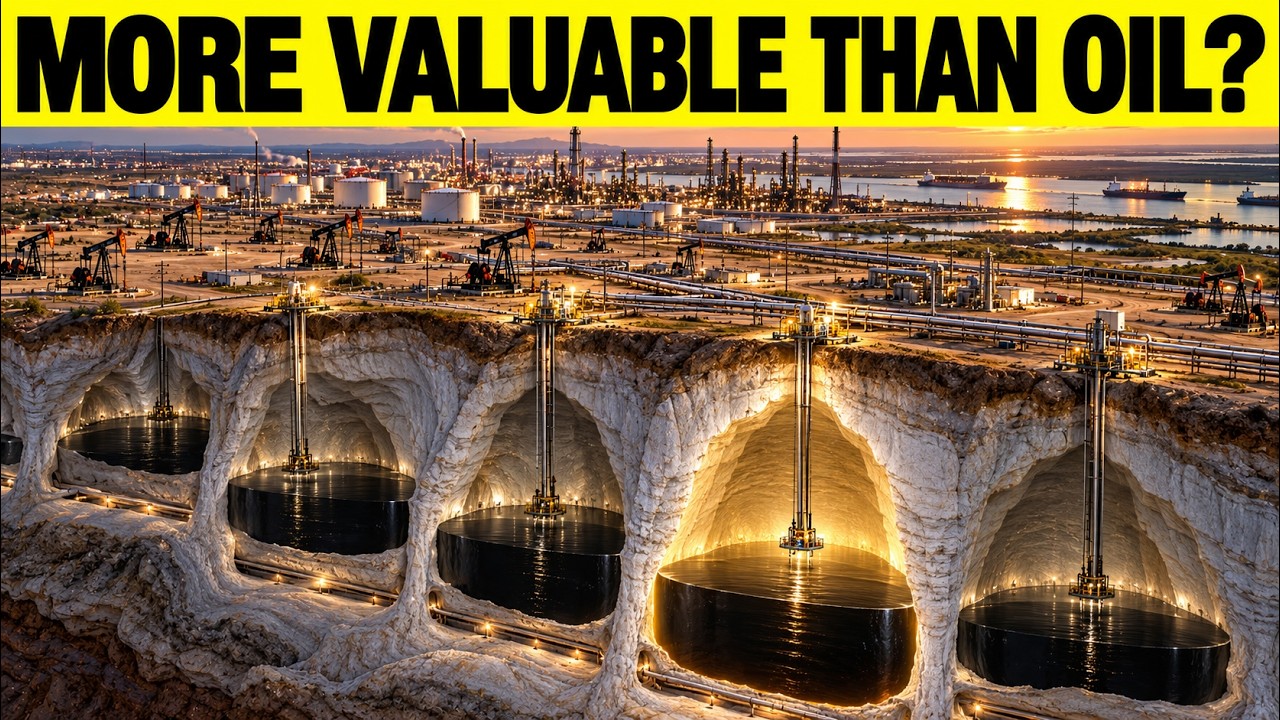
Beyond that first quarter-billion barrels, the Department of Energy had to make its own rooms. The method is delightfully low-tech. Crews drill a well into a salt dome and pump in fresh water. The water eats the salt.
The resulting brine comes back up and gets injected into disposal wells or, more often, piped several miles out into the Gulf. By controlling how the water flows, engineers can sculpt the cavity to a very precise shape. It takes about seven barrels of water to hollow out room for one barrel of oil. A typical finished cavern is a tall cylinder roughly 200 feet across and 2,500 feet high, holding around 10 million barrels.
The biggest holds 37 million. Even a typical one is 420 million gallons—roughly 640 Olympic swimming pools’ worth in a single hole. The government likes to point out that Chicago’s Willis Tower would fit inside one with room to spare. Today, there are 60 of these chambers spread across four sites: Bryan Mound near Freeport and Big Hill near Beaumont in Texas, West Hackberry near Lake Charles, and Bayou Choctaw near Baton Rouge in Louisiana.
Bryan Mound is the largest, with 19 caverns and room for about 247 million barrels, while Bayou Choctaw is the smallest, with six. Together, they’re authorized to hold 714 million barrels. The Gulf Coast was chosen for a practical reason. Texas and Louisiana are home to roughly half of the country’s refining capacity, and the four sites connect to pipeline systems named Seaway, Texoma, and Capline that lead to major refining centers and marine terminals.
Why go to all that trouble instead of building tank farms? Money, mostly. The Department of Energy says storing oil in salt caverns costs up to ten times less than using above-ground tanks and twenty times less than mined hard-rock caverns. The safety case is just as strong.
The department calls salt caverns one of the most environmentally secure ways to store oil over the long haul. The seal works both ways: the oil can’t leak out, and groundwater and other contaminants can’t get in. A tank is a steel shell sitting out in the open. A cavern is a hole in rock that repairs its own cracks.
Steel works fine for a corner gas station, but scaled up to a national insurance policy, it gets expensive fast. None of this makes the system perfect, and geologists will tell you so. Nothing that holds hundreds of millions of barrels ever is. Pressure inside the caverns gets checked every day, because a weak spot and enough pressure can still add up to trouble.
Although earthquakes are rare along the Gulf Coast, the ground is never entirely still. The salt itself is a testament to that. Go back about 160 million years, to the late Jurassic, when the ground beneath today’s Gulf Coast was pulling away from Mexico’s Yucatan Peninsula. A rift opened, and a basin spread out between the two landmasses.
For a long stretch of time, that basin was cut off from the open ocean. Rain and river runoff poured in with nowhere to go, so the water simply evaporated under a brutal sun and left its dissolved minerals behind. The main one was halite—plain sodium chloride, the same stuff in your kitchen shaker. Picture a shimmering inland sea shrinking to a white crust, refilling and shrinking again, round after round, until the whole basin was less a sea than a giant pit packed with salt.
Then the salt got buried. Sediment piled on top for ages, and the deposits ended up thousands of feet underground. Down there, under all that weight, salt stops acting like a seasoning and starts acting more like thick plastic. It creeps.
It bends. Most rock is riddled with tiny connected gaps that let oil and water seep through, but salt has almost none. And if a crack starts to open, the salt slowly flows in and closes it. In places, the deposits pushed upward into massive columns called domes.
Nature had spent well over a hundred million years building a vault, and it sat there under the marshland and farmland, waiting for someone to notice. Getting the oil out relies on the oldest trick there is: oil floats on water. So operators pump fresh water into the bottom of a cavern. The crude rises, and it flows out the top toward the pipelines.
Thirteen days after a president gives the word, the system is designed to move up to 4. 4 million barrels a day. That word has to come from the top. Only a president can authorize a full or limited drawdown, though the Energy Department can run exchanges and test sales on its own.
The reserve has been tested before. In January 1991, at the start of the Gulf War, the president ordered its first emergency release, and the announcement alone helped calm nervous markets. After Hurricane Katrina wrecked Gulf Coast oil operations in 2005, refiners asked for help and approval came within a day. In 2011, the reserve sent 30 million barrels into the market when Libya’s exports were disrupted.
In 2022, the government let go of about 180 million barrels after Russia invaded Ukraine. Each time, the caverns did their job without much drama, which is exactly what you want from a vault. Nothing quite prepared the reserve for 2026. On February 28th, the war with Iran began, and tanker traffic through the Strait of Hormuz nearly stopped.
Prices jumped. On March 11th, the 32 members of the International Energy Agency agreed to the biggest coordinated emergency release ever attempted: 400 million barrels, more than double the previous record set in 2022. America’s share, authorized by President Trump, was 172 million barrels over about four months, drawn from a reserve that then held around 415 million. This time, most of the oil didn’t get sold.
It got loaned. Companies borrow crude from the caverns and have to return it later with extra barrels on top—a premium that ran around a fifth or more in the early rounds, with repayment scheduled to start this November, a little over a month from now, and stretch into 2028. The first round, awarded in late March, covered 45. 2 million barrels from three of the four sites.
The Energy Department’s pitch was that refiners get oil quickly and the reserve ends up bigger than before, at no cost to taxpayers. The pace was relentless. In one week in May, nearly 10 million barrels left the caverns, which one bank counted as the fastest weekly drop on record. By early August, the reserve had slipped below 300 million barrels.
Last week it fell to 283. 8 million, the lowest level since October 1982. Compared with about 406 million a year earlier, that’s just under 40 percent of what the caverns can hold, and roughly two weeks of the country’s total oil use. Meanwhile, according to AAA, the national average for a gallon of gasoline climbed from $2.
98 on the day the war started to $4. 15 by early September—a jump of 39 percent you can feel at every fill-up. Hormuz traffic is still far below its pre-war level, and the reserve is still draining. Even at that record pace, the reserve was never going to replace the strait.
The 172-million-barrel plan works out to about 1. 4 million barrels a day, a small slice of the roughly 20 million that normally move through Hormuz. A reserve like this buys time. It doesn’t replace a shipping lane.
Here’s the twist that gives this story its title. The oil is temporary. It comes in, it goes out, it gets borrowed and paid back. What you can’t borrow or buy quickly is the room.
Roughly 430 million barrels of authorized space now sit empty inside those salt walls, and every cavern took real time and money to create. Building that much capacity from steel would cost several times more—up to ten times, by the department’s own estimate. And you can’t simply order up new salt domes next to the right refineries. Refilling it with crude is a separate bill.
At recent prices, topping off that space would run about $35 billion, although about 200 million barrels are supposed to return through the loans. And one early analysis suggested the reserve wouldn’t return to its pre-war level until around mid-2028. The logic of the whole thing is as old as commerce. Fill the vault when oil is cheap, draw it down when oil is dear.
But you can only do either if the vault exists. The oil is expensive. The vault is the bargain. That’s what the country really found in 1977 when it chose to buy a few old caverns instead of building a tank farm: not just a place to park crude, but a cheap, secure, permanent structure beside the nation’s refineries.
It’s an odd sort of treasure, one measured partly in emptiness. Standing at any of the four sites, you’d see wellheads, pipe, and a lot of flat coastal land. Everything that matters is thousands of feet below, in rooms cut from rock that formed when dinosaurs still ruled. The oil will come and go with the headlines.
The salt will still be there, sealed and patient, waiting for the next time the country needs somewhere safe to put its worst-case plan.






