The midwife took one look at the newborn boy and threw him into a fire. He was born in Bengal in 1783 with a second head attached upside down above his own, and the woman who had helped bring him into the world was so horrified by what she saw that she tried to destroy it. The boy survived, but he carried the burns for the rest of his life. His parents began exhibiting him around Calcutta, where physicians, soldiers, and curious strangers gathered to watch both faces.
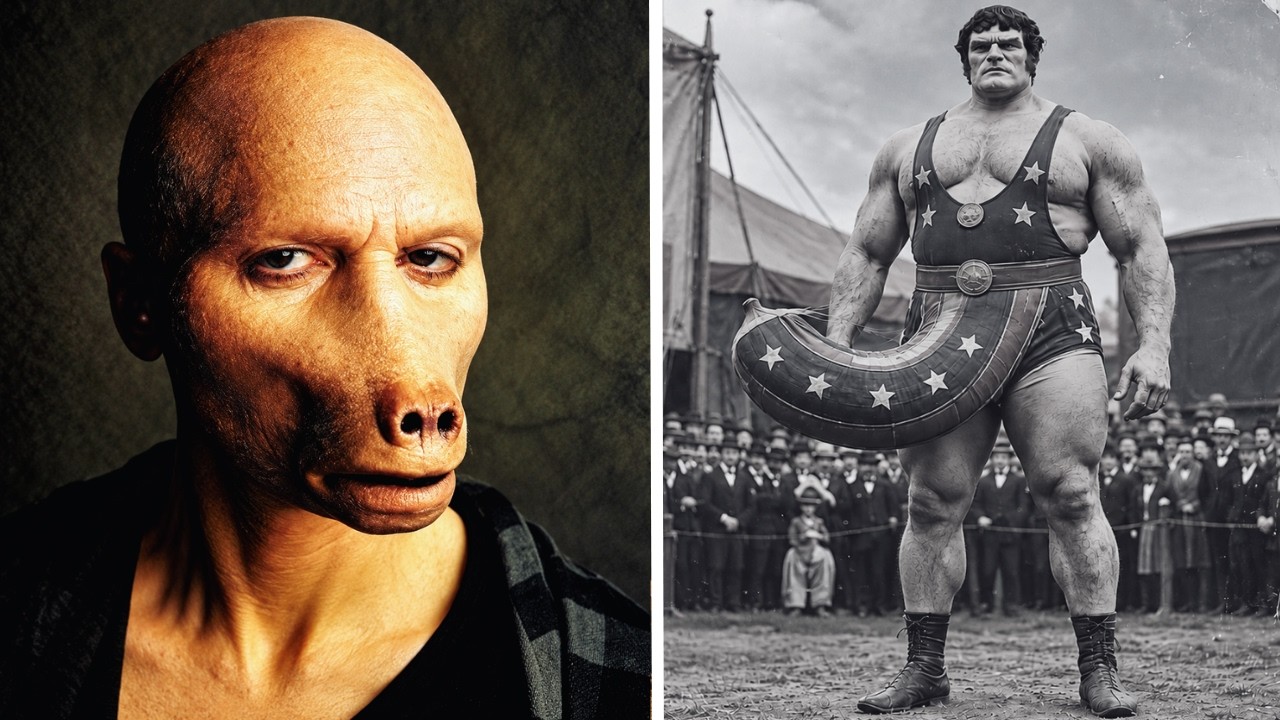
According to old accounts, the second head blinked, drooled, and slept separately from the boy himself, sometimes reacting while he remained quiet. He never reached his fifth birthday. A cobra bite ended his life when he was only four, but even death brought him no peace. His grave was robbed, his body dissected, and his unusual skull eventually reached England, where it remains with the Hunterian Collection centuries later.
Circus history can sound colorful from a distance, but for this child, it was a life that barely allowed him to be a child at all. And yet his story, painful as it is, is only one of many. There was a time when people happily paid to see those who looked unlike anyone they had ever seen. What would be heavily criticized today was once a major form of entertainment.
Circus sideshows, also known as freak shows, presented individuals with ultra-rare physical features to satisfy the curiosity of paying crowds. Some found fame and considerable fortune. Others were simply treated as attractions. Ella Harper was twelve years old when her walk became something strangers bought tickets to see.
She had spent her childhood in Tennessee with her parents and siblings after losing her twin brother Everett during infancy. Her knees bent backward because of a condition called genu recurvatum, so moving on all fours came more naturally to her. Circus promoters saw an act and money in that difference, and they called the young girl the Camel Girl. Soon, Ella was traveling through big cities such as St.
Louis and New Orleans, eventually appearing with W. H. Harris’s Nickel Plate Circus. Sometimes they even placed a camel beside her and asked people to compare a teenage girl with an animal.
Ella smiled for photographs and carried on performing, but we can only wonder how that felt at sixteen. Then she made a choice that said more about her than any circus poster ever could. In 1886, Ella walked away from the show and chose school instead. The crowds lost their Camel Girl.
Ella Harper finally got to be Ella. J. C. Ryan was not what sideshow posters usually promised.
His story began with loss, not an unnatural body he had always known. At around twenty-two, a Dakota blizzard cost Ryan both hands, leaving him with years of painful attempts to work again. He first learned to write with his feet while traveling with a show, but he found it awkward. So Ryan tried something that must have demanded endless patience: holding and guiding a pen between the ends of his arms.
Eventually, beautiful lettering began appearing on the page. His friend Warner C. Brownfield described him as an optimist and a tireless worker who studied the finest penmen, including the work of L. Mattarase.
Ryan traveled from city to city selling handwritten cards and meeting other artists of the craft. His own letters sounded cheerful, especially after everything he had endured. The blizzard took Ryan’s hands. It never managed to take away his wish to work, travel, learn, and earn for himself.
A. E. Bischel had a name before showmen decided that Joe the Leopard Boy would sell a better story. His skin was marked by pale patches associated in historical accounts with leukoderma, and in the circus world of the late nineteenth century, that difference could become someone else’s business.
Bischel was dressed for the role, promoted under an animal-like identity, and exhibited in dime museums where spectators could study him from only a few feet away. There was something painfully lonely about that arrangement. Everyone knew what his skin looked like, but nothing survives about the person underneath the costume. His thoughts, friendships, goals, ambitions, and even how he felt about being called Leopard Boy were not worth recording.
Some reports place his death around 1909, after a backstage fall through a trapdoor, when he was about forty. The stage name survived much better than A. E. Bischel did.
The business made his appearance unforgettable, but the man disappeared. His name was Ram Assama, and except for this, very little is known about the man underneath all that hair. In the late 1890s, he was taken from town to town as a supposed wild man covered in thick brown and gray hair, said to have been captured somewhere near the Himalayas. He growled instead of speaking, sat before strangers like some lost human ancestor, and even allowed doctors to examine him.
People felt sorry for him. One newspaper called him a poor man being exhibited like a beast. But Rama Assama had a secret. He was not wild at all.
Earlier encounters had already exposed him speaking French, English, German, and even Spanish when his cage caught fire. His real name may have been Albert, and behind the frightening act was reportedly a married father simply earning a living. For nearly twenty years, he kept playing the exhausting role. People paid to see a missing link between man and ape.
Rama Assama knew he was giving them exactly the story they wanted. John Valerius was born in 1667 in Upper Palatinate, but this German man was born with no arms at all, only a thumb projecting from his right shoulder and, according to period descriptions, a single breast on his chest. Losing his parents young could easily have narrowed his world further, but it did not. Valerius learned to make his feet do work most would struggle to perform with both hands.
His toes could hold a pen, manage personal grooming, handle games, and even fence. Those skills carried him through Europe and then to London, where records place his performances between 1698 and 1705. The musket demonstration must have been nerve-racking: Valerius could load and fire one using his feet. He also drank from glasses balanced on his head and wrote in several languages.
Afterward, he sold portraits bearing samples of his toe writing. People may have arrived expecting a curiosity. Valerius gave them something harder to dismiss: a man who refused to let other people decide what his body made possible. John Tunnell was only seven months old when he already weighed around two stone.
His parents watched their little boy grow at a speed nobody could explain, and even doctors had no real answer for them. By six, John was nearly fourteen stone. At fourteen, around twenty-six. London soon gave him a name that would stick for years: the Fat Boy of Peckham.
John did not spend those years feeling sorry for himself. He loved making people laugh and seemed comfortable with the attention, performing with the Electric Automatic Vaudeville and later appearing on screen. He even became friendly with Charlie Chaplin. But fame does not always stay.
After World War One, people lost interest, and John eventually left that old life behind. He learned watch repair and settled into quieter days in London. Tuberculosis took him in 1944, when he was forty-six. People had once gathered because of his body, but those who knew John remembered the cheerful man inside it.
Some circus acts made people laugh. The stone eaters made them clutch their stomachs. Stories of people swallowing rocks stretch back centuries, including an account from Prague in 1006, but performers turned the habit into a spectacle. Thomas Gobsil began eating pebbles because he believed they helped his digestion, only to accumulate over two hundred stones that were said to rattle inside him as he moved.
Then came Francesco Battaglia, whose story grew stranger with every retelling. He was said to have rejected milk as an infant, developed an appetite for stones, swallowed spoonfuls of them, and followed them with beer and tobacco. By the eighteenth century, stone eating had become enough of a curiosity for performers to accept rocks supplied by spectators. But the secret was often less supernatural than the posters suggested.
Skilled regurgitators could swallow objects and bring them back at will, a technique Houdini studied. Modern regurgitation performers like Stevie Starr later carried that stomach-turning tradition into a very different age. Stephan Bibrowski was only four when his mother handed him over to a German showman named Settelmaier. Perhaps no part of his later circus story feels sadder than that.
Thick hair covered much of the little boy’s face and body because of hypertrichosis, and an old family story claimed his frightened mother connected his appearance to seeing a lion attack his father while she was pregnant. Settelmaier renamed him Lionel and turned that resemblance into Lionel the Lion-Faced Man. But the person underneath all that hair was nothing like the wild creature or monster the posters promised. Stephan grew into a gentle, educated man who spoke five languages, enjoyed gymnastics, and reportedly dreamed of becoming a dentist.
By 1901, Barnum & Bailey had brought him before American crowds, where people came expecting something animal-like and met a polite young man instead. He later worked around Coney Island before returning to Germany. A heart attack ended his life in 1932. The circus gave Stephan a lion’s face and name.
He spent his life quietly showing everyone the human being underneath. There must have been mornings when Ed Hayes looked in the mirror and saw nothing unusual at all. Then the curtain went up, his shirt came off, and the Anatomical Wonder took his place. Anatole Hayes could pull his stomach so far inward that his ribs stood out and his middle seemed to disappear.
People called it swallowing his stomach, and the sight was strange enough without fake monsters, costumes, or circus tricks. It was simply his body, controlled in a way few others could manage. His brother Keen also performed and sometimes used the Anatole name, leaving their stories tangled together over time. Sadly, that stage act is almost everything history bothered to keep.
There are descriptions of his stomach and advertisements selling his unusual ability, yet very little about Ed himself: what made him laugh, what frightened him, whom he loved, or where life took him afterward. The circus preserved Anatole because he could astonish people. Somewhere along the way, it almost completely lost Ed Hayes. Beautiful Hawaii gave tired people somewhere else to be.
During the 1920s, Copper State shows carried this modest attraction through American mining towns, where days were often spent around dust, machinery, and hard labor. Then came a painted sign promising Hawaii. Behind it stood two light-skinned women in grass skirts slowly swaying across a bare stage while a talker worked his megaphone outside. Neither woman was Hawaiian, there was no island music, and nothing about the performance belonged to Hawaii.
Still, perhaps reality was not really what people were buying. After another exhausting day, a little color and fantasy could feel like a holiday, even when everyone knew the palm tree paradise ended behind a canvas curtain. For the women performing night after night, however, that fantasy was work: change clothes, smile, dance, pack everything away, then repeat it in another town. Beautiful Hawaii sold an island that was not there, and somehow people were happy to believe it was.
Martin Semnak walked into Coney Island in 1954 and left with his first tattoo. He loved it enough that one quickly became another, and before that year was over, nearly thirty pieces of ink covered his skin. Martin eventually became Jack Dracula, and more than four hundred tattoos turned his body into something he had designed for himself. Even his face became part of it.
Naturally, sideshow crowds could not stop looking. But Jack was not some unhappy man trapped inside an appearance he never asked for. Every needle mark was his decision. Hubert’s Museum, Ringling Brothers, and Coney Island’s Wonderland gave him places where that choice became a career.
His unforgettable appearance even reached cinema in 1976 in The Witch Who Came from the Sea. Some strangers probably thought he had ruined himself. Jack seemed to feel the opposite. The tattoos gave him an identity that belonged entirely to him.
When he died in 2011, aged seventy-five, there was little mystery about how Jack wanted the world to see him. Barbara LaMay did not wait for society to become comfortable with her. She had a life to live, and waiting could have taken forever. The Great Glamazon built her career during the 1960s, when openly expressing a transgender identity could bring ridicule, rejection, or worse.
But there she was, working burlesque stages, carnivals, and clubs with a confidence and a presence people truly remembered long after the curtain closed. This offered more than applause. It gave Barbara room to exist on her own terms, when everyday society gave very little. In 1975, filmmaker Daniel D.
Teoli, Jr. documented her in Gone Up in Smoke. His college refused to screen the film, considering its subject unacceptable. Barbara carried on anyway.
Away from the spotlight, she found companionship within early LGBTQ circles and helped younger performers find their footing. There is something deeply human in that stubborn refusal to disappear. Barbara was not asking the world for permission to be herself. She had already decided she belonged.
John Rogan never needed a circus tent to make a living from being different. By his teenage years, his body had begun changing so quickly that he eventually reached around eight feet nine inches. But being that tall brought John far more pain than wonder. His joints became stiff, his legs could no longer carry him, and a wooden cart made by his father became his way of getting around.
John pushed it with his hands, often traveling through the streets around Gallatin, Tennessee. He had another way of earning money, too: drawing. John made portraits and pictures, then sold them along with postcards. Showmen wanted him, but John wanted no part of becoming somebody’s attraction.
He preferred earning his own money near home, where people knew more than his height. His life ended in 1905, when he was only thirty-eight. His family even covered his grave with concrete, afraid someone might steal his body. John was not a circus freak.
He was an artist and salesman protecting the little independence he had. He was not a so-called circus freak. He was a man whose strength made people wonder whether his body followed the same rules as everyone else’s. Michael Buddy Subrug became a familiar face around 1950s Britain, and his jaw was responsible for the attention.
At the London Palladium in 1959, he lifted singer Bridie Gallagher while she remained seated in a wooden chair, gripping the load with his teeth. Somehow, that was not enough for Buddy. Another performance had him hauling a double-decker bus with a rope held between his teeth, while another saw a man sitting on a chair balanced above his head. There was something wonderfully old-fashioned about him: no elaborate costume, no illusion, just a man calmly doing things that looked painfully unreasonable.
Beer halls and fairs loved him for it. While sideshow history remembers plenty of unusual bodies, Buddy earned his place differently. People came to stare, certainly, but mostly because they wanted to know how on earth he did it.






