The news reached her not from a battlefield, but in the quiet, agonizing form of a telegram. Prince Christian Victor, her eldest son, the soldier who had survived India, the Ashanti expedition, and Kitchener’s march to Omdurman, had contracted enteric fever while stationed in Pretoria. For weeks his life hung in the balance, and Helena, a woman who had devoted so much of her life to the cause of nursing and medical care, was utterly powerless, thousands of miles away, able only to wait and pray. On October 29th, 1900, at the age of 33, he died.
The ultimate cruel irony: her son had come through countless battles and perilous campaigns, only to be felled by disease. For any parent, the death of a child is the reversal of the natural order, an unbearable grief. For Helena, who had already buried two infant children, this loss was catastrophic. Yet, even in the depths of her personal agony, the demands of her station required a public display of fortitude.
She was a princess of the United Kingdom, and her grandmother was the Queen Empress. Her grief had to be managed, contained within the strict protocols of royal mourning. She received the news with the quiet dignity that had defined her entire life. But those close to her spoke of a light that had gone out, a profound and permanent sadness that settled upon her.
She had poured so much of her hope and pride into her adventurous, capable son, and now he was gone. He was buried in South Africa, and Helena would never have the chance to visit his grave. The loss of Christian Victor was a wound from which she would never fully recover, a silent sorrow she would carry with her for the rest of her days. The death of her favorite grandson was also a terrible blow to the aging Queen Victoria.
Now over 80 years old, her health was in a state of visible decline. The Boer War, with its heavy casualties, weighed on her conscience, and the loss of Christian Victor seemed to sap her remaining strength. The turn of the century, the dawn of the 1900s, found the queen frail and failing. During this final period, Helena’s role as the devoted daughter reached its somber crescendo.
She, along with her sister Beatrice, was an almost constant presence at her mother’s side at Osborne House. Her days were now consumed with the intimate and draining tasks of caring for an elderly and dying parent. The grand duties of state had fallen away, replaced by the simple, profound human acts of providing comfort, reading aloud, and simply being present. The atmosphere in those final weeks of January 1901 was heavy with anticipation.
The world held its breath, waiting for news of the monarch who had defined an age. But inside Osborne, it was a family vigil. Helena sat by her mother’s bedside, watching the formidable woman who had dominated every aspect of her 54 years of life slowly slipping away. Her entire life had been lived in service to this one woman.
Her home, her marriage, her daily schedule, everything had been arranged around the queen’s needs. Now that central gravitational force was about to disappear. For the first time in her life, Princess Helena was facing a future without her mother. On January 22nd, 1901, surrounded by her children and grandchildren, Queen Victoria died.
The Victorian age was over. For the nation, it was the end of an era. For Princess Helena, it was the end of her world as she had always known it. The shadow that had defined her existence had finally lifted, leaving her standing in the light, blinking into an uncertain future.
To understand the woman at that bedside, one must go back to her beginnings. Princess Helena Augusta Victoria was born on May 25th, 1846, at Buckingham Palace, the fifth child and third daughter of Queen Victoria and Prince Albert. The initial joy surrounding her birth was quickly subsumed by the demands of imperial life and the constant scrutiny of the public eye. Affectionately known as Lenchen within the family, she arrived when the royal nurseries were already bustling.
Her elder siblings—Vicky, Bertie, and Alice—occupied significant positions within the family dynamic. Her younger sisters, Louise and Beatrice, would follow. The formative years of all Victoria’s children were profoundly shaped by the educational philosophy of their parents, particularly Prince Albert. A man of immense intellect and rigid moral principles, Albert believed passionately in an education that was broad, disciplined, and purposeful.
He saw the royal children not merely as heirs, but as future leaders and exemplars of virtue. Consequently, Helena’s early education was rigorous, encompassing languages—German, French, and Italian were standard—history, geography, mathematics, and the arts, including drawing, music, and painting. Governesses and tutors, often of German extraction, ensured a strict curriculum with a strong emphasis on diligence and self-improvement. Beneath this veneer of enlightened education lay a more subtle conditioning: the children were taught not just what to think, but how to behave, how to present themselves, and how to prioritize duty above all else.
Obedience to their parents, particularly to their mother, was paramount. Within the complex tapestry of the royal nursery, Helena occupied a unique position. She wasn’t the brilliant, intellectually curious Vicky, destined for a grand future as Empress of Germany. Nor was she the vivacious, rebellious Bertie, whose escapades caused his parents endless consternation.
She wasn’t the compassionate, sensitive Alice, who would forge a deeply empathetic path in Hesse. Helena was, by many accounts, a quieter, more reserved child, perhaps less assertive than her older siblings. This wasn’t a flaw, but a characteristic that made her particularly susceptible to her mother’s influence. As the elder children grew and started their own lives, particularly after Vicky’s marriage in 1858 and Alice’s in 1862, the royal household began to feel emptier.
Victoria, profoundly dependent on her children’s presence, unconsciously began to cast her remaining daughters in the role of perpetual attendants. Helena, being the next in line after Alice, gradually became more central to her mother’s daily life. The sudden and devastating death of Prince Albert in December 1861 plunged Queen Victoria into a profound, almost pathological grief from which she never truly recovered. This event irrevocably altered the lives of all her children, but perhaps none more so than those who remained within her immediate orbit.
Victoria retreated from public life, rarely appearing outside the palace walls, and demanded that her children, particularly her daughters, dedicate themselves to comforting her. It was in this atmosphere of intense mourning and heightened maternal demand that Helena’s role truly solidified. She, along with her younger sisters Louise and Beatrice, became essential pillars of the queen’s secluded existence. They were her companions, her secretaries, her confidants.
The palace, particularly Osborne House and Balmoral, became places of quiet vigil, where the queen’s sorrow cast a long shadow over every aspect of life. For Helena, this meant a dramatic curtailment of any independent life she might have hoped for. Her days were no longer just about lessons and decorum. They were about attending to her mother’s needs, reading to her, writing letters at her dictation, accompanying her on carriage drives, and enduring her prolonged silences and occasional emotional outbursts.
This wasn’t merely duty. It was an emotional entanglement of profound depth. Victoria, in her grief, clung to her daughters with an almost suffocating grip. Biographers often note that while all Victoria’s daughters felt the weight of her demands, Helena’s placid nature, her willingness to comply, and her deep-seated loyalty made her particularly suited for this role.
She was less prone to open rebellion than Louise, less emotionally fragile than Alice, and older than the perpetually indulged Beatrice. Helena became, in many ways, the steady, reliable presence that Victoria craved. She adapted. She accommodated.
And in doing so, she unwittingly began to lose herself. As Helena approached her 20s, the question of her marriage began to loom large. For Queen Victoria, this was not merely a matter of finding a suitable husband. It was a continuation of Prince Albert’s grand vision for a united, peaceful Europe bound by familial ties.
Victoria used her children, and particularly her daughters, as instruments to maintain British royal influence. Each marriage was a deliberate political move. The idea of Helena leaving, of losing her constant presence, was deeply unsettling to Victoria. Yet the pressure to marry her off was undeniable.
The eventual choice, Prince Christian of Schleswig-Holstein, was unconventional and raised more than a few eyebrows. Christian was a younger son of Duke Christian August II of Schleswig-Holstein-Sonderburg-Augustenburg. Crucially, he was 15 years Helena’s senior. But the bigger issue was his family’s recent history.
The Schleswig-Holstein question had been a simmering diplomatic crisis for decades, involving territorial disputes between Denmark, Prussia, and Austria. Christian’s family had been dispossessed of their ducal lands, aligning them with the German side in a conflict that had deeply involved Britain. To many, marrying into a dispossessed German family with such recent political baggage, and to a prince who was not particularly wealthy or high-ranking, seemed a step down, almost tasteless and old-fashioned, as contemporary critics put it. It lacked the grandeur and political significance of Vicky’s marriage to the future German emperor or Alice’s to the Grand Duke of Hesse.
It was seen as a decidedly unglamorous match, a marriage of convenience—not for grand dynastic expansion, but primarily for the convenience of Queen Victoria. Why then, Prince Christian? The reasons all point back to the queen’s needs. Christian’s family, despite their recent misfortunes, was still part of the broader German royal network Victoria so valued.
And, most importantly, Christian agreed to a critical stipulation: he would live permanently in Britain, near the queen, and effectively become part of her household. Helena would not be whisked away to some distant European court. She would remain within arm’s reach, available for companionship and duty. For Helena, the choice was not truly hers to make.
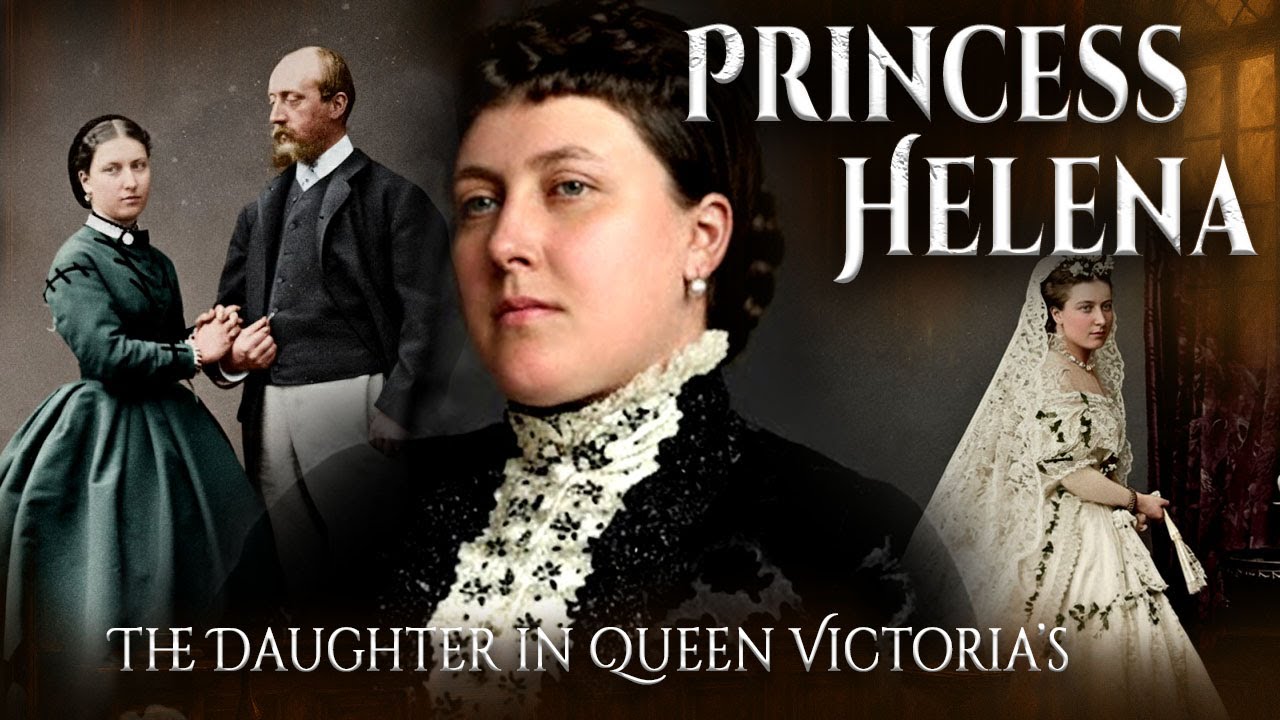
Raised in an environment where obedience was paramount, where her own desires were secondary to her mother’s will and the needs of the crown, she accepted. There is little evidence of a passionate courtship or a deep romantic connection. This was a pragmatic arrangement. Their engagement was announced in December 1865, and the wedding took place on July 5th, 1866, at the private chapel at Windsor Castle.
It was a relatively modest affair compared to previous royal weddings, again reflecting the circumstances of the groom and the queen’s continuing deep mourning. Helena, dressed in white with orange blossoms in her hair, carried herself with grace and composure. She was marrying not just a man, but a life, a prescribed existence dictated by her mother’s design. Upon their marriage, Prince Christian was given the style of Royal Highness and made a Knight of the Garter.
The couple was granted apartments at Windsor Castle, along with Schomberg House in London and later the picturesque Frogmore House, also within the grounds of Windsor Home Park. This close proximity to the queen was entirely by design. Helena and Christian went on to have six children: Christian Victor, Albert, Helena Victoria (known as Thora), Marie Louise, Harold, who died in infancy, and an unnamed stillborn son. The arrival of children brought a new dimension to Helena’s life, perhaps a source of genuine joy and personal fulfillment.
She was a devoted mother. However, the domestic tranquility she might have hoped for was soon overshadowed by new challenges. Prince Christian was not a robust man. He suffered from various ailments throughout his life, including periods of ill health that required considerable care.
Almost immediately after their marriage, Helena found herself shouldering the responsibility of tending to her ailing husband. She became his nurse, his companion, and his primary support system. This role as caregiver, while intensely personal, also had significant public implications. It meant Helena was even more tied to her home base, further limiting her independence and reinforcing her position within the queen’s immediate orbit.
Despite her increasing domestic responsibilities, Queen Victoria’s expectations of Helena remained undiminished. In fact, they arguably intensified. Helena was still required to be a constant presence at court, to accompany her mother on numerous engagements, and to fulfill a growing list of public duties. She was, in many ways, the queen’s chief companion and unofficial secretary, often tasked with assisting Victoria with her voluminous correspondence and acting as an intermediary for her mother’s various charities.
Her life was a perpetual balancing act. Her letters, though guarded, sometimes hint at the sheer exhaustion she must have felt. There are subtle mentions of needing rest, of the ceaseless nature of her obligations, but never a direct complaint. She was too well schooled in obedience for that.
And then there was the ultimate constraint: her mother’s implicit and often explicit prohibition against her leaving the palace or undertaking extended travel. While her siblings forged lives in their own respective kingdoms, Helena remained tethered to Windsor. Even when opportunities arose for personal excursions or much-needed breaks, they were frequently curtailed or outright denied by the queen. “Mama needs me” was a phrase Helena likely uttered countless times, both to herself and to others.
It was a justification, a resignation, and a simple statement of fact. Her life, for all its privilege, was one of perpetual availability. A life defined by constraint can lead to one of two outcomes: a withering of the spirit, or the discovery of profound purpose within those very limitations. For Princess Helena, bound to Windsor and her mother’s will, the gilded cage could have easily become a tomb for her aspirations.
Instead, she turned her gaze outward, beyond the palace walls, to the suffering and needs of her mother’s subjects. It was here, in the realm of philanthropy and service, that Helena began to forge an identity entirely her own. Hers was a quiet revolution, a channeling of her immense capacity for duty into causes that gave her life meaning far beyond mere royal companionship. Her primary and most enduring passion was nursing.
In an era when nursing was still struggling to be seen as a respectable profession for women, often viewed as little more than domestic service, Helena became its most powerful and dedicated royal champion. In 1887, she became the founding president of the Royal British Nurses Association, an organization she would lead with unwavering dedication for the rest of her life. She fought tirelessly for the professionalization of nursing, advocating for standardized training, better working conditions, and, most controversially, a national register for qualified nurses. This last point was fiercely opposed by figures like Florence Nightingale.
Nightingale believed that nursing was a calling, a vocation that could not be quantified by exams and registers. She feared that professionalization would strip the profession of its compassionate soul. Helena saw it differently. She understood that for nursing to be truly respected and effective, it needed standards, recognition, and a clear path for advancement.
She saw registration not as a bureaucratic hurdle, but as a vital tool to protect both patients from unqualified practitioners and nurses from exploitation. She poured her energy into this cause, chairing meetings, writing letters, and using her royal influence to lobby politicians and sway public opinion. Her dedication extended beyond committee rooms. During the Franco-Prussian War of 1870, while her elder sister Vicky was on the German side and her brother Bertie’s wife Alexandra was Danish with sympathies against Prussia, Helena helped establish the National Society for the Aid of the Sick and Wounded in War.
This organization, a precursor to the British Red Cross, provided vital medical supplies and support to both sides of the conflict. Helena worked tirelessly fundraising, organizing volunteers, and ensuring that aid reached those who needed it most. Helena’s philanthropic vision wasn’t limited to nursing. She was also a passionate advocate for the arts, particularly for crafts that provided women with opportunities for skilled employment.
In 1872, she became the first president of the newly established Royal School of Art Needlework. The school’s mission was twofold: to revive the lost art of English embroidery, and crucially, to provide a respectable profession for impoverished gentlewomen who had fallen on hard times. Helena championed their work, promoting the school’s creations and helping to secure prestigious commissions, including the altar frontal for St. Paul’s Cathedral.
She also took a keen interest in literature and translation. A fluent German speaker, she undertook the translation of several important German works into English. Perhaps her most significant project was the translation of the memoirs of Wilhelmina, Margravine of Bayreuth, the sister of Frederick the Great. This was a scholarly, intellectually demanding task that required not just linguistic skill, but historical understanding.
Yet, while these public achievements provided an outlet for her talents, the private realities of Helena’s life remained a constant and often heavy burden. The relentless demands of Queen Victoria did not abate. Living at Frogmore, a stone’s throw from Windsor Castle, meant that Helena was perpetually on call. A summons from the queen was not a request, but a command, and it could come at any time.
Victoria relied on Helena for everything from companionship during her lonely evenings to assistance with the monumental task of sorting through Prince Albert’s voluminous papers, a project that seemed to stretch on for decades. This proximity also meant that Helena’s own family life was lived under her mother’s intense scrutiny. Victoria took a proprietary interest in her grandchildren, offering unsolicited advice on their upbringing, their health, and their education. Adding to this was the ongoing concern for her husband’s health.
Prince Christian’s ailments were chronic and often debilitating. He suffered from severe rheumatism and other health issues that left him in frequent pain and required constant care. Helena was his devoted nurse. And behind the public facade of dutiful composure, Helena was fighting her own private battles.
She herself suffered from poor health, plagued by rheumatism and joint pain, conditions likely exacerbated by the damp English climate and the immense stress she was under. To cope with the chronic pain, she, like many in the Victorian era, turned to the common remedies of the day: opium and laudanum, its alcoholic tincture. This is a detail often glossed over in official biographies, but it is a profoundly humanizing one. Her reliance on these substances was likely not seen as an addiction in the modern sense, but rather as a necessary part of managing her chronic illness.
Nevertheless, it speaks volumes about the unseen suffering she endured. Her children were, without doubt, the central source of joy and meaning in her life. Her eldest son, Christian Victor, known as Christle, was a source of great pride. He chose a military career, a path that would take him far from the suffocating confines of the royal court and allow him to forge his own identity.
Helena supported his ambitions even though it meant enduring long periods of separation and the constant worry that came with having a son in the army. Her second son, Albert, would eventually succeed his father as the Duke of Schleswig-Holstein. Her daughters, Thora and Marie Louise, were her constant companions. In a poignant echo of her own life, they too would dedicate themselves to a life of duty and charity, remaining unmarried and becoming integral parts of the royal household.
But motherhood was not without profound sorrows. In 1876, she gave birth to her fifth child, a son named Harold. The infant was weak and lived for only eight days. A year later, she delivered a stillborn son.
These successive tragedies, borne with quiet dignity, added yet more layers of pain to a life already laden with responsibility. Beyond her immediate family, Helena had to navigate the intricate and often fraught dynamics of her siblings. With her placid and diplomatic nature, she often found herself in the role of mediator and peacemaker. Her relationship with her elder brother Bertie, the Prince of Wales, was particularly noteworthy.
Queen Victoria harbored a deep and lasting disapproval of Bertie’s hedonistic lifestyle. Helena, however, remained close to her brother. She understood his frustrations, and while not condoning his behavior, offered him a consistent and non-judgmental familial bond. She and Christian were often guests at Sandringham, Bertie’s lively country estate.
This loyalty to her brother in the face of their mother’s stern disapproval was a quiet act of independence. As the 19th century entered its final decades, Helena, now entering her 40s and 50s, found her life a complex tapestry of immense public pride and deep private sorrow. Her greatest source of anxiety was her eldest son. Christian Victor’s service record read like a gazette of late Victorian military campaigns: India, the Ashanti expedition in West Africa, Kitchener’s forces in the Sudan, witnessing the Battle of Omdurman.
For each of these deployments, Helena would pour over maps, read newspaper accounts with a knot in her stomach, and wait anxiously for letters. The words of a mother reaching across thousands of miles, trying to exert a small measure of protection over a son engaged in the perilous business of empire. In 1887, the nation celebrated 50 years of Queen Victoria’s reign. Ten years later, in 1897, the Diamond Jubilee marked her 60th anniversary on the throne.
These were global spectacles, carefully choreographed displays of imperial might. For most, these events were a distant, glorious spectacle. For Helena, they were an intensely personal and demanding reality. She was not just a spectator; she was part of the intricate machinery that made it all happen.
She would have been involved in the endless planning, the managing of foreign royal relatives, and above all, the supporting of her elderly mother. After the parades were over, it would be Helena, along with her sisters, who would be there to help the exhausted queen, to sit with her in the quiet of the evening. The grand public triumphs of the Jubilees, however, could not hold back the private sorrows that were beginning to gather. The queen’s court in these later years was increasingly a court of old age and mourning.
In 1896, a devastating blow struck the heart of the family. Prince Henry of Battenberg, the handsome and beloved husband of Helena’s youngest sister, Beatrice, died of malaria while serving in the Anglo-Ashanti war in Africa. The very same campaign from which her own son Christle had thankfully returned. The death of Liko plunged the family, and especially Beatrice, into a grief that mirrored the queen’s own decades-long mourning for Albert.
Helena, the ever-present comforter, would have been a crucial source of support for her devastated sister. Then came the Boer War, and the death of her son. Queen Victoria’s funeral was the last great pageant of the Victorian age. Helena played her part with the stoic grace that was her hallmark.
She stood with her siblings, a united front of royal mourners. But beneath the veil of public duty, a profound and disorienting internal shift was taking place. The lifelong mantra of “yes, Mama” had suddenly fallen silent. The constant demands, the suffocating proximity, the unwavering expectations—all had vanished.
For the first time, Helena was truly on her own. This was not the exhilarating rush of liberation one might imagine. It was the quiet, unsettling void of a life’s primary function suddenly rendered obsolete. The transition was immediate and absolute.
As soon as the period of deep mourning was over, the heavy somber curtains of the Victorian court were thrown open, and the dazzling, champagne-fueled light of the Edwardian era flooded in. Her brother Bertie, now King Edward VII, was the polar opposite of their mother. He was determined to modernize the monarchy. The court was transformed overnight.
The stuffy sobriety of Victoria’s Windsor was replaced by the glamorous sophistication of what was known as the Marlborough House set, the king’s circle of wealthy, fashionable, and often racy friends. In this new, glittering world, Princess Helena and Prince Christian were anachronisms. Their quiet dignity, their devotion to duty, their preference for a sober domestic life—these were not currencies that held much value in the court of Edward VII. Helena, who had been at the very heart of her mother’s court, now found herself on the periphery.
She was respected, of course. She was the king’s sister. But she was no longer central. The new queen, Alexandra, while publicly gracious, had always harbored a degree of coolness towards Helena’s husband.
The Schleswig-Holstein issue had been a deeply painful political conflict for her native Denmark. Helena, now in her mid-50s, was not one to compete in the dazzling social games of her brother’s court. She continued to live at Frogmore House, her beloved home on the Windsor estate, which now felt like a quiet island of Victorian calm in a sea of Edwardian excess. This new reality, however, may have contained a silver lining: a quiet and unacknowledged freedom.
With her mother gone, Helena was finally the undisputed mistress of her own daily life. There were no more sudden summons to the castle, no more endless hours spent reading aloud or sorting papers. Her time, for the first time, was truly her own. She could devote herself more fully to her husband, whose health was becoming increasingly precarious, and to her two unmarried daughters.
A poignant cyclical pattern emerged. Just as Helena had dedicated her life to her mother, her daughters, Thora and Marie Louise, now dedicated their lives to her. Frogmore became a distinctly female household, a sanctuary of quiet routine, music, correspondence, and devotion to their various causes. It was during these quiet Edwardian years that Helena’s true legacy solidified.
Freed from the constant demands of the court, she poured even more of her considerable energy into the organizations she cherished. She remained the energetic president of the Royal British Nurses Association. She was a tireless leader for the Royal School of Art Needlework and a patron of countless other hospitals and benevolent societies. While the fashionable set partied at Sandringham, Helena was chairing committee meetings, visiting hospital wards, and making a tangible difference in the lives of ordinary people.
The passing years brought the inevitable sorrows of aging. The health of her husband continued to decline. The couple made frequent trips to European spas in search of remedies and relief. In 1910, another era came to a sudden end.
Her brother, King Edward VII, died after a reign of just nine years. The brief, glittering Edwardian age was over. For Helena, it was the loss of the brother she had always been quietly loyal to. With the accession of her nephew, King George V, the tone of the court shifted once again.
George and his wife, Queen Mary, consciously rejected the flamboyance of the Edwardian era, favoring a more modest, duty-bound style that was in many ways a return to the values of Queen Victoria. For Helena, this new court was perhaps more comfortable in its temperament. Yet it also cemented her status as a figure from a distant past. She was now the venerated aunt of the king, a living link to the legendary Victorian age.
But as she settled into what should have been a peaceful old age, the world outside her quiet sanctuary at Frogmore was growing darker. The intricate web of royal cousins and dynastic marriages that her mother and father had so carefully constructed to ensure peace was beginning to fray. Political tensions in Europe were escalating. Nationalism was on the rise.
A new, terrifying arms race was underway. Her nephew George was king of England, but another nephew, Wilhelm II, was the German Kaiser. The family was on a collision course with itself. The summer of 1914 was the last summer of the old world.
The intricate, fragile peace of Europe, held together for decades by a complex web of treaties and familial ties, shattered with breathtaking speed. For most in Britain, the declaration of war against Germany was a matter of national honor and patriotic duty. But for Princess Helena and for the entire British royal family, it was an unimaginable catastrophe. It was a civil war.
This was not a conflict against a distant, faceless enemy. It was a war against their own blood. Kaiser Wilhelm II of Germany was Queen Victoria’s eldest grandson, Helena’s nephew. King George V of the United Kingdom was also Victoria’s grandson.
The Empress of Russia was her niece. Countless other cousins, nephews, and in-laws were scattered throughout the German principalities, now officially the enemy. The Coburg web, Prince Albert’s great dream of a united, peaceful Europe bound by family, had become a tangled, bloody net. For Helena, a woman whose entire identity was a blend of her British birth and her German marriage, the war was a personal crucifixion.
True to her nature, she did not retreat into private grief. At nearly 70 years old, she channeled her anguish into action. Her long-standing work with nursing and the Red Cross now took on a desperate urgency. She helped to organize hospital trains, visited convalescing soldiers, and lent her name and her tireless energy to countless fundraising efforts.
She became a familiar comforting presence in the hospital wards. Every casualty was a fresh wound to her divided soul. Her own son-in-law, Prince Aribert of Anhalt, was a German prince. Her daughters, Thora and Marie Louise, who were on a visit in Germany when the war broke out, had to make a harrowing journey home, suddenly finding themselves in enemy territory.
As the war dragged on, a wave of intense anti-German sentiment swept across Britain. German Shepherd dogs were renamed Alsatians. Sauerkraut was called Liberty Cabbage. And the royal family, with its distinctly German name of Saxe-Coburg and Gotha, found itself in an untenable position.
In 1917, King George V made a historic decision. He renounced all German titles and dignities for himself and his family and adopted a new, quintessentially English surname: Windsor. This decision had immediate and dramatic consequences for Helena and her family. By royal warrant, Prince and Princess Christian of Schleswig-Holstein ceased to be.
Their territorial designation, the name that had defined their marriage and their identity for over 50 years, was erased. They were to be known simply as Their Royal Highnesses, Prince and Princess Christian. Their daughters became Princess Helena Victoria and Princess Marie Louise, with no German title. It was a necessary act of political survival.
But for Helena, it must have felt like the final brutal severing of her past. Amidst this national identity crisis and the ongoing slaughter of the war, Helena faced her final, most intimate loss. Her husband of 51 years, Prince Christian, passed away at Schomberg House in London in October 1917. Theirs had been a marriage born not of passion, but of dynastic convenience.
Yet over five decades, their relationship had deepened into a partnership of genuine affection, mutual respect, and shared experience. She had been his devoted caregiver, his unwavering support through years of ill health. Now, in the darkest days of the war, he was gone. She was truly alone, a widow at 71.
When the war finally ended in 1918, the world was a graveyard of empires. Her nephew, the Kaiser, was in exile. Her other nephew, the Tsar of Russia, had been brutally murdered along with his entire family, including Helena’s niece, the Empress Alexandra. The Europe of her youth was gone forever.
Helena lived on for five more years, a quiet, dignified matriarch in a world that had largely forgotten her. She continued her charity work, a constant, steady presence. She was a living link to a bygone era, a quiet repository of memories of a world of horse-drawn carriages, of visits from foreign emperors who were also her cousins, of a time when the map of Europe was a family tree. She passed away peacefully at Schomberg House on June 9th, 1923, at the age of 77.
She was the last surviving child of Queen Victoria and Prince Albert to have been born while her grandfather, King Leopold of the Belgians, was still alive. Princess Helena is not remembered for her beauty, for a dramatic romance, or for wielding political power. Her story is quieter, more subtle, and perhaps for that reason, more profound. She was the quintessential devoted daughter, a woman whose life was circumscribed by the immense shadow of her mother.
Born into a gilded cage, her freedom was sacrificed for the convenience of the crown. And yet, within that cage, she did not wither. She found her own form of freedom: the freedom to serve. Her tireless advocacy for the nursing profession left a tangible, lasting legacy, helping to transform it from a lowly service into a respected career.
Her life is not a fairy tale. It is a deeply human story about the contradictions of existence, of immense privilege and profound constraint, of public duty and private suffering. Princess Helena may have lived in the shadow, but hers was a life of quiet, undeniable, and enduring substance.
