The old photograph had hung in the Madrid military archive for eighty years, catalogued as something forgettable: propaganda from the Aragonese front, twenty-three soldiers posing after a victory at Belchite in October 1937. Only one of them raised his hand. The others stood in strict formation, arms at their sides, eyes fixed forward, the standard image of Republican morale that the war had produced in countless variations. The raised hand belonged to a young soldier in the second row, slightly to the left.
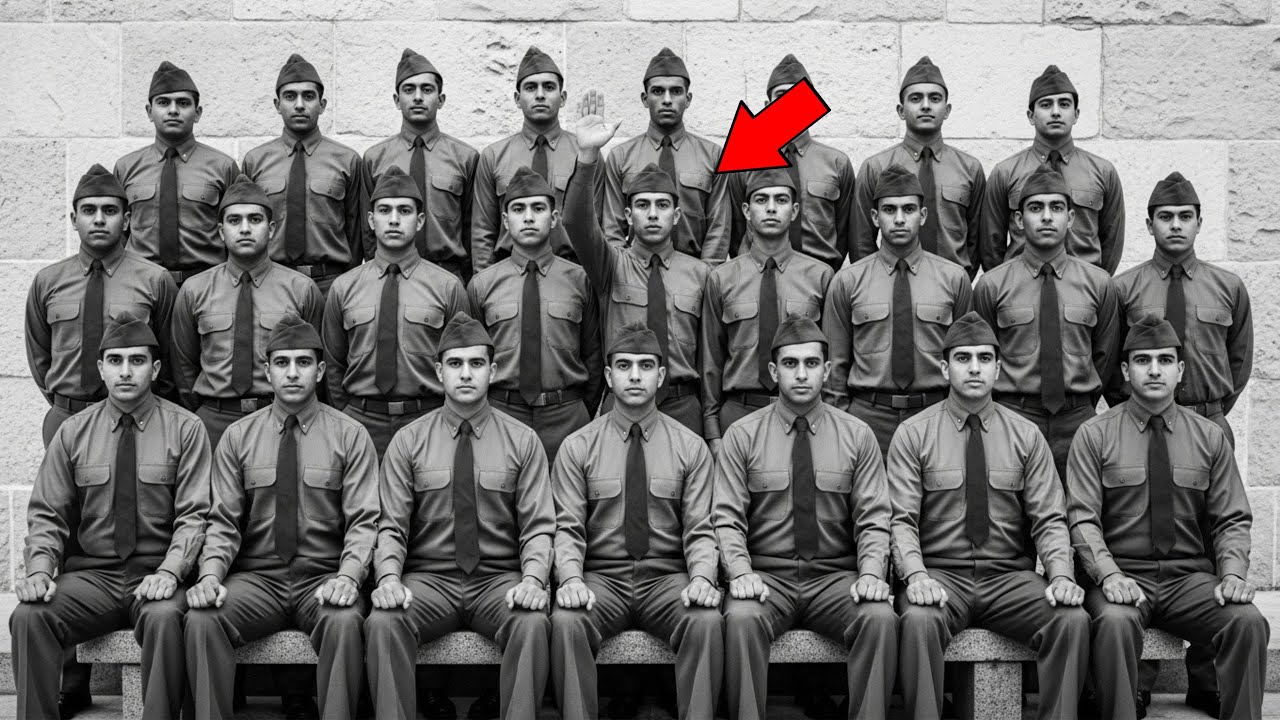
His face carried a barely perceptible smile. No one had thought much of it. Dr. Carlos Mendoza, a historian of the Spanish Civil War, had passed over the photograph dozens of times.
That November morning in 2017, preparing an exhibition on wartime propaganda, he took it down again and held it closer to the lamp. Something about the hand refused to fit. Republican commanders were notoriously strict about photographic discipline; a unit posed for propaganda was expected to look like a unit, uniform in posture and expression. One soldier breaking that uniformity in an official session made no sense.
He turned the photograph over. The back bore an annotation in faded ink: *Belchite, October 1937, after victory, complete unit. * In the lower corner, a small number written in pencil: 231. Mendoza digitized the image and enlarged the area around the soldier’s hand.
What he found was not a salute at all. The fingers were arranged in a specific configuration: three extended, the thumb and pinky folded, the palm inclined slightly to the left. His position in the formation seemed deliberately calculated to keep the gesture visible from a particular angle. Comparing the image against Republican instruction manuals, Mendoza found no match.
None of the official salutes looked like this. “This isn’t military protocol,” he murmured. It was as if the soldier had been sending a message to someone outside the frame. He called Elena Vargas, a specialist in codes and wartime communications at the Complutense University in Madrid.
She arrived that same afternoon and examined the photograph for an hour before speaking. The gesture, she said, matched signaling codes used by intelligence services during the war—but not Republican ones. It was a Francoist intelligence code, meaning *imminent danger* or *compromised mission*. That made no sense either.
All records indicated the unit was completely loyal to the Republic. But if Elena was right, they were looking at an infiltrator who had communicated with the enemy in the middle of an official photo session. “We need to identify this soldier,” Mendoza decided, “and discover what happened to this unit after this photograph was taken. ”
The military archives answered the second question quickly, and the answer was disturbing.
Official reports described the Fifth Division participating gloriously in the taking of Belchite and then continuing toward Zaragoza. But a second document, dated a week after the photograph, told a different story: the division had walked into an enemy ambush. Twenty-three soldiers dead. The cause was listed as compromised information about Republican positions, with infiltration suspected.
The entire unit in the photograph had died within days of the picture being taken. If the soldier with the raised hand had been a Francoist infiltrator, why had he died with the rest? His signal might have been a warning that arrived too late—or something more complicated was happening. A further document from the Republican general staff, headed *Operation Reconquest*, noted that information leakage had been detected in units on the Aragonese front and ordered immediate position changes for three divisions.
The order was dated the same day as the photograph. Someone in the Republican high command had known about the infiltrator, but the information had not reached the Fifth Division in time. To identify the soldier, they needed individual records. The division’s files contained a complete list of names but no individual photographs.
Mendoza kept coming back to that pencil number on the back of the photograph: 231. Twenty-three soldiers in the photo. Twenty-three soldiers dead. What if the 1 meant soldier number one in some list or formation?
The answer would only come by tracing the unit’s personnel more closely than anyone had in decades. The search turned up a discrepancy. The casualty report listed twenty-three dead, but the division’s official roster contained twenty-four names. One man was not on the casualty list: Miguel Santos Herrera, a corporal of the Fifth Division.
His file ended abruptly after Belchite, with no record of death or transfer. Postwar civil records showed he had survived the war, settled in Barcelona, and worked as a mechanic until retirement. At ninety-nine years old, he was living in a nursing home in Sitges. Mendoza and Vargas traveled to Barcelona.
Miguel Santos was frail but sharp-minded. When they showed him the photograph, his eyes filled with tears. “My God, I haven’t seen this photo in eighty years,” he whispered. “I remember that day perfectly.
It was the last day I saw my companions alive. ” Asked about the soldier raising his hand, he fell silent for a long time. Then he spoke. His name was David Ruiz.
He was very young, maybe nineteen, and had arrived at the unit two weeks before Belchite. He said he came from Málaga, but something about him didn’t fit. He knew things a private shouldn’t know—troop movements, strategies, enemy positions. At first the men thought he was brilliant.
Then they began to suspect. On the morning of the photograph, Miguel had intercepted David writing a letter in code. Confronted, David confessed: he was a Republican agent who had been infiltrated into Francoist ranks to gather information. But he had discovered something worse.
Another agent operated in the same unit—this one working for Franco. That agent had sold their position to the enemy. The ambush was already planned. The raised hand in the photograph was a desperate signal, an attempt to warn his Republican contacts that the unit was compromised.
It was already too late. The testimony transformed the investigation. This was not a simple case of espionage but a double infiltration: both sides had placed agents in the same unit. Mendoza contacted the Civil War Studies Center in Salamanca to access Francoist archives.
There he found records of an agent, coded D. R. , who had provided valuable information about Republican positions on the Aragonese front. More importantly, in the files of the Francoist Military Police and Information Service, he found the file on something called *Operation Confusion*.
Its purpose was to infiltrate Republican agents with false information, allow them to be discovered by the enemy, and thereby create distrust inside the Republican ranks. David Ruiz, Mendoza realized, might have been the victim of a counterintelligence operation far more sophisticated than they had imagined. The Francoists had not simply placed a spy in the Fifth Division. They had manipulated David to act suspiciously, letting him be discovered as an agent in order to sow paranoia, while the real Francoist spy remained hidden and kept feeding information to the enemy.
Miguel had provided a crucial clue about the real infiltrator’s identity. There was a sergeant named Tomás Mendoza who always knew too much about other sectors’ plans and who organized the unit’s defensive positions. Did he appear in the photograph? Yes—front row, third from the left.
Miguel noted his posture: he was the only man not looking directly at the camera. He was looking slightly toward David. Examined with this new knowledge, the photograph revealed a subtle interaction. David raising his hand in alarm; Mendoza watching him discreetly, aware his cover was about to be exposed.
The photograph had captured not a moment of propaganda but the climax of an espionage operation that had cost twenty-three lives. The Francoist archives held the full file on *Operation Confusion*, listing Mendoza as primary agent T. M. He had not always been an enemy agent.
Until 1936 he had been a genuine Republican, captured by Francoist troops and turned through threats against his family. His wife and children had been taken in Burgos and held hostage to ensure his cooperation. His orders were two-fold: provide information on Republican positions, and identify and neutralize any Republican agent who infiltrated units where he operated. When David Ruiz arrived, Mendoza suspected him immediately but waited to gather proof, planning an operation that would eliminate both the enemy agent and the entire unit—making it appear that David had been responsible for the massacre.
An intercepted communication confirmed the plan. *Agent T. M. confirms Republican infiltrator identified.
Requests authorization for sacrifice operation. Complete elimination of compromised unit scheduled for October 20th. * Mendoza had sacrificed his own companions to maintain his cover and prove his worth to Franco. David’s signal had been a genuine attempt to warn, but it came too late.
One mystery remained. If Mendoza was a Francoist agent, why had he died in the ambush he helped organize? The answer lay in a direct order from a Francoist general, dated October 19, 1937: *Operation Sacrifice authorized. Agent T.
M. must remain with unit to avoid suspicion. Sacrifice necessary for the greater good of the cause. * Both agents—the Republican and the Francoist—had been sacrificed by their own commands in a game where human lives were currency.
Miguel had been right from the beginning: David tried to save his companions, but both infiltrated men were doomed by the very operations that had placed them there. A forensic re-examination of the photograph now revealed details that had gone unnoticed. David’s raised hand pointed directly at Mendoza, but so subtly that only someone trained in codes would see it. Other soldiers showed signs of tension: the man directly behind David was looking not at the camera but toward Mendoza, and the soldier beside Mendoza had his hands clenched into fists.
David had managed to communicate his suspicions to at least some of his companions, but military discipline kept them from acting during the session. There was more. The soldier in the third row carried a long-range radio, not standard infantry equipment. David must have used it to contact Republican command.
He had, in fact, made contact—but his message was intercepted and decoded by Francoist intelligence. Instead of preventing the ambush, the information confirmed that the plan was working. David had sent a complete radio message with names, positions, and details of the infiltration, and that message sealed the unit’s fate. Miguel had mentioned something else that now made sense.
David had insisted that all soldiers appear in the photograph, even those who normally would not participate in propaganda sessions. He knew they were going to die and wanted evidence to remain of who had been betrayed and who had been the traitor. The raised hand had never been just a warning. It was a final act of resistance, a silent testimony for posterity.
Elena Vargas then traced what had happened to Tomás Mendoza’s family. She found something disturbing: his wife, María Mendoza, and their two children had been executed in Burgos on October 25, 1937—five days after the ambush. If Mendoza had fulfilled his mission, why kill them? A document answered: *Operation Confusion witnesses eliminated for national security.
No evidence of employed methods can remain. * Mendoza had betrayed his companions to save his family, and Franco had ordered the hostages executed anyway. But in the parish archives of Burgos, Elena found that María had managed to send a letter to her sister in France before her death. The family had preserved it for decades.
The letter confirmed María knew about her husband’s espionage activities—and revealed something truly unexpected: she had been sending secret information to the Republicans about Francoist operations in Burgos. She was a double agent herself. The crucial passage read: *My dear sister, if something happens to us, you must know that Tomás never voluntarily betrayed his companions. I sent him false information about our well-being so he would believe we were safe.
He died thinking he had saved us, but we already knew Franco doesn’t keep his promises. *
María had deliberately sacrificed her life and her children’s to protect the information she had been filtering to the Republicans. Tomás died believing he was saving his family. María died knowing she had served the Republican cause to the end.
The photograph had captured not simply a moment before a massacre, but the convergence of multiple betrayals unfolding on several levels at once. Reconstructing the sequence, Mendoza and Vargas identified three simultaneous operations. David Ruiz: a genuine Republican agent, infiltrated to gather information. Tomás Mendoza: a Republican turned Francoist agent under blackmail.
María Mendoza: Tomás’s wife, operating as a Republican agent from Burgos. David discovered Tomás’s double role but did not know about the blackmail that drove him. Tomás identified David as a spy but never knew his own wife was playing a more dangerous game behind Francoist lines. The photograph was taken at the exact moment David decided to expose Tomás—his raised hand a warning that the unit was compromised, and a message that he himself was about to be discovered.
The events unfolded with tragic precision. David sent his radio message alerting command about Tomás; it was intercepted and used to confirm the sacrifice operation. Tomás, believing he was protecting his family, provided the unit’s final positions for the ambush. María, from Burgos, fed false information both to her husband and to the Francoists to protect other Republican agents.
Everyone lost. David died trying to save his companions. Tomás died believing he was saving his family. María and her children died after her husband completed his mission.
And twenty-three soldiers died from a chain of betrayal none of them fully understood. The final document, an intelligence report in the Republican archives dated a week after the massacre, read: *Belchite operation, complete loss of Fifth Division confirmed. Agent D. R.
sent valuable information before his death. Enemy infiltration confirmed but enemy agent also eliminated. Operation classified as tactical victory despite losses. * The most tragic element, Elena noted, was that each protagonist died believing they had failed—when in fact all had carried out their missions with extraordinary courage, without knowing their enemies had done the same.
Mendoza and Vargas organized a special exhibition at the Civil War Museum in Madrid, telling the full story of David Ruiz, Tomás Mendoza, and María Mendoza for the first time. At the inauguration, Mendoza said the image taught something fundamental about war: there were no simple heroes or clear villains, only ordinary people facing impossible decisions, trying to protect what they loved most in a world that had gone mad. The exhibition included María’s letters, David’s records, and the reports on Tomás. The central display remained the photograph—twenty-three soldiers posing for posterity, unaware they had a week to live.
Miguel Santos, now one hundred years old, attended in a wheelchair. When he saw the enlarged photograph on the museum’s main wall, he approached slowly and touched the glass with trembling fingers. “Now I understand why I survived,” he said. “It wasn’t chance.
David sent me to carry a message to another sector the night before the ambush. He saved my life without me knowing why. Until today I lived with the guilt of being the only survivor. ”
Elena had found that final detail during the last days of the investigation.
David had gotten Miguel out of the danger zone by sending him with a routine message—but in reality he saved the only witness who could tell the story decades later. “David didn’t just try to warn about the betrayal,” Elena explained gently. “He made sure someone would survive to tell what really happened. You have been his witness for eighty years without knowing it.
”
The photograph now hangs in a place of honor, beneath a plaque reading: *In memory of David Ruiz, Tomás Mendoza, María Mendoza, and the twenty-one soldiers of the Fifth Division, victims of the multiple betrayals of a fratricidal war. Their sacrifice reminds us that in every war, the real enemies are not the soldiers of the other side, but those who manipulate people’s courage and love for their own ends. * Visitors come from all over Spain and look at it differently now. They see David Ruiz raising his hand in a final gesture of warning and resistance.
They see Tomás Mendoza living his last moments believing he was saving his family. They see twenty-one men who died without understanding why, victims of a web of betrayals that overwhelmed them. And above all, they see proof that even in history’s darkest hours there are people willing to sacrifice everything to protect others, knowing that probably no one will remember their names.
Eighty years later, they finally were remembered.
