Behind glass in a museum outside Washington hangs a Belgian lace veil made for a teenage princess promised the Austrian throne. The lace survived. The promise did not. Within eight years of wearing it, Princess Stephanie of Belgium lost her husband at Mayerling, where Crown Prince Rudolf was found dead beside seventeen-year-old Mary Vetsera.
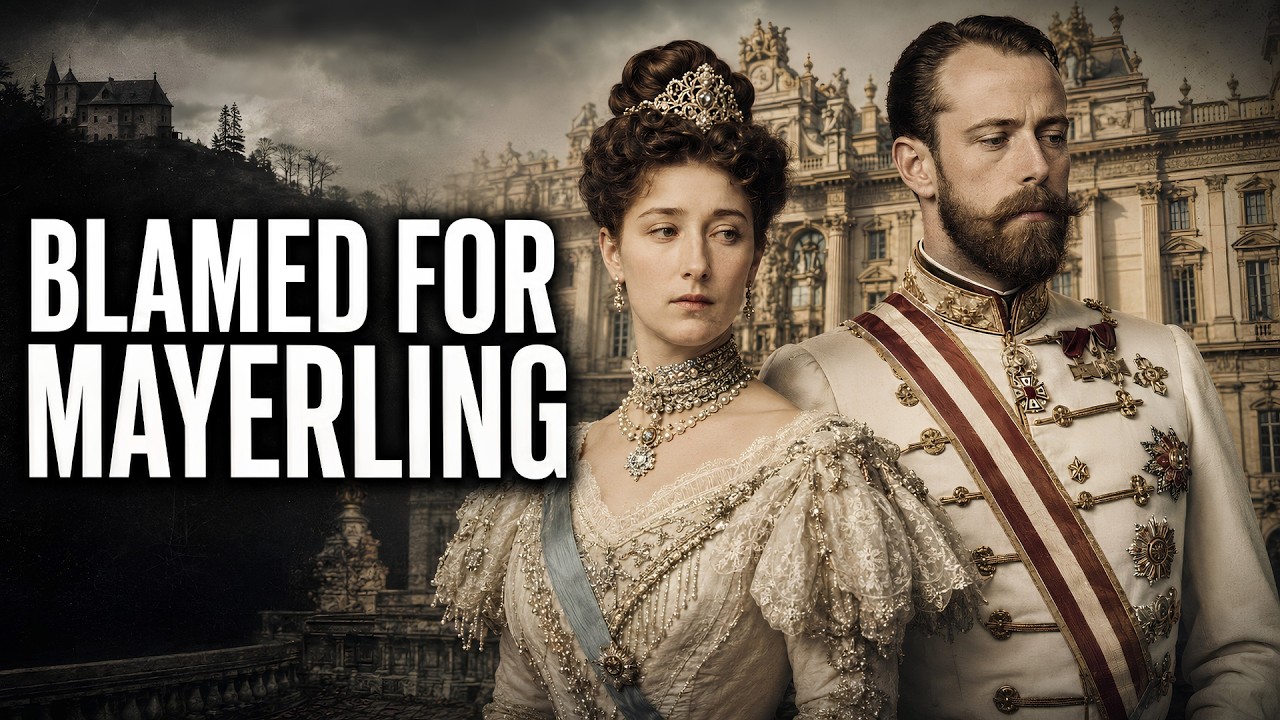
The Viennese court began treating Stephanie as part of the failure, even though she had not been at the hunting lodge and had spent months warning that Rudolf was deteriorating. Yet her story is also about what she later denied her own daughter. More than four decades after Mayerling, Stephanie published a memoir in German under a title that summarized the strange future tense in which she had lived her life: I Was to Be Empress. The book created immediate controversy, with Austrian authorities moving to seize copies.
A French edition followed in 1937, giving Stephanie something she had rarely possessed while living inside royal households: the first word about her own experience. Stephanie was born on May 21, 1864, at Laeken outside Brussels, the third child of the future King Leopold II and Marie Henriette, an Austrian Archduchess. Her older sister Louise had arrived six years earlier. Between them stood the child who mattered most to the Belgian succession: their brother Leopold, Duke of Brabant, the only son and heir.
The royal children were raised amid servants, formal lessons, and strict routines. Stephanie later remembered cold-water bathing as part of their upbringing, a practice that in her recollection became part of a wider emotional climate. Discipline was reliably available. Affection was less certain.
Her parents had married young for dynastic reasons, and their paths had moved apart, Leopold turning toward politics, money, mistresses, and the ambitions that would make his name inseparable from the Congo. The first loss Stephanie remembered clearly came when her brother fell gravely ill. After months of deteriorating health, the young heir died in January 1869 at age nine. Stephanie was four.
In her memoir, she described the death as the first event deeply engraved in her memory, particularly the sight of her mother’s pain as the boy died in her arms. The consequences reached beyond grief. The death removed the male heir around whom the family’s future had been arranged, and Leopold’s disappointment influenced how he regarded the daughters who remained. Before she was seven, Stephanie became seriously ill during a typhus outbreak.
Doctors reduced her fever with cold baths, a treatment credited with her recovery. She survived, but survival reinforced an expectation already forming: suffering was something to endure quietly until authority declared the danger over. Leopold’s fortune and power were being expanded through the Congo Free State, which he controlled as his personal domain. The system imposed there depended on coercion, forced labor, and atrocities committed against African communities.
Stephanie did not design those policies, and a child’s loneliness does not make her responsible for her father’s colonial crimes. But private pain existed beside public brutality, not instead of it. In March 1880, Crown Prince Rudolf of Austria-Hungary needed a wife. He was the only son of Emperor Franz Joseph and Empress Elizabeth, heir to one of Europe’s great dynasties.
The search was restricted by religion, rank, and politics. A bride had to be Catholic, suitably royal, and acceptable to both imperial parents. Stephanie was fifteen when Rudolf visited Brussels. He was twenty-one, held military rank, maintained his own household, and possessed a private life about which the Belgian princess was told very little.
Under pressure to marry, he considered her eligible. The day after formal discussions, Stephanie’s parents called her into their presence. Her father told her that the Crown Prince had come to ask for her hand and that she had been chosen to become Empress of Austria and Queen of Hungary. Then he told her to think about it and give them an answer the next day.
On the surface, she had been offered time. In reality, every word before the deadline had defined the acceptable response. Her father supported the marriage. Her mother described becoming Austrian as a great future.
Refusal would mean opposing both parents, embarrassing two courts, and disrupting negotiations already treated as a triumph. That night, Stephanie spoke with her governess and her mother. By morning, she agreed. Years later, she would describe the choice as the acceptance of chains whose weight she had not understood.
Empress Elizabeth was not enthusiastic. The Belgian monarchy dated only from 1831, making it young beside the ancient Habsburg dynasty. Franz Joseph reportedly referred to Leopold II’s commercial interests with contempt, calling him a grocer. Rudolf’s private behavior provided another warning: accounts indicate that he traveled to Brussels accompanied by a current mistress within his entourage.
Stephanie was not given a full explanation before the engagement became public. Once the courts announced the match, withdrawal would have caused a diplomatic scandal. The formal engagement lasted more than a year because Stephanie was considered too young to marry immediately. She trained for her future position and presented as the princess who would one day stand beside an emperor.
When the time came to leave Brussels, a special train carried her toward Vienna. She later remembered crying as the journey began and being reprimanded for showing too much emotion before attendants. The wedding took place on May 10, 1881, at the Augustinian Church in Vienna, only days before Stephanie’s seventeenth birthday. She wore an elaborate Belgian lace veil, a visible promise of what the marriage was supposed to accomplish.
The public celebration could not prepare her for the private marriage. She later wrote about the wedding night in language of fear, ignorance, and disillusionment. What remains clear is that she believed she had been sent to the altar without the knowledge required to understand what marriage would demand of her. A visit to Hungary shortly after the wedding briefly gave Stephanie the warmth she had hoped Vienna might provide.
Crowds greeted her enthusiastically, and Belgian colors appeared along the route. But becoming Crown Princess did not mean learning gradually. Her German remained imperfect, and she did not know every family rivalry or ceremonial expectation. Empress Elizabeth had spent years resisting the demands of court, traveling extensively and seeking distance from Vienna.
For Stephanie, those absences had a practical consequence: many ceremonial obligations fell upon the young daughter-in-law. The woman promised future power found herself performing duties the existing empress preferred to avoid. The marriage gained new hope when Stephanie became pregnant. Both parents expected or hoped for a boy.
On September 2, 1883, Stephanie gave birth at Laxenburg to a daughter, Elizabeth Marie, known within the family as Erzsi. Franz Joseph welcomed his granddaughter warmly. Rudolf initially failed to conceal his disappointment that the baby was not the male heir the empire expected, though his correspondence indicates he later took an active interest in her. For Stephanie, motherhood offered a role that was both assigned and emotionally real, and Elizabeth became the most personal relationship in her Viennese life.
The birth did not heal the marriage. It briefly gave Rudolf and Stephanie a common purpose, then exposed the pressure surrounding them. A daughter did not resolve the demand for a male heir. Rudolf spent increasing amounts of time away, hunting, traveling, and pursuing other women.
He also lived under a different form of constraint. As heir, he possessed political ideas but little power to implement them, secretly supplying articles to sympathetic newspapers that criticized aspects of the system he would supposedly inherit. The marriage suffered its most intimate betrayal when Rudolf contracted a venereal disease through his extramarital life and transmitted it to his wife. The exact infection is not consistently identified across later accounts, but the consequence reported by numerous biographers is less disputed: Stephanie became unable to have another child.
She was not yet twenty-two. Court physicians did not initially tell her plainly what had happened. Euphemism and secrecy surrounded the illness. Her body carried the consequence of information other people managed.
From this point, reconciliation became increasingly unlikely. Stephanie refused to continue conjugal life as before, and Rudolf remained away. Some biographers associate Stephanie with Polish Count Artur Potocki during the later years of the marriage. Whatever the exact boundaries of that attachment, the marriage had ceased to operate as an intimate partnership long before Mayerling.
Rudolf’s political and psychological condition worsened. Accounts from those around him describe periods of depression, anger, and instability. He drank heavily and used morphine. In the autumn of 1888, Stephanie saw him after a period apart and was shocked by the change, describing loose skin, restless eyes, and an expression that seemed to have lost its internal strength.
She went to Franz Joseph and warned him that Rudolf’s condition had become dangerous. According to her account, the emperor did not accept the seriousness of what she described, treating his son as fundamentally well and her alarm as unnecessary. During these final months, Countess Marie Larisch, a niece of Empress Elizabeth, helped introduce Rudolf to Mary Vetsera, a seventeen-year-old fascinated by the Crown Prince. Stephanie did not know Mary well.
By January 1889, the marriage existed largely as an official performance. Late that month, Rudolf told Stephanie he was going to his hunting lodge at Mayerling, southwest of Vienna, and was expected to return for a family dinner. When he did not appear, the explanation sent back was ordinary: he had caught a cold and could not travel. Stephanie repeated the message to the family.
On the morning of January 30, Stephanie began her usual activities. Her memoir describes a singing lesson interrupted when her chief lady-in-waiting entered with urgent news. Before the details were given, Stephanie reportedly said, “He is dead. ” She was summoned to Franz Joseph and Elizabeth, and it was Empress Elizabeth who told her that Rudolf had been found dead at Mayerling.
Mary Vetsera’s body was beside him. Both had suffered gunshot wounds. The dominant historical account is that Rudolf shot Mary and then killed himself as part of an agreed death pact. Claims of assassination have persisted, but the broad documentary record continues to support murder followed by suicide, even while some details remain contested.
Because the Catholic Church regarded suicide as a mortal sin, the court emphasized that Rudolf’s mind had been disturbed at the moment of death, allowing a Catholic funeral in the Imperial crypt. Mary Vetsera received no comparable protection. Her body was removed under secrecy and buried quickly. Stephanie was handed a farewell letter from her husband.
Rudolf wrote that she was freed from the torment of his presence, instructed her to be good to their poor little girl, wrote that death alone could save his good name, and ended with an expression of affection. Even in farewell, Rudolf controlled the action while Stephanie inherited the consequences. She was twenty-four. Her husband had died with a teenage mistress, and her only child had lost a father while the imperial succession fell into uncertainty.
In her memoir, she acknowledged that Rudolf’s death released her from a marriage filled with anxiety and sorrow, but release came at a devastating price. She would never become empress. Then came blame. Court society increasingly treated the failed marriage as part of Rudolf’s despair, judging Stephanie to have lacked the warmth her husband needed.
The accusation reduced attention on Rudolf’s affairs, illness, and drug use, and avoided confrontation with Franz Joseph’s refusal to recognize his son’s deterioration. For more than a decade, Stephanie remained caught between identities, too important to disappear and no longer central to the succession. Then she met Count Elemér Lónyay, a Hungarian aristocrat and diplomat without a throne or rank equal to her birth. Their relationship developed outside the dynastic logic that had controlled her first marriage.
No emperor needed the union. By most accounts, their marriage would prove genuinely happy. Choosing him nevertheless carried serious consequences. Franz Joseph reluctantly permitted the match, but Stephanie would leave the Imperial house and renounce the rank and privileges attached to her position.
Her daughter remained in Vienna under the emperor’s guardianship. On March 22, 1900, Stephanie married Elemér at Miramar. Her father reacted with fury, regarding the marriage as beneath her and cutting her off from the Belgian family. After the death of Queen Marie Henriette in 1902, Stephanie returned hoping to pay her respects, but Leopold barred her from attending the funeral service.
When Leopold himself approached death in 1909, Stephanie was denied a final meeting with him. Afterward, she and her sisters challenged his arrangements through prolonged legal disputes over property and money. Stephanie settled with Elemér at Rusovce, then part of Hungary, where their home provided the stability that neither Brussels nor Vienna had given her. But one relationship her second marriage did not repair.
Elizabeth Marie regarded her mother’s decision as abandonment and became increasingly estranged. Franz Joseph took a strong role in her upbringing. In 1902, Elizabeth married Prince Otto of Windisch-Graetz, producing four children before the union became bitter and unstable. She later began a relationship with Leopold Petznek, a social democratic politician, and her politics moved sharply away from her grandfather’s world, earning her the nickname the Red Archduchess.
Stephanie disapproved of her daughter’s relationship outside marriage, her politics, and the wider disorder of her private life. Mother and daughter stopped seeing each other. In 1944, Stephanie made a will that disinherited Elizabeth and left her real property to the Benedictines. The woman who had condemned her father’s rejection now used inheritance to express rejection of her own.
By the 1930s, the political world Stephanie had once expected to enter had vanished. The Austro-Hungarian Empire collapsed at the end of the First World War, and the Habsburg throne ceased to exist. Her memoir appeared inside that changed world, challenging decades of stories centered on Mayerling’s dead prince, but also producing legal conflict with Elizabeth, who objected to aspects of the account. Then Europe entered another war.
Rusovce was drawn into military occupation. German forces took over much of the residence. In April 1945, the Red Army reached the estate, and Stephanie and Elemér left for the Benedictine Archabbey of Pannonhalma, under the protection of the International Committee of the Red Cross. She was eighty, in poor health, and once again displaced by forces larger than herself.
On August 23, 1945, Princess Stephanie of Belgium died at Pannonhalma after suffering a stroke. She was eighty-one. Elizabeth was not at the funeral. Elemér survived her by less than a year and was later buried beside her.
Stephanie did not rest beside Crown Prince Rudolf, the husband selected when she was fifteen. She was buried beside Elemér Lónyay, the husband she had chosen after the imperial future disappeared. The wedding veil followed a different journey. It outlived Leopold, Marie Henriette, Sissi, Franz Joseph, Rudolf, Stephanie, and the empire that had arranged the marriage.
It crossed into private ownership and eventually entered the collection of Marjorie Merriweather Post. Today, it is preserved at Hillwood outside Washington. The lace still performs the purpose for which it was created. It looks delicate while holding its shape, because every thread stays where it was placed.
Stephanie was expected to do the same. For much of her life, she obeyed. Then she pulled herself free.
The tragedy is that she never entirely stopped believing that a daughter’s place should still be chosen for her.
