On August 27, 1939, just five days before the outbreak of World War II, a small silver aircraft lifted off from a secret German airfield near Rostock. It was not faster than the fighters of its day, nor did it carry weapons. But it had no propeller. For the first time in history, a jet-powered aircraft had left the ground.
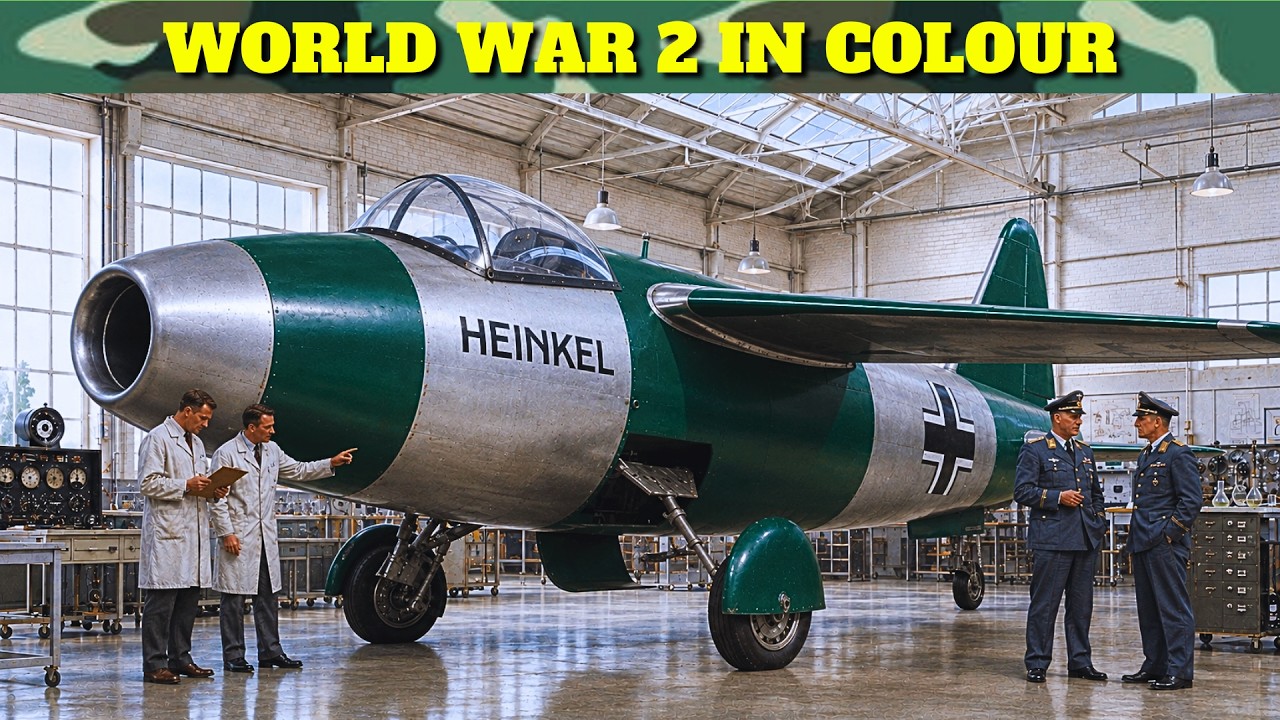
The Heinkel He 178, powered by a turbojet engine designed by Hans von Ohain, flew for only a few minutes. Yet that brief hop marked the beginning of a new era in aviation, even as the world was about to tear itself apart. The race toward jet flight had begun years earlier, conceived independently on opposite sides of the North Sea. In the late 1920s, propellers still ruled the skies, but already their limits were becoming clear.
The higher and faster aircraft flew, the less efficient propellers became. More piston power meant more weight, more drag, and more mechanical complexity. Two young men, one in Britain and one in Germany, saw a fundamentally different answer. In 1928, Frank Whittle was a 21-year-old pilot and officer in the Royal Air Force.
As a final-year student at the RAF College at Cranwell, he proposed an engine that would draw in air, compress it, mix it with fuel, and burn it continuously. A turbine would extract just enough energy from the exhaust to drive the compressor, while the rest rushed out of the tail as thrust. No propeller, no pistons, just a constant stream of compressed air and flame. In January 1930, Whittle filed a British patent for a gas turbine designed to produce jet thrust directly.
His patent contained the basic components of the modern jet engine. But a patent was not an engine. The Air Ministry consulted its experts, who concluded that the idea was theoretical and that the temperatures involved exceeded the capability of available materials. The design was deemed impractical and not even worth protecting as secret.
Whittle refused to let the idea die. Two former RAF colleagues, Rolf Dudley-Williams and James Tinling, helped him secure private backing, and an independent engineer, Morgan Branson, reported that the project was difficult but feasible. In March 1936, Power Jets Limited was formed. The name sounded grand; its resources were not.
Whittle remained an RAF officer, the staff was tiny, and money was desperately short. Most work was carried out in borrowed industrial space with components made by outside firms. Only then, after six valuable years had been lost, could work on an experimental engine finally begin. In Germany, meanwhile, another inventor was moving fast.
In 1933, Hans Joachim Pabst von Ohain was a young physicist at the University of Göttingen. Claiming he had never seen Whittle’s published patent, he began his own research into an engine that could create thrust without a propeller. Where Whittle approached the problem as a pilot and practical engineer, von Ohain approached it as a physicist. With the help of mechanic Max Hahn, he built a primitive experimental machine.
It was not a copy of Whittle’s design; the airflow, turbine, and combustion system took a different path. And von Ohain had an advantage Whittle could only dream of: Ernst Heinkel. Heinkel was fascinated by speed and willing to fund unconventional ideas. In 1936, von Ohain and Hahn joined his company at Marienehe near Rostock.
They received workshops, skilled technicians, and the freedom to develop an engine in complete secrecy. While Whittle struggled to obtain every component, von Ohain had the resources of a major aircraft firm behind him. Whittle’s first experimental engine took shape at British Thomson-Houston in Rugby. It looked less like an aircraft engine and more like industrial machinery, pipes, chambers, and a massive centrifugal compressor bolted to a test stand.
On April 12, 1937, the engine ran for the first time. It nearly ended in disaster. Fuel had leaked and pooled inside the combustion chamber without Whittle knowing. When it finally ignited, the engine, which had been running normally, suddenly accelerated.
Whittle cut the fuel supply, but the engine kept speeding up, burning the fuel trapped inside. The high-pitched whine grew louder. Whittle and the other witnesses fled, expecting the turbine to explode. The engine eventually slowed as the remaining fuel burned off.
It had terrified its inventor, but it had worked. Early tests were violent, unpredictable, and deafening. Combustion failed, turbine blades damaged themselves, and components had to be rebuilt again and again. Each failure consumed the time and money of Power Jets Limited.
But the principle was proven, and Britain now had a working jet engine. Von Ohain’s team moved at a similar pace. His first experimental model, the Heinkel HeS 1, ran successfully on hydrogen in early 1937. Hydrogen made combustion easy, but it was not practical fuel for a combat aircraft.
The next engine had to burn liquid fuel, carry its own systems, and survive in the air. The result was the HeS 3, a compact and clever design that placed an annular combustion chamber around the center of the engine. Early versions were tested under a Heinkel He 118 aircraft while engineers pushed for more thrust and reliability. Von Ohain faced technical challenges similar to Whittle’s, but he could draw on Heinkel’s materials, components, and fresh engineers.
Inside Heinkel’s factories, a small silver aircraft was being built around von Ohain’s engine. The Heinkel He 178 was a private project, hidden from most of Germany’s aviation establishment. Air entered through the nose, the engine sat deep in the fuselage behind the cockpit, and a steel jet pipe carried the exhaust to the tail. It was not a practical aircraft in any real sense.
It carried no weapons and had fixed landing gear. It was built to answer a simple question: could an experimental jet engine lift an aircraft off the ground and keep it flying? On the morning of August 27, 1939, test pilot Erich Warsitz climbed into the He 178 at Rostock-Marienehe. The engine spooled up, the aircraft rolled down the runway, and then, for the first time ever, a jet-powered aircraft left the ground.
The flight lasted only minutes. The He 178 was small, short-ranged, and light. But it had flown without a propeller, driven only by a continuous stream of burning gas. Five days later, Germany invaded Poland.
Two days after that, Britain and France declared war. The first true jet flight had taken place in the middle of a global crisis. Heinkel expected the achievement to excite the Luftwaffe. It did not.
A demonstration before senior officials failed to impress them. Germany expected a short war fought with conventional aircraft already in production. The He 178 offered long-term potential rather than immediate combat capability. Its engine consumed fuel rapidly, accelerated slowly, and was unreliable.
Despite the German government’s shortsightedness, other German firms recognized the future and began developing their own powerful axial-flow jet engines. In Britain, the approaching war was changing minds. During a demonstration before Air Ministry officials, the flight engine, the W. 1, ran successfully at high power for twenty minutes.
The Air Ministry finally placed orders for a flight engine and a small experimental aircraft to carry it. Gloster designed the E. 28/39 as a flying laboratory. It was small, streamlined, and built for one purpose: to prove that Whittle’s engine could push an aircraft through the air.
Behind its pilot sat the Power Jets W. 1, a compact centrifugal-flow jet engine descended from the primitive test stand at Rugby. Every part, the turbine, bearings, combustion chambers, and compressor, had been tested to the point of failure. There was no certainty it would succeed.
The airframe was ready before its flight engine. Whittle’s team fitted a temporary W. 1X engine for ground-running trials to buy time until the main engine was complete. At Brockworth in April 1941, Gloster’s chief test pilot, Gerry Sayer, began high-speed taxi trials.
The little aircraft gathered speed until the runway could no longer contain it. The E. 28 rose a few feet into the air, touched down, and bounced up again. They were only short hops, but for the men watching from the edge of the airfield, the message was clear enough: Whittle’s engine wanted to fly.
On May 15, 1941, the E. 28 stood on the runway at RAF Cranwell. The final W. 1 engine had been installed.
Whittle waited on the ground, carrying the weight of more than a decade of rejection, debt, and dangerous testing. At 7:47 in the evening, Sayer opened the fuel valve. The aircraft accelerated, rose smoothly, and climbed into the Lincolnshire sky. For seventeen minutes it flew above the airfield, reaching about 340 miles per hour before landing safely.
One of Whittle’s supporters turned to him and said, “Frank, it flies. ” Whittle replied, “That’s what it was designed to do. ” Britain had entered the jet age. The race now moved beyond experimental aircraft.
Germany had plans for an advanced jet fighter. Heinkel’s answer was the He 280, a twin-engine aircraft with tricycle landing gear and an ejection seat. It flew first as a glider in 1940, and under jet power in March 1941. The He 280 looked like the future; it was fast, sleek, and designed from the start as a jet fighter.
But Heinkel’s engines never achieved the reliability and thrust the aircraft required. The German Air Ministry wanted standard engines that could power aircraft from more than one manufacturer. The real competition was no longer about who could make a jet fly. The challenge was building an engine powerful, reliable, and cheap enough for mass production, then manufacturing it by the thousands.
The HeS 011 became caught in political rivalries, shifting requirements, and an official preference for a competing Messerschmitt design. In 1943, the program was abandoned. Despite winning the race for the first jet-powered flight, the engines for Germany’s first practical jet fighter did not come from von Ohain and Heinkel. That honor went to Anselm Franz at Junkers.
His Jumo 004 used an axial compressor, in which air flowed almost straight through rows of rotating and stationary blades, making the engine narrow enough to hang under a fighter’s wing. Germany lacked sufficient heat-resistant metals, so critical components were redesigned using cheaper alloys, a sacrifice that reduced durability in favor of production ease. The operational life of the engine averaged only about twenty hours. But the Jumo 004 could be manufactured in huge quantities.
It became the world’s first mass-produced operational turbojet. Britain faced the same transition. Power Jets could invent engines but could not produce them in massive numbers. The W.
2 design was handed to Rover for production, where delays, redesigns, and strained relations with Whittle slowed progress. Eventually Rolls-Royce took over. Its engineers and manufacturing experience turned Whittle’s work into a dependable production engine, the Welland. The British centrifugal compressor made the engine short and powerful, though wider than German axial-flow designs.
An entire industry began to grow around Whittle’s core idea. As in Germany, once the concept was proven, competing firms such as Rolls-Royce, de Havilland, and Vickers developed their own gas turbine engines. The jet was no longer the obsession of isolated inventors. It had become a rearmament program involving factories, ministries, and thousands of workers.
Equipped with two Jumo 004 engines, the Messerschmitt Me 262 became the first jet fighter to enter combat. It was dramatically faster than the piston-engine fighters sent to intercept it, and its four 30mm cannons could tear a heavy bomber apart in seconds. It made every propeller-driven fighter obsolete. But speed alone could not reverse Germany’s defeat.
Engine failures remained common, fuel was scarce, and pilot training was deteriorating. Factories and airfields were under constant attack. Every Me 262 had to slow down to take off and land, where Allied fighters waited in ambush. Germany had produced the first jet fighters, but too late and in too few numbers to control the skies.
Britain’s first operational jet fighter was the Gloster Meteor. Powered by two Rolls-Royce Welland engines, it entered service with No. 616 Squadron in July 1944. The Meteor was not sent across Europe to duel with the Me 262; its technology was too valuable to risk over enemy territory.
Its first assignment was closer to home: hunting the V-1 flying bomb. The V-1 was fast, small, and packed with explosives. Meteor pilots attacked the targets with their four 20mm cannon. When the guns of pilot T.
D. Dean jammed during an interception, he drew alongside a V-1 and used his wingtip to flip the weapon’s wing, disrupting the airflow around it and sending it crashing to the ground. By the final months of the war, Meteors were operating from Belgium, first against aircraft on the ground and then on armed reconnaissance missions. The Meteor and the Me 262 never met in combat.
The first jet war ended without the two leading fighters facing each other, but it was clear that the age of piston-engine fighters was drawing to a close. The Jumo 004 also powered the Arado Ar 234, the world’s first operational jet bomber, alongside several other aircraft. Whittle’s engines, in addition to powering the Meteor, served as the basis for both American and Soviet jet programs. Neither side developed a perfect wartime engine.
German jets offered speed but with limited lifespans. British engines developed more slowly but laid a solid foundation. Although the experimental machines of Whittle and von Ohain are now museum exhibits, their invention changed the world. Jet fighters would fly faster than sound, and jet airliners would carry hundreds of passengers across continents in hours rather than weeks.
It all traces back to the efforts of two young men in the 1930s. The machines became far more efficient, but the principle remained the same: draw in air, compress it, add fuel, ignite, and turn heat into thrust. Later in life, Whittle and von Ohain met not as enemies but as fellow pioneers. In 1991, they shared the Charles Stark Draper Prize for their independent development of the turbojet engine.
The jet age was the product of two visions pursued across a continent on the brink of war. Neither man knew of the other’s work, but together they broke the propeller’s hold on the sky, making the planet feel much smaller.
