In August 1999, a company in Glen View, Illinois shipped its first high-definition television set, a 64-inch rear projection model representing a decade of American engineering. That same month, the same company filed for Chapter 11 bankruptcy in a federal courthouse twelve minutes from its headquarters. The company was Zenith. It had invented the wireless remote control.
It had built the best-selling television sets in the United States for decades. It had developed the 8VSB digital transmission system that the FCC had adopted three years earlier as the American broadcast standard, a technology now embedded inside every digital television sold in the country. And that summer, Zenith was being sold for the price of its own debts. LG Electronics, the Korean conglomerate formerly known as Lucky Gold Star, exchanged $200 million in claims against Zenith for one hundred percent of the company’s equity.
Shareholders received nothing. Their stock was cancelled. Everything Zenith ever was, every patent, every factory floor, every version of the plastic pistol-shaped remote control built in 1955, now belonged to someone else. The question is not whether Zenith deserved better.
The question is how a company that invented the future went bankrupt the month it finally delivered it. The story begins in 1918 in Chicago, where two amateur radio enthusiasts, Carl Hassel and Ralph H. G. Matthews, began building radio sets for other hobbyists.
They called themselves the Chicago Radio Laboratory, and their entire manufacturing operation fit in a single room. Hassel ran an amateur radio station with the call letters 9ZN, and from those letters they derived a brand name for their equipment: Zenith. Commercial radio barely existed. There was no broadcast industry, no advertising model, no consumer market in any form a modern viewer would recognize.
Hassel and Matthews were tinkerers who happened to be good at building things, selling to a community of other tinkerers who happened to want them. By 1920, the infant radio industry had begun to grow, and Chicago Radio Laboratory had outgrown the kitchen table. They moved into a small shack on North Sheridan Road, a 250-square-foot building on property owned by the Edgewater Beach Hotel. Half of it was the factory.
The other half was the radio station. That was the entire company. Then in 1921, a man who would reshape it walked through the door. Eugene F.
Macdonald Jr. was born in Syracuse, New York in 1886. He earned his first money as a boy reading electric meters. By the time he found Hassel and Matthews, he was already a self-made millionaire, a Navy veteran who had served in World War I and kept the title of Lieutenant Commander for the rest of his life.
Everyone called him the Commander. Macdonald was not an engineer. He was a salesman, a showman, and a relentless publicist who understood that the best way to sell radios was to make people believe that radios mattered. He entered into a partnership with Hassel and Matthews, brought capital the two men desperately needed, and demanded one change immediately.
The brand name would no longer be Z-Nith. It would be Zenith, spelled out with a lightning bolt. In 1923, Macdonald, Matthews, and Hassel incorporated the Zenith Radio Corporation. Hugh Robertson, a Scotsman who served as Macdonald’s financial counterweight for decades, joined as treasurer the same year.
Macdonald ran the vision. Robertson ran the books. Matthews left the company in 1928. Hassel stayed for forty years.
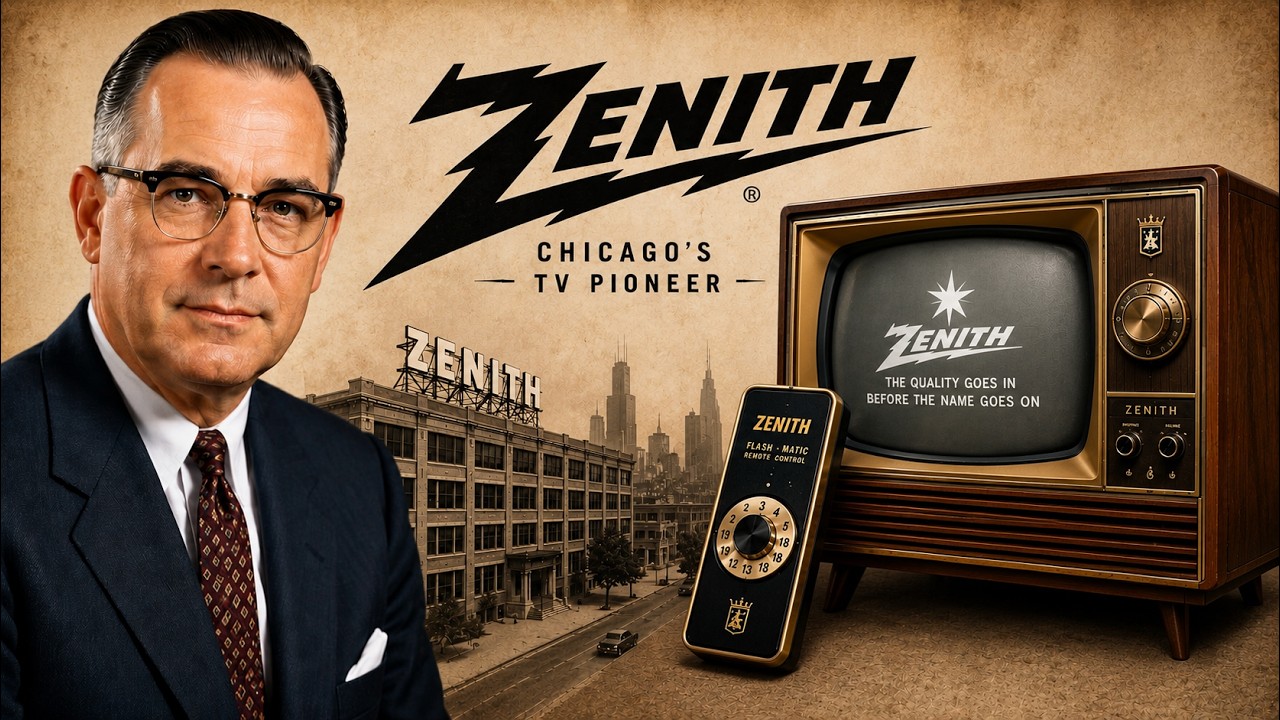
What followed was a decade of firsts. In 1924, Zenith introduced the world’s first portable radio. In 1926, it released the first home radio receiver that ran on household AC current, eliminating the need for bulky batteries. In 1927, automatic push-button tuning arrived, and with it a slogan Macdonald stamped across every advertisement and every product for the rest of his life: “The quality goes in before the name goes on.
” The Depression hit the radio business hard, and competitors folded across the country. Macdonald survived by doing what most executives considered reckless: he kept investing in research and development and kept launching products. He financed expeditions to the Arctic with explorer Donald MacMillan, equipping the ships with Zenith shortwave transmitters and broadcasting Inuit voices singing into the microphone back to American living rooms. Zenith radios became the brand of exploration, of reach, of signals that traveled farther than anyone expected.
In 1939, Zenith launched one of the first experimental all-electronic television stations in the country. The following year, it established one of the first FM radio stations in the Midwest, W9XZL, named for Macdonald himself. The station was among the earliest to broadcast in FM stereo beginning in June 1961, using a multiplex system that Zenith developed and that the FCC authorized as the national standard. That system is still in use worldwide.
Then the world intervened. World War II transformed Zenith from a consumer electronics company into a defense contractor overnight. The factories on Dickens Avenue in Chicago pivoted to radar equipment, communication systems, and high-sensitivity frequency meters for the military. Revenue climbed from $23.
8 million in 1941 to $34. 2 million in 1942. When the war ended, Macdonald came back to television with an idea thirty years ahead of the market. In 1947, Zenith launched Phonevision, the world’s first subscription television concept.
Viewers would pay for quality programming directly, the way they paid for a movie ticket, rather than watching shows financed by advertisers. Macdonald despised commercials, considering them an invasion of the viewer’s home. The broadcast networks, built entirely on advertising revenue, fought Phonevision at every turn. Regulators sided with the networks.
Macdonald lost that fight decisively, but his hatred of commercials planted a seed that would bear fruit in a different form. If viewers could not escape advertisements through a subscription, Macdonald reasoned, Zenith would give them a tool to silence the ads themselves. The man who built that tool was Eugene Polley. Born November 29, 1915 in Chicago to parents of Polish descent, Polley had no university degree and no formal engineering credentials.
He walked into Zenith in 1935 and started in the stock room. He moved to the parts department, where he produced the company’s first catalog, then transferred to engineering. For twenty years, Polley worked his way through radar systems, push-button car radios, and video disc prototypes, accumulating eighteen United States patents along the way. In 1955, Macdonald gave him a specific assignment: build a device that lets a viewer shut off a commercial without leaving the chair.
What Polley built was the Flashmatic, a pistol-shaped handheld unit that fired a beam of directional light at four photocells mounted in the corners of the television screen. Aim at the upper left, the set turned on or off. Aim at the lower right, the channel changed. It was the world’s first wireless television remote control.
Macdonald ordered it into production immediately and gave Polley the President’s Award. There was one problem: the Flashmatic could not tell the difference between Polley’s light beam and sunlight. On bright afternoons, Zenith sets changed channels on their own. Within a year, another Zenith engineer had designed a replacement.
Robert Adler, an Austrian-born physicist with a doctorate, proposed an entirely different approach. His Space Command remote used tiny aluminum rods that, when struck by miniature hammers inside the unit, produced ultrasonic tones at frequencies too high for the human ear to detect. No batteries, no electronics, no light. Adding the Space Command system to a Zenith set required six additional vacuum tubes and pushed the retail price up by roughly thirty percent.
Consumers paid it anyway. The Space Command became the standard, the clicker, the device that redefined the relationship between a viewer and a screen. Adler’s name replaced Polley’s in the industry press. The National Inventors Hall of Fame later inducted Adler as the inventor of the first practical television remote control.
Polley was never inducted. According to his son, the distinction ate at Polley for the rest of his life. In 1997, the National Academy of Television Arts and Sciences awarded Zenith an Emmy for the pioneering development of wireless remote controls. Polley and Adler shared the stage.
It was the only formal recognition that treated them as equals. But the same decade that produced the Space Command also produced Zenith’s peak. Every peak in American electronics has a cliff on the other side. The force that would eventually kill Zenith arrived quietly, priced below cost, and packaged in cardboard boxes from Japan.
Through the 1960s, Japanese television manufacturers had been building market share in the United States with sets that undercut American prices by margins Zenith’s engineers considered physically impossible. In December 1970, Zenith and National Union Electric Corporation filed suit against Matsushita and twenty other Japanese companies along with American importers, including Sears, Roebuck and Company. The complaint alleged a twenty-year conspiracy to fix artificially high prices in Japan and use the profits to subsidize below-cost dumping into the American market, all with the goal of driving domestic manufacturers out of business. The case became one of the longest and most expensive antitrust battles in American history.
It ground through federal courts for more than a decade. By the end of 1983, Zenith had spent millions on the litigation alone. In March 1986, the Supreme Court of the United States ruled for the Japanese manufacturers on the antitrust claims, holding that the evidence was insufficient to prove a predatory pricing conspiracy. In April 1987, the court refused to hear Zenith’s final appeal on the anti-dumping claims.
The legal fight was over. The numbers told the rest. In 1960, Zenith and RCA each commanded more than twenty percent of the American television market. By the late 1970s, Japanese manufacturers collectively held the majority.
Motorola had already sold its television business to Matsushita. RCA was absorbed by General Electric in 1986 and its consumer electronics division sold off. One by one, the American television manufacturers surrendered or disappeared. Zenith refused.
In 1977, the company announced mass layoffs and began moving production to Mexico and Taiwan. Angry workers held protests for weeks outside Zenith’s Chicago factories. No amount of anger could change the math. But Zenith’s 1960s, before the cliff, were worth remembering.
The 1962 Illinois manufacturers directory lists Zenith Radio Corporation as having 11,000 employees, at least 6,460 of them spread across seven Chicago plants. Electronics and communications equipment had become Chicago’s leading manufacturing sector, and Zenith was one of the primary reasons. Quality was not a slogan. It was an engineering philosophy.
Zenith sets were hand-inspected, component-tested, and designed to survive decades of daily use. Zenith console televisions from the 1960s still power on in basements and living rooms across the Midwest sixty years later with original components. Collector communities buy, restore, and trade them. The Trans-Oceanic shortwave radio was Commander Macdonald’s personal obsession, refined through more than two decades of continuous production.
Then on May 15, 1958, Macdonald died of cancer at the age of 72. Chief Engineer Gilbert Gustafson died the same year. The two losses left what one observer called a void of talent at the top that the company never fully replaced. Zenith reached its financial peak in the mid-1970s, with revenue approaching $978 million in 1975, driven primarily by dominance in color television.
The Chromacolor picture tube, introduced in 1969, gave Zenith a technical edge competitors took years to match. By the early 1980s, annual revenue stabilized around $1. 2 billion, but profitability was eroding under the weight of Japanese competition. In 1982, the company posted a net loss of $24 million on that $1.
2 billion in revenue. The margin was gone. To counter the decline, chairman Jerry Pearlman made a move that looked shrewd at the time. In 1979, Zenith acquired the Heath Company, a longtime maker of do-it-yourself electronics kits, for $64.
5 million. Zenith Data Systems was born. By the mid-1980s, ZDS was winning contracts that startled the industry. It beat IBM for a deal with the Internal Revenue Service.
It won major orders from the Department of Defense. Its SupersPort laptop, released in 1988, captured a quarter of the American laptop market in a single year. Revenue peaked at $1. 4 billion in 1988, briefly larger than the entire television operation.
For a moment, it appeared Zenith had found its escape route. Then in 1989, Pearlman and the Zenith board decided to sell Zenith Data Systems to France’s Groupe Bull for $511 million and use the cash to pay off debt. The most profitable division Zenith had ever built, gone in a single transaction to fund one more stand in a television war the company was already losing. Zenith had just sold its future to finance its past.
Stripped of its computer business and battered by two decades of Japanese competition, Zenith staked everything on one last invention. The technology worked perfectly. The company that invented it had months to live. Beginning in 1988, Zenith poured its remaining engineering talent and dwindling capital into high-definition television.
The bet was not irrational. American broadcasters were preparing for the transition from analog to digital, and the company that set the transmission standard would collect royalties on every receiver sold for decades. Zenith was the first to propose a partially digital television signal. It pioneered the use of broadcast channels the industry had previously considered unusable.
In early 1994, the Grand Alliance, a consortium of the country’s leading electronics researchers, selected Zenith’s VSB technology as the terrestrial broadcast and cable transmission subsystem for American HDTV. In December 1996, the FCC adopted Zenith’s 8VSB system as the centerpiece of the ATSC digital television broadcast standard. Every digital television tuner sold in the United States since then has been built around an 8VSB chip licensed from Zenith. The company had invented the standard.
It held the essential patents. It had won. But winning a standards war means nothing if you cannot survive long enough to collect. By the time the FCC made its decision, Zenith was hemorrhaging cash.
LG Electronics had purchased a five percent stake in the early 1990s. In 1995, LG paid $351 million for a controlling fifty-eight percent share. The New York Times announced it under the headline: “Last U. S.
TV maker will sell control to Koreans. ” That headline was not an exaggeration. Every other American television manufacturer had already exited or been absorbed. Zenith was the last one standing, and now it belonged to Seoul.
The losses kept coming: $92. 4 million in 1995, $178 million in 1996, $299. 4 million in 1997. CEO Alvin Mosner resigned abruptly in July 1996.
His replacement announced the layoff of twenty-five percent of the remaining United States workforce, roughly 1,175 workers. In 1998, Zenith posted a loss of $275. 5 million on revenue of $984. 8 million.
That same year, it closed its last American manufacturing plant, the Melrose Park Picture Tube facility on the west side of Chicago, putting 1,200 workers out of their jobs. The company that once employed 11,000 people across seven Chicago factories now made nothing in the United States at all. On August 23, 1999, Zenith filed a petition for reorganization under Chapter 11 of the federal bankruptcy code. The filing came weeks after the company shipped its first HDTV set and months after a failed venture with DivX pay-per-view DVD players, its last attempt at a new consumer product.
There were only seventy digital television stations on the air in the entire country at that point. The market Zenith had spent a decade building was still years from maturity. The bankruptcy was prepackaged, meaning the outcome had been negotiated before the filing. LG Electronics, as Zenith’s largest creditor, agreed to exchange $200 million in claims for one hundred percent of the newly issued equity.
Bondholders received new notes at a reduced rate. Shareholders received nothing. The stock was cancelled. On November 5, 1999, a federal bankruptcy judge confirmed the plan.
Zenith emerged as a wholly owned subsidiary of LG Electronics, no longer a manufacturer of anything, but a designer, a marketer, and a licenser of patents. In 2000, Zenith sold its network systems division, the unit that made set-top boxes for cable and satellite providers and one of the few remaining profitable operations, to Motorola. What remained was a brand and a portfolio of patents. The Lightning Bolt logo continued to appear on budget televisions and DVD players sold through discount retailers, but the products were designed and built by LG.
What survives is scattered but stubborn. The 8VSB chip sits inside every digital television tuner in the United States, collecting licensing fees for a subsidiary in Lincolnshire, Illinois that most consumers have never heard of. The engineers still working there continue to develop broadcast standards, contributing to the ATSC 3. 0 specification that will define the next generation of over-the-air television.
In collector’s homes and repair shops across the country, Zenith televisions from the 1950s and 1960s still receive signals. The Trans-Oceanic still picks up shortwave from stations half a world away. The machines outlasted the company that built them. They outlasted the factories, the workers, the engineers, and the chairman who insisted that the name be spelled correctly and the lightning bolt be placed just so.
Polley died on May 20, 2012 in Downers Grove, Illinois at the age of 96. He was not in the National Inventors Hall of Fame. Robert Adler, the physicist who replaced his design and received the credit, died in 2007 at 93. The company they both worked for exists today as a line item on LG Electronics’ organizational chart.
Zenith invented the way Americans watch television. It invented the remote control, the subscription broadcast, and the digital transmission standard. It refused to abandon American manufacturing longer than any of its competitors. And the cost of that refusal was everything.
The industry Zenith helped build buried it without a headstone.
