On the night of September 2, 1982, fifteen-year-old Karen Stitt took a bus from her home in Palo Alto, California, to the neighboring town of Sunnyvale to visit her boyfriend. Their date was unremarkable in the best way: video games at a 7-Eleven, a round of miniature golf, the ordinary pleasures of teenagers in the early eighties. When the night ended just past midnight, her boyfriend, worried about his own curfew, walked her toward the bus stop at the busy intersection of El Camino Real and Wolfe Road. He watched her cover the final stretch of pavement, then turned and ran home.
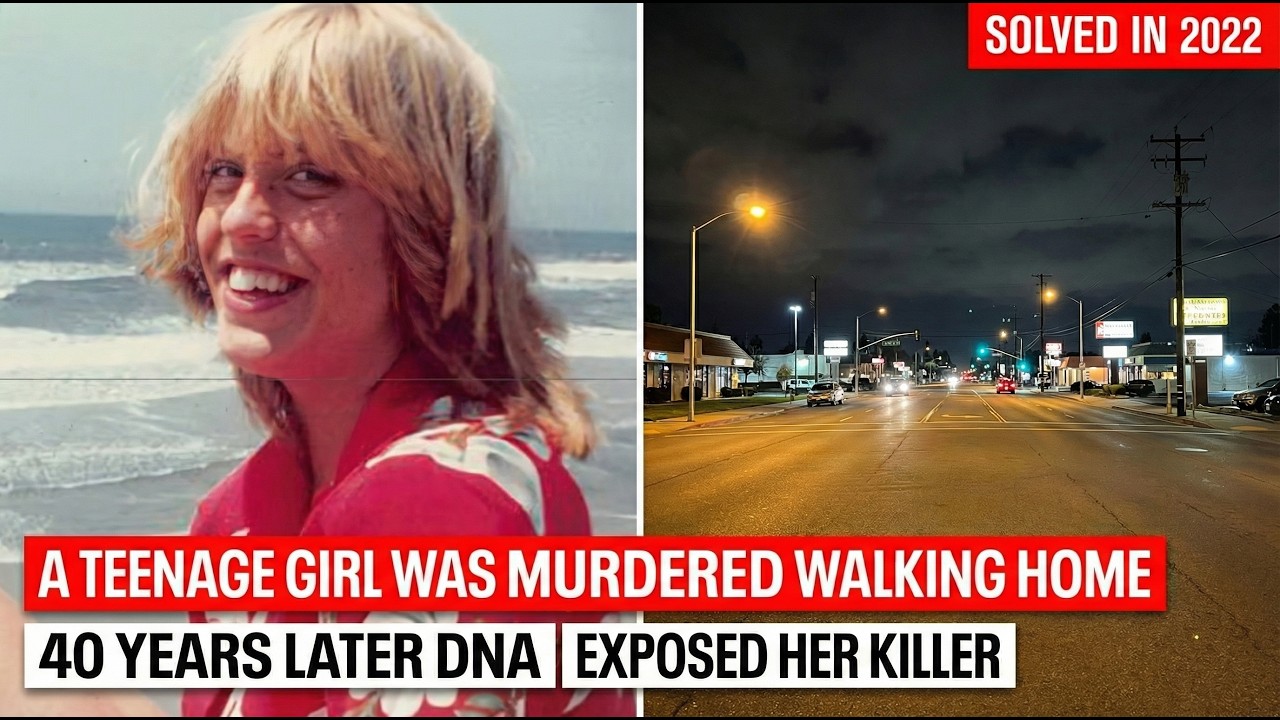
That fleeting glance over his shoulder was the last time anyone saw her alive. The next morning, a delivery truck driver making his rounds found Karen Stitt’s body behind a low, blood-stained cinder block wall, barely a stone’s throw from where her boyfriend had last seen her. She had been sexually assaulted and stabbed 59 times. Her naked body was bound with her own clothing, her leather jacket and striped shirt used as restraints.
The ferocity of the attack had left the killer’s own blood and bodily fluids on her body and on the wall. It was a microscopic calling card that would go unnoticed for decades. In the immediate aftermath, investigators did what they always do: they looked at those closest to the victim. Karen’s boyfriend became the primary and, for a long time, the only suspect.
He was the last person known to have seen her alive, and the weight of that suspicion crushed him. For years, he grieved the violent death of his girlfriend while simultaneously being viewed by police and his community as her potential killer. The real killer remained free, living his life, while an innocent man was trapped in a nightmare. It wasn’t until the early 2000s, when DNA analysis became more sophisticated, that the evidence finally cleared him.
The biological material left by the killer was tested, and the results were unmistakable: it did not match Karen’s boyfriend. He was exonerated, but the case plunged into a new kind of darkness. The DNA belonged to a complete stranger, and there were no matches in any criminal databases. The one solid piece of physical evidence police possessed, the killer’s genetic blueprint, led nowhere.
Over the years, more than twenty detectives worked the case. Karen’s father and older sister both died without ever learning who was responsible. The case file grew thick, yellowed with age, and was eventually moved to the cold case unit. Dead-end leads were documented, including a witness report of an unusual white panel truck seen near the scene that night, a clue that ultimately went nowhere.
The physical landmarks of the crime scene faded into the background of a bustling Silicon Valley. But for the family, the questions of who and why loomed over every day. Karen’s sister, Suzanne, scattered her ashes over Mount Tamalpais, a beautiful peak in the Bay Area, but there was no peace. In 2019, after nearly 37 years, a new detective took a look at the cold case file.
Matt Hutchison of the Sunnyvale Department of Public Safety had grown up in Sunnyvale, and his own stepfather, an officer, had often spoken of the haunting Stitt case. For Hutchison, this was personal. He tacked a photograph of Karen on his desk and made a promise to a girl he’d never met. As he would later put it, “We have a responsibility to these victims, no matter how old the case is.
”
Hutchison decided to pursue a forensic tool that had recently gained national attention for cracking the Golden State Killer case: investigative genetic genealogy. Investigators upload an unknown DNA profile to public genealogy databases, and if it matches a distant relative, even a third or fourth cousin who voluntarily shared their DNA, genealogists build family trees backward and forward through generations to narrow down potential suspects. Working with an expert forensic genealogist, Hutchison’s team began the painstaking work. The killer’s DNA, carefully preserved for decades, was their guiding star.
By 2021, after two years of relentless research, they had a major breakthrough. The analysis pointed not to a single person, but to a group of four brothers from Fresno, California. Their surname was Ramirez. One of them, Gary Gene Ramirez, had ties to the Bay Area around the time of the murder.
But a strong hunch is not enough for an arrest. The law requires direct evidence. Detective Hutchison, now laser-focused on Gary Ramirez, began tracking the family’s digital footprint. In April 2022, he found his opening.
He planned to covertly obtain a DNA sample from one of Ramirez’s children. The sample was secretly collected from the trash can of Ramirez’s daughter in Southern California and rushed to the Santa Clara County Crime Lab. Technicians compared the child’s DNA to the killer’s profile from 1982. The results came back as a high-probability match.
The genetic link was undeniable: Gary Gene Ramirez was the man who had left his DNA at the scene of Karen Stitt’s murder. After 40 years of dead ends, the ghost finally had a name. But there was another twist. Gary Ramirez was not in California.
He was 75 years old and living thousands of miles away on the island of Maui in Hawaii. He had served in the Air Force and drifted around before settling into a quiet life in the small town of Makawao. He was a grandfather, working odd jobs as a bug exterminator, his violent past seemingly buried by time and distance. The arrest took months of planning.
On August 2, 2022, Detective Hutchison and a team of officers flew 2,500 miles across the Pacific. They knocked on the door of a guest house in Makawao, and when a 75-year-old man with gray hair and a ponytail answered, they arrested him for the 1982 murder of Karen Stitt. The four-decade-long manhunt was over. The contrast was stunning: the brutal killer who had vanished from a dark street corner in 1982 was now an elderly man arrested without a fight in a tropical paradise.
On August 10, 2022, Gary Ramirez appeared in a Maui courtroom and agreed to be extradited to California. The legal process moved forward, and on February 24, 2025, Ramirez stood in a Santa Clara County Superior Courtroom. Now 78, he pleaded no contest to first-degree murder. While not a direct admission of guilt, a no contest plea is treated as one in a criminal court.
For some of Karen’s family, the plea was a source of frustration. Her aunt, Robin Stitt Morris, said she wished he would admit the truth. “He’s lived his entire life, and my niece didn’t get that privilege,” she said. On May 12, 2025, the final chapter was written.
Gary Ramirez was sentenced to life in prison with the possibility of parole. Given his age, it is effectively a life sentence; he will almost certainly spend the rest of his days behind bars. Many of Karen’s family and friends were present in the courtroom that day, standing to express their continued grief and anger, making clear that after more than four decades, Karen Stitt had never been forgotten. District Attorney Jeff Rosen captured the moment: “Over 40 years ago, Karen Stitt lost her life, but she was not forgotten.
Today, thanks to a dedicated detective, a persistent prosecutor, and our crime lab, the person responsible is behind bars. ”
Justice delayed for four decades had finally been delivered. A fifteen-year-old girl’s bright future had been extinguished in an act of senseless brutality. An innocent young man’s life had been shadowed by suspicion for years.
A family had navigated an ocean of grief with no answers for more than forty years. But a detective who refused to let a case go cold, who saw a victim rather than just a file, and the power of science, where a microscopic trace of DNA from 1982 held the key to unlocking the truth in 2022, brought the story to a close. The ghost who haunted Sunnyvale for forty years now has a face, a name, and a prison cell. Karen Stitt, the spunky girl from Pittsburgh, is no longer just a cold case statistic.
She is a name remembered, a life honored, and a victim for whom justice was finally served.
