In the spring of 1943, on a dirt road east of Mareth in southern Tunisia, a German armored column was caught in the open by American and British fighter-bombers. The wreckage was still smoking the next day when Allied ground troops came through: Panzer III tanks with turrets split open by cannon fire, Opel trucks burned down to their chassis rails, a kitchen trailer reduced to twisted ribs of steel. There were no artillery craters beside the vehicles and no enemy tank tracks in the sand. What had destroyed the column had come from above, at low altitude, in a single pass.
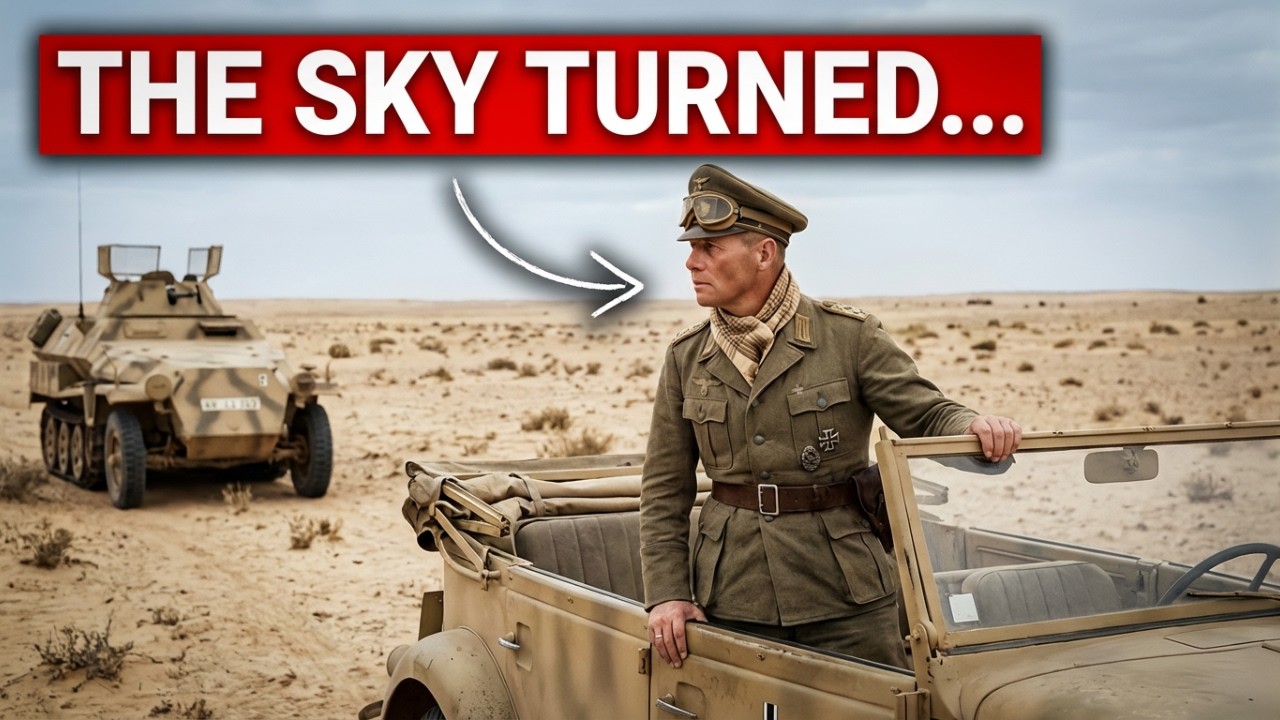
Field Marshal Erwin Rommel, who had commanded that army and was at that moment in Germany on sick leave, understood what those photographs meant before he ever saw them. He had been watching it happen for six months. What he wrote afterward, in the personal manuscript he kept and the letters he sent home to his wife Lucie, is one of the most unflinching professional autopsies any commander has ever performed on his own defeat. Anyone forced to fight against an enemy in complete command of the air, he wrote, fought like a savage against modern European troops, under the same handicaps and with the same chances of success.
Three years after the war, the British military theorist Basil Henry Liddell Hart, working with Rommel’s widow, their son Manfred, and Rommel’s former chief of staff Fritz Bayerlein, translated and expanded those notes into the volume known as The Rommel Papers. The manuscript also contained the line that every American air power officer would eventually quote back: the fact of Allied air superiority had thrown to the winds all the tactical rules he had applied with such success, and in every battle to come, the strength of the Anglo-American air force would be the deciding factor. Rommel, the man who had broken the British line at Gazala in June 1942 and driven the Eighth Army back to the gates of Egypt in a matter of weeks, had come to understand by the end of that year that something fundamental had changed about modern war. And he had reached that understanding largely through the agency of an air force that a year earlier had not existed.
For roughly eighteen months after his arrival in Libya in February 1941, Rommel had enjoyed the kind of air support he expected. Luftwaffe fighters flew from forward desert airfields, Stuka dive bombers answered divisional commanders, and at the peak of the Axis position in the summer of 1942, the Luftwaffe held local air superiority over whatever stretch of front he happened to be attacking. What happened after that, in the space of about five months, was not that the Luftwaffe became bad. It was that the opposing air force became something the Axis had never faced before.
The man most responsible for that change was Arthur Coningham, an Australian-born, New Zealand-raised officer whose name is largely forgotten. Coningham had gone to war in 1914 with the New Zealand Expeditionary Force at Gallipoli. When illness ended his infantry service, he transferred to the Royal Flying Corps, and by July 1941 he commanded the Western Desert Air Force, the RAF’s tactical air arm supporting the British Eighth Army. Over the following eighteen months, in defeat after defeat, he built a doctrine that would outlive him.
An air force fighting alongside an army, he argued, must operate as a single theater-wide weapon, not as a collection of squadrons parceled out to corps commanders for personal protection. It had to do three things in strict order: win air superiority first by killing the enemy air force in the air and on the ground, then conduct interdiction against the enemy’s rear area, striking supply heads, rail junctions, and armored columns while they were still moving up, and only then provide close support to the ground forces. The order could not be reversed. Coningham built these principles with Air Chief Marshal Arthur Tedder, who had taken over RAF Middle East Command in June 1941.
Together they spent much of the second half of 1941 fighting the British Army command structure as much as the Luftwaffe, because the standing assumption in the Eighth Army was that air units should be handed to corps and divisional commanders for direct support. Every time that had been tried, the aircraft had been used up in penny packets, and the Axis Air Force had been left free to operate in the rear. By Operation Crusader in late 1941, the principle was established that air assets would remain under a single air commander, with the army commander specifying priorities but not individual tasks. When the Americans began arriving in the theater in the autumn of 1942, Coningham’s message was plain.
He wanted them to profit by all their mistakes and successes. On the American side, the officer who carried this forward was Major General Carl Spaatz, who took command of the Northwest African Air Forces on February 18, 1943, with headquarters in Algiers. Above the whole structure sat Tedder as air commander-in-chief of the Mediterranean Air Command. The first clear sign that something had changed came during the Battle of Alam Halfa in late August and early September 1942.
Rommel attempted the last major Axis offensive of the desert war. Montgomery, reading the German intentions through decrypted signals, let Rommel’s armor drive into prepared killing ground. What finished the attack, in Rommel’s own words, was the desert air force. Fleet Air Arm Albacores dropped flares over the German columns at night, and Wellington bombers followed the flares in.
During the day, fighter-bombers ranged over German transport. Two senior German commanders were lost in the fighting. Rommel called off the attack on September 2. Afterward he wrote that British air superiority had been the decisive factor, and he began for the first time to disperse his forces as a defensive measure against air attack.
When the Battle of El Alamein opened on the evening of October 23, Rommel was not in Africa. He was recuperating in Austria after months of exhaustion and illness and flew back under direct order from Hitler, reaching his headquarters on October 25 to find a situation he could not repair. Casualties in his forward positions were severe, and most had come not from British tanks but from massed artillery and continuous air attack on a scale he had never experienced. The Desert Air Force flew over a thousand sorties on several days of the battle.
When Rommel ordered armored counterattacks, his columns were detected on the move and bombed before they reached their assembly areas. By October 30 he had been reduced to roughly 148 serviceable German tanks and 187 Italian tanks against about 800 British tanks. On November 2 he signaled Hitler that the battle was lost. In the letters he wrote home during those weeks, the word that kept appearing was powerlessness.
Air superiority, he wrote, had fundamentally changed what was possible for a commander on the ground. The worst was still coming. Operation Torch put British and American troops ashore in Morocco and Algeria on November 8, nearly a thousand miles behind Rommel’s retreating lines. Hitler’s response was to pour reinforcements into Tunisia by sea and air.
By early February 1943 the Axis had roughly 180,000 troops concentrated in the Tunisian bridgehead. Then came Kasserine. On February 14, the Fifth Panzer Army launched an offensive against American positions at Sidi Bou Zid. The American First Armored Division was badly beaten in the first forty-eight hours, and the Americans suffered roughly 6,500 casualties, with more than two hundred tanks destroyed or abandoned.
German after-action reports described the Americans as poorly coordinated and tactically unimaginative. Rommel, who joined the attack from the south and pushed through the Kasserine Pass, believed those reports and reinforced his long-standing conviction that the American Army was not yet a serious opponent. He turned the attack off on February 22 and withdrew. Kasserine was the last engagement in the African theater in which the Axis enjoyed anything close to air parity.
The Allied response was swift. Eisenhower relieved the corps commander and put Major General George S. Patton in command of II Corps. At the air level, the Northwest African Tactical Air Force was constituted under Coningham, bringing American and British squadrons under a single combined command.
When American air support came back up in March, it came up under the same three-priority sequence that had been breaking the Luftwaffe in the desert since the summer of 1942. The turn began on March 6 at Medenine in southern Tunisia. Rommel had proposed a spoiling attack against Montgomery’s Eighth Army advancing westward out of Libya. At six in the morning, three panzer divisions of the Afrika Korps rolled forward with about 150 serviceable tanks.
They were expected. Montgomery had positioned nearly five hundred anti-tank guns in concealed enfilade across the open ground, and his artillery had pre-registered every approach. When the fog burned off, the German columns stood exposed. The Luftwaffe’s attempts to intervene proved ineffectual against the weight of Allied fighter cover.
By late afternoon Rommel cancelled the attack, having lost approximately fifty tanks. Three days later he flew out of Africa. He would never return. The destruction he had seen coming proceeded in his absence.
At an oasis village called El Guettar on the morning of March 23, the Tenth Panzer Division, which had broken the American First Armored Division at Kasserine five weeks earlier, attacked the American First Infantry Division under Major General Terry de la Mesa Allen. The Panzers hit a minefield and slowed. As they slowed, the new American tank destroyer battalions fired from concealed positions, and divisional artillery, guided by forward observers on the hills, bracketed the German formation. By mid-morning thirty Panzers were burning.
By midday the division had withdrawn. The Tenth Panzer Division had been stopped cold by the same American division many of its crews had dismissed as hopeless amateurs. What was missing on the German side was the air cover that should have suppressed the American observation posts and protected the Panzers. It was being hunted that same week in a different sector.
Operation Flax opened on April 5, 1943. Its target was not the Africa Korps directly but the supply system that kept it alive. By early April, with Allied naval interdiction strangling Axis shipping, the Germans had transferred most of their Tunisia logistics to the air. Daily flights of Junkers 52 transports and Italian Savoia-Marchetti aircraft crossed the narrow strait from Sicily to Tunisia, at peak over a hundred missions a day.
Through Ultra intercepts, the Allies had the German flight schedule. Fighter sweeps intercepted the transports over the strait. Bombers hit the airfields in strict sequence, catching aircraft on the ground at departure and arrival. The rate of attrition was severe.
On the evening of April 18, only six out of sixty-five German transports that had left Tunis that day made it back to Sicily. The climax fell on Palm Sunday, April 18. The American 57th Fighter Group, based at El Jem in Tunisia, flying P-40s and trained alongside the RAF, was sweeping the coast of Cape Bon when they spotted a formation of Junkers 52s returning empty to Sicily, escorted by German fighters. Forty-six P-40s and a squadron of Spitfires rolled in out of the sun.
In the next ten minutes the transports exploded in the air, broke apart, or crashed burning into the sea and along the Tunisian shore. The verified German losses were twenty-four transports shot down with another thirty-five damaged so badly they crash-landed along the Sicilian coast, and ten escort fighters destroyed. The American cost was six P-40s and a single Spitfire. Four days later, a South African formation caught a flight of huge six-engine Messerschmitt 323 cargo aircraft and shot down sixteen in a single engagement.
After that, daylight transport runs effectively stopped, and the Axis supply system in Tunisia was finished. When the final Allied ground offensive began on April 22 and reached its climax on May 6, the Axis line could not hold. Tunis and Bizerte fell on May 7. On May 13, the last organized Axis forces in North Africa surrendered.
The prisoner count reached approximately 250,000, with some 2,400 Axis aircraft destroyed in the Mediterranean between November 1942 and May 1943, roughly forty percent of the entire Luftwaffe force structure. More German and Italian soldiers surrendered in Tunisia than had surrendered at Stalingrad three months earlier. Ordinary Germans began calling it Tunisgrad. The Luftwaffe in North Africa had been built around the assumption that it would support its army directly at the front.
It had never developed a theater-wide command that could contest air superiority across hundreds of miles at once. Above it all, a culture had settled in which junior commanders could not be confident their initiative would be rewarded. Against that system, the Western Allies had assembled a single theater air headquarters with three priorities in strict sequence: superiority, interdiction, close support, never reversed. Rommel had foreseen this outcome.
A note in his papers from 1942 predicts almost exactly what happened. He wrote that in future, battle on the ground would be preceded by battle in the air, and that which of the contestants had to suffer operational and tactical disadvantages would be determined by the outcome of that air fight. He could see it, but he had no authority over the Luftwaffe. On July 17, 1944, at the height of the Battle of Caen, his staff car was strafed by Allied fighters on a road in Normandy.
He was thrown clear and suffered a fractured skull. He was sent home to recuperate. He was still at home on October 14, 1944, when two generals sent by Hitler arrived with a choice: public trial before the People’s Court, which would cost his family everything, or cyanide in exchange for a state funeral and a guarantee that his family would be left alone. He said goodbye to his wife and son, walked out with the generals, and took the poison.
He was fifty-two years old. The official cause of death was announced as a cerebral embolism resulting from his earlier wounds. In one of the last letters he wrote before his wounding, composed shortly after D-Day in June 1944, he repeated in the plainest language available to him what he had first written about the African campaign two years earlier. The enemy’s air superiority, he told his wife, had a very grave effect on their movements.
There was, he wrote, simply no answer to it. Modern armies have not fought a sustained campaign without air superiority in eighty years. The doctrine that made that possible was written in the desert, by men who understood before anyone else in their profession that the shape of the next war was going to be decided in the first thousand feet above the ground.
