She was a granddaughter of Queen Victoria, born with royal blood that should have opened every door in Europe. Instead, that same blood became the curse of her life, taking her children, poisoning her marriage, and turning an entire nation against her. This is the story of Victoria Eugenia of Battenberg, the British princess who became Queen of Spain. In 1887, a baby girl was born to Princess Beatrice, Queen Victoria’s youngest and last child.
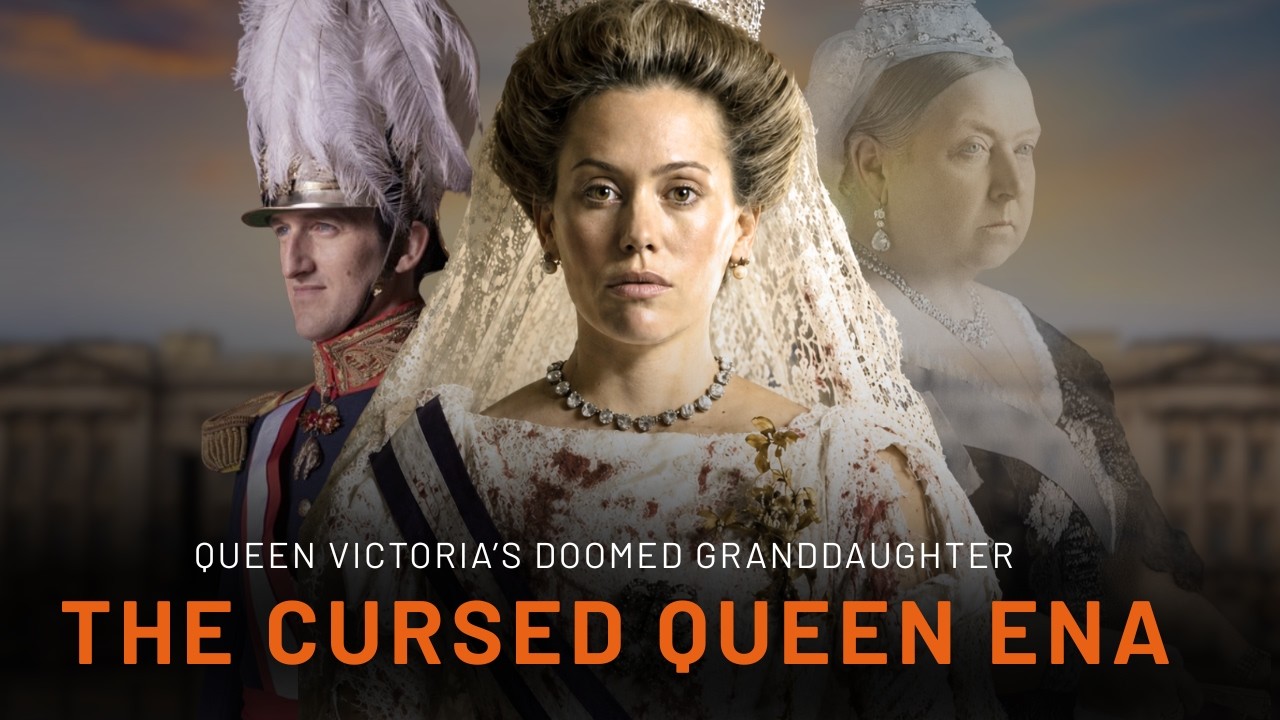
The year marked the fiftieth anniversary of the Queen’s reign, so the little girl, named Victoria after her grandmother, became known as the Jubilee grandchild. The Queen, usually selective with her many descendants, adored her. Victoria Eugenia and her siblings spent their entire childhood under their grandmother’s wing, and the Queen nicknamed the girl her little treasure. The name that stuck, however, was Ena, a shortened version of her second name, by which history remembers her.
Ena’s idyllic childhood ended at age nine when her father died suddenly of typhoid fever, the same disease that had killed Prince Albert decades earlier. The death devastated the family, but it drew the girl even closer to her grandmother, who had lost her own father as an infant and understood the child’s pain. That bond was not destined to last. On January 22, 1901, Queen Victoria died.
For the British Empire, her death marked the end of an era. For fourteen-year-old Ena, it marked the end of her childhood. In 1905, London high society buzzed with the news that King Alfonso XIII of Spain was coming to Britain on an official visit, and everyone knew he was also looking for a bride. Many of Queen Victoria’s unmarried granddaughters excitedly anticipated such an advantageous match.
Everyone except Ena. The modest young princess was convinced the Spanish king would hardly notice her. Ironically, that was exactly what caught Alfonso’s attention. At an official dinner, he could barely take his eyes off her, admiring a young woman who behaved naturally, without any attempt to charm or flatter him.
The two soon began an intense correspondence, and within months Alfonso told his mother that Ena was his first and only choice for a wife. The problem was that neither his mother nor those around him approved. Ena was a Protestant, and Spain was a Catholic monarchy. But that was the smaller problem.
By then, people across Europe were beginning to suspect that Queen Victoria’s descendants through the female line carried hemophilia, a hereditary condition in which blood does not clot properly. Even a small wound or internal injury could lead to prolonged, dangerous bleeding. Another of the Queen’s granddaughters, Alexandra, had married into the Russian imperial family, and the heir to the Russian throne, Tsarevich Alexei, born in 1904, suffered from exactly this disease. People at the time had little understanding of genetics, but they were putting the pieces together, and no royal family wanted to risk producing sick heirs.
Despite all warnings, Alfonso insisted on marrying Ena and no one else. He believed love could overcome everything. The wedding they wanted so badly became the first bloody page in their story. On May 31, 1906, around 300,000 people lined the streets of Madrid along the wedding procession route to catch a glimpse of the bride in her magnificent dress, said to have cost twenty thousand dollars, an enormous sum at the time.
Flowers filled the air and crowds shouted, Long live the queen! But within seconds, the cheers turned to screams of horror. Hidden among the bouquets thrown toward the royal carriage was a bomb. The explosion shook the streets of Madrid, killing thirty-seven people and wounding dozens more.
The royal couple miraculously escaped death, but Victoria Eugenia’s wedding dress was soaked in the blood of a guard. The young couple stubbornly pushed away dark thoughts and continued the celebrations, determined to show their subjects everything was fine. For a long time afterward, the young queen shuddered whenever she had to ride through the streets of Madrid. By autumn of that same year, Victoria Eugenia was pregnant, but the birth of the long-awaited heir turned into an ordeal.
Court tradition demanded that royal childbirth take place almost publicly, with around 150 high-ranking diplomats waiting just outside the delivery room door. As soon as their first son was born, also named Alfonso, the doors were opened before the queen had recovered. Spain celebrated. But not long afterward, when doctors performed a medical procedure on the baby, they noticed the bleeding would not stop.
It was an unmistakable sign. The boy had hemophilia. Alfonso had known about the risk before the marriage, but once forced to face the disease in his own son, his attitude toward his wife suddenly changed. Devotion gave way to resentment, and he placed all the blame on Ena.
He accused her of bringing a curse into his family, of daring to pass this filth onto the heir, as though any of it had been her choice. The king distanced himself from his wife, disappearing for long hours and sometimes entire days without explanation. Though the couple continued to fulfill their public duties and had more children, Alfonso drifted into a world of excess. He had countless mistresses, and even his own mother joked in horror about how many royal bastards must be running around Spain.
He also developed a rather specific interest in adult films, commissioning them to be made especially for him, becoming one of the first major sponsors of that emerging industry. While her husband explored this new cinematic genre, Ena tried to hold the family together, dealing with one tragedy after another. In 1908, their second son, Jaime, was born, this time escaping hemophilia, and for a moment the family had reason to hope. The relief did not last.
The boy developed a severe ear infection, and an operation meant to treat it left him completely deaf. In Alfonso’s eyes, another heir had turned out defective. Fortunately, their third son, Juan, was completely healthy, giving the monarchy new hope and easing some of the tension between husband and wife. But when their fourth son was born, he too was diagnosed with the disease, and the humiliation and accusations began all over again.
Altogether the couple had six children, four sons and two daughters. As the future would show, neither daughter inherited the disease, and neither passed it on. Despite her status as mother of the heirs and queen of Spain, life in her adopted country was never easy. At first the public welcomed the young and beautiful princess with great affection.
For a time, she was nearly as popular with the Spanish people as Princess Diana would become with the British many decades later. She was especially admired for her charitable work and played an important role in the development of the Red Cross in Spain. Years later she was honored with a statue in Barcelona. But gradually the affection faded.
To many Spaniards, Ena seemed too cold and too foreign. She struggled to learn Spanish. She disliked bullfighting, which she considered cruel. And the fact that some royal heirs were sick slowly became another reason for resentment, not only within the royal family but among ordinary people.
Things became more complicated with the outbreak of the First World War. Ena’s Austrian mother-in-law openly sympathized with Germany, while Victoria Eugenia naturally supported Britain. Spain remained officially neutral, but many people felt the queen was far too sympathetic to the country of her birth. The world that emerged after the war was fragile.
The conflict had shaken monarchies that only a few years earlier had seemed permanent. In 1918, Ena’s cousin Alexandra was executed in Russia with her entire family. The Austro-Hungarian Empire collapsed, the German monarchy fell, and before long the stability of the Spanish monarchy itself was called into question. On April 12, 1931, the Spanish people voted against the monarchy.
Alfonso XIII was the first to flee to France, leaving his wife and children behind to pack their belongings while an angry crowd gathered outside. As a truck rammed the gates of the palace courtyard, Ena turned to a servant and said, I thought I had done well. A few days later, afraid she and her family might suffer the same fate as her relatives in Russia, Ena left Spain with her children. She left behind a country she would not see again for almost thirty years.
In exile, away from the public eye, the royal marriage fell apart completely. Alfonso, whose countless affairs were known to practically everyone in Madrid, somehow decided that now his wife should be accused of infidelity. That was more than the queen would tolerate. I never want to see your disgusting face again, she shouted at her husband.
That was essentially the end of their marriage. There was no divorce, but from that point on the two no longer lived together and barely saw each other for almost a decade. The rest of her life was no easier. For years she had managed to keep her sons alive despite the disease, but in the end death still found them.
In the summer of 1934, her youngest son, Gonzalo, was involved in a car accident. His injuries were relatively minor, but hemophilia did what the accident itself could not, and the prince died from internal bleeding. Four years later, his older brother suffered almost exactly the same fate, dying from bleeding after another relatively minor car accident. By a cruel twist of fate, the hemophilia Ena had inherited through the bloodline of her beloved grandmother ultimately took the lives of two of her sons.
In January 1941, Alfonso XIII became seriously ill. Despite everything he had done to her and all the resentment built up over the years, Victoria Eugenia came to the bedside of her dying husband. On February 28, he died. From that point on, most of her attention focused on her remaining family.
Her daughters married and renounced their rights to the throne, while two of her sons, Jaime and Juan, were still alive. Somewhere deep down, Ena continued to believe that one day one of them might return to Spain and restore the family to the throne. But Jaime had lost his hearing, so dynastic hopes increasingly centered on Juan and eventually on Juan’s son, Ena’s grandson, Juan Carlos. Victoria Eugenia took a great interest in the boy, carefully teaching him about Spain and watching from abroad as the possibility of restoring the monarchy slowly took shape.
Under the dictatorship of Francisco Franco, Spain was eventually declared a monarchy again, with the expectation that after Franco’s death the royal family could return. But Ena would not live to see that moment. She returned to Spain only briefly for the baptism of her great-grandson, the future King Felipe VI, and died just a few months later in 1969 at the age of eighty-one. To ordinary people, aristocratic blood should offer some protection from the hardships and sorrows of life.
Ena’s life shows that is not true. The most expensive wedding dress and the most beautiful diamonds mean very little when your children are sick, your husband does not respect you, and your own subjects turn against you. Time and history eventually restored the good name of this unfortunate queen.
Her surviving descendants are healthy and still rule Spain today, carrying within them the very same blood that had once been a curse for Ena.
