For most of American history, the moment the sun sank below the horizon, the world as people knew it ended. Not figuratively, but in a very literal sense. The work stopped. The streets emptied.
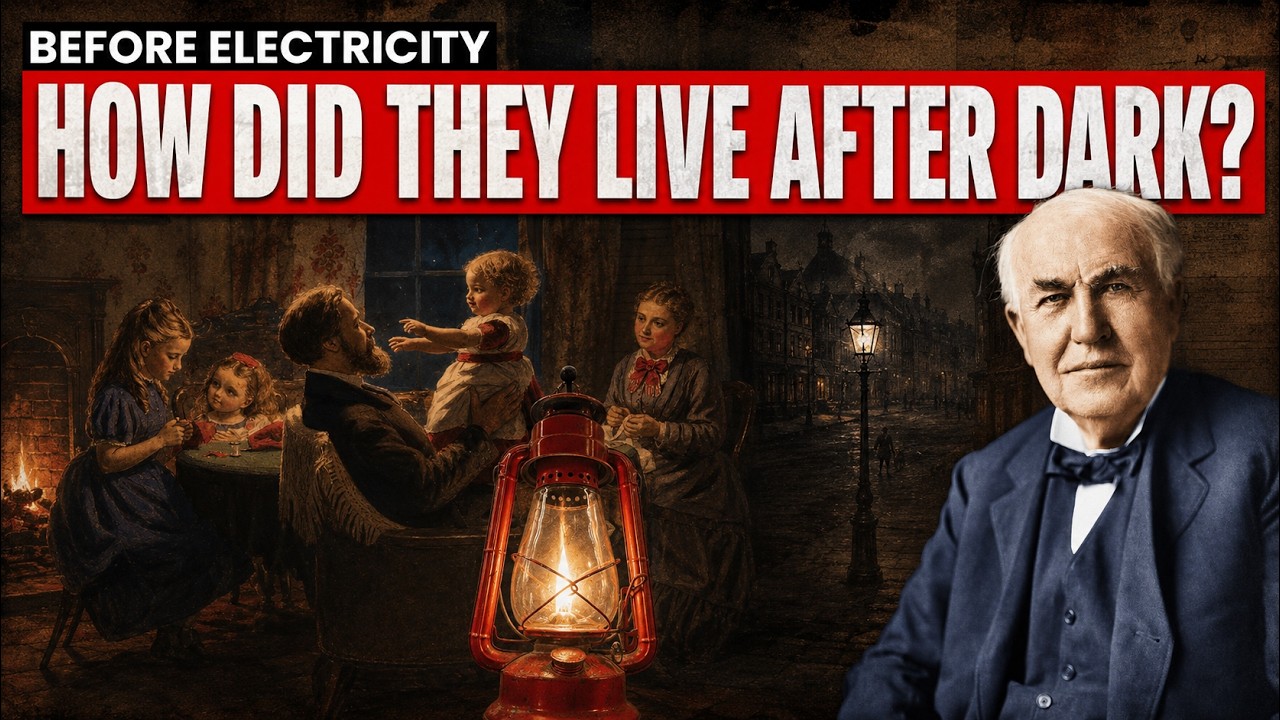
The doors were barred. And everything that could not be done by firelight simply did not get done until dawn returned. Before electricity, the American night was not a time of day. It was a place, an environment as foreign and hostile as the deep ocean, and learning to survive it shaped everything about how people lived, slept, worked, and understood the world.
For the first two and a half centuries of American life, from the colonial settlements of the 1600s through the 1870s, the sun was the absolute law of daily existence. Farmers, who made up the vast majority of the population well into the nineteenth century, planned their entire lives around daylight. You woke at dawn because that was when you could see. You worked the fields, fed the livestock, and hauled water during the precious hours of sunlight.
When the sun began to dip, the work literally became invisible, so you came inside, ate whatever had been prepared, said your prayers, and went to bed. Not necessarily because you were tired, but because there was nothing else you could do. Even in the growing cities of the eastern seaboard, shops closed at dusk, markets packed up, streets emptied, courts adjourned, and churches locked their doors. The entire machinery of civic life shut down when the sky went dark.
The darkness itself was something modern Americans have almost completely lost touch with. When we say it is dark outside today, we usually mean it is dimmer. There are still street lights, the ambient glow of a city reflecting off clouds, the pale light of a phone screen. But in colonial and early America, darkness meant darkness.
On a cloudy, moonless night, stepping outside your front door meant seeing absolutely nothing, not the outline of a tree, not the road, not your own hand in front of your face. Historians describe a darkness so total that people got lost walking across their own property, fell into ditches, stumbled off bridges, and drowned in rivers they could not see. That darkness concealed genuine danger. Crime flourished under its cover.
Theft, assault, robbery, and arson were not just risks after dark; they were expectations. As early as 1631, Boston established a night watch, a group of mostly volunteer men tasked with patrolling the streets from around nine or ten at night until sunrise. They carried wooden rattles, enforced curfews, looked for fires, and were supposed to stop suspicious characters. By most accounts, the system was a joke.
Watchmen drank on duty, fell asleep at their posts, or simply did not show up. Wealthier citizens routinely paid the least qualified person they could find to take their turn. The watchmen did not prevent crime; they occasionally stumbled across it. In the vast stretches of unlit street between their patrols, the night was lawless.
The suspicion of night was so deeply embedded in the legal system that laws carried over from English tradition, called Nightwalker statutes, empowered watchmen to arrest anyone found on the streets after dark who could not provide a satisfactory explanation for being out. Being outside at night was in itself treated as suspicious behavior. You were essentially guilty until proven innocent simply for being awake after sundown. The fear of nighttime was not just about crime.
Fire was an ever-present terror. In an era when every home was heated by a wood-burning fireplace, every room lit by a candle or oil lamp, and every curtain, bed, and garment made of highly flammable material, a single knocked-over candle could destroy an entire household. In densely packed cities, one house fire could easily become a city-wide inferno. This is one reason curfew was taken so seriously.
The word curfew itself comes from the French couvre-feu, which literally means cover the fire. Its original purpose was not about controlling behavior; it was about making sure people extinguished their flames before going to sleep, so they did not burn the whole town down. The economics of light created a stark class divide. A single tallow candle, made from rendered animal fat and the cheapest available light source, produced roughly the equivalent of about thirteen lumens.
A modern sixty-watt bulb produces around eight hundred lumens. A tallow candle gave off a small, guttering, yellowish flame that barely illuminated the table it sat on, produced an acrid smoke that smelled like burning fat, and constantly needed trimming. And even these cheap, sputtering candles were not free. For poor families, especially on the frontier, light was a luxury.
Many households could not afford to burn a candle every night and simply went to bed at sunset because they could not afford to stay awake. Wealthier Americans had better options, but not dramatically so. Beeswax candles burned cleaner and brighter but were expensive, reserved for churches and wealthy households. Spermaceti candles, made from a waxy substance found in the head of the sperm whale, were the premium lighting product of the eighteenth and early nineteenth centuries, burning longer with no offensive smell, but they came at a premium price and drove the whaling industry to hunt certain species nearly to extinction.
Oil lamps were a step up, but the most common fuel, whale oil, could cost the equivalent of close to two hundred dollars a gallon in today’s money, putting it out of reach for ordinary working families. The wealthy could afford to extend their days into the evening, to read, write, and entertain guests after dark. The poor could not. Darkness enforced an invisible class barrier.
If you could not afford light, you were locked out of the evening world entirely. Inside the home, however, the evening hours became intensely communal. Families gathered in a single room, usually the one with the fireplace, because that was where the warmth and the only significant source of light were. There was no retreating to separate rooms, no private space.
The entire family, sometimes spanning three generations, occupied the same few square feet of dimly lit space for the duration of the evening. What they did there was remarkably consistent across class and region. They talked. Conversation was the primary form of evening entertainment for most Americans for most of the country’s history.
In an era without newspapers, radio, or television, the evening conversation around the fire was how culture was transmitted from one generation to the next. Songs were taught, prayers memorized, family histories preserved. Women, in particular, used the evening hours for productive work. Sewing, knitting, spinning, and mending were tasks that could be done by the feeble light of a single flame because they relied more on touch than sight.
This was not a hobby; it was an economic necessity. Clothing was expensive, and every garment was patched and mended until it literally fell apart. Reading was far more limited than we might imagine. Books were rare and expensive, and reading by candlelight was physically punishing.
The dim, unsteady light caused eye strain, headaches, and long-term vision damage. Many Americans developed serious vision problems by middle age, in part because of years spent squinting at text by the light of a guttering flame. One of the most underappreciated consequences of this world without artificial light concerns how people slept. A groundbreaking paper published in 2001 by historian Roger Ekirch at Virginia Tech revealed that our ancestors did not sleep the way we do.
After sixteen years of research, sifting through hundreds of diaries, court records, medical texts, and personal letters from the pre-industrial era, Ekirch discovered they practiced what he calls segmented or biphasic sleep. They slept in two distinct chunks. After going to bed shortly after nightfall, usually around eight or nine in the evening, people slept for three to four hours. This was called first sleep or dead sleep.
Then, sometime around midnight, they would naturally wake up for an hour or two in a period sometimes called the watching. During this interval of quiet wakefulness, people got out of bed to tend to chores, checked on livestock, added wood to the fire, visited neighbors, prayed, or simply lay in bed and reflected on their dreams. After this period of wakefulness, they drifted back to sleep for another three or four hours. This was called second sleep or morning sleep, and it carried them through to dawn.
Ekirch found over five hundred references to this pattern in historical documents spanning centuries and crossing social classes. It was the dominant way people in Europe and North America slept before the industrial age. When artificial lighting became widespread in the nineteenth century, this pattern began to disappear. Gas lamps and then electric lights extended the usable hours of the day.
People started going to bed later, the quiet interval of midnight wakefulness was squeezed out, and the two-phase sleep cycle was compressed into one continuous block. Within a few generations, the entire concept of first and second sleep was forgotten so completely that when modern people wake up in the middle of the night, they diagnose themselves with insomnia. According to Ekirch’s research, waking up in the middle of the night might not be a disorder at all, but the oldest and most natural sleep pattern in human history. The gaslight era marked the first significant transition in America’s relationship with the night.
Baltimore became the first American city to install gas street lights in 1816. The light produced by a gas flame was significantly brighter and more reliable than a candle or oil lamp, and for the first time, it was possible to illuminate an entire street. Cities that installed gas lighting saw an immediate change in the rhythm of nighttime life. Shops stayed open later, restaurants extended their hours, and people began walking the streets after dark, not because they had to, but because they wanted to.
The gas-lit street became a space of leisure rather than a space of fear, and a legitimate, middle-class culture of going out after dark was born. But gas was expensive, so the divide between lit and unlit streets often corresponded to the divide between rich and poor neighborhoods. And gas was volatile. Leaks were common and could cause devastating explosions.
In enclosed spaces, gas consumed oxygen and produced fumes and soot, making poorly ventilated rooms genuinely hazardous. Then came Edison. On September 4, 1882, at approximately three in the afternoon, Thomas Edison’s chief electrician at the Pearl Street station in lower Manhattan threw the master switch on the world’s first commercially viable central power station. Underground cables carried 110 volts of direct current from six massive coal-fired dynamos, each weighing about twenty-seven tons, to eighty-two customers in a one-quarter-square-mile area of the financial district.
About four hundred incandescent lamps flickered to life. In a twinkling, according to a reporter for the New York Herald, the area bounded by Spruce, Wall, Nassau, and Pearl Streets was in a glow. What Edison had demonstrated was not just a new kind of light, but a complete, scalable, commercially viable system for generating, distributing, and selling electrical power. By 1884, just two years later, the station was serving over five hundred customers with more than ten thousand lamps.
Electric light did not just make things brighter. It remade the entire structure of daily life. For the first time in human history, the night truly became optional. Factories could run twenty-four hours.
Shops could stay open long past dark. The ancient rhythm of waking with the sun and sleeping with the moon, a rhythm that had governed human life for thousands of years, was shattered in a single generation. But the transition was not instantaneous, and it was not uniform. For decades after Edison threw the switch at Pearl Street, millions of Americans on farms and in small towns continued to live by candlelight and kerosene lamp.
It was not until the 1930s, when President Franklin Roosevelt’s Rural Electrification Administration began stringing power lines across the countryside, that electric light finally reached the majority of rural Americans. More than fifty years after Pearl Street, there were still vast stretches of the American landscape where the night looked exactly as it had a century before, dark, quiet, and lit by nothing more than a flickering flame. When electricity finally arrived in these communities, the reaction was often stunned disbelief. Families who had never seen an electric light before gathered around a single bulb and stared at it in wonder.
Children who had grown up doing homework by kerosene lamp discovered what it felt like to read by a light that did not flicker, smoke, smell, or threaten to burn the house down. Farmers who had spent their lives going to bed at sundown found themselves awake at ten o’clock at night listening to a radio for the first time. The arrival of electricity in rural America was not just a technological upgrade. It was a transformation of consciousness.
In the span of that transformation, something was lost. The communal evenings around the fire, the ancient rhythm of segmented sleep, the profound connection to the natural world that came from living in sync with the sun, the stillness and the silence, all of it vanished in the span of a single lifetime. Today, light pollution has erased the Milky Way from the view of roughly eighty percent of the American population. The stars that guided our ancestors, that inspired their myths and religions and navigation, are invisible to most of us.
Nobody in their right mind would want to go back to the era of tallow candles and nightwalker statutes and theater fires. The electric light is one of the greatest inventions in human history, and the world it created is better by almost every measurable standard. But the way we live now, bathed in perpetual artificial light and awake at hours that would have baffled our great-grandparents, is a very recent experiment. The American night before electricity was terrifying, beautiful, dangerous, and deeply human, a world where fire was precious, darkness was absolute, and sleep came in two acts.
It shaped the culture, economy, psychology, and physiology of everyone who lived in it, and it vanished in the span of a single lifetime.
