The plain envelopes had no return address and no signature. Each one contained the same thing: photographs of a woman, explicit images taken by a private detective, sealed and addressed by hand to the heads of every major Hollywood studio. The man sealing them was Frank Tone. He was 45 years old, a serious actor of the studio era, a man who had been married to Joan Crawford and had moved through the upper circles of Hollywood for three decades.
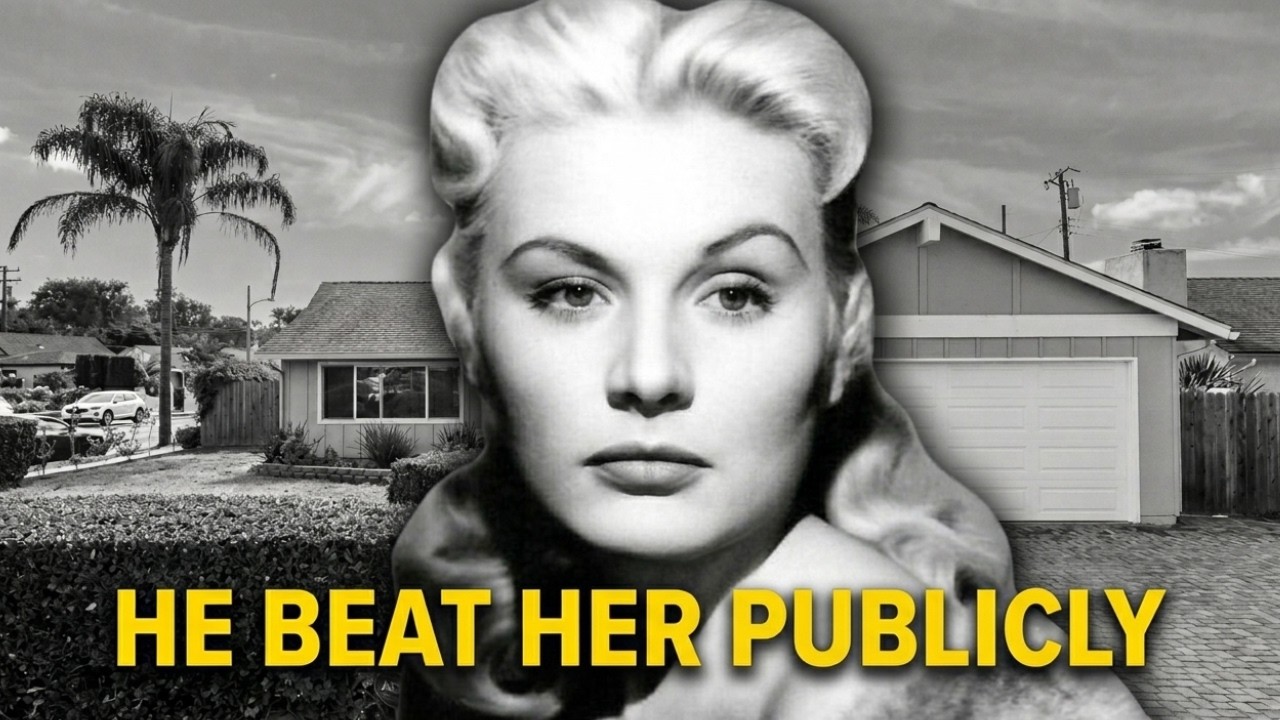
He told himself, later, that she had made it necessary. The woman in the photographs was Barbara Payton. She had worked opposite James Cagney, Gregory Peck, and Gary Cooper. She had earned $10,000 a week at the height of her pull.
She was 24 years old and still climbing. She had been his fiancée, then his wife for 53 days, then nothing. She did not know the envelopes existed. She was going about her day in spring 1952, making plans, making calls, not yet understanding why the silence on the other end of the line was different from before.
That silence was the moment. It had already happened. Everything after was different. She just didn’t know it yet.
Barbara Lee Redfield was born November 16th, 1927, in Cloquet, Minnesota, a Norwegian-American girl from a cold northern town. Her parents drank. The family moved to Odessa, Texas, when she was 11, flatland, heat, nothing that suggested what was coming. She was beautiful in the way that unsettles people: blue eyes, platinum hair, the kind of presence that makes a room reorganize itself around her.
She knew it, and she also knew that knowing it was only the start. She arrived in Hollywood in 1948, twenty years old, and signed quickly with Universal Pictures. She started in bit parts, as everyone started. But Barbara was not suited to bit parts.
She had something the camera registered as dangerous in the best possible way, a luminous recklessness, a barely contained energy that the noir films of the early 1950s needed the way fire needs oxygen. By 1950, her name sat alongside James Cagney’s in Kiss Tomorrow Goodbye. She held her own. She was 22.
Then came Dallas with Gary Cooper, then Only the Valiant with Gregory Peck. In under two years, she had stood opposite three of the most powerful male stars in American cinema. The studios were starting to build around her, not because she was the finest actress of her generation—she would have been the first to say she wasn’t—but because she had something that cannot be manufactured or faked. Her own account, years later, described her earning power at that period as $10,000 a week.
Exact figures from an autobiography deserve some skepticism, but the general truth held. She was working. She was visible. She was being offered more.
She had a beautiful apartment, went to the right parties, and had climbed from Odessa to the inside circle of Hollywood in under three years on nerve and a face the camera found irresistible. She was also, by every account, constitutionally unable to make the cautious choice. She had married twice before she was 23. She moved through that social world with the appetite of someone who had arrived hungry and found the table fully set.
The studio was not entirely happy about this, but the work was good enough that they kept investing. In 1950, she met Frank Tone at Ciro’s nightclub. Tone was 45, a veteran of the stage and screen, a man who had been married to Joan Crawford. He moved in circles Barbara was only beginning to enter: educated, theatrical, old Hollywood money and social capital.
He wore class the way other people wear clothes, as if he had been born into the fit of it. He was completely captivated by her from the first night. He announced their engagement at a party at the Stork Club in New York, in front of people whose names were in the columns. Barbara later said she respected him.
People who knew her well during that period said she liked what he represented: the stability, the legitimacy, the access to rooms she hadn’t yet earned her way into by her own effort. He paid her rent. He took her to the right places. He offered something her career, accelerating as it was, couldn’t yet supply: the sense that she had fully arrived.
But she was 23 years old, and the world kept offering her things. She had never in her life been someone who turned away from what was offered. She was still engaged to Tone when she was cast in Drums in the Deep South and began spending time with her married co-star, Guy Madison. Confidential magazine reported the affair.
Tone, by some accounts, walked in on them. The engagement survived, because he could not let her go and she could not quite commit to anyone. His friends were concerned. Joan Crawford reportedly tried to talk him out of the relationship entirely.
He ignored all of it. In the summer of 1951, Tone went to New York on business. Barbara went to a pool party. She met an actor named Tom Neal: a B-movie tough, a former college boxer, broad-shouldered and physically direct in a way entirely unlike Tone’s cultivated sophistication.
She was immediately and completely struck by him. She began an affair almost at once. By the time Tone returned, the triangle had formed, and Barbara could not, or would not, choose between them. She went back and forth publicly: engaged to Tone and seeing Neal, then reversing, then reversing again.
The scandal press ran the story weekly. The studio was displeased. Projects that had been discussed moved to other actresses without explanation. The first pressure on her career was building, though nothing from those months compared to what was coming.
Frank Tone was not a villain by nature. That is the first and most important thing to understand, because what he did was the act of a man who had been broken past a point he had not known existed inside him. Barbara’s sister-in-law, quoted in the research of biographer John O’Dowd, said the photographs were not like him at all. Researcher Lisa Burks described his behavior as the product of extreme emotional pain.
Even people who loved Barbara agreed: what he did was cruel, and it was not who he was. But it is still what he did. Tone had spent his adult life getting what he reached for: good roles sustained across decades, money, social standing built and maintained through relationships stretching across all of Hollywood. When the Crawford marriage ended, he kept everything except her: the friendships, the professional respect, the access to rooms that mattered.
He was a man who understood the architecture of the industry not as a dream factory but as a system of closed doors and open ones, of who could work and why and what it took to change that. He had been inside that system for 30 years. He knew how it functioned at a level that never appeared in the trade press. He had invested in Barbara completely, with the expectation of return.
He paid her rent. He introduced her to the people who mattered. He absorbed the public humiliation when Confidential reported she had been caught in bed with her co-star Guy Madison while still wearing his ring, and he married her anyway, because he was past the point where rational calculation applied to her. He had been warned.
Joan Crawford tried to talk him out of it. His friends had concerns. Barbara’s history—two marriages before 23, a faithlessness that was not a secret to anyone watching—was not hidden. He had chosen to proceed with open eyes, because he could not stop himself.
That was his weakness, and he had always had it, and it made him eventually capable of something he would not otherwise have been capable of. When Tom Neal put Frank Tone in a coma on the night of September 14th, 1951—smashed cheekbone, broken nose, 18 hours unconscious—every newspaper in the country covered it. He had been beaten in front of her home by her other boyfriend, while she reportedly stood and watched. The humiliation was complete, public, and permanent.
That kind of story does not age well for the man on the ground. He had been waiting for exactly this opening: not the brawl, but what came after. Because when Tone recovered, Barbara married him. And when she walked out 53 days later and returned to Neal, then came back to Tone, then left again, in the full extended public spectacle running from September 1951 through early 1952, something calcified in him that would not soften.
What he wanted was no longer her. It was what he could take from her. And because he had spent his career inside that system, he knew precisely what to take and exactly how to take it without leaving his name on it. He filed for divorce, then quietly maintained the filing while allowing Barbara to believe he had dropped it.
According to O’Dowd’s research, she was unaware the original action remained active. She had no reason to check. She hadn’t been told. He had counted on that.
By spring 1952, the private detective had delivered the photographs. He used them in the courtroom, arguably within legal procedure for a 1952 divorce action. The judge ruled against Barbara’s alimony claim. She left the courthouse without what she had expected.
Then he put copies in plain envelopes, no return address, no signature, and mailed them to the heads of the major Hollywood studios. He knew what he was doing. He knew what those photographs would mean, arriving anonymously at the desks of men already looking for a clean reason to close a door. He was a man.
The photographs were of her. That asymmetry was not accidental. It was the architecture. He sealed the envelopes.
He put them in the mail. After that, everything was different. Barbara Payton did not know the envelopes existed. Spring 1952.
She was 24, recently separated from a 53-day marriage, still attached to Tom Neal in the way people sometimes hold hardest to the thing doing them the most damage. She was drinking more than she should. The press had been at her for months, but she was still working. She had not yet crossed the line that cannot be uncrossed.
The divorce hearing was the first thing she understood as a direct attack. Frank had filed on grounds of extreme mental cruelty. She had countered with an alimony claim. She arrived in court not knowing that the divorce action she believed he had dropped was still alive and active, still threading through the legal system while she had no idea to prepare for it.
Then the photographs were introduced. According to period records and O’Dowd’s documentation, the explicit photographs taken by Tone’s private detective were entered into evidence. They nullified her cross-complaint. The judge ruled against her alimony affidavit.
She left the courthouse without the settlement she had expected, and without understanding the full geometry of what had just been done to her. She did not know that identical photographs were already sitting in the offices of the men who decided who worked in Hollywood. He had sealed the envelopes, addressed them by hand, dropped them in the mail. He signed nothing, because he understood, with the precision of someone who had built his life inside that system, that an anonymous delivery lands differently than an attributed one.
An accusation with a name on it can be challenged, investigated, refuted. A plain envelope from nowhere, arriving at the desk of a man already cautious about the woman inside it, becomes something simpler. It becomes a fact, a document, a reason that will never need to be spoken aloud. Think about when those envelopes were opened.
An ordinary morning in a studio office. A secretary probably brought the mail. A man, the kind of man who made decisions about which women worked in Hollywood in 1952, opened a plain envelope with no return address and found photographs of Barbara Payton. He already knew her name.
He already knew the scandal. He already had, from the preceding nine months of newspaper coverage, every reason to be cautious about attaching his studio’s name and money to hers. The photographs did not need to create a new opinion. They only needed to confirm the one that already existed, to make temporary caution into permanent closure, to give the hesitation a document it could point to quietly in the back of a file, never needing to be shown to anyone.
What was lost that morning, in those offices she would never enter again, in the moment the envelopes’ contents were noted and set aside, was not simply a next role or a next contract. It was the trajectory. It was the version of her life that required only time and the right roles and the natural development of something genuine that had been visible in every film she’d made. What was lost was the future in which Barbara Payton recovered.
The moment passed. Nothing else did. The first ripple was invisible. It moved before she understood what had happened.
Studios do not send rejection letters. Doors do not slam in Hollywood; they gradually, noiselessly, permanently stop opening. A role goes to someone else without explanation. A meeting gets rescheduled and then forgotten.
The machinery of exclusion is designed to look exactly like nothing, so the person being excluded cannot point to a moment and say, there. But the decision had been made. According to O’Dowd and multiple period accounts, the photographs reached the studio heads and the result was immediate and permanent. She lost the lead in Lady in the Iron Mask in 1952.
Projects she had been attached to evaporated. No one said why. No one needed to. The first ripple made the second one possible.
What the loss of studio work destroyed was not only income. It was structure. The work had been the holding grid: the schedule, the purpose, the professional identity that gave the rest of her life something to organize around. Without it, the drinking that had been manageable, or at least containable, moved to the center.
She and Tom Neal toured in stage productions, performing The Postman Always Rings Twice, trading on the notoriety the scandal had generated. They made one film together, The Great Jesse James Raid, in 1953. These were not the projects of a career moving forward. They were the last resources of a career trying to stay visible long enough to turn around.
She went to England. She worked for Hammer Films. The productions were competent, and she was good in them, genuinely good, showing in both films a contained tension the camera responded to. But they were not a ladder back.
They were proof that the ladder had been removed. The second ripple caused the third, and the third reached someone who had never been in the room when the envelopes were sealed. Her son, John Lee Payton, was a child during those years. The public record does not give us his interior life; he was not a public figure, just a boy watching his mother from whatever distance the adults around him allowed.
But the shape of what the moment did to him is traceable from the outside: a mother who had been a name above the title, a woman building something visible and real, reduced by the time he was old enough to understand the world to someone arrested for passing bad checks, then for public drunkenness, then, by 1962, to selling herself on Skid Row for $5. What that does to a child does not require elaboration. It only requires acknowledgement that it happened, and that it was connected through a chain of consequences to a man sealing envelopes in spring 1952. His damage was four steps from the moment, but the chain held.
By 1962, Barbara was living in the shadows, as O’Dowd documented. A former police officer who arrested her during that period described her as completely lost and out of it, not as a figure of speech but as a medical description of someone whose addiction had progressed into what O’Dowd called psychosis. She was 34 years old. She had been a household name less than a decade earlier.
The final ripple is the one still moving. What Frank Tone did in spring 1952 was never prosecuted. It was never named in any contemporaneous account as what it was. He continued working.
He continued to be received in the circles he moved in. He died in 1968, one year after Barbara, and his obituaries treated him with the respect due a serious actor of the studio era. The photographs were a footnote when they appeared at all. The envelopes were barely mentioned.
Seventy years later, Barbara Payton’s story is still told primarily as a story about a woman who made bad choices: her drinking, her faithlessness, her inability to behave in ways Eisenhower’s America required of women who wanted to keep their careers. The deliberate, targeted, premeditated act of a man who used his specific knowledge of the industry to close every door she had—that part is still the footnote, still the background detail, still the thing mentioned briefly before the conversation returns to what she did. He had counted on that too. One moment, four ripples.
The last one is still moving. Barbara tried to go back. Not once. She tried in different ways, at different moments, with different understandings of what going back would actually require.
Each attempt taught her something new about how completely the moment had closed. The first attempt was the most direct. After the divorce, in May 1952, she tried to resume serious work. She was 24.
She had real credits alongside real stars. She was not, by any objective measure, a finished actress, but what going back required was access to the producers and studio heads who had received the envelopes and who would now need to make the active, deliberate choice to work with her anyway, knowing what they knew, accepting the association. That requirement could not be met. Not because no individual in Hollywood would have her—some would, and some did, at the smaller productions and in England—but because the photographs had done something more precise than making her radioactive.
They had given every cautious executive a documented reason. Not a feeling, not a general reluctance: a document sitting in a file. A producer who hired her now was making a decision that could be explained only as a choice to ignore specific evidence. A producer who didn’t hire her was simply being prudent.
The asymmetry was permanent, and it had been built in deliberately. She could not undo it, because undoing it required someone else to absorb a risk they hadn’t created, couldn’t explain away, and had been specifically handed. She understood something new from this. The moment had not simply damaged her standing.
It had transformed her into a liability that transferred to anyone who helped her. That was the design. The second attempt took a different shape entirely: England, Hammer Films. She demonstrated on camera, in two productions, that she could still work, still perform, still hold the screen.
What this attempt required was translation: for the British record to constitute enough evidence that the Hollywood system would be forced to reconsider its closed verdict. What prevented it had nothing to do with England. Her relationship with Tom Neal, which continued on and off through most of that period, was still generating press. The scandal coverage was not historical; it was ongoing, current, providing the columnists with material week by week.
Whatever rehabilitation the Hammer films represented was being simultaneously undermined by the continued spectacle of a relationship the press had already decided was evidence of character. She could not rebuild a reputation while the story about her reputation was still actively being written. That was the second requirement: silence from a press that had no commercial incentive to be silent. She could not produce it.
He had not needed to plan for it. It produced itself. The third attempt came closest. By late 1953, Neal was finally and permanently gone from her life.
The headlines thinned. A window opened—perhaps a year, perhaps less—in which genuine interest from producers re-emerged. There were conversations. There was a version of this that was almost real.
What closed it was the alcohol. Not as moral judgment, but as physical fact. By that point, her drinking had crossed the threshold past which reliable professional behavior was no longer consistently possible. The requirement was simple functional consistency: the ability to show up, to sustain the work that a production’s financial investment depended on.
Meeting that requirement needed resources: money, stability, medical support. Those resources had been gone since the moment the studio work stopped. She was three ripples from the sealed envelopes, and she could no longer see the chain, and neither could anyone trying to help her. Going back required four things.
She came close on three. The fourth was the one he had made sure would never exist: the foundational, structural ability to be employable in the specific industry whose gatekeepers he had specifically targeted. Once that was gone, closed in those offices in spring 1952, everything else that might have sustained a recovery was gone with it. She understood this eventually, not with that vocabulary, but she understood it.
In her 1963 autobiography, dictated in a Skid Row apartment to a ghostwriter who had come looking for a sensational book, she said: “How or why had I failed? What had happened? Yet somehow I wasn’t dismayed. It was in the cards.
I played them as best as I could. ”
She had stopped trying to go back. Not from defeat—from the clear understanding of exactly what going back would have required, and what had been done to make sure she could never meet it. What remained on the other side of the moment was a specific shape: a woman who had been built for a particular life—the work, the visibility, the forward motion of a career in acceleration—removed from that life without being told the removal was happening, left to move forward into the absence without understanding what had changed.
The drinking had existed before the envelopes. That is the honest accounting, and it matters. Barbara Payton grew up watching both parents drink. Her relationship with alcohol did not begin in 1952.
She had managed it, or it had managed her, in the way that looks functional from the outside until suddenly it doesn’t. What the moment destroyed was not a sober woman. It destroyed the scaffolding that had been keeping the rest of her life in the shape of stability. Without the work, there was no schedule.
Without the schedule, no structure. Without structure, nothing to push back against the thing that had been waiting in the background since childhood. She became something against her will. The scandal press had been constructing the story since 1951: the bad blonde, too sexual, too openly herself, too unwilling to be managed in an era when Eisenhower’s America required women in Hollywood to be manageable, or at least concealable.
After 1952, that story became the only story. She was the cautionary tale held up in columns as evidence of what happens when a woman refuses the unwritten rules, lives too visibly, burns too bright in the wrong direction. She knew what she was being made into. “I am not ashamed,” she said, and asked not to be judged too harshly for living.
But the living in the years after 1952 was increasingly desperate and increasingly visible: bad checks in 1955, public drunkenness arrests, and by 1962, Skid Row. O’Dowd documented that by that point she had passed entirely beyond ordinary reach—medically, psychologically. No individual act of help was going to reverse what had accumulated, and the foundation that might have made help possible had been removed a decade earlier. In 1963, a ghostwriter named Leo Guild arrived at her apartment with a publisher’s offer.
She was paid $2,000 for the book. Guild found her polite on the phone and physically marked in ways he was unkind enough to record in print: the years visible on her body, the distance between what she had been and what she was now measuring itself in the room. The book was published. She kept the $2,000.
She received almost nothing else. Now return to spring 1952. The plain envelopes. A man at a desk.
He thought of it as something she had made necessary, as the only available response to two years of humiliation, as retaliation—which sounds like it is about the past but was entirely about the future. Specifically, her future, and his ability to remove it. What it actually was: a professional execution, carried out with the precision of a man who had spent 30 years learning exactly which door to close, and who held the key to it. He knew which men would receive the envelopes and what those men were already inclined to decide.
He knew the photographs would not touch him. He had nothing to lose. She had everything. He sealed the envelopes and put them in the mail with no name on them.
She found out what she had lost the way it was designed for her to find out: not in one moment, not with a reason she could name, but gradually, from the accumulated silence of rooms that stopped having space for her. From inside the moment, from Barbara’s position in spring 1952, the envelopes did not exist. She knew about the photographs because they had been used in the divorce proceedings. She knew Frank was angry.
She knew the marriage was over and that it had ended in the worst possible way, publicly, with her name in every newspaper. What she did not know was that identical copies had already been delivered to the offices of the men who controlled her professional future. There was no moment when someone told her. No letter, no confrontation, no explanation.
She simply began to understand, over weeks and then months, that work was harder to find, that calls went unreturned, that projects she had been attached to were quietly reattached to someone else. She experienced it as atmosphere: the general consequence of having been too visible in the wrong way. She had no way to locate the specific mechanism, and no reason to look for sealed envelopes, because she had no reason to know they existed. The moment, from inside it, was invisible.
That was not a side effect of what he had done. It was the central feature of how he had designed it. From one year out, 1953, the shape of what had happened was legible in outline to anyone watching from the outside, but not in its cause. The trajectory had broken in 1952 and stayed broken.
The Hammer films were competent, and she was genuinely good in them, a controlled, watchable tension the camera responded to. But they were not a return. They were a smaller track. The woman who had shared a screen with Cagney and Cooper was now making productions that required someone to go looking for them.
From that distance, observers read the break as natural consequence: too scandalous, too difficult, an era that punished women for living the way she had lived. That reading was not entirely wrong. The era was exactly as punishing as described. But it was incomplete, because it left out the envelopes, which were invisible from every distance except the one that would not exist for decades.
From one year out, the cause was still buried beneath the effect. The effect looked like justice. That misreading became the story told about her life. It lasted 70 years.
From the full distance of time, the mechanism is finally visible: the timing, the secret divorce filing maintained while Barbara believed it had been dropped, maintained so she would arrive in court unprepared, unable to build a defense against something she had not been told was still coming. The private detective. The photographs used first in the courtroom, then copied and distributed anonymously to the specific men who controlled studio access. The asymmetry between what he risked and what she lost, built in from the start and permanent by design.
This is not a scandal. It is not a cautionary tale about a woman who lived too freely in a conservative era. She was found on the bathroom floor of her parents’ San Diego home on May 8th, 1967. Heart and liver failure.
She was 39 years old. She had moved there a few months earlier in a final attempt to stop drinking. It was too late. For years before she died, she had sold her story for $2,000 and called herself not ashamed.
She had said she played the cards as best she could. She had not been dealt those cards. They had been switched while she wasn’t watching, by a man who knew exactly what he was doing and paid no price for it. Spring 1952.
Plain envelopes, no return address. A career ended before the ink was dry. That is what the moment was.
Nothing after.
