In August of 1977, an American shopper could walk into any of thousands of small neighborhood stores and buy a fully assembled personal computer for $599. The machine, called the TRS-80, had a keyboard, a monitor, and a cassette recorder for storing programs. A salesperson on the floor would demonstrate how it worked, answer questions, and send the customer home with a device that had, until that moment, been the exclusive domain of engineers and universities. The store was RadioShack, and within days of its release, the initial run of 3,500 units sold out.
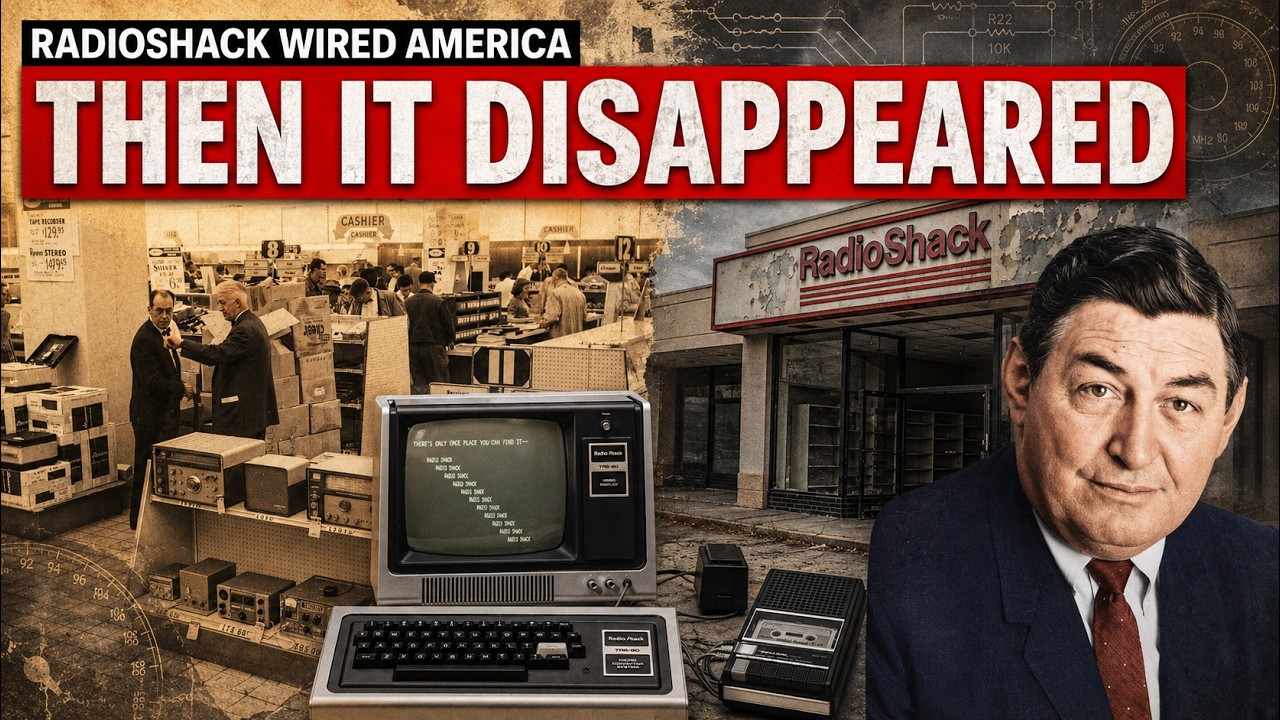
By June 1979, the company had sold more than 100,000. Alongside the Apple II and the Commodore PET, the TRS-80 became part of what historians now call the 1977 Trinity, the three machines that launched the personal computing revolution. For several years, it was the best-selling personal computer in the world, with some estimates suggesting it outsold Apple by a factor of five. That moment marked the peak of a company that had spent more than five decades building the infrastructure to make it possible.
But it would not last. The story of how RadioShack reached that height, and how it collapsed from it, is a story of identity abandoned for short-term profit, and of a retail institution that helped wire America only to be outlived by the technology it introduced. RadioShack began in 1921, when brothers Theodore and Milton Deutschmann opened a small retail and mail-order shop at 46 Brattle Street in Boston. An employee named Bill Halligan suggested the name, drawn from the small wooden structure aboard ships that housed radio equipment, the cramped room where a lone operator listened through static for messages from shore.
The store sold radio components to a niche community of ham operators and tinkerers who built their own devices. By 1939, the company had published its first catalog, expanding its reach far beyond Boston. During World War II, RadioShack became a supplier of military-grade equipment, and when millions of servicemen returned home in 1945 with working knowledge of radio technology, the company was ready for them. In the post-war years, RadioShack expanded into high-fidelity audio, opening what is widely considered the nation’s first audio showroom in 1947.
By 1954, the company began manufacturing its own products under the brand name Realistic, which would appear on millions of radios, stereos, and speakers for decades. For a generation of Americans, their first decent headphones, their first stereo receiver, their first set of speakers came from a RadioShack store. But by the early 1960s, the company was on the verge of collapse. It had expanded to about nine stores and maintained a thriving mail-order business, but downtown shopping was declining and the company had extended too much credit to customers who could not pay.
Buried under nearly $800,000 of uncollectible debt, RadioShack was within a hair’s breadth of bankruptcy. That is when Charles D. Tandy entered the picture. Tandy came from a leather goods family in Fort Worth, Texas, and had built the Tandy Corporation into a respectable enterprise.
He believed that businesses catering to passionate hobbyists were the best retail investments available. In 1963, he bought RadioShack for roughly $300,000. The company would eventually generate billions in annual revenue. Tandy moved quickly.
He slashed the product catalog from about 40,000 items to around 2,500, keeping the 20 percent of products that generated 80 percent of sales. He killed the money-losing mail-order business, ended the practice of selling on credit, and fired most of the top management while keeping the salespeople. Instead of operating a handful of large stores, he opened hundreds of small ones, which he called little holes in the wall, cheap to rent and easy to relocate. He focused on private-label products manufactured by his own subsidiaries, maintaining gross profit margins consistently above 50 percent.
And he poured as much as 9 percent of gross profits back into advertising. He used to say, “If you want to catch a mouse, you have to make a noise like a cheese. ”
Within two years, Tandy had turned a $4 million loss into a profit. The company was generating $20 million in annual sales and growing.
Stores appeared in strip malls and shopping centers across the country, staffed by employees who could explain the difference between a capacitor and a resistor. RadioShack became a community hub, a place where curiosity was welcome and asking a stupid question did not get you laughed at. When the citizens band radio craze of the mid-1970s began to fade, the company needed something new. That something was the personal computer.
John Roach, an engineer who had joined Tandy in 1967, believed computers would appeal to ordinary people, not just scientists. In January 1977, he presented a prototype to Charles Tandy and RadioShack’s president, Lewis Kornfeld. Tandy was skeptical, reportedly saying he saw no point in a machine that could not do anything useful. Roach persuaded him to order an initial run of 3,500 units.
Two young programmers, Bill Gates and Paul Allen, were hired to write the operating system for a little company they had founded called Microsoft. Charles Tandy died in 1978 at the age of 60, and the computer boom was exactly what the company needed to survive his loss. John Roach rose rapidly through the ranks, becoming CEO in 1981 and chairman in 1982. Under his leadership, RadioShack captured 19 percent of the personal computer market by the mid-1980s.
But cracks were already appearing. IBM entered the market in 1981 and published its technical specifications, allowing other manufacturers to create compatible clones. An open ecosystem formed around the IBM PC standard. RadioShack, stubbornly committed to its proprietary systems, could not run IBM-compatible software.
By 1984, its market share had plummeted to under 9 percent. In 1993, the company stopped manufacturing its own computers entirely, retreating from the revolution it had helped launch. The loss of the computer market left a gaping hole in RadioShack’s identity. The company needed a new anchor, and in the 1990s it found one: cell phones.
RadioShack partnered with wireless carriers and became one of the first major retailers to sell mobile phones in stores. In 1997, it launched the Sprint store at RadioShack, embedding Sprint’s wireless products directly into its locations. By the early 2000s, cell phones and wireless accessories accounted for roughly half of total sales. Revenue peaked around $5 billion in 2005, with more than 7,000 stores across the United States.
On paper, things looked healthy. Beneath the surface, the business was rotting. Selling a cell phone took about 45 minutes, requiring paperwork and credit checks, while other customers stood around waiting and left frustrated. The hobbyists who had been loyal for decades found their components shoved into dusty drawers at the back of the store, while the front was dominated by glossy phone displays.
RadioShack had traded its identity for a revenue stream. The carriers, Sprint, Verizon, AT&T, and T-Mobile, had no intention of letting a third-party retailer control their customer relationships forever. They began opening their own branded stores. When Apple launched the iPhone in 2007, Apple stores and carrier stores absorbed the market.
RadioShack was left in the middle, selling a product consumers had no reason to buy from them. Meanwhile, Amazon, launched in 1994 as an online bookstore, was rapidly expanding into electronics. Every resistor, capacitor, cable, and adapter RadioShack sold could now be ordered online at a lower price with free shipping. RadioShack’s leadership saw e-commerce as a threat to their stores rather than an opportunity.
They launched a ship-to-store program in 2006, more than a decade too late. The stores themselves had become a liability. More than 7,000 locations were clustered so closely they cannibalized each other’s sales. In Sacramento, there were 25 stores within a 25-mile radius.
In parts of New Jersey, seven stores sat within five miles. Each had its own lease, its own staff, its own overhead. And the company could not close them fast enough. In 2013, RadioShack secured a $585 million line of credit from GE Capital and a $250 million loan from Salus Capital Partners.
The loans came with restrictions on how many stores RadioShack could close each year. Even as the company hemorrhaged money, it was contractually trapped in a bloated retail footprint. The lenders’ real estate collateral was worth more than the business itself, and they had no incentive to let RadioShack shrink. In its final years, the company cycled through CEOs.
One pushed harder into wireless, redesigning stores and further alienating core customers. Another lasted fewer than two years. A third made the baffling decision to rebrand the company as “The Shack. ” Nothing worked.
Inside the company, reports described a culture of denial, with employees seeing the writing on the wall while leadership insisted things would turn around next quarter. In 2012, RadioShack began posting negative earnings. After 11 consecutive quarterly losses, the New York Stock Exchange delisted its stock in February 2015. Days later, the company filed for Chapter 11 bankruptcy protection.
In May 2015, a hedge fund subsidiary called General Wireless purchased RadioShack’s assets for $26. 2 million, a fraction of the $5 billion in annual revenue the company had generated just a decade earlier. General Wireless struck a partnership with Sprint, converting hundreds of stores into co-branded locations, but the partnership was not profitable. On March 9, 2017, RadioShack filed for bankruptcy again, closing 200 stores immediately and placing the remaining 1,300 under evaluation.
This time, the doors closed for good. The name refused to die. In 2020, an online retailer acquired the brand and relaunched the website. In 2023, the El Salvador-based Unicomer Group acquired the brand and began reopening physical stores.
As of today, roughly 400 authorized RadioShack dealer locations exist in the United States, a ghostly fraction of the more than 7,000 that once dominated the retail landscape. The collapse of RadioShack was not inevitable. It was a series of choices, each compounding the last: the choice to abandon the hobbyist community that had been the company’s backbone, the choice to become a cell phone reseller instead of leaning into what made it unique, the choice to ignore e-commerce until it was too late, and the choice to trade identity for short-term revenue. The maker movement of the 2010s, with its Arduino boards, Raspberry Pi computers, and 3D printers, was RadioShack’s market.
Those were RadioShack’s people. By the time the movement arrived, the company had already gutted its component inventory, fired its knowledgeable staff, and transformed its stores into phone kiosks. Charles Tandy understood the lesson when he bought a bankrupt nine-store chain and turned it into a national powerhouse. He knew exactly who his customer was and served that customer with obsessive focus.
The tragedy of RadioShack is that the company forgot that lesson. It forgot the small wooden room on a ship where a solitary operator sat among the wires and static, listening for signals and making connections. For nearly a century, that little store made America a more curious, more capable, and more connected place.
In the end, it abandoned the very people who had built it, and when that trust was broken, it was gone forever.
