The photograph from the Oregon woods in 1921 shows a man named Axel Halgrren walking up the side of a tree. Not climbing hand over hand, but walking upright, leaned back against a rope looped around the trunk, steel spurs biting into the bark, an axe in one hand and two hundred feet of open air below his heels. The men standing on the ground look like dropped tools. This was not a stunt.
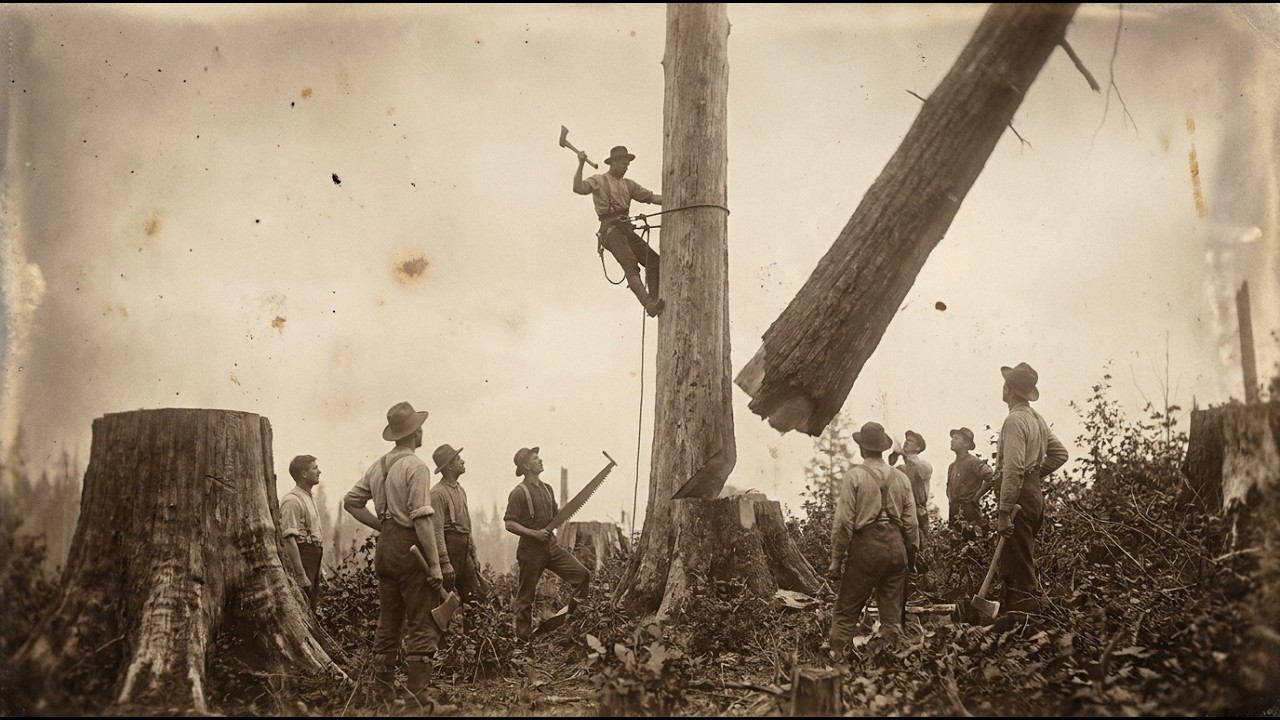
It was his job. Every working day, Halgrren and a few hundred men like him scattered through the forests of the Pacific Northwest climbed higher than the top of a twenty-story building on nothing but a rope and a pair of spurs to do the most dangerous single piece of work in the entire deadly business of logging. They were called high climbers, or high riggers, and they were the elite of the woods: the best paid, the most respected, the most reckless, the men every green kid in camp wanted to be. Most of them had the sense not to try.
The job sounds insane stated plainly. The high climber climbed a living tree, one of the giant firs of that country, and as he went, he chopped off every limb with a short-handled axe. Near the very top, two hundred feet up, he cut the entire crown of the tree off above his own head and rode out the explosion that followed. The moment the severed top broke free, the whole tree, suddenly relieved of the weight it had carried for a century, snapped and whipped back and forth through the air in violent arcs, with the climber lashed to it, hanging on two hundred feet up while the trunk bucked like an animal trying to throw him.
To understand why anyone would do this, you have to understand the problem the logging companies were trying to solve. The problem was weight. The Douglas firs, cedars, and spruces of the Pacific Northwest had been growing since before Columbus. Some were tall enough to shame a city building, with trunks so thick that a felled log could weigh more than a locomotive.
Cutting one down was hard enough. Getting it out of the rough country, miles from any mill, was harder. Oxen could not do it fast enough. Horses could not do it at all.
Even the steam donkey, the engine that changed everything, could only drag a log along the ground, plowing it through mud and stumps where it snagged and tore up everything in its path. So someone had a better idea. Instead of dragging the log along the ground, why not lift the front end into the air and fly it over the obstacles? To do that, you needed a mast: a tall, strong pole with a pulley at the top, so a cable could run up and over and pull the log toward you and up at the same time.
In a forest, you did not have to build a mast. The forest was full of them, already standing, already rooted deeper than any mast you could sink. You just had to take the biggest, strongest, best-placed tree in the area and turn it into your derrick. That was the spar tree: a living tree stripped, topped, and rigged into the central mast of the whole logging show.
The man who made it was the high climber. A logging show was a small industrial army. Down on the ground, the rigging crew wrapped heavy chokers, loops of cable, around each log so it could be pulled in. The whistle punk, often a boy, yanked a wire that blew coded blasts on a steam whistle, relaying signals to the distant engineer who could not see the log he was hauling; one wrong pull would kill someone.
There were buckers and fallers out in the timber, engineers on the steam donkeys, chasers at the landing. The whole roaring operation worked around the mast, and none of it could begin until the high climber had turned a standing tree into that mast. Before the high-lead system came in, the donkeys dragged logs along the ground on a cable, ground lead they called it, and the logs plowed and snagged on every stump in the way. Lifting the front end into the air on a tall spar was the leap that made the whole thing fast.
The price of that leap was a man two hundred feet up with an axe. It started with choosing the tree. Not just any giant would do. The spar had to be tall, straight, and sound, with no hidden rot in the heart of the trunk that could let go under load.
It had to be deep-rooted, because it was about to be pulled on hard from every direction at once. And it had to stand in exactly the right place, at the center of the ground they meant to log. Choose wrong and you had a spar that failed or a show badly placed. Then the climber looked up at the tree he was about to trust his life to, buckled on his spurs, and started up.
In the early days, before climbing spurs, men cut notches into the trunk and jammed in springboards, tapered planks with a lip of angled iron, standing on one board to cut the slot for the next, walking themselves up one narrow plank at a time. Later came the proper tools: sharp steel spurs strapped to the boots and a stout rope with a core of wire, the flip line, thrown around the trunk and buckled to the belt on both hips. The climber leaned back against the rope so it held him tight to the tree, kicked his spurs into the bark, then flipped the rope a foot up the trunk, stepped up, flipped it again, stepped up again, two hundred feet straight up with the trunk narrowing and swaying more with every foot. He was not just climbing.
He was working the whole way up. Every branch within reach of that short axe had to be cut clean off, because a spar tree with limbs on it was no good to anybody, and because those limbs were handholds and ledges he could not afford to leave for the rope to catch on. He climbed one-handed and chopped with the other, sap running down the bark and gumming everything. By the time he neared the top, he was standing on spurs driven into a trunk perhaps a few feet thick, swaying in the wind with the entire forest spread out flat beneath his boots.
Then came the topping. When the climber reached the height he wanted, where the trunk had narrowed to about three or four feet across, still thick enough to be a strong mast but slim enough to cut, he set his rope, braced his spurs, and began to chop through the tree above his own head. Above him was still a huge piece of tree, tons of green wood and branches, and he was severing it with an axe while tied to the trunk just below the cut. He worked an undercut on one side, then chopped from the other.
He had to read the lean and the wind exactly right, because he needed that top to fall clean away, not to split down the trunk toward him, and not to kick back into him as it went. When it finally let go, the tree tried to kill him. A tree that has carried the weight of its crown for a hundred years is under enormous strain. The instant you cut the top off, all of that stored energy releases at once.
The trunk springs upright, then past it, then whips back the other way, snapping through the air in arcs that could be many feet wide at the top, over and over until the energy bleeds off. The climber was tied to the tree near the very top, at the point where the whip was most violent. His entire job in that moment was to hold on, press himself to the trunk, grip the rope, and ride the bucking tree without being snapped off it. Men were thrown.
Men were killed. The ones who survived it did it again the next day, for as long as their nerve and their luck held. Once the tree was topped, the most dangerous minute was over, but the skilled work was just beginning. Hanging there, the climber rigged the spar.
He hauled up and bolted on heavy steel blocks, the pulleys the main cables would run through. He set the guidelines, a dozen or more massive cables running from near the top of the spar down to stumps anchored around the clearing, turning the single tree into the strong center of a great web that could take the strain of pulling logs weighing tons through the air. Near the very top went the biggest pulley of all, the main block, and below it more blocks for the lines that pulled the empty cable back out to the woods. The guidelines had to hold the spar rigid against a sideways pull of many tons without letting it lean or crack.
Get the geometry right and the tree became a machine that could work for years. Get it wrong and the first heavy log would find the mistake, and everyone standing under it would pay. When it all worked, it was one of the most impressive things in American industry. The spar tree stood in the middle of the clearing, stripped, topped, and strung with steel.
Out in the timber, the fallers had brought down a giant. The steam donkey coughed and roared and took up the slack. The main cable running up and over the block at the top of the spar came tight, and the front end of that enormous log lifted off the ground and swung into the air, flying in toward the landing over the stumps and brush that would have stopped a dragged log cold. In the biggest operations, they ran a cable clear across the valley from one spar tree to another and flew the logs through the sky on it, a system they called the skyline.
Logs weighing as much as a house sailed over the treetops on a wire, every bit of it hung on the one tree the high climber had turned into a mast. The high climber was the aristocrat of the logging camp. He was paid more than any other man in the woods. In an era when a top faller might make six dollars for a hard day’s work and a choke setter counted himself well off at eighty dollars a month, the climber stood above them all, in his pay and in his standing, and he knew it.
There was showmanship in it. At fairs, a great climber would top a spar for a crowd, cut the head off a tree, and ride the whip for an audience that gasped and cheered. The best became local legends, and camps competed for them the way a ball club competes for a star, because a logging show without a man who could rig a spar was a show that could not run. For every legend who topped spars into his sixties, like Hap Johnson, one of the most celebrated riggers of the old high-lead days, who later doubled for John Wayne in a Hollywood picture and was still topping spars for the camera at an age when most men who had done that work were long dead or crippled, there were men who did not see thirty.
The work killed in a dozen ways. The whip of the topping threw men to their deaths. Rotten wood high in a trunk gave way under a spur without warning. A guideline under strain could part and cut a man in half.
A block could fail and fall. Widow makers, the loose limbs and broken tops hung up above, could drop at any moment onto the man working below. Logging as a whole was one of the deadliest trades in the country, and the high climber worked at the deadly heart of it. The men accepted it the way soldiers accept a war, with grim humor and superstition and a refusal to talk about it much, and they went up the tree the next morning all the same.
Then, in the 1960s and into the 1970s, the whole trade vanished. The high climber was not killed off by safety rules or by mercy. He was made obsolete by steel. The logging companies began to replace the spar tree with a machine: a portable steel tower that could be hauled in on a truck, set up in an afternoon, and moved to the next show when this one was cut out.
No climbing required. A steel spar does not have to be found, does not have to be climbed, does not rot, does not care about the wind. It just needs a truck and a road. The reason for the high climber simply evaporated.
The skill that had taken a lifetime to master and a great deal of nerve to use was, in the space of a few years, no longer needed at all. The last of the old high climbers topped their last spars, hung up their spurs, and became old men telling stories that the young men in the steel tower crews could barely believe. A little of it survives at logging festivals, where men race up a spar pole and ring a bell at the top, speed climbing turned into a weekend sport. The climbing gear lives on in the kit of arborists who trim and take down trees in our cities.
But the thing itself, the working high climber who topped a living giant to make the mast that an entire industry hung from, is gone. What went with them was not only a job but a body of knowledge that had no other home, a hundred small judgments never written in any manual: how a fir would whip compared to a cedar, how to read a gust before it hit, how much trunk to leave below the cut, when a top was going to split and when it would fly clean. It was the kind of knowing that lives only in a person who has done a thing ten thousand times. When the steel towers came and the last climbers retired, that knowing was not handed down, because there was no longer anyone who needed it.
Every log that flew over those forests flew because he went up first. He was a man with an axe and a rope and a level of nerve we have half forgotten was ever possible. He did his work for wages, not glory, and he kept doing it until a machine made him unnecessary.
Then the whole thing was quietly forgotten, his name gone off the tree he climbed, his courage remembered now only in a handful of photographs where he is so high up you can barely make out his face.
