On the morning of March 30, 1854, the first arrow came down out of a clear sky and struck the ground six inches from Trooper Peter Welden’s left boot. It buried itself in the wet earth and stood there quivering. Welden did not move. A second arrow came, then a third, then so many that a survivor later said it began to rain pieces of sharpened wood.
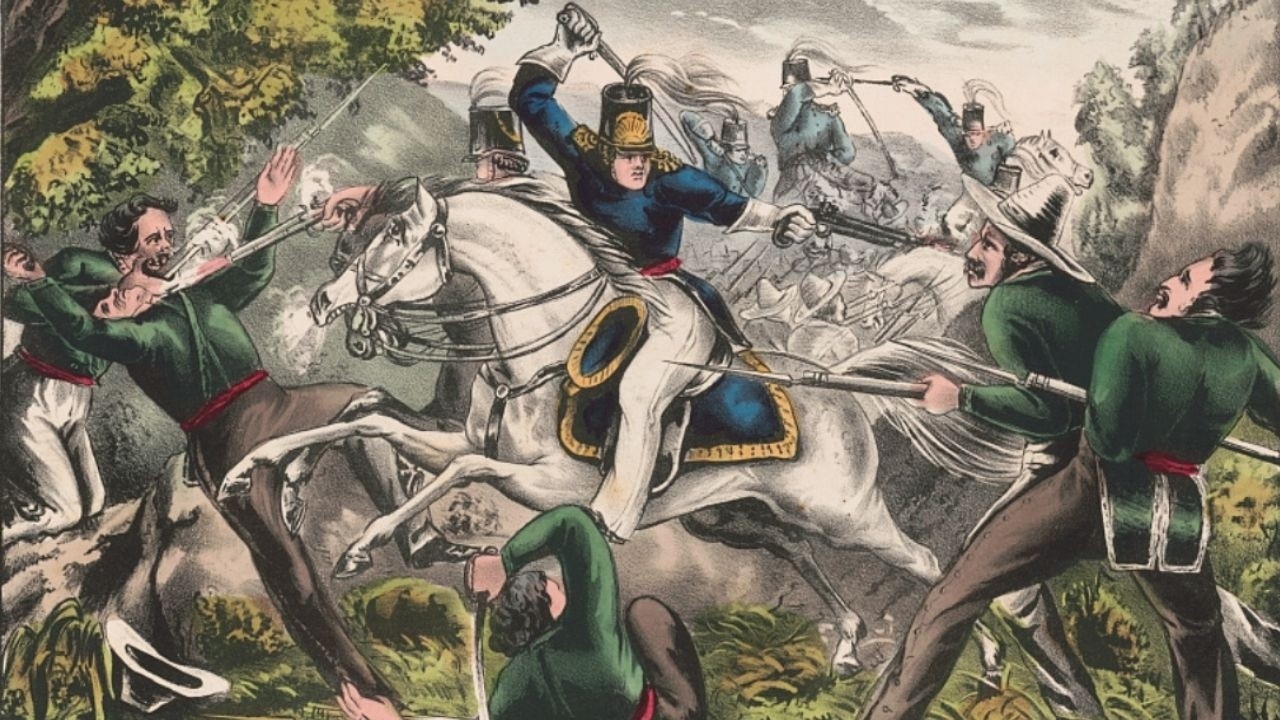
The place was a narrow draw in the Embudo Mountains of northern New Mexico Territory, above a small settlement called Cieneguilla. Sixty United States Dragoons had ridden into that draw at sunrise. Most of them would not ride out. Above them, on the high rocks, roughly 250 Jicarilla Apache and Ute warriors held every piece of high ground that mattered.
They had known the soldiers were coming for hours. They had chosen the place, the hour, and the man who would lead the Dragoons into the killing ground. His name was John Wynn Davidson. He was 28 years old, and he believed he was about to win a famous victory.
He was wrong. To understand how sixty trained soldiers ended up trapped in that canyon, it helps to go back a few weeks to another fight along the Canadian River, about 120 miles east. The Jicarilla had lived in northern New Mexico and southern Colorado for centuries. The Spanish had named them for the small, tightly woven baskets the women made.
They were not the great horse nations of the plains. They hunted antelope and traded with the Pueblo villages. But by 1854, the world that had carried them for generations was closing in. The Santa Fe Trail ran through their country, buffalo were thinning, settlers were pressing from the east, and hungry men made hungry decisions.
A few young Jicarilla had begun raiding cattle herds that supplied army forts. In February of 1854, a beef contractor named Samuel Watrous reported that a small herd of his cattle had been driven off by Jicarilla raiders. The garrison commander at Fort Union, Lieutenant Colonel Philip St. George Cooke, sent a young officer named David Bell with twenty-four men of the Second Dragoons to recover the cattle.
Bell found a Jicarilla camp on the upper Canadian River on March 5. The chief was a man called Lobo Blanco, White Wolf. According to surviving accounts, Bell and Lobo Blanco rode out alone between their lines and spoke through an interpreter. The chief said the cattle were his by right of grievance, because his people were hungry and the herds were on Jicarilla land.
Bell said he would have to take the chief back to Fort Union. Lobo Blanco refused. Then the talking stopped. What happened next would be argued about for years.
The fight started suddenly, hand-to-hand, with the chief and the lieutenant grappling between the lines. The dragoons opened fire. Lobo Blanco fell badly wounded, and the story goes that even after he could no longer stand, he fought from the ground. Some accounts say a soldier finished him with a large rock.
Others say he was shot. Either way, the chief was dead before the smoke cleared, along with five other warriors and two dragoons. By frontier standards, it was a small thing, a skirmish finished in under an hour. Lieutenant Bell rode back to Fort Union satisfied.
But he had just lit the fuse on the worst dragoon defeat the Southwest would see before the Civil War. Lobo Blanco was not just a chief. He was a relative, a friend, and a leader to almost every adult Jicarilla in northern New Mexico. The Apache do not forget a man like that.
The older men who had counseled restraint for two winters found themselves out of arguments. Word went out across the high country, to the Llanero on the plains, to the Ollero along the upper Rio Grande, and to the Ute bands north of Taos who had old friendships and intermarriages with the Jicarilla. The young men sharpened their iron arrowheads. The older men cleaned out their flintlock rifles.
And in a village called Cieneguilla, two respected Jicarilla leaders began gathering warriors: Francisco Chacón and a man the Americans rendered as Flechas Rayadas, Striped Arrows. Striped Arrows picked his ground the way a good chess player picks his squares. He would be proven a tactician of rare skill. John Wynn Davidson was born in 1825 in Fairfax County, Virginia.
He graduated from West Point in 1845 and fought in California and New Mexico under Stephen Watts Kearny. By the spring of 1854, he was a first lieutenant with the First Dragoons, posted to a small adobe fortification called Cantonment Burgwin, ten miles south of Taos. The men there were a mix of Mexican War veterans and green recruits just off the boat from Ireland or Germany. They were paid eight dollars a month.
Their carbines, the Springfield Model 1847 musketoon, fired a heavy . 69 caliber ball but were notoriously inaccurate past about one hundred yards. In the weeks after Lobo Blanco’s death, scouts brought reports of Jicarilla campfires and unshod pony tracks. Major George Alexander Blake, who commanded the cantonment, called Davidson in on March 29 and gave him a specific order: take sixty men from Companies F and I, ride south to the Rio Grande, find the Jicarilla band, and watch them.
He was not to engage. He was not to bring on a fight. To make the point clear, each dragoon was issued only twenty rounds for his musketoon and twenty for his pistol. It was a scouting load, not a fighting load.
Davidson understood the order. He confirmed it. Then he marched out on a cold, gray afternoon. But a few weeks earlier at Fort Union, Davidson had stood in the officers’ mess and announced that the Jicarilla Apache were, in his exact words, puny cowards.
Other officers told him gently to lower his voice. He said it again. He said any properly led dragoon company could ride straight through them. He believed it down in his bones.
The march south was uneventful. By the night of the 29th, the command had reached Ranchos de Taos and camped in the broken country above the Rio Grande. In the small hours before dawn, Davidson sent two men ahead: a civilian scout named Jesus Silva and a young Irish trooper named Jeremiah Maloney. They reached the Embudo crossing about an hour before sunrise.
No tracks at the ford. They turned back, and as they did, Maloney saw far up on a high ridge a cluster of small orange lights. Campfires, dozens of them, strung along the ridge like a row of low stars. Silva reported to Davidson that the Apache were in a large camp less than two miles to the northeast.
He warned that the ground above that ridge was bad and the canyon below it worse. Any force going up that draw would find the high ground belonged to the people on top. Davidson could have done what his orders said. He could have positioned his men on the western bank of the river, blocked any crossing, and sent a courier for reinforcements.
Instead, he ordered his bugler to sound boots and saddles. He told his men they were going to find the Apache camp, surprise it before full daylight, and disperse it. They rode out at a slow walk, sixty men in a column of twos, into the rising sun. The trail led up broken ground covered with juniper and scrub oak.
The horses’ iron shoes struck loose rock with a sound any lookout would have heard a mile away. It is reasonably certain the Jicarilla heard them coming for at least an hour before they arrived. About forty minutes into the climb, Davidson sent forward an advanced party under Sergeant William Kent, an experienced six-year veteran. Kent’s party found the village tucked into the bottom of a small box canyon, almost enclosed by steep slopes on three sides.
Twenty or so hide lodges, horses in a brush corral, smoke from breakfast fires. It looked exactly like what an experienced Apache war leader would want a young American officer to see. A few warriors at the bottom of the canyon spotted the dragoons and began calling and gesturing for them to come down, taunting them. Davidson took the bait.
He ordered his men to dismount at the edge of the high ground. He left the horses in a small hollow with no clear field of fire and no easy line of retreat. Then he split his command into three platoons. Sergeant Kent took the right, Sergeant Holbrook the left, Davidson held the center.
The dragoons started up the slope, their leather-soled boots slipping on melting snow and wet pine needles. It felt less like a charge than a slow, exposed climb. At about thirty yards from the crest, Kent’s platoon broke into a final rush. That is when the rifles opened up.
The Jicarilla and Ute were not in the village. The village had been a decoy. The warriors were hidden on the high ground in juniper and behind boulders, perhaps 250 of them, with flintlock rifles and iron-tipped arrows that punched through wool uniforms like needles through cloth. They had the high ground, the sun behind them, and they had been waiting in absolute silence for almost an hour.
The first volley took Sergeant William Kent in the chest. He died before he hit the ground. Six more men went down before they could return fire. The warriors had positioned themselves carefully.
They were close enough to shoot down with accuracy and just far enough that the dragoons’ musketoons and pistols were nearly useless against them. Many of the warriors did not even use rifles. They used bows, sending arrows on high, lazy arcs that came down almost vertically. There was no cover from arrows like that.
For the next forty minutes, the dragoons held their position. They fired carefully, each round counting. They watched their friends get hit. Trooper Peter Welden took an arrow through his right arm and fired his pistol left-handed.
Sergeant Holbrook took two wounds in five minutes and kept giving orders. Then they began to run low on ammunition. Twenty rounds per man burned through in under an hour. When the survivors reached down for more, there were no more.
Men went through the cartridge boxes of their dead comrades, through pockets still slick with blood. Two soldiers briefly fought over a single paper cartridge before one, ashamed, gave it to the other. Davidson did not panic. He moved along the firing line, took a slight wound in the leg, and bandaged it himself.
Finally, he gave the order to fall back to the horses. The retreat was when the killing got worst. The dragoons came down in groups of two and three, dragging their wounded, slipping on the same loose ground. The Jicarilla did not pursue in a screaming charge.
They moved along the high ground, calmly picking shots. It was not a battle anymore. It was a hunt. When they reached the horses, they found twenty-two mounts dead where they stood.
Most of the survivors were wounded badly enough to die within the day. The assistant surgeon worked over Trooper George Breinwald, shot through the lung, but could not stop the bleeding. The men got back into their saddles, many riding double, and turned the column toward Cieneguilla and the river. The Jicarilla were already ahead of them.
Striped Arrows and Chacón had anticipated the retreat and had men in position along every likely escape route. The broken column took fire from above again and again. Trooper James Bennett, enlisted under the assumed name James Bronson, took a rifle ball through his left thigh that traveled upward and ended near his groin. He went down, fainted from pain and blood loss, and came to alone with the column gone and the Apache close.
He crawled on hands and one knee until he reached two surviving horses that had stopped to let wounded men climb on. He grabbed a stirrup with each hand, and when the horses moved, he was dragged between them for half a mile, his body off the ground. He did not let go. He survived.
He would later desert, study medicine, and serve as an assistant surgeon in two New York heavy artillery regiments during the Civil War. He died in 1865, a few weeks after Lee surrendered at Appomattox. By noon, four hours after the first shots, the dragoons had broken contact. The warriors did not press the pursuit.
They had achieved what they came to achieve. Davidson rode into Ranchos de Taos late that afternoon at the head of a column unrecognizable as a military formation. Twenty-two dragoons were dead, scattered across two miles of broken country. Thirty-six more were wounded, some so badly they would die in the next few days.
Of sixty men who rode out that morning, fewer than ten could stand at attention by sundown. The army was stunned. The news traveled to Santa Fe, to Fort Union, to Independence, Missouri, and finally to the eastern newspapers. The New York Times picked it up on May 24.
Davidson wrote his official report two days after the fight. In his telling, sixty men had been ambushed by a vastly superior force of perhaps three hundred warriors who had used overwhelming numbers and treacherous tactics. He had attacked with vigor, withdrawn in good order, and brought out his wounded. The defeat was a glorious example of American courage against impossible odds.
Lieutenant David Bell, the same officer who had killed Lobo Blanco, read Davidson’s report and wrote a counter report. He knew the village had been almost empty. He knew the warriors had not ambushed Davidson. He knew Davidson had charged uphill into a prepared defensive position with sixty men carrying twenty rounds each.
Bell wrote it all down and sent it up the chain of command. It was buried. A court of inquiry convened in 1856, two years after the fight. Davidson testified at length.
His surviving sergeants testified carefully in his support. The court cleared him of every wrongdoing. Bell, the one officer who tried to write the truth, was killed at Cold Harbor in 1864. His report was filed away and not seriously examined for almost 150 years.
In 2009, archaeologists began the first real excavation of the battlefield at Cieneguilla. They mapped every cartridge case, fired bullet, iron arrowhead, and brass button. The evidence showed the dragoons had advanced uphill into a prepared defensive position, been outflanked and hunted methodically down escape routes the warriors had anticipated. The archaeologists pointed at the evidence and let it speak.
It said what David Bell had said in 1854. The official story was a lie. The defeat made the army furious, not cautious. Within five days, Lieutenant Colonel Philip St.
George Cooke was organizing a punitive expedition. He was a veteran of the Black Hawk and Mexican Wars, a careful student of frontier tactics, and he took Kit Carson with him. The pursuit took almost a year. Cooke and Carson chased the Jicarilla through the worst weeks of winter.
The bands dispersed, moved constantly, sometimes traveling days through deep snow without lighting fires. Many died from cold and hunger. The army called it a pursuit. From the Jicarilla side, it was slow extermination by weather and exhaustion.
On April 8, 1855, Cooke’s column caught up with a large camp at Ojo Caliente in the Sangre de Cristo Mountains. The fight was short. The Jicarilla, exhausted and badly outnumbered for once, broke and scattered. Many got away.
Many did not. Chacón and Striped Arrows both survived, though both died within a few years from causes the army records do not specify. A few days before the fight, Striped Arrows had offered to return every horse and captured weapon if the army would make peace. General John Garland refused.
The army’s terms were about surrender. By the end of 1855, the Jicarilla War was effectively over. Bands of survivors drifted into agencies at Cimarron and Taos. By 1887, after another generation of negotiation and broken promises, the surviving Jicarilla were given a reservation near the town of Dulce, where about 3,500 of their descendants still live.
The descendants of the men who rode with Striped Arrows still tell the story of Cieneguilla. Not the version Davidson wrote. The other version, the one the rocks told the archaeologists in 2009. John Wynn Davidson did not suffer for what he did.
He fought in the Civil War, commanded cavalry brigades, and was brevetted brigadier general for gallant and meritorious service. He retired in 1881 and died peacefully two years later in St. Paul, Minnesota. His obituary described him as a brave and distinguished officer.
It did not mention Cieneguilla. Twenty-two American dragoons died that Thursday morning because a young officer disobeyed a direct order and walked them into a fight they should never have been in. The Jicarilla won that fight, and in winning, they lost everything. Striped Arrows had executed one of the most tactically brilliant ambushes in the history of the southwestern Indian wars, and it did not matter.
Within a year, his people were on the run. Within a generation, their world was gone. The frontier was not a story of heroes and villains. It was a story of people on both sides who made hard choices in country that did not forgive mistakes.
The Apache father who picked up his flintlock that morning had reasons. The Irish dragoon who climbed the hill behind Sergeant Kent had reasons too. They did not know each other’s reasons. By noon on March 30, both sides had paid for them.
The battlefield is now part of the Rio Grande del Norte National Monument. You can still see the rocks the warriors used for cover and the draw the dragoons came up. The wind comes down out of the high country and sounds sometimes like voices, though that may just be a trick of the rocks.
