The morning of November 4th, 1791, began with a short-lived calm. The army of Major General Arthur St. Clair had been roused from its tents before daylight, ordered into formation under arms, and made to stand in the cold until the scouts came back one by one with the same report: no enemy in sight. The men were dismissed to their breakfasts.
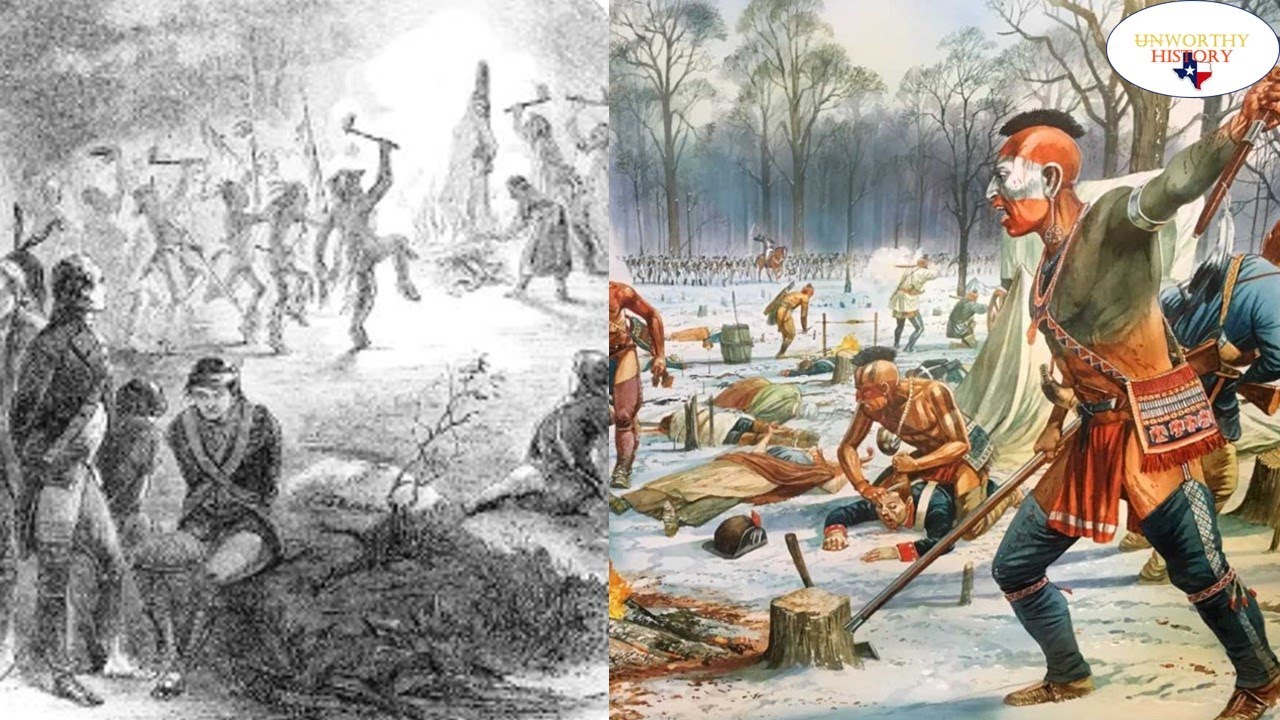
Many of them, exhausted from weeks of marching through the Ohio wilderness, simply lay down where they stood to snatch a few minutes of rest. They did not get it. Before the sun had fully risen, the crack of rifle fire tore through the camp, and then came the yells. The attack fell first upon the militia, who broke almost immediately and fled in a panic straight into the heart of the regular camp, with painted warriors close behind them, tomahawks raised.
A soldier named Jackson Joe Hunot, a sergeant in Captain Felon’s company, had been sleeping in his tent when the first volleys and the terrible whooping of the Indians jolted him awake. He seized his musket and ran out with several of his comrades. What he saw was the militia being butchered in front of the tents. He fired into the mass of Indians and had the satisfaction of seeing one of them drop at the very moment his tomahawk was raised to strike a gallant officer who was already engaged sword in hand with another warrior.
Hunot believed his example steadied the men around him. The regulars of his company, joined by soldiers from other units, drove the Indians back into the bush and formed into tolerable order under commanders who, as he later put it, were as gallant as ever died in defense of America. The firing stopped for a few minutes. It was, Hunot wrote, like the interval of a tornado, designed to strike the deeper horror.
Then the storm broke again, and this time it was far worse. From every side of the camp, the heaviest and most deadly firing erupted. The army was exposed, the ground gave the enemy cover, and men fell in droves, drenching the ground with blood. The American return fire, directed almost at random, did little execution.
Orders came to charge with bayonets. The men obeyed with alacrity, and a swarm of tawny warriors rose from the grass and fled before them. But the officers, made conspicuous by their efforts to push the men forward, were singled out and cut down so fast that scarcely a shot from the enemy seemed wasted. The ground gained by the bayonet was lost again for want of support, and the small American force was forced, again and again, to give way.
The army had been reduced to less than half its original number, and to less than a fourth of its officers. The horses were all killed or captured. The artillerymen had been wiped out, and the cannon were in enemy hands. There was nothing left but to retreat, and the retreat soon became a flight.
For miles, Hunot ran and walked amid the yells of the Indians, more dreadful to his ears than the screams of damned fiends, amid the groans of dying men, and the terrible sight of the Indians overtaking and massacring the stragglers. He fired his musket many times and believed his shots took effect. “Providence was pleased to sustain my spirits and preserve my strength,” he wrote. He had been so weakened before the campaign that he could not bear a moderate degree of exercise, yet he traveled on foot all night and reached Fort Jefferson the next morning at ten o’clock.
It was not the first time Hunot had stared down death in this war. He had been born in Falmouth, in Casco Bay, which was then part of Massachusetts and is now in Maine. His parents were poor, their farm small and hard to cultivate, the family large and expensive. Just past his seventeenth year, having resolved to seek his own fortune, he took leave of his friends and sailed on the first of May, 1791, aboard a coasting schooner for Boston.
Once in the capital, he found himself entirely out of employment, and many times sincerely wished himself back home. Pride kept him from returning. One morning a young officer came into his room and began to talk about the pleasures of military life, the great chance for an active young man to obtain promotion, and the grand prospect of making great fortunes in the western country. After treating him to a bowl or two of punch, the officer convinced him to enlist, with a firm promise to help him obtain a sergeant’s warrant before the party left Boston.
Hunot soon learned the value of that promise. Instead of becoming a sergeant, he was treated severely for his ignorance of military matters and insultingly ridiculed for complaining about the officer’s conduct. After a time he gave up complaining, applied himself to learning the drill, and in a few days became a tolerable expert. At the beginning of July the regiment left Boston and marched west to join the Western Army.
At Fort Washington he was ordered to join Captain Felon’s company, and in a few days set out on the expedition under General Josiah Harmar. The hardships of that campaign were constant: hunger, fatigue, and toil. Yet the men kept their spirits up, expecting easy conquest, rich plunder, and fine arms at the end of it. Hunot had obtained his sergeancy and flattered himself that he was on the direct road to honor, fame, and fortune.
It did not last. Before he had a chance to distinguish himself in battle, he was taken in an ambuscade by a party of Kickapoo Indians on the bank of the Wabash River, together with ten others. The survivors were marched toward the upper Miami. On the second day after their capture, one of his companions, an Irishman named George Akins, became so faint with hunger and fatigue that he could go no further.
A short council was held among the Indians who guarded them. The result was that Akins should be put to death. The captain of the guard approached the bound man, made a circular incision on his skull with a knife, and two others pulled off his scalp. Then each of them struck him on the head with a tomahawk.
They stripped him, stabbed him with their knives in every sensitive part of his body, and left him weltering in blood, not quite dead. “A wretched victim to Indian rage and hellish barbarity,” Hunot called him. The march to the upper Miami took eight days. Hungry, thirsty, and exhausted, the prisoners were met at the entrance of the town by about five hundred Indians, besides squaws and children, who had been warned of their approach by a hideous yelling from the escort, answered from the village.
The prisoners were all severely beaten. Four of their number, James Durgy of Concord, Samuel Foresight of Beverly, Robert Deoy of Marblehead, and Oza Benton of Salem, fainted under the heavy trials. They were immediately scalped and tomahawked in the presence of the others and tortured to death with every affliction of misery that Indian ingenuity could invent. It was the fourth of August when the prisoners were taken, and the thirteenth when their companions were massacred.
That same day news arrived of the destruction of a detachment of General Harmar’s army. The warriors exhibited numbers of scalps, and several prisoners were paraded through the village, among them three women and six children, destined for a Kickapoo settlement further westward. Two days later, on the fifteenth of August, four more of Hunot’s fellow prisoners, Lemuel Saunders of Boston, Thomas Tharp of Dorchester, Vincent Uppam of Mystic, and Young Glove Croxell of Abington, were taken away. Whether they were massacred or preserved alive, Hunot could never say.
For a fortnight after that, nothing of consequence happened, except that the prisoners were several times severely whipped on the receipt of bad news, and their allowance of provisions was cut, so that they feared they would starve to death if they did not first fall sacrifice to the fire or the tomahawk. But heaven had decreed otherwise. On the night following the thirtieth of August, the guard of four Indians, tired out with watching, lay down to sleep, leaving only an old squaw to watch the prisoners. By some means, Hunot’s companion had worked one of his hands free, and having a knife in his pocket, cut the bindings from his own feet and from Hunot’s arms, all unnoticed by the old squaw, who sat drowsy by a small fire in the wigwam.
Hunot ruminated only a few moments. There was no weapon near them except the knife. He looked at his companion to make him observe him, and at the same instant sprang and grasped the squaw by the throat to keep her from making a noise. His comrade cut her throat from ear to ear down to the neckbone.
Then Hunot seized a tomahawk and his companion seized a rifle, and at the same instant they dispatched two of the sleeping enemy. The sound of the blows awakened the other two, but before they could rise, the prisoners renewed their strokes, stunning them, and then, repeating the blows, sank a tomahawk into each of their heads. They armed themselves completely, took what provisions the wigwam afforded, and committed themselves to the protection of providence, making the best of their way into the wilderness. The journey that followed was, in Hunot’s words, too great to have been endured by any who had less interest than life at stake, or a less terrible enemy than Indians to fear.
Hunger, thirst, and fatigue were constant companions. They traveled hard day and night, with only the few hours of rest absolutely required to keep nature from sinking, one always keeping watch while the other slept. They shifted their direction when they met impassable bogs, deep morasses, and hideous precipices. On the morning of the fifteenth of September, steering nearly north to avoid a bog, they came upon the bodies of an old man, a woman, and two children, newly murdered, stripped, and scalped.
From the circumstances, Hunot concluded they had been dragged from their homes, and with their feet worn out, had been inhumanly murdered and left weltering in their own blood. At a loss which way to go, they chose a course about northwest and walked as fast as they could. About noon they came to a good spring, a great relief, but within minutes they believed it would be the last of their earthly comforts. Hunot’s companion, a corporal named Richard Sackfell of Captain Newman’s company, stepped into the thicket and returned with the report that a few rods away he had discovered four Indians, with two bound prisoners, sitting under a tree, eating.
If Hunot would join him, he would either relieve the captives or perish in the attempt. No time was to be lost. Sackfell took the lead and brought Hunot undiscovered within fifty yards of the Indians. Two of them lay on the ground with their muskets in their arms, apparently asleep.
The other two sat at the head of the prisoners, muskets resting against their left shoulders and tomahawks in their right hands, held over the heads of their captives. Each of the two Americans chose his man and fired deliberately. Both Indians fell. The other two started up and, seeming at a loss to determine where the attack came from, fell on their bellies and looked carefully around.
Sackfell and Hunot recharged, shifted position slightly, and waited impatiently for them to rise. In a minute the Indians raised themselves on their hands and knees and, having discovered the smoke of the guns rising above the bushes, attempted to crawl into the thicket on the opposite side. The two Americans fired again, at different men, and brought them both down. One lay motionless.
The other crawled a few yards, and Hunot loaded in an instant and rushed toward him, keeping an eye on him as he reached his comrade’s gun and sat upright in a posture of defense. The noise in the bushes gave away their direction, and a fatal shot from the wounded Indian killed Sackfell. At that moment the two prisoners, only loosely bound, tried to escape toward Hunot, but the desperate Indian fired again and shot one of them dead. The other gained the thicket within a few yards.
Hunot, having reloaded, discharged his weapon at the wounded Indian and struck him in the neck, from which he saw the blood flow swiftly. The Indian still kept his seat, and having loaded his guns, fired them both at the Americans before falling, seemingly from faintness and loss of blood. Hunot ran to the surviving prisoner, unbound his arms, and armed him with Sackfell’s musket. They approached the wounded Indian cautiously.
Hunot ordered his new comrade to fire, and the shot took effect, though the Indian still lay motionless. When the musket was reloaded, they drew near and found him not quite dead, a tomahawk in each hand, which he flourished at them, seemingly determined not to be taken alive. Hunot wanted to take him prisoner, but his companion prevented it, shooting him through the body. Hunot asked his new companion what course they should steer, and where the party had come from.
The man, whose name was George Ston, formerly of Newport, Rhode Island, told him they were within about three days’ march of Fort Jefferson. He and three others had been taken four days before by a party of ten Wabash Indians in the neighborhood of the fort. Two of his companions, being wounded, were immediately scalped and killed. The party had held seven other prisoners, three of whom were under the charge of a separate group of four Indians; what became of them was unknown.
The others, worn down with fatigue, had been massacred the day before. Those were the bodies Sackfell had found in the thicket. The remaining two Indians had gone toward the settlements, having sworn to kill certain persons whose names Ston had forgotten. “Destruction seemed to be their whole drift,” Hunot wrote.
Ston proved to be an excellent woodsman and a man of great spirit, and so grateful for his deliverance that he would not let Hunot stand watch, nor allow him to sleep more than one hour in the twenty-four, though Ston himself was so fatigued he needed far more rest. He would not even permit Hunot to carry any of the baggage. From the eighteenth of September they steered as direct a course as possible toward the southeast, guiding themselves by the sun and by the moss on the trees by day, and by the moon at night. On the evening of the eighteenth, they providentially fell in with an American scouting party, which conducted them safely in a few hours to Fort Jefferson, where they were treated with great humanity and supplied with the best refreshments the fort afforded.
To Hunot it was very welcome, for he had tasted nothing but wild berries and ground nuts for more than a week. A week after his arrival, Hunot returned to duty with his own regiment, which had joined the army at the end of August for an expedition against the Miami village, the very place where he had suffered so much and so recently, where he had beheld so many cruelties perpetrated on unfortunate Americans. It is easier to conceive than describe the perturbation of his mind. The ordinary risk of battle seemed heightened by the certainty of torture that awaited him if he was captured.
The reflection only produced a firm resolution to do his duty vigilantly and to sell his life as dear as possible, but by no means to be taken alive if he could avoid it. His captain showed him every kindness on the march, giving him a horse as often as possible and promising to use his influence to obtain a commission for him if he conducted himself well. “Poor gentleman,” Hunot wrote. “Little did he think he was soon to expire gallantly fighting the battles of his country.
”
On the third of November the army arrived within a few miles of the Miami village. The force numbered about twelve hundred regular troops and nearly an equal number of militia. That night, expecting an attack, they were ordered under arms about midnight and kept in formation until just before daylight, when the scouts came in with nothing to report. That was when the men were dismissed to breakfast, and the rest of the camp was so short.
In the battle that followed, the militia broke, the regulars held and charged, the officers were picked off one by one, and the army was ground down until fewer than half the troops and a quarter of the officers were left, the artillery lost, the horses gone. What remained was a desperate flight that lasted until the survivors reached Fort Jefferson. Hunot reached the fort the day after the action, at ten in the morning, having traveled on foot the whole night. In the aftermath, General St.
Clair, in consequence of Hunot’s sufferings and what he and others were pleased to call soldier-like exertions, presented him with an ensign’s commission on his rejoining the remains of his old company. “In which station I mean to serve my country again,” Hunot wrote, “as far as my slender abilities will permit, trusting that the same kind protecting providence, which hath covered my head in the day of battle, and shielded me repeatedly in the hour of danger, will dispose of me as to infinite wisdom seems best. ”
He closed his narrative with a hope: that if he died in the cause of his country, the remembrance of his sufferings, his escapes, and his perseverance might kindle a flame of heroism in the breast of many an American youth and lead him to defend the frontier inhabitants from the depredations of Indians, “whose tender mercies are cruelties and whose faith is by no means to be depended on though pledged in the most solemn treaties. ”
The account of Jackson Joe Hunot was published in 1808 in a book by Ludencus Archibald, a selection of narratives of outrages committed by the Indians in their wars with the white people.
The great defeat he survived is real. St. Clair’s campaign ended on that November morning in the worst loss the United States Army ever suffered at Indian hands: six hundred fifty-six soldiers killed or captured on the banks of the Wabash, near the present border between Ohio and Indiana, led by the Miami war chief Little Turtle. Hunot’s own story is harder to verify.
Beyond Archibald’s book, and its reprinting in Joseph Pritts’ 1838 “Incidents of Border Life,” almost no records survive of the people he named. The one trace is a record of a George Saxton, born in Connecticut in 1760, bordering Rhode Island, the home of the man who reached Fort Jefferson with Hunot after their captivity. There is no record of Saxton being captured by Indians, though it is possible a connection exists, and just as possible that the author of the narrative died shortly after writing it, leaving no descendants and little record of himself.
The battle itself, and the suffering of those who stumbled out of the wilderness afterward, remain stamped into history, vouched for by the testimony of an illiterate soldier who asked only that the reader pardon his inaccuracies and drop a tear of sympathy for the unfortunate countrymen who fell into the hands of the Western Indians.
