The letter reached the Medical Society of Charleston at midday during a damp summer week in 1852, written in the shaky hand of a country doctor who had ridden forty miles through swamps and pine woods to see something he had been told twice was impossible. He apologized in the first paragraph for the trembling of his script, blaming the heat and the horse, before turning to the purpose that had drawn him from his usual practice for the first time in nine years. He described a pair of enslaved infants, about ten months old, born to a woman named Monemia on a small farm in Columbus County, North Carolina. The doctor had heard of them as everyone in that part of the state had, in the hushed way country people share news that unsettles them.
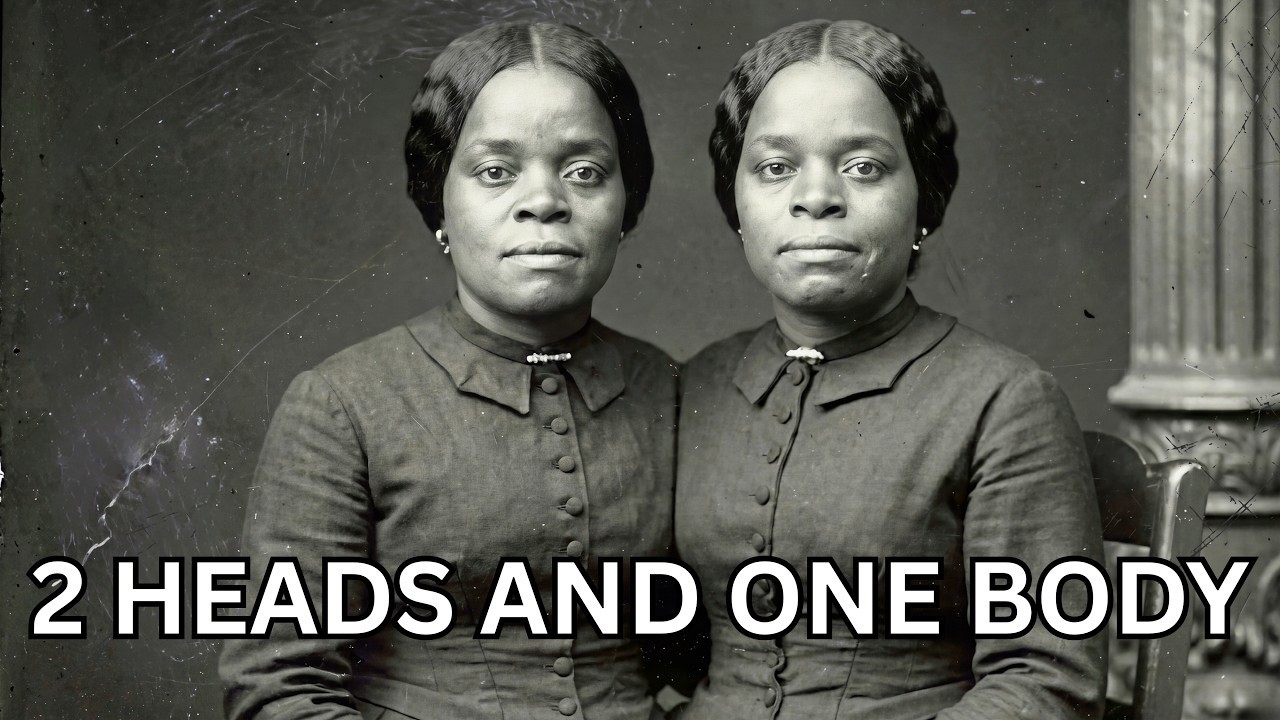
Two children in one body, joined at the base of the spine, sharing a single pelvis but possessing two heads, two hearts, four arms, and four legs—and, as far as he could determine after a two-hour examination in a hot cabin behind a blacksmith shop, two entirely separate personalities. He wrote that he had come intending to expose a fraud. Before seeing the children, he assumed the story was either a grotesque exaggeration or a showman’s trick, perhaps a costume, or two ordinary infants bound together under a single shirt. He had brought his instruments: a stethoscope, a small measuring rule, and the certainty of a Southern physician whose career had been spent being asked to confirm the natural inferiority of people who did not look like him.
What he found in that cabin matched nothing he had been trained to interpret. The children were, in his exact words, one body and two genuine persons in every sense of the word, more so than anything my hands have touched in my medical practice, and I confess I do not know what to do with what I have seen. The letter ran seven pages. It circulated among several members of the Medical Society.
It was eventually forwarded to a showman in South Carolina named John C. Purvis, who had made a small fortune in traveling exhibitions and understood, the way certain men always understand, that a thing which cannot be explained can almost always be sold. Within weeks, Purvis traveled to Columbus County. He walked to the small farm owned by a rural blacksmith named Jabez McKay.
He opened a leather bag. He counted out one thousand dollars in gold coins on the wooden porch. And he left that porch an hour later carrying two ten-month-old girls in a wicker basket wrapped in a single blanket, while their twenty-two-year-old mother stood at the door of the slave cabin behind the blacksmith shop and screamed until her voice gave out and could no longer be heard from the road. Their names were Millie and Christine McCoy.
They were born on July 11, 1851, near the small town of Whiteville, North Carolina. They shared one pelvis and one spine below the tailbone and, according to their mother, one soul distributed across two entirely different daughters. Before they turned four, they were sold five separate times. They were exhibited at the North Carolina State Fair.
They were exhibited at P. T. Barnum’s American Museum in New York City. They were kidnapped by one of their managers.
They were smuggled across the Atlantic. They ended up on a stage in Birmingham, England, where British physicians examined them, while their mother sat three thousand miles away in North Carolina, not knowing whether they were alive or dead. And then, in a story no sane person would believe were it not documented in medical journals, newspaper accounts, court records, and their own carefully preserved handwriting, those two children, sold like a pair of horses before they could form a complete sentence, grew up to speak five languages, sing duets before Queen Victoria, tour four continents, and earn more money than most white physicians made in a lifetime, and finally bought the farm where they were born. They referred to themselves for the rest of their lives in the singular.
Not we, but I—one person with two minds, two hearts beating as one. And when they died twelve hours apart on an October morning in 1912 at the age of sixty-one, those words were carved on a single headstone above a single coffin. But before any of that, before diamond hairpins from a queen and tours of Paris, Berlin, and Havana, before the school for Black children they built with their own money on land they recovered with their own money, they had to survive being carried out of that cabin in Columbus County in a wicker basket on the arm of a stranger who had paid for them in gold. They had to survive as infants, before they could walk, being worth more to the American economy than most enslaved adult men.
They had to survive the strange and horrifying arithmetic of the world they were born into—a world in which their extraordinary bodies made them at once the most protected and the most exploited children in the entire state. The farm where they were born was not the kind of farm that survived in Hollywood memory. There were no white columns and no grand house. Jabez McKay was a blacksmith who owned a small parcel of land near Welch Creek in Columbus County, North Carolina, and eight human beings, which made him, by the accounting of 1851, a modest slaveholder rather than a wealthy one.
His workshop sat at the front of the property near the road, with his cabin behind it. Behind the cabin, at the edge of a stand of longleaf pines, stood a smaller structure made of unpainted boards with a single window and an earthen floor. In that cabin lived Jacob and Monemia McCoy with their growing family of enslaved children. Monemia was twenty-one years old that summer.
She had already borne seven children by the time Millie and Christine were born, though only some had survived early childhood. Jacob was in his thirties, a strong, quiet man who worked for McKay in the forge and in the surrounding fields. They had married in the informal way enslaved people were permitted to marry, without legal document, license, or protection. But inside the four walls of that small cabin, they built the kind of family the white society of the time refused to acknowledge existed at all.
They loved each other. They loved their children. They sang to them at night. Jacob, according to family stories passed down through the next four generations, could distinguish each of his children’s cries in the dark without opening his eyes.
On the morning of July 11, 1851, Monemia went into labor believing she was having twins. She had given birth to twins before, or something close to it, and the memory was uncertain because children who died in their first year on that farm were rarely recorded anywhere, and Monemia was not permitted to keep records of her own. A local midwife was summoned, a free Black woman who had delivered all of Monemia’s children. When the birth began, the midwife realized within minutes that something was different this time.
One contraction, then a pause that lasted too long, and then a second head appeared. And when she reached down to lift the baby, she discovered there was no single baby to lift. There was one body, and in that body there were two children. The midwife later said, in an account preserved in the twins’ autobiography, that when the children were finally born, she did not immediately know what to tell the mother.
She wrapped them in clean cloth. She held them up in the candlelight. She looked at them for a long time. Then, in the direct voice older Black women in that part of North Carolina used for news of the worst kind, she said, “Monemia.
God has given you two children in one body. I do not know whether this is a blessing or a burden, but I know that whatever it is, you must love them equally. ”
Monemia held her two babies in her arms. She did not cry.
That fact matters, and it was recorded in more than one place—because in a world that expected an enslaved woman to react to unusual children with shame or despair, Monemia reacted with something else entirely. She looked at the two small faces, one slightly larger than the other—Christine weighed twelve pounds at birth, Millie five, for a total of seventeen pounds—and in the first hour of their lives she chose a single name for them both. Not Millie and Christine. Millie Christine.
One name, one child. Because in the mind of the woman who had just given birth to them, that is what they were. She held to that view for the rest of her life. On the two occasions the United States census came to ask her how many children she had, she counted Millie Christine as one child.
The census taker wrote two both times. Even in that small administrative disagreement, you can see the shape of the story to come, because Millie and Christine McCoy would spend all sixty-one years of their existence being counted, measured, examined, and defined by other people. Their mother was the only person on the face of the earth who never asked them to be one thing or another. To Monemia, they were her daughters.
That was all. And it did not matter how many limbs her daughter had, or how many heads, or how many pulses any number of white doctors could find pressing their fingers on any number of wrists. Her daughter was her daughter, whole and loved, one. The whispers began within a week.
There is a particular sound a rural Southern community makes when news of something unusual passes through it, and by the end of July 1851 that sound was spreading along the wagon roads of Columbus County. An enslaved woman on the McKay farm had given birth to conjoined twins. Some whispers said the children would not live. Some said they were a punishment.
Some said they were a wonder. Some said—and this was the group whose whisper mattered most—that they were worth money. Not the ordinary money a healthy enslaved child was worth in the cotton economy of the 1850s, but more. Because in the 1850s, the traveling exhibition business, later more honestly called the freak show, was one of the most profitable entertainment industries in the United States.
P. T. Barnum had opened his American Museum in New York City ten years earlier and turned it into one of the most visited buildings on the continent. Traveling shows wound their way through every county fair, every state fair, every crossroads town with a hotel large enough to rent a hall in the evening.
And the thing those shows paid the most money for was what they called, in the plain and brutal language of the trade, “the new. ” A person whose body differed enough to make ordinary people pay ordinary money to look at it. Jabez McKay was, by all accounts, not a particularly cruel man, but he was a rural blacksmith with a growing family, a piece of land that produced little, and a trade that required cash he did not always have. When the whispers reached him in the third or fourth month of the twins’ lives that a man from South Carolina named John C.
Purvis was willing to pay a great deal of money for the children, Jabez McKay did what any small slaveholder in North Carolina in his position would have done. He listened. The first offer came while the children were still nursing. McKay did not sell them at first.
He rented them out. In the fall of 1851 and the winter of 1852, a series of visitors began arriving at the small blacksmith shop—some wealthy planters from neighboring counties, some traveling showmen carrying letters of recommendation—all paying a small fee to see what lay under the blanket in the corner of the cabin behind the forge. Monemia was asked, again and again, to reveal her children to strangers. She was asked to hold them up high.
She was asked to answer questions about her body, her pregnancy, her birth, before white men who addressed her, if they addressed her at all, in the tone one uses with a farm animal that has produced an unusual offspring. In those months she learned a very particular kind of composure—the composure enslaved women of that era developed out of necessity, which their granddaughters carried into the twentieth century, and which some Black women in America still carry today. It is the composure of a person forced to allow something unbearable to happen, who decides without saying a word that the only part of herself she can still protect from those strangers is the stillness behind her eyes. Monemia protected that stillness.
She sang to her children while she nursed them. She spoke to them in a low, steady voice when visitors were not present. She told them, though they could not yet understand, that they were beautiful, that they were hers, and that God, who had made them the way they were, had done so for a reason no white man in North Carolina would be allowed to determine. In the small green cloth-covered notebook Christine kept in her own handwriting fifty years later, there is a passage in which she recalls something her mother said to her in those first months, though of course she could not have remembered it herself.
She had been told it again and again in later years by Monemia herself. Her mother had said to her, in the plain accent of the rural folk in a North Carolina slave cabin in 1851: “My daughters, they will look at you all your life. Do not let them see through you. ” They did not, not for sixty-one years.
But the time had come for them to leave. In the spring of 1852, when the twins were about ten months old, John C. Purvis came to the McKay farm with a leather bag of gold coins and made the offer Jabez McKay had been waiting to accept. One thousand dollars in cash for two children who could not yet crawl.
It was an amount worth roughly the annual salary of a comfortably situated white schoolteacher, more than most healthy adult enslaved men were worth in the slave markets of Charleston or New Orleans that year, and it was paid for two children whose combined weight was under twenty pounds. McKay accepted. The transaction was documented. The papers were drawn up, and on an April morning in 1852, John C.
Purvis walked out of that small cabin behind the blacksmith shop carrying Monemia McCoy’s daughter—one daughter in one body with two names—inside a wicker basket wrapped in a single quilt. Monemia followed him to the cabin door. She followed him into the yard. She followed him past the blacksmith shop until Jabez McKay gently stopped her and told her she could go no farther.
She stood in the middle of that bare yard and watched a stranger drive a small wagon down the road with her ten-month-old daughter beside him in a basket. She watched the wagon turn onto the road and move south toward the coast. She watched until the road bent and the wagon disappeared behind the trees. Then she watched the empty road for a very long time.
Then, according to the accounts passed down through her family for generations, she went back to the cabin, closed the door, sat on the edge of the small bed where her children had slept the night before, and did not speak a word for three days. She did not see her daughters again for five years. By the time she saw them again, her daughters were standing on a stage in Birmingham, England, three thousand miles away, speaking words in an English accent Monemia had never heard, before a hall full of British physicians who had come to see, according to the placard on the theater door, “the greatest natural wonder of the American South. ”
The years between 1852 and 1855 are, for most enslaved children in the American South, almost impossible to reconstruct.
Children sold away in those years disappeared in the precise historical sense of the word—no letters, no photographs, no legal documents mentioning them by their individual names rather than as part of a group. But the McCoy twins are an exception, and they are an exception for a horrifying reason. They were valuable enough to have records kept about them. Every man who bought them wrote down their names.
Every showman who exhibited them printed a poster. Every physician who examined them filed a report. And because of the extraordinary paper trail their unusual bodies produced, we can now trace, month by month, what was done to two children too young to remember any of it. John C.
Purvis did not keep them long. He was a middleman in the language of the exhibition trade, a man who bought promising acquisitions from rural slaveholders and sold them at a profit to showmen who ran larger operations with better distribution networks. He moved Millie and Christine from Columbus County south into South Carolina, then east toward the coast. He exhibited them briefly in a small exhibition hall in Charleston, where a second local physician wrote a detailed medical report on their short lives.
Within months, he sold them again—this time to a traveling showman whose name has not been preserved in the records except as “Brower,” a man who ran a small circuit of shows through the Deep South. That was the second sale. Brower kept them for a year, perhaps slightly less. He took them to New Orleans, where they were exhibited in a hall on Canal Street.
He took them to Mobile, Alabama. In the fall of 1853 he took them to Raleigh, North Carolina, where they appeared at the first North Carolina State Fair at the age of two. They were the main attraction. A newspaper report from that fair, preserved in the state archives, describes crowds standing in a line stretching the length of the exhibition hall, jostling and pushing, so eager to see the two-headed child of Columbus County that a boy of about eight, according to the same report, was heard saying to his father in the honest, simple language of childhood: “Papa, I did not know a person could be built two ways at once.
”
Brower made a great deal of money at that fair. That is why what happened next is so revealing, because at some point in the fall of 1853, Brower did something showmen did when they possessed an exhibit of exceptional value, something that revealed more clearly than any medical report what these two children represented to the men who moved them from town to town. He tried to trade them—not for money, but for land. Brower approached a merchant in South Carolina named Joseph Pearson Smith and offered him Millie and Christine in exchange for a piece of property Smith owned.
The deal was made. The land changed hands, and Brower prepared to receive the deed. But upon actually examining the papers, it turned out Brower had committed some form of fraud. The nature of the fraud has not been preserved with precision, but it involved either a forged land deed or a financial paper that was not what he claimed it to be.
And Joseph Pearson Smith, who had believed until that moment that he was trading real estate for strange entertainment, suddenly found himself the legal owner of two two-year-old children with a combined market value of nearly two thousand dollars. That was the third sale. Or more precisely, since the way it happened would affect the rest of Millie and Christine’s lives, it was the third transfer, and the first one made to a man we have reason to believe was not entirely comfortable with what he had just received. Joseph Pearson Smith was a wealthy merchant of Whiteville, North Carolina—by all accounts a strange figure among the slaveholders of that era.
A man who owned enslaved people, yes, but who, according to the account the twins later left in their autobiography, treated those he owned in ways the neighbors sometimes found disturbing. His wife, Mary Smith, eventually broke North Carolina law by teaching Millie and Christine to read and write, a crime that in the 1850s could bring fines, imprisonment, and the confiscation of the very people she was teaching. Joseph Pearson Smith eventually, at great cost to himself, crossed the Atlantic to recover Millie and Christine after they were kidnapped. And when emancipation finally came in 1863, the Smiths sat down with the twins and presented them, in clear legal language, with a full accounting of everything they had earned as performers minus expenses—a sum of money they were free to take or leave without condition.
None of that was normal. None of that was expected. And one of the strangest ironies of this entire story is that the man who ended up owning Millie and Christine had acquired that ownership by accident, through another man’s fraud, to become, in the twins’ own words in their autobiography, “the closest thing to a father we ever knew outside our dear father Jacob in Whiteville. ”
But we are getting ahead of the story, because before Joseph Pearson Smith became anything to the twins at all, he had to lose them.
In 1854, when the girls were three years old, Smith made a mistake that he would spend the next three years trying to correct. He hired a showman and entertainment impresario named William Thompson—though some accounts give the name as Miller—to take the twins on tour. Smith was not himself a showman. He was a merchant.
He knew the value of what he had acquired, but he did not know how to move it profitably from town to town. So he did what wealthy men always do in such situations. He hired a professional, and in the process he handed physical custody of Millie and Christine to a man who had every incentive to keep them and no particular incentive to return them. By late 1854, Millie and Christine were appearing at P.
T. Barnum’s American Museum in New York City. They were three years old. They had already been sold four separate times: to Purvis, then Brower, then effectively to Smith, and now operationally to Thompson’s touring apparatus.
They were the headline act. A poster from that period, preserved in the archives of the American Circus Museum in Sarasota, Florida, shows an artistic rendering of two small girls in identical white dresses, joined at the base of the spine, holding hands and looking directly at the viewer. The poster’s title was printed in huge red letters: “The Carolina Twins, the Eighth Wonder of the World, One Body and Two Souls. ” Ticket price: fifty cents.
They were three years old. The fifty cents above the price of regular admission to Barnum’s Museum was a significant sum. The regular admission to Barnum’s in 1854 was twenty-five cents. To see Millie and Christine, you had to pay three times the regular price—and people paid it, according to Barnum’s own memoirs, in numbers that surprised even him.
Because the twins were not merely an unusual physical exhibit. By the time they reached New York, they had begun to develop a personality no one had expected—not Brower, not Purvis, not Thompson, not even Barnum himself. They talked to the crowd. Christine, whose voice was slightly higher, introduced them both.
Millie, whose voice was slightly softer, answered questions. They had learned, from Thompson and a series of tutors he reluctantly hired, to sing a few simple songs together in a harmony never heard from any other exhibition performer, because no other exhibition performer could produce two separate vocal parts simultaneously from one body. And by the age of three, they had already begun doing what would eventually make them world famous: walking. Because of the way they were joined—sharing one pelvis but with four separate legs—Millie and Christine could not walk straight forward like any ordinary child.
Instead, over the first two years of their lives, they developed a gait of their own, a sideways slide, a rotational alternating movement of weight that made them appear to a viewer to be dancing rather than walking. The twins had, according to accounts at every stage of their lives, an unusual grace. They were not, as the medical reports of that era relentlessly insisted, deformed. They were beautiful, and when they moved together they had a physical harmony that made people who had come to mock sometimes end up weeping at the sight.
They were three years old. They were, in the phrase of the professional showman, drawing crowds. And that is why what happened next was inevitable. Somewhere between the winter of 1854 and the spring of 1855, William Thompson, the showman to whom Joseph Pearson Smith had entrusted physical custody of the twins, did what any man in his position might be tempted to do.
He calculated the size of the crowds. He calculated the ticket receipts. He calculated the money he would eventually have to send to Smith in Whiteville, North Carolina. And he made a decision.
He decided that Millie and Christine were by now too valuable to return. He packed his equipment. He booked passage on a ship, took the twins quietly—without informing Smith, without telling any of the authorities in New York—across the Atlantic to Liverpool, then inland to Birmingham, England, where he reestablished his own show circuit under new management and began, at British ticket prices, making himself a very wealthy man. That was the fifth sale, except technically it was not a sale.
It was a theft. But it was a theft, in the legal reality of 1855, of a piece of property, not of two human beings, because the legal system of the American South in the 1850s did not recognize Millie and Christine as human beings at all. It recognized them as goods. And when goods are stolen and transported across international borders, the law provides for their recovery—but only if the original owner is willing to spend the money to recover them.
Joseph Pearson Smith, when he received word of the disappearance of his property, was willing. Back in Whiteville, in the small cabin behind the blacksmith shop, Monemia McCoy received different news through the furtive network that carried information between enslaved families in Columbus County. Her daughter had been taken to England. Her three-year-old daughter, whom she had not seen for almost two full years, was on a ship on the other side of the ocean.
Or perhaps she had already arrived. Or perhaps she had died during the voyage. Or perhaps the ship had sunk. Or perhaps her daughter was at that very moment the object of British children’s stares in an exhibition hall in Birmingham, while their mothers whispered to them about that strange little colored creature from the American South.
Monemia did not know. She would know nothing for two more years. And during those two years, she would do the only thing she could still do. She would work in Jabez McKay’s kitchen.
She would care for the two more children she would bear after Millie Christine. She would sing at night in the small cabin behind the forge, the same songs she had sung to her twin daughters when they were still in her arms. And she would wait. She would wait for a knock at the door.
She would wait for two years with not a single letter, not a word of news, not any guarantee in the world that the child she had lost had not simply disappeared into the vast machine of the exhibition trade. She would wait. In 1857, in a way no one in that small cabin behind the forge could have predicted, the knock finally came. Joseph Pearson Smith did not at first understand what had happened.
The letters he received from William Thompson throughout the fall and winter of 1854 described a tour schedule taking the twins through New York, Boston, Philadelphia, and Baltimore. The letters kept arriving at regular intervals until early spring of 1855. Then, in a week in April, they stopped. Smith wrote to Barnum.
Barnum replied that Thompson had taken the twins out of the American Museum weeks earlier and had not told him his next plans. Smith wrote to his acquaintances in Boston. He wrote to hotel owners in Philadelphia. He wrote to the manager of an exhibition hall in Baltimore where Thompson had appeared the previous winter.
The replies came one by one over the next four months, each polite and useless. Thompson was in Baltimore in March. Thompson left Baltimore in late March. Thompson was seen at the New York docks in early April.
Thompson appeared to have boarded a ship. By the summer of 1855, Smith understood. He was not the first American slaveholder to have his property stolen and taken abroad. There was by then a small but effective industry of private detectives and international lawyers specializing in the recovery of such property.
Smith hired one—a man whose name is preserved in the records only as “the Philadelphia detective”—and instructed him to find William Thompson and Millie Christine wherever they went in the world. The detective began his work in June 1855. He worked on the assignment intermittently over the next twenty-two months. He traced Thompson’s path through Liverpool.
He followed the trail inland to Manchester, then Leeds, then Sheffield. He found witnesses in a dozen English exhibition halls who had seen Thompson and the twins pass through. He lost the trail twice, once at the Scottish border and once in a small resort town on the Yorkshire coast, but recovered it each time by paying small sums of money to innkeepers, carriage drivers, and theater doormen who remembered the strange sight of a red-faced American business manager traveling with two little Black girls in a specially designed double baby carriage. And in the winter of 1856, the detective’s letters to Whiteville began to include a phrase Smith had hoped to hear since the previous summer.
He had located them. They were in Birmingham. They were performing nightly in a hall in the theater district. They were being watched, by the detective’s estimate, by four hundred paying customers every night.
William Thompson, who had traveled to England with almost no capital, had by then, according to the local newspapers, become a wealthy man. Now Smith had to recover them. And here the story takes a different turn, because Joseph Pearson Smith made a decision that historians have argued about for 170 years. There was no obligation under American or British law that compelled him to make it.
He decided he could not go to England alone. He decided that the case he would have to bring in a British court before a British judge was not primarily a case about property. It was a case about family. And the person who could make that case most effectively—indeed the only person who could make it in a way a British judge might be willing to hear—was not a wealthy merchant from North Carolina.
It was Monemia McCoy. Smith rode his horse from Whiteville back to Whiteville in early spring 1857. He arrived at Jabez McKay’s blacksmith shop on a cold, bright morning. He negotiated a price.
And then, for the second time in five years, he walked out of that small yard behind the blacksmith shop carrying a part of Monemia McCoy’s family. But this time he was not carrying an infant in a basket. He was taking Monemia herself. He bought her because it was the only method the law of North Carolina recognized in 1857.
And now he intended to reunite her with the daughter she had not seen in five years. They traveled together to Wilmington, North Carolina. They took a coastal steamer to New York. And in the port of New York City, in April 1857, a twenty-seven-year-old enslaved woman from Columbus County, North Carolina, who had never in her life seen a body of water larger than the Waccamaw River, walked across the gangplank of a transatlantic steamship with her white companion and boarded a vessel bound for Liverpool.
Consider the geography of that journey for a moment, because it is one of the strangest geographies in the entire history of American slavery. Monemia McCoy was born in Columbus County, North Carolina. She had lived her entire life within twenty miles of her birthplace. She had never ridden a train.
She had never entered a hotel. She had never eaten a meal cooked by anyone other than herself or another enslaved woman. And now she stood on the deck of an ocean liner, watching the coast of the United States fade behind her, on her way to a country whose name she had only heard in fragments of overheard conversation, to recover a daughter she had last seen at ten months old, a daughter who would be nearly six by the time they stood face to face again in the summer of 1857. The voyage took two weeks.
Monemia was seasick for almost all of it. She remained below deck in a small cabin adjacent to Smith’s, because a Black woman traveling as a passenger on a Cunard liner in 1857 was not permitted to appear on the upper deck without permission, and Smith, for reasons sometimes practical and sometimes protective, did not generally grant it. She lay on a narrow berth. She ate what was brought to her.
And she rehearsed, again and again, in the cramped space of the cabin, one sentence she had been repeating since she left Whiteville. It was the sentence she intended to say to her daughter if her daughter still remembered her when she saw her again for the first time. The sentence, according to the account preserved in the twins’ autobiography, was very simple: “Millie Christine, this is your mother. I have come to take you home.
”
They arrived in Liverpool on a gray morning in the last week of April. Smith found a carriage. They traveled inland toward Birmingham. And on the second night after their arrival, after Smith had contacted the detective who had surveyed the theater district, after a British lawyer had been retained and a legal warrant prepared and executed, Monemia McCoy walked into a small hotel parlor in the theater district of Birmingham, England, wearing a plain dress that had been washed and ironed for the occasion, and saw her daughters for the first time in five years.
Millie and Christine were sitting on a small sofa. They wore identical white pinafores. Their hair had been braided by a British governess Thompson had hired. They were holding each other’s hands, which is what they always did when they were nervous, and they were looking at the strange Black woman in the doorway with the confused, cautious expression of two small children who had been told several times in the past hour that they were about to meet someone very important to them and who could not clearly remember why.
Monemia took two steps into the room. She knelt on the wooden floor of the hotel parlor. She looked at her daughters, and according to the account preserved in their autobiography, she did not in that first moment speak the sentence she had rehearsed for two weeks in a cabin below deck of a Cunard ship. She did not speak at all.
She simply held out her arms. Christine, the younger of the two and the one with the sharper voice, slid off the sofa first. Millie followed, because Millie always followed Christine when she moved, the way a shadow follows the thing that casts it. They walked together in the strange sideways gait they had perfected by then across the parlor floor.
And they walked without hesitation, without knowing in the ordinary sense of the word, directly into Monemia’s arms. Christine, when she was older, tried to describe that moment in a passage in her own handwriting still preserved in the archives of East Carolina University. In the plain, sober prose she wrote for the rest of her life, she said she did not remember her mother’s face in that moment. She had been too young when she was sold.
She did not recognize her. But she recognized something else. She wrote: “I did not know her by her face. I did not know her by her voice.
I knew her by the smell of her arms, which was the first smell I knew in the world when I opened my eyes upon it, and which I had forgotten I remembered until my head touched her neck again. Then I knew her, and I knew that we had been carried away, but not so far away that we had ever truly left. ”
The court case took three days. William Thompson, when served with the warrant, produced a series of documents claiming to prove his legal ownership of the twins.
The British court examined those documents. Then the British court heard the testimony of Joseph Pearson Smith, who produced the original bill of sale from Brower, and of Monemia McCoy, who produced no document at all but testified in the hotel parlor before the judge—because the court permitted her to testify seated—that these two children had come out of her body on the morning of July 11, 1851, in the cabin behind Jabez McKay’s blacksmith shop, and that whatever paper William Thompson claimed to hold, it changed nothing in the end. That morning, the judge ruled in Smith’s favor. The twins were returned.
Monemia was permitted to accompany them home. In the summer of 1857, a carriage carrying an American merchant, an enslaved mother, and a pair of five-year-old conjoined twins in identical white pinafores stopped before the porch of a house in Whiteville, North Carolina. The door of that house was opened by a woman named Mary Smith, who stood in the doorway with her hands clasped in front of her apron and said, in a voice everyone present later remembered: “Well, here you are. Come in, all of you.
Your supper is ready. ”
Millie and Christine had come home. Not the home where they were born—that was still forty miles away in the cabin behind the forge in Whiteville. But they had come to a home at last, a home where, over the next six years, they would be given something no one, not even Monemia, had been able to give them in the first five years of their lives.
An education. Mary Smith, by all accounts remaining, was an eccentric woman for her time and place. She was the wife of a slaveholder in Whiteville, North Carolina, and thus lived, by definition, inside the moral apparatus of the antebellum South. But she had been raised in a family of religious dissenters, old evangelical Methodists who took seriously the idea that every human soul, regardless of the color of the body it inhabited, was equal in the sight of God.
She had married Joseph Pearson Smith at twenty-one. She had never, in twelve years of marriage before the twins arrived, been entirely comfortable with the fact that her husband owned other human beings. And when the two little girls in their identical white dresses were brought up her front steps in the summer of 1857, she made a decision without consulting her husband that would shape the rest of Millie Christine’s life for fifty-five years. She decided she would raise them as her daughters.
Not in the legal sense—the law of North Carolina in 1857 did not permit that—but in every other sense that mattered within the walls of the Smith house. She dressed them in the same clothes she would have dressed her own children. She fed them at the same table. She taught them to say grace before meals.
She taught them to sit up straight, to answer politely, to hold a fork correctly, to close a door quietly. And in what would become, over time, the greatest gift she ever gave them, she taught them—in open and deliberate violation of the law of North Carolina—to read and write. The North Carolina Anti-Literacy Act of 1830 made it a crime to teach an enslaved person to read. The penalty for a white woman who violated that law was a fine of one hundred dollars and, in aggravated cases, public whipping.
Mary Smith knew the law. She taught them anyway. She did it in the front parlor of her house with the curtains drawn in the afternoon hours when Joseph was at his store in town. She began with the alphabet.
Then she moved to simple sentences from the Bible. Within eighteen months, the girls were reading independently at a level that would have been considered acceptable for a white child their age. Within three years, they were reading Shakespeare. Within five years, they were writing poetry—small verses at first, imitating the hymns they learned in the Smith family parlor on Sunday afternoons.
But by the age of ten, Christine, whose voice was slightly higher and whose handwriting was more careful, had begun writing in her own voice, in a small green notebook Mary Smith had given her, sentences that were unmistakably her own. She wrote in that notebook, in an entry that survives to this day in the archives of East Carolina University, a paragraph that stands as one of the earliest written texts recorded by an enslaved American child under the age of twelve. She wrote: “I and Millie are one person and two persons at once. When people ask us what we are, we tell them the truth, which is that we are both and neither.
And another thing that has no name yet in any language. We are learning many languages. Perhaps one of them contains that word. ”
The many languages were not an exaggeration.
In 1858, a year after their return from England, Mary Smith made another decision that broke the conventions of her age if not the law. She hired tutors. Not one tutor, but a series of them. She hired a German-speaking music teacher from a small immigrant community in Charlotte.
She hired a French-speaking woman who had come to Whiteville from New Orleans. Later she hired an Italian-speaking traveling piano instructor, a Spanish-speaking priest from a Catholic mission in South Carolina, and eventually a British voice coach who came from Charleston twice a month for four years. By the time they were fifteen, Millie and Christine McCoy could speak, read, and write in English, French, German, Spanish, and Italian. They could sing opera duets—Millie as alto, Christine as soprano—in all five languages.
They could perform piano duets on a single keyboard, using their four hands with coordination from two opposite sides of a shared bench. They had read the King James Bible cover to cover in English and memorized long passages of it. They had read Shakespeare’s Romeo and Juliet and could recite the balcony scene from memory, Christine playing Juliet and Millie playing Romeo at the request of guests in the Smith house on Sunday evenings. And in those same years, they began performing again.
But now—and this is the transformation that would define the rest of their lives—they performed on their own terms. Joseph Pearson Smith, whatever his private moral qualms about slaveholding, remained first and foremost a merchant—a man who understood the value of what he owned. Beginning around 1860, when the twins were nine, he began booking performances for them that resembled in no way the shows of their childhood. They were no longer merely curiosities in an exhibition.
They were, in the language of the advertising posters, “the Carolina Nightingales” and “the Two-Headed Nightingale. ” They appeared on stages in identical white dresses and sang. They sang in English. They sang in French.
They sang in German. They played piano. They recited poetry. And when they finished, they answered questions from the audience in whatever language the questions were asked.
Ticket prices began at fifty cents, then a dollar, then two, then five. By 1867, when they were sixteen—four years after the Emancipation Proclamation had legally freed them, and after they had voluntarily chosen, of their own free will, to remain with the Smith family under formal contract—they were commanding ten dollars per seat in the finest halls of Boston and Philadelphia. Every seat sold. By 1868, they were among the highest-paid Black American performing acts in the United States.
They were seventeen years old. In the summer of 1871, they crossed the Atlantic for the second time in their lives. Not this time in the cargo hold of a stolen ship, not as the property of a fleeing showman. They crossed now in first-class cabins aboard the Cunard liner Pavia, accompanied by Joseph and Mary Smith, with sixteen trunks of stage costumes, three professional tutors, a personal maid, and a British booking agent who had traveled to New York specifically to escort them.
They traveled on their own passports issued by the United States Department of State, which listed them in a quiet, unremarked bureaucratic procedure as Miss Millie McCoy and Miss Christine McCoy. Two names, two separate passports, though the two passports were bound together with a small brass ring at Mary Smith’s specific request. They were going by personal invitation of the Lord Chamberlain of Great Britain to perform before Queen Victoria at Buckingham Palace. Imagine, if you can, the room they entered on that summer evening in 1871.
Buckingham Palace is not merely a house; it is a rebuke to houses. Its ceilings rise twenty-five feet. Its walls are painted in colors ordinary people have no names for. Its floors are inlaid with woods shipped from six continents.
In the room they were led into that evening, the music room on the west side of the palace overlooking the gardens, there were seventeen people when they entered. Fourteen were servants and ladies-in-waiting. Two were the Prince and Princess of Wales, Albert Edward and Alexandra, future king and queen of England. And one, seated on a small upholstered chair in the center of the room, dressed in the black she had worn since her husband’s death ten years earlier, was Queen Victoria of the United Kingdom of Great Britain and Ireland, Empress of India, ruler of the largest empire the world had ever known.
She was fifty-two years old. Millie and Christine McCoy, aged twenty, entered that room wearing identical gowns of cream silk made for them in Paris the previous month and curtsied in a single graceful motion. They did it, according to the eyewitness account preserved in the court circular of the London Times that week, with such harmony and deliberation that Her Majesty was heard to say, in a voice audible to all present: “Good heavens, they did it as if they were one child. ”
Then they sang.
The sisters sang three pieces. The first was a duet from Bellini’s opera Norma in Italian. The second was a German song by Schubert. The third was an English hymn Mary Smith had taught them when they were eight years old in the Whiteville parlor, “Rock of Ages, Cleft for Me.
” Christine sang soprano. Millie sang alto. From one body, their voices produced two entirely separate vocal parts, and the parts harmonized, and the harmony filled the vast room. When they finished the hymn, according to the same account, Queen Victoria rose from her chair, walked across the music room without waiting for her attendants, and reached out to take the twins’ hands in her own.
She said, in the low, quiet voice she used for things that mattered most to her: “You have brought me great joy today. I thank you for it. And I want you to have something to remember this day by. ” She sent one of her ladies-in-waiting to fetch a small velvet-lined box.
Inside the box were two diamond hairpins, each worth, in the currency of the time, roughly a year’s wages for a middle-class British family. She placed one in Christine’s hair. She placed the other in Millie’s hair. She stepped back.
She looked at the two young women before her—two women who had been born, as she was surely aware, into legal slavery in the American South, and who had entered her palace two decades later as fluent speakers of five languages and musicians of world-class standing—and she spoke another sentence that the McCoy twins would repeat for the rest of their lives whenever asked to describe the most important moment of their careers. She said: “My kingdom welcomes you for as long as you live. ”
They toured Europe for the next seven years. They sang for Napoleon III in Paris before the Franco-Prussian War destroyed his empire.
They sang for the King of Belgium. They sang for the monarchs of half a dozen small German states. They sang in Vienna. They sang in Rome.
They sang in Madrid. They gave a private performance on a warm autumn evening in 1875 for the Empress Eugénie, the exiled Empress of France, in a rented villa on the Isle of Wight. And every night, in every hotel room and every city, Christine took out her small green notebook and recorded the events of her day in her small, precise handwriting. The notebook filled.
She began another. That filled as well. By the time they returned to America in the spring of 1878, at the age of twenty-six, Christine had filled seven notebooks with meticulous daily entries, while Millie, who was not inclined toward writing, had filled three notebooks of her own with dried flowers, postcards, and small pen drawings of the cathedrals they had sung inside. And in the seventh notebook, on the last page, dated April 3, 1878, three days before their ship left Liverpool for New York, Christine wrote a sentence that tells you, more than any other sentence in the surviving records of their lives, what had become of them.
She wrote: “We are going home—not to the farm, but to our own house we will soon buy from the man who used to own the farm, if he will agree to sell it, because we intend before our mother dies to give her back the piece of earth she was torn from. Twenty-seven years have passed. It is time. ”
They returned to a country that had spent the previous thirteen years dismantling, piece by piece, the freedoms it had briefly promised at the end of the Civil War.
Reconstruction had officially ended a year before their return. Federal troops had withdrawn from the South. By 1878 the Ku Klux Klan, which had first appeared in Tennessee in 1866, had spread its terror into every former Confederate state. The Fifteenth Amendment, which guaranteed Black men the right to vote, was being systematically nullified through poll taxes, literacy tests, and organized violence.
The Freedmen’s Bureau dream of Black land ownership, schools, and citizenship was fading month by month into the long, dark century of Jim Crow. And into that country, in the spring of 1878, came two of the wealthiest women of African descent in the United States. They arrived in New York, according to the shipping manifest of the Pavia, with twenty-three trunks of personal effects, three trunks of stage equipment, and a bank draft drawn on the Bank of England in an amount never publicly disclosed but estimated by historians, based on the revenues of their seven-year European tour, at between eighty and one hundred twenty thousand dollars—the equivalent, in purchasing power, of between two and a half and four million dollars today. They were twenty-six years old.
They were the highest-paid twins in the world. They returned home—not to Whiteville, where the Smiths still lived; they visited the Smiths within a week of arriving and stayed for a month, paying in full for the construction of a new wing on Mary Smith’s house as a birthday gift the following December. They returned to Whiteville, to Columbus County, to the little crossroads community around Welch Creek where Jabez McKay had once owned a blacksmith shop. And behind the shop, a cabin.
And inside the cabin, a woman named Monemia, who had given birth on a hot July morning in 1851 to a daughter a man had carried away in a wicker basket. Jabez McKay had died six years earlier. His farm had passed to his heirs, and his heirs, whose finances had not been strong even before the war, were by now approaching, like most small white slaveholding families in the South, a state of near-destitution from which they would never recover. The land was for sale.
The blacksmith shop was for sale. The cabin behind the shop, which still stood, was for sale. Millie and Christine McCoy bought all of it. They paid, according to the deed recorded in the Columbus County courthouse in June 1878, sixteen hundred dollars in cash.
They took possession in July and moved into the farm with their elderly father Jacob, their elderly mother Monemia, and all nine of their surviving brothers and sisters, whom they had spent the previous three years quietly locating through a network of correspondence and Freedmen’s aid societies, and whom they had managed, over those same three years, to quietly reunite into a single extended family. They gave the farm to their father. They did not sell it to him, did not rent it to him—they formally transferred ownership to him. By the fall of 1878, Jacob McCoy was the legal owner of that entire parcel of land: the man who had watched, twenty-seven years earlier, a stranger walk out of a cabin behind a blacksmith shop on that very spot carrying his daughter in a basket.
He was in his mid-fifties. He had never in his life owned a piece of land. He walked to the middle of the front pasture on the first morning after the deed was registered and stood there for a long time, looking at the tree line, saying nothing to anyone. When he came back inside, according to the family memory passed down through five generations, he sat at the kitchen table and wept in complete silence for nearly an hour.
Monemia stood behind his chair with her hand on his shoulder, and neither of them spoke. Millie Christine never stopped performing. They alternated between stopping and continuing over the next twenty years. They joined P.
T. Barnum’s traveling circus in the early 1880s—the same Barnum who had exhibited them as three-year-olds in his New York museum—but they joined on entirely different terms. They commanded a salary of around twenty-five thousand dollars a season, making them among the highest-paid performers Barnum ever employed. They chose their own repertoire.
They chose their own costumes. They chose the songs they would sing and the languages in which they would sing them. And when their contract ended, they went home. With the money they earned, they built things.
First they built a school on a parcel of land adjoining the family farm, a small clearing they cut out of the pine woods themselves. They established a one-room school for the education of Black children in Columbus County. They hired the teacher. They paid the teacher’s salary.
They bought the books. They provided lunch at their own expense for every child who walked through the door. Over the twenty-three years the school operated, more than four hundred children learned to read in that building—children whose parents had in most cases been born into slavery and had never held a book. Second, they funded a series of Black colleges: Shaw University in Raleigh, Livingstone College in Salisbury, and several smaller institutions across the South.
They did not put their names on any of those buildings. When asked in a newspaper interview in 1902 why they gave anonymously, Christine’s answer was recorded and preserved. She said: “Look at our history. Because we were known by our names for so long, they pointed at us.
They categorized us. They exhibited us. What we give, we do not give as an exhibit. We give so that the children who come after us will not have to exhibit themselves to earn what they deserve.
”
They funded a Black church in Whiteville that still stands today. They funded scholarships for the children of enslaved people who had been sold away from the McKay farm before their birth—scholarships granted, in some cases, to the grandchildren of women they had known as little girls and never seen again after they were sold. They quietly paid, over four decades, the burial costs of dozens of Black neighbors who could not afford their own funerals. And they lived on the small farm behind the old blacksmith shop in conditions visitors sometimes found astonishingly modest—because they had jointly and without discussion decided that the only two rooms that mattered in that house were the room where their parents lived and the room where they themselves slept together in a single custom-made bed.
They never married. They considered it. There were at least two occasions in Christine’s life when she received marriage proposals from admirers—one from a Black American physician in Philadelphia in 1884, another from a British scholar in 1889. She refused both.
In the letter she wrote to the Philadelphia physician, a letter that still exists in a private collection, she said: “I am one soul in two bodies, or perhaps one body with two souls. In either case, I cannot become a wife without losing the sister who has been beside me in every hour of my life. And she does not wish to be lost, and neither do I. ”
They officially retired from the stage in 1900, at the age of forty-nine.
Their mother, Monemia, had died four years earlier, in 1896, at the age of sixty-six. Jacob followed in 1898. The old cabin behind the blacksmith shop, where they were born, was left standing at their instruction—unpainted, unrepaired, but never demolished. They walked past it sometimes on their slow, sideways walks around the property.
They never went inside. The last twelve years of their lives were quiet. They read. Christine kept writing in her small notebooks.
Millie, who had always been the quieter of the two, took up gardening, planting a rose garden on the south side of the house that survived into the 1970s and that neighbors remembered for decades as the most beautiful garden in the entire county. They received visitors from time to time. A journalist from the Charlotte Observer came in 1908 and wrote a long, detailed feature about them. A young Black professor from Howard University came in 1910 and interviewed them about their European tours.
They welcomed both. They were, by all accounts from those years, of a constant gentleness and constant modesty, deeply and quietly happy. In the summer of 1912, at the age of sixty-one, Millie began to cough. The cough grew worse.
A doctor was called. The doctor diagnosed tuberculosis—in the days before antibiotics, in a body that had shared its bloodstream with another body for sixty-one years. There was no treatment available that could reach Millie without also reaching Christine. And the doctor explained, in the small room of the farmhouse behind the blacksmith shop, what would happen next.
Millie would go first. It would be a matter of weeks. And when Millie went, Christine would follow, in one way or another. Their shared circulatory system would carry the disease from one to the other, and there was no method at that stage of medicine to prevent it.
Millie received the news in silence. Christine received it at first in tears. Then she reached out and took her sister’s hand and spoke a sentence that family records preserved and that appeared in the notebook she still kept in the final months of her life: “Well, then we will leave together as we came. ”
Millie died at about six o’clock in the morning on October 8, 1912.
The doctor gave Christine a strong dose of morphine at Christine’s explicit written request, made weeks earlier. The dose was administered around ten o’clock that morning. Christine died about twelve hours after her sister, in the late evening of the same day. They were buried, at their request, in a single coffin.
The coffin was placed in an unmarked grave on family land, in a small clearing near the pine woods, not far from the school they had built. Their family, which had opposed the decision to leave the grave unmarked, respected it for fifty-seven years. Then, in 1969, their descendants and the community moved the coffin to a proper cemetery in Whiteville and raised over it a single granite headstone. On that stone they carved the seven words Christine had written in her own small, precise handwriting on the last page of the seventh notebook, on the morning she and Millie had first agreed, as young women in the winter of 1878, on the way they wanted to be remembered.
The seven words were: “A soul with two minds, two hearts beating as one. ”
So what do we do with the story of Millie and Christine McCoy? How do we understand the meaning of such a life? Because, as their mother insisted, and as they insisted, it was one life that began as property carried out of a slave cabin in a wicker basket and ended in a rose garden behind a house they had bought with their own money from the family that had once owned them.
The easy answer is that their story is a story of triumph—that they beat the system, that two little girls sold five times before their fourth birthday grew up to become celebrated performers, speakers of five languages, singers before a queen, returning home with a fortune sufficient to reclaim the very land from which they had been torn. That answer is not wrong. It is true in most of its important details. But it is not the complete answer.
Because the same country that produced Millie and Christine—that gave them their languages, their music, their queens, their fortune—also produced the arithmetic by which they were sold for one thousand dollars at ten months old. And the same country that allowed them to return to the land of their birth as free women and property owners in 1878 would, within a generation, strip every other formerly enslaved family in Columbus County of the small parcels of land they had briefly obtained during Reconstruction. The story of Millie and Christine is not, in the end, a story about how the American system worked for Black women who worked hard enough. It is a story about how the American system almost never worked for Black women, and how two of them, by the accident of being born inside a body that made them commercially valuable, were permitted to pass once through a gap in that machine—and what they did with that gap once they had passed through it.
Notice what they did with the money. They did not build monuments to themselves. They did not go on lecture tours. They did not seek revenge against any of the men who had bought and sold them.
They did not, as far as the records show, attempt to locate John C. Purvis or William Thompson or any of the other men who had traded them across two continents in the early years of their lives. Instead, they bought a piece of land for their father. They provided a home for nine of their siblings.
They built a school for four hundred children. They funded three Black colleges anonymously. They paid for the burials of neighbors who could not afford them. And they lived quietly in a house behind a blacksmith shop until the same disease took them from the world within twelve hours of each other.
They did, in other words, what almost no exceptional person in the recorded history of exceptional people has done. They took the improbable gift of their survival through the ordinary machinery of oppression, and they spent every dollar and every year and every atom of their attention trying to dismantle that machinery for those who would come after them. There is one more passage to consider. In Christine’s final notebook—that small green cloth-covered book she wrote in during the last weeks before Millie’s cough became fatal—there is an entry dated August 14, 1912, in her precise hand, a passage that reflects on the question that had been asked of her, in one form or another, every day of her sixty-one years on earth: the question of what she was—whether she was one person or two, whether she was a woman or a wonder, whether she was, in the phrase the American medical journals had used throughout her life, a specimen, or whether she was, in the phrase her mother had used from the first hour of her life, her daughter.
Christine’s answer in that August entry is a single sentence. She wrote it in very small letters in the corner of the page, as if writing it for herself and no one else. She wrote: “I have decided that I am the answer my mother gave, and not the question the world asked. ”
That is Millie Christine McCoy.
One soul, two minds, two hearts beating as one. Born into slavery inside a cabin behind a blacksmith shop in Columbus County, North Carolina, on the morning of July 11, 1851. Sold five times before the age of four. Kidnapped across the Atlantic at three.
Reunited with their mother in a hotel parlor in Birmingham, England, at six. Taught to read by a white Southern woman who broke the law to do it. Educated in five languages by a series of tutors who came to a small North Carolina town because a merchant’s wife would not accept that the girls she was raising should be less than her own daughters. Presented to Queen Victoria at twenty.
Retired to the farm where they were born as its legal owners at twenty-six. Buried in a single coffin at sixty-one, under seven words they wrote themselves. A soul with two minds, two hearts beating as one. They deserved to be famous.
They were famous in their time. They may have been the most famous Black performers of the entire nineteenth century. And then, in the way this country has always specialized in women who achieved too much, they were quietly forgotten. Their grave lay unmarked for fifty-seven years.
Their autobiography went out of print. The seven notebooks Christine filled during their European tours sat in a wooden box in the attic of a distant relative’s house in Whiteville until 1979, when a graduate student at East Carolina University finally opened them—and read, for the first time in over a century, the small, precise handwriting of a Black girl who had once curtsied to the Queen of England. They existed. They mattered.
And the fact that we almost forgot them should make you wonder who we are forgetting now. Millie and Christine. They were fully human.
