She had been awake since four in the afternoon, and by the time the music started downstairs she could no longer feel the ache in her feet. She stood at the bottom of the stairs, pressing the bodice into her ribs with both hands, because the bone had cracked and she could not afford another. Her knuckles were red from lye soap. Her boots were a size too small, the ones that fit having been taken by a woman who left town in the night.
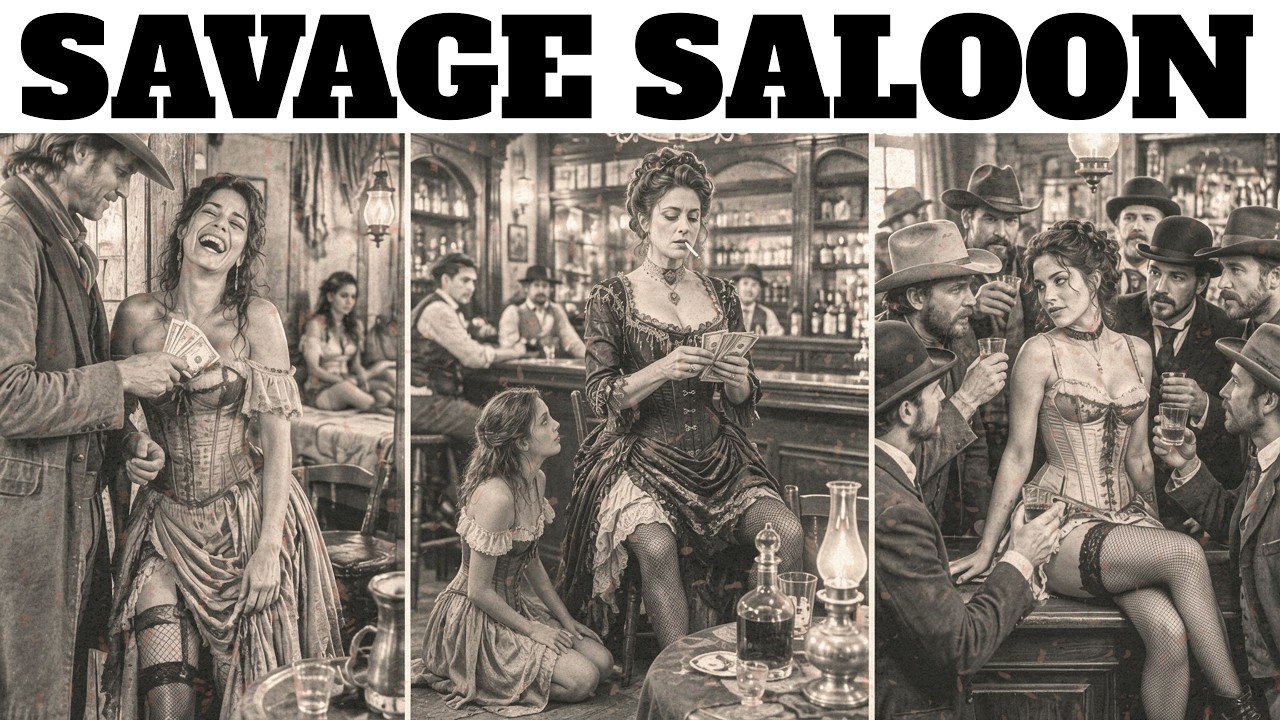
The bruise along her jaw was three days old and turning yellow, and she had told two different men two different stories about how it happened. She was not a metaphor and she was not a symbol of the fallen frontier. She had a name, and a town she came from, and a reason she had stopped using both. Before the first glass was poured, before any man walked through those swinging doors, she had already been carrying the weight of every room in the house: the money, the law, the other women, the landlord, the doctor who came on Tuesdays and never looked any of them in the eye.
The ceiling upstairs was so low that a tall woman had to bend to cross the room. Downstairs, the bar rail had been worn smooth by a thousand hands gripping it for balance, and the floor behind the counter was sticky with tobacco spit and beer that no one had mopped before morning. The air carried whiskey and sweat and cheap rose water poured over linens to cover what it could not cover. The piano near the window had three dead keys, and the man playing it knew which ones they were and worked around them without looking.
The women of these houses were everywhere, and the towns could not have survived without them. The 1880 census for Dodge City recorded more working women per capita than almost any occupation besides cattle work. In Wichita, Abilene, and Dodge, the monthly fines collected from prostitutes were often the single largest source of municipal revenue. The first sidewalks, the first marshal’s salary, the first public wells and lampposts in those towns were paid for with money taken from the houses every thirty days.
The Ford County Globe printed the fine receipts alongside the town budget as if it were perfectly ordinary, because it was. In Abilene in 1871, the year Wild Bill Hickok served as marshal, the fines from the houses on Texas Street brought in more money than any other line in the city ledger. Hollywood painted the brothel as a colorful sideshow, the winking backdrop behind the sheriff’s badge. In reality it was the tax base.
The town did not tolerate these women. It depended on them, and it made sure they knew the difference. Inside the trade there was a rigid class system, and most women lived at the very bottom of it. Hollywood collapsed them into one glamorous image, the beautiful figure on the staircase with the knowing look.
The reality was a steep and merciless ladder. A parlor house girl at Fanny Porter’s place in San Antonio lived in furnished rooms with wallpaper and clean linen, entertaining men of means. A crib girl in Deadwood worked behind a plywood partition four feet wide, charging fifty cents, seeing fifteen or twenty men a night. She never saw a clean sheet.
Same word for the work. A different century of suffering. Most of them did not choose the life. The dime novels and the movies invented the bold independent woman who went west for adventure and freedom.
The charity reports and court testimony told a different story: widowhood, abandonment by a husband who simply walked away, crushing debt, immigrant women arriving in a country where they knew no one and spoke nothing but their mother tongue. The Territorial Enterprise in Virginia City printed letters from women on D Street begging relatives back east for train fare home. Those letters were not written by women living a grand adventure. They were written by women who wanted out and had no money for a ticket.
Economic desperation was the recruiter, not the open road. In Dodge City, census records showed former domestic servants, former laundresses, former hotel workers, women who had tried every other kind of labor a frontier town would allow and found that none of it paid enough to survive. The dime novel heroine made a bold choice. The real woman made the only choice the economy left her.
The cribs were exactly as terrible as the name sounded. A crib was a wooden room barely wider than a door and just long enough for a narrow cot. Rows of them lined streets like D Street in Virginia City and the alleyways behind the Barbary Coast in San Francisco. There was no lock on the inside of the door and no stove in winter.
The door stayed open between customers so the next man in line could see the woman was available. A woman working a crib might see twenty men in a single night at twenty-five to fifty cents each and hand most of it to whoever controlled the row. A crib had less than forty square feet. A woman lived and worked and sometimes died in that space, and the only record of her was the fine the city collected on the first of the month.
Venereal disease was constant, and the treatments were nearly as cruel as the sickness. Before antibiotics existed, syphilis and gonorrhea were lifelong sentences handed down with no appeal. The standard treatment was mercury in the form of blue mass pills, calomel powder, or direct application. Mercury poisoned the organs, rotted the teeth, caused uncontrollable tremors, and eventually destroyed the mind.
Army surgeons at Fort Laramie and Fort Riley kept detailed infection logs, and those records suggested that the majority of enlisted men passing through the posts, and a corresponding share of the women who served them, were carrying one or both diseases at any given time. Hollywood has never once shown a frontier woman losing her teeth to mercury. That silence was not a kindness. It was a lie by omission.
The average working life in the trade was brutally short. Historian Anne Butler, in her study Daughters of Joy, Sisters of Misery, drew on court records, census data, and coroner’s files across multiple territories and estimated the average working span of a frontier prostitute at roughly four years. Not a career. A window.
After that, the body gave out, the disease advanced, the addiction tightened, or the woman simply aged past what the market would bear. The women Hollywood showed lounging through decades of beauty and wit rarely survived the profession long enough to see their thirtieth birthday inside it. A schoolteacher in the same era might work for thirty years. A shopkeeper’s wife might keep a household running for forty.
These women got four. And when those four years were up, the town had no use for them. No pension, no charity ward, no soft landing. The ones who survived moved to cheaper houses, then to cribs, then to the street.
The ones who did not survive are the ones history has been talking about ever since. They did not retire. They disappeared. The madam took most of the money.
In a parlor house, a working girl typically surrendered fifty percent or more of her nightly earnings to the madam for room, board, laundry, and the protection of the house. On top of that, she was charged for her own dresses at prices set by the madam, for cosmetics, for soap, for the doctor who came when the mercury stopped working. It was a debt system, quiet and efficient, designed to keep her working long past the point she wanted to stop. A woman who owed the house could not leave.
If she tried, the madam could report her to the marshal for theft. The law that refused to protect a prostitute from violence was perfectly happy to enforce a madam’s claim on her labor. In some parlor houses, a woman could work for years and still owe money at the end of every month. The books were kept by the madam.
The woman never saw them. The law did not protect these women. It harvested them. Monthly fines of five to twenty-five dollars per woman were standard across the Kansas cattle towns.
The women were not arrested to punish them. They were fined to fund the city treasury. In Wichita in 1872, the city council sat around a table and debated not whether to close the brothels but exactly how much to charge them per month. They set the rate and collected it like rent.
The fine was the license. In Dodge City, Marshal Larry Deger collected the monthly fines with the same regularity and the same ledger book he used for any other city business. The women paid, the city spent the money, and then the same officials who signed the receipts stood in church on Sunday morning and shook their heads at the state of moral affairs. That system ran for decades.
It was not a failure of the law. It was the law working precisely as intended. In most territories, they could not testify in their own defense. A known prostitute’s word was ruled inadmissible or given no legal weight in many Western courts.
A woman could be beaten half to death, robbed of every cent she had earned, and have no standing to name the man who did it. Court records from Kansas and Colorado territory showed cases thrown out on the sole ground that the complainant was a woman of the town, not for lack of evidence, not for lack of injury, but for lack of personhood. Hollywood gives these women sharp courtroom speeches. The real courtroom did not have a chair for them.
Violence from customers was routine, and the system was built to ignore it. Coroner’s inquest records from Tombstone, Deadwood, and Dodge City listed women found dead in or near brothels with causes of death recorded as accidental, unknown, or self-inflicted in circumstances that clearly suggested none of those words were true. In Deadwood in 1878, a woman known only as Crazy Horse Lil was found dead in her crib. The inquest lasted less than one full day.
No suspect was named. No one was charged. The Deadwood paper gave the death four lines and moved on to the cattle prices. In Tombstone in 1881, a woman identified only as Gold Dollar was badly beaten in a house on Allen Street.
No arrest followed. The local paper mentioned the incident in a single sentence wedged between livestock prices and a notice about a church social. The suicide rate among them was staggering, and the method was almost always the same: laudanum, liquid opium dissolved in alcohol. It cost pennies at any drugstore counter and could end a life as quietly as blowing out a candle.
Newspapers in Virginia City, Tombstone, and Leadville ran suicide notices for working women with a regularity that would shock a modern reader. The Territorial Enterprise in Virginia City recorded multiple laudanum deaths among women on D Street in a single calendar year. The coroner’s standard finding was four words: died by her own hand. No further questions asked.
No further questions wanted. Many of these women were mothers. Census records from Dodge City, Deadwood, and Virginia City listed children living in or near working houses. Some women placed their children with farming families outside of town and sent money when they had it.
Others kept the children close in a back room behind a curtain because they had no other person on earth to send them to. Court records from Denver showed custody hearings in which a woman’s profession was the only evidence needed to remove her children permanently. No abuse, no neglect, just the occupation listed on a document. The movies never showed the child sleeping in the back of the house while the front room worked.
They never showed the woman walking to the school with a child who would be turned away at the door because the other parents complained. They never showed the courtroom where a judge signed a paper and a mother watched her child carried out by a stranger. A large number of these women were immigrants who spoke no English and had no path to escape. Chinese women were trafficked through the port of San Francisco.
French women were recruited under false pretenses through New Orleans. German and Irish women arrived in American harbors with nothing but a name and a promise that turned out to be hollow. The 1870 census of San Francisco’s Chinatown listed hundreds of Chinese women under occupations that were thin paper over an ugly truth. Many had been purchased outright or signed into labor contracts written in a language they could not read.
Atoy, one of the few Chinese women in San Francisco whose name survives in the record, brought cases to court in the early 1850s, but she was an extraordinary exception. The vast majority had no knowledge of American law, no money for a lawyer, and no one willing to intervene. Opium and laudanum addiction among these women was nearly universal, and it was not a moral failing. It was a job requirement.
The drugs dulled the pain. They flattened the fear. They made one more night survivable when nothing else could. Laudanum cost pennies.
Chinese opium dens in Deadwood and Tombstone served working women right alongside miners, soldiers, and gamblers, no questions asked. The addiction did not begin as weakness. It began as survival. And then it became the thing that killed them slowly and without ceremony in rented rooms that smelled of smoke and tallow.
The soiled dove funeral was often the only dignity a working woman received in death. When a woman in the trade died, the other women in the house passed a hat and collected what coins they could for the burial. Sometimes the madam paid out of the house accounts. Sometimes nobody paid at all, and the county wrapped her in canvas and put her in an unmarked hole.
Boot Hill in Tombstone and the old cemetery in Dodge City hold the graves of women known only by their working names: Irish Mag, Squirreltooth Alice, Dutch Jake. The funerals were short, attended almost entirely by other women from the same houses, and conducted without a minister more often than with one. No headstone with a family name. No obituary in the paper.
Just a mound of dirt on a hill above a town that could not have built its first street without her. The town that collected her fine every single month did not bother to mourn her when she was gone, and the men who had visited her house on Saturday night stood in the crowd on Sunday and said nothing at all. Some of these women built real wealth, and the system made sure they did not keep it. A madam like Mattie Silks in Denver or Jenny Rogers on Market Street could own property, run a business, and command real economic power.
But morality statutes and property laws written by men who never intended a woman in her profession to own anything meant that wealth could be seized or stripped through legal channels no man would have faced. Jenny Rogers built one of the finest parlor houses in Denver and spent years in court defending the roof over her head. The frontier celebrated ambition in men. In women, it called ambition something else, and the law made sure the difference held.
The heart of gold was a fiction invented by men who never bothered to ask. The trope of the tender-hearted prostitute who saves the cowboy with her love came straight from dime novels and stage melodramas, all of them written by men who had never spoken to a working woman as a full human being. The real women left behind almost no first-person testimony, not because they could not write, but because no one ever asked them to. The few scraps that survive, fragments of letters, notes in the margins of ledgers, describe exhaustion, loneliness, and fear.
Not golden hearts. Ordinary ones carrying extraordinary weight. The powerful madam was not a feminist hero. She was a business operator in a market that ran on the bodies of younger and more desperate women.
Hollywood loved the madam, sharp, wealthy, in command of her world, and some were all of those things. But that command was built on the labor of younger and more desperate women, held in place by debt, dependency, and sometimes physical force. A madam’s profits required keeping her girls earning and keeping the money flowing upward. Celebrating the madam without naming what she demanded from the women she controlled was telling half the truth and calling it whole.
Racial segregation inside the trade was absolute, and the women at the bottom of that hierarchy paid the highest price. Black women, Mexican women, Chinese women, and Native women worked in separate establishments, cheaper, more dangerous, with less protection and lower pay. In many towns they were confined by local ordinance to specific blocks or alleys. The 1870 and 1880 federal census records make the segregation unmistakable.
In Virginia City, the Chinese women on the lowest tier of the trade worked in underground rooms for as little as twenty-five cents per customer, in conditions that made the cribs look comfortable by comparison. In Dodge City, black women were confined to a separate row south of the railroad tracks, out of sight of the main street. Hollywood’s frontier saloon was warm, colorful, and integrated, everyone welcome at the same long bar. The real frontier had separate doors, separate streets, separate prices, and separate graveyards.
When the temperance crusades and moral reform movements swept through the cattle towns in the 1880s and 1890s, they padlocked the doors and declared victory. But they opened no shelters. They funded no job training. They built no path from the life to any other life.
Dodge City closed its houses in the mid-1880s. The women did not disappear. They moved to the next town down the railroad line, or to the alley behind the next saloon, or to the laudanum bottle. Reform without rescue was relocation, nothing more.
The women of the line in Dodge did not become schoolteachers overnight. They became women without income, without housing, and without the only community that had ever accepted them. Some found work in laundries or kitchens for a fraction of what they had earned before. Most did not.
And that is exactly where the real story begins, and where Hollywood stops filming. Most of their real names are permanently lost, and the loss was not an accident. Court clerks recorded working names or bare initials. Census takers wrote seamstress or housekeeper in the occupation column to keep the official pages respectable.
Coroners identified the dead by the house they had worked in, not the families they came from. This was not sloppiness. It was administrative policy. The same towns that depended on these women’s fines made certain the permanent record would not carry their real names forward into the future.
A woman could live and work and pay her fines in a town for ten years, and when she died, the official record would show nothing but a working name and a cause of death. No hometown, no maiden name, no next of kin. Somewhere back east, a family might have spent years wondering what happened to a sister or a daughter who went west and stopped writing. The paper trail that could have connected them was deliberately kept thin.
Hollywood did not erase these women. The government paperwork erased them first. The women who escaped the trade almost never escaped the mark it left on them. A woman who got out and married a respectable man spent the rest of her days hiding.
Mattie Blaylock lived as Mrs. Earp, cooked and kept house, and watched it all collapse. When Wyatt left her behind, she returned to the trade, moved from camp to camp, and died alone of a laudanum overdose at roughly thirty-seven years old. The women who escaped successfully are the ones history will never be able to identify, because their survival depended on the world never finding out where they had been.
The ones whose names are known are the ones whose hiding failed. A neighbor who recognized a face. A vindictive acquaintance with a long memory. A newspaper item from years ago that surfaced at the worst possible moment.
In small frontier towns where gossip traveled faster than the mail, the past was never really past. It sat in the next room waiting. Children born inside the trade were marked for life before they took their first breath. A child born to a known working woman carried the mother’s reputation like a legal brand.
In many territories those children could not inherit property. They could not enter a school without someone raising an objection. Courts removed them from their mothers on no other evidence than the occupation written on a piece of paper. Orphanages in Denver and San Francisco took in children surrendered by women who believed, and were often right, that giving the child away was the only chance it would ever have at a normal life.
The diseases they carried did not stay inside the brothel, and the silence about that fact cost thousands of innocent lives. Syphilis traveled. Soldiers carried it back to the fort. Cowboys carried it back to the ranch.
Merchants carried it home to their wives. Congenital syphilis, passed from an infected mother to her newborn child, caused blindness, deafness, deformed bones, and death. Army medical records from frontier posts across the Great Plains documented infection rates so high that the chain of transmission is impossible to deny. The respectable town that condemned the prostitute for carrying the disease was quietly dying of the very same sickness it blamed her for spreading.
No Hollywood western has ever acknowledged this. Not once in 140 years of filmmaking. And here is the truth that sits at the center of everything else. These women were the most documented and the least recorded people on the American frontier.
They appear in thousands of surviving documents: tax rolls, fine ledgers, arrest dockets, census pages, coroner’s files, court transcripts, newspaper columns, military surgeons’ logs. They are among the most frequently referenced populations in the entire written record of the American West. And yet almost none of those records contain a single word these women actually said. Not their real names, not their birthplaces, not what they thought or feared or dreamed about or wanted.
The record used them precisely the way the town used them, as revenue, as cautionary examples, as anonymous bodies lowered into anonymous graves with no family standing at the edge. They were not hidden. They were visible every single day on every street in every town, standing in doorways, walking to the general store, paying their fines at the city clerk’s window in plain sight of every respectable citizen who pretended not to see them. The town knew exactly who they were.
The marshal knew their names. The doctor knew their ailments. The tax collector knew their income down to the last cent. And not one of those men, not the clerk, not the lawman, not the journalist, not the census taker, ever sat down and wrote a single sentence about what any of these women actually thought about the life they were living.
Nobody asked. Nobody wrote it down. Then Hollywood walked into that silence and filled it with costume jewelry: the golden-hearted girl, the sassy madam, the rescued dove who falls in love with the right cowboy and never looks back. Every one of those tropes was written into the blank space left by a record that never once treated a real woman as a person worth listening to.
The dime novelists came first. Ned Buntline, Prentiss Ingraham, and a dozen others invented the tender saloon girl to sell penny fiction to eastern readers who had never set foot west of the Ohio River. They turned real suffering into a romantic costume and shipped it to drawing rooms by the crate. Then Hollywood took that costume and made it permanent.
Miss Kitty Russell on Gunsmoke, who ran a saloon on CBS for twenty years while the network made absolutely certain no one ever said plainly what her real occupation was. The nameless rescued woman in Unforgiven, brave but silent. The sharp-tongued madam in Deadwood, entertaining and quotable, built on the same dime novel blueprint with better writers. She held the ledger, the law, and every woman under that roof in the same worn hands.
She settled debts with men who carried revolvers and made promises to women she knew she could not keep. But the body that managed the house was not the body the room was built to watch. Most madams were not former prostitutes. The Hollywood version has every madam starting as a working girl who climbed the ranks.
The census records say otherwise. A significant number were widows. Others were wives abandoned by men who went west and never came back. Some had run boarding houses or laundries and watched the money walk through the saloon doors night after night until they understood where the real demand was.
In a world with no safety net and almost no legal work for women beyond washing, sewing, or teaching, they looked at an open market and they filled it. This was not a fall from grace. It was a business decision made with cold eyes and no alternatives. Josephine Hensley, known in Helena, Montana as Chicago Joe, arrived in 1867.
She was a Civil War widow from New York carrying a small stake of money and no connections in the territory. Within two years she owned a hurdy-gurdy house on Wood Street. Within ten, she was one of the wealthiest people in all of Montana Territory. She did not stumble into that.
She built it ledger line by ledger line in a town full of men who underestimated her every single day. They kept meticulous financial records. These were not chaotic rooms run on impulse and whiskey. They were organized operations with account books, payroll systems, and supply chains for liquor, linens, candles, food, firewood, and medicine.
Madams tracked credit extended to miners by name and amount. They logged payments received, wages owed to employees, and fines paid to the city at regular intervals. In Tombstone in the early 1880s, monthly fines on the houses ran between twelve and sixteen dollars per woman. Steady, predictable income that the city council counted on the same way a modern county counts property tax.
In Dodge City, the fines from the district helped pay the salary of the very lawmen assigned to keep it orderly. In some smaller mining camps where the mine payroll was seasonal and unpredictable, the madam’s fine was the only reliable revenue the town had for months at a time. The town did not want her gone. It wanted her paying on schedule.
The better houses required weekly medical inspections by whatever doctor the town had available. They mandated bathing for workers and turned away visibly sick customers at the door without apology or exception. A madam who let sickness spread through her house would lose her workforce in weeks, her paying regulars within a month, and her reputation for good. The health measures inside a managed parlor house predated any municipal public health authority in most frontier towns by a full generation.
In 1875, in a mining camp with no running water, no sewer, and no doctor closer than a two-day ride, a woman with a wash basin and a posted set of rules was the only health system for miles in any direction. They did not rent their rooms and hope for the best. They bought the building, then they bought the one next door, then the lot across the alley. Mattie Silks accumulated multiple properties along Market Street in Denver over the course of three decades.
Chicago Joe assembled a commercial block in Helena that included storefronts, rental rooms, and a variety theater. Property was one of the very few forms of legal standing available to women in the nineteenth century. Under coverture law, a married woman’s possessions belonged to her husband, but a single woman or a widow could hold a deed in her own name. These women understood that a signed deed was worth more than any promise, any handshake, or any man’s word.
Surviving photographs of real madams show high collared dresses, dark fabrics, careful tailoring, and the same modest styles worn by the banker’s wife or the merchant’s daughter walking the same street. Looking respectable was not vanity. It was strategy. Diamond Jessie Hayman of San Francisco was known for the quantity and quality of her diamonds, but she wore them over dresses that would have passed at any respectable gathering in the city.
The diamonds were not decoration. They were portable wealth, an asset she could carry on her person and convert to cash within the hour if a raid, a fire, or an arrival forced her to leave town before the sun came up. When a woman was beaten by a husband, or left with children and no money after a mine collapse, or stranded by a man who simply rode out one morning and never came home, there was no government office to visit, no charity ward, no women’s shelter. In many towns the madam’s house was the only door a desperate woman could knock on and expect to find a meal, a bed, and someone who understood her situation without judgment or sermon.
Madams took women in. They fed them and sheltered them. Many went to work in the house, but madams also loaned money for stage fare out of town and arranged passage to family in other states. In court records from Denver and Helena there are instances of madams appearing before a judge to testify on behalf of women who had been beaten or robbed by men the law had no interest in pursuing.
A man who raised his hand to a woman in one of these establishments was thrown into the street by the doorman, beaten if he resisted, and banned permanently. His name went on a list that every employee could see. He did not come back. The rule was not sentimental.
It was economic. An injured worker could not earn. A second injury might keep her from working for weeks, and a reputation for rough customers drove away the steady, well-paying regulars and attracted the kind of trouble that brought the marshal down on everyone. Madams employed bouncers, armed doormen, and in several documented cases off-duty deputies.
In a time when the law gave a husband the legal right to discipline his wife, the madam’s house was one of the few places on the frontier where a man faced consequences for raising his hand to a woman. When a miner walked into town with gold dust in a leather pouch and no access to a bank because there might not be a bank for a hundred miles in any direction, the madam extended credit. She tracked the balance in her own ledger. She collected when the money came in, and if the money did not come, she held collateral.
Some madams weighed gold dust on their own scales, kept behind the bar or in a locked back office. Others accepted livestock, saddles, tools, or even mining claims as security against a running tab. In 1870, in a Nevada mining camp with no telegraph and no postal route, the only person who could extend a line of credit, keep an honest ledger, and collect on what was owed was the woman behind the desk in the parlor house. And every man in that camp knew it.
When Virginia City needed a volunteer fire company, Julia Bulette was among the first donors. She gave money, she gave blankets and supplies, and the company made her an honorary member of Engine Company Number One, the only woman they ever honored that way in that town. When she was murdered in January of 1867, strangled in her bed by a drifter named John Millain who wanted her furs and her diamonds, her funeral procession filled the main street of Virginia City from one end to the other. The fire company led it in full dress.
The Metropolitan Brass Band played behind them. The Territorial Enterprise reported it as one of the largest public funerals the city had ever seen. The men who walked behind her coffin knew exactly who she was, what she did for a living, and exactly what she had given to their town. But when the city wrote its official history a generation later, her name was nowhere in it.
That pattern repeated across the entire West. When a frontier town needed a church, a schoolhouse, or a hospital, the donation rolls often included money from the district, sometimes recorded under a name, sometimes accepted quietly through a middleman with no acknowledgement at all. The towns took the money, every single time they took the money. And when the buildings were finished and the paint was dry, they forgot who paid for the lumber.
The steeple went up. The bell rang on Sunday morning. And the woman whose money bought the bell sat three blocks away, unwelcome in the pew. Mattie Silks shared her life with a man named Cortez Thompson for the better part of thirty years.
The relationship had its storms, and Thompson was not always a reliable man, but it endured longer than most frontier marriages, where death, distance, and disappearance ended unions constantly. Laura Evans of Salida, Colorado operated her house for over fifty years and was a recognized, familiar figure in the community for her entire adult life. She was not hiding. She was not ashamed.
She walked the same streets as everyone else, and they nodded to her on the sidewalk. The red light district was drawn by the city, not by the women who worked in it. The line, the boundary of the tolerated district, was a zoning decision made in a council chamber by elected officials who understood exactly what they were doing and why. City officials drew the borders, posted the rules, collected the fines, and enforced the geography with the marshal’s office.
The ordinances are still in the municipal archives of Dodge City, Abilene, Tombstone, and Deadwood. When a town later decided to shut the district down, the same council members who had drawn that line and counted that revenue for years stood up in public and blamed the women for corrupting the morals of the community. The red light districts were segregated by race, by price, and by street. White madams ran the most expensive parlor houses on the best blocks.
Chinese women, many of them sold or trafficked from Canton and held in conditions closer to slavery than employment, were confined to separate alleys under the control of tong organizations that treated them as property to be rented out and replaced. Black women operated in designated blocks with lower prices, rougher rooms, and almost no legal protection of any kind. Ah Toy arrived in San Francisco around 1849 and became one of the first Chinese women known to operate independently outside tong control in the city. She appeared in court repeatedly.
She sued clients who tried to pay her with brass filings instead of gold dust. She fought for her earnings in a legal system that was built to deny her any standing at all. The court records preserve her voice, one of the very few Chinese women’s voices from Gold Rush San Francisco that survive in any official document anywhere. She won some of those cases, and the city spent the next fifty years trying to write her out of its memory anyway.
Every powerful man in a cattle town or mining camp passed through the parlor at some point, and men in those rooms talked freely because they believed that what happened behind a closed door stayed there. They discussed land deals before the papers were filed. They revealed mining claims before the stakes were driven. They named political enemies, described business rivals in detail, and laid out plans they would never have spoken aloud in a courthouse or a crowded saloon.
The madam heard all of it. She cataloged it and she deployed it with precision to protect her operation, to block a hostile city official before he could move against her, to ensure the right candidate won an election she could not vote in herself. Territorial correspondence from Montana and Colorado contains careful references to intelligence gathered through parlor house channels. The most valuable commodity in a frontier town was never gold or cattle or land.
It was knowing what the man across the table was going to do before he did it. Chicago Joe Hensley did not write a check and walk away. She organized voters. She opened her doors for political meetings when no other venue in town would host them.
She extended credit to candidates who needed funds and made certain they understood exactly whose support had put them in office and what that support expected in return. In a territory where the margin of victory might be twenty or thirty votes, a madam who could direct a block of men who owed her money, favors, or discretion was the single most important political figure in town. She could not cast a ballot herself, but she could decide who won and who lost. Newspapers in Helena and Denver complained openly about the influence of the parlor houses on territorial politics.
When madams died or retired, the towns they had helped build systematically erased them. Gravestones were pulled from cemeteries. City directories were edited and reprinted. Street names were changed.
Buildings were torn down or given new histories that mentioned no previous owner. Donation records disappeared from church archives and civic files. Laura Evans served Salida, Colorado for over fifty years. She was a fixture of the town.
Everyone knew her by name and everyone knew her address. When the era of respectability arrived, the town began behaving as if she had never been there. Pearl DeVere of Creede died in June of 1897. The circumstances remain disputed: poison, possibly self-administered, possibly given to her by someone who has never been identified.
She was buried at the edge of town after a funeral that drew a sizable crowd. Within one generation, Creede had swept her from its story. Her name survived only because a handful of stubborn local historians refused to let the silence stand. The real women were calculating, fiercely competitive, and capable of a ruthlessness that would have unsettled a cattle baron.
Mattie Silks and Jenny Rogers were rivals in Denver for the better part of two decades. Their competition was personal, expensive, and occasionally physical. Madams dismissed employees who broke house rules without a moment of hesitation or sentiment. They sued former partners in open court.
They fought eviction attempts with lawyers, political connections, and sometimes threats that the surviving correspondence only hints at. They undercut competitors, guarded their territory, and punished disloyalty with the same cold efficiency any railroad magnate would have recognized. The movie version, the woman who smiles through tears and needs a good man to save her, would not have lasted a week in Mattie Silks’s Denver. Several madams accumulated more wealth than the richest men in their communities.
Mattie Silks at the height of her career held Denver real estate worth more than the holdings of mine owners and cattlemen whose names filled the society pages. Diamond Jessie Hayman’s jewel collection alone was valued at a figure that would have bought a comfortable working ranch in the Sacramento Valley. While the general store owner waited on credit from a wholesaler back east and the mine foreman waited on the assay office, the madam’s revenue came through her door in gold and silver every single night. In a time when a working man earned a dollar a day and a schoolteacher brought home perhaps forty dollars a month, these women managed revenues that rivaled the output of small mines.
Belle Brezing of Lexington, Kentucky is widely documented as the primary model for Belle Watling in Gone with the Wind. She operated one of the most well-known houses in the South for nearly forty years. She maintained strict standards, managed a loyal staff, corresponded with prominent citizens, and navigated the complicated politics of a border state with a skill that most elected officials would have envied. She outlasted every legal challenge, every reform campaign, and every wave of public morality that tried to close her doors.
Margaret Mitchell took a four-decade career of extraordinary resilience and reduced it to a sentimental minor character who appears in a handful of scenes and exists only to make Rhett Butler look generous. The fiction made her small and pitiful. The actual record shows a woman who built an institution, defended it for decades against attack from every direction, and retired on her own terms with her finances intact. In many frontier towns, the madam was not merely the most powerful woman.
She was the most powerful person. She owned the buildings. She held the deeds in her own name. She knew every secret that mattered because the men who carried those secrets spilled them in her own parlor over whiskey they bought on credit she extended.
She determined elections without casting a single ballot. She funded the fire company, the church, and the school. She ran a financial operation that half the town depended on. She paid more into the city treasury than most of the legitimate merchants on Main Street.
And unlike the sheriff, nobody appointed her. Unlike the mayor, nobody could vote her out. Unlike the circuit judge, she did not ride away and vanish for months. She was there every single night in the same building behind the same desk keeping the same books.
In a town of three hundred souls with no established institutions, no reliable courts, and no permanent law beyond the marshal’s revolver, the person who controlled the money, the information, and the relationships was the person who held the real authority. Town after town, decade after decade, the evidence points to the same conclusion. That person was the madam. She smiled because the floor demanded it, and she moved because the music never stopped.
The men along the bar watched her like she was the evening itself, something bright put there for them. Her feet bled into her boots on the nights the dancing ran past midnight. Her ribs ached from the corset pulled a full inch tighter than the one she wore in the afternoon because the evening dress required it. But when the last song ended and the stairs began, her body crossed into the truth.
The whole performance was built to sell. She climbed those stairs the way a woman walks into a room she has already left a hundred times. The door closed behind her and the music downstairs kept playing as though nothing had changed. Nothing had, for the men still drinking.
Everything had, for her. The line between what the saloon showed the world and what it cost the woman inside it was fourteen pine steps and a door with no lock. The name itself was a lie. Saloon girl covered everything from a card dealer to a dance partner to a woman selling the only thing the town would let her sell.
The blur served everyone except the women it described. Census takers cooperated. In Dodge City and Tombstone, women working in saloons were recorded as seamstress, actress, boarding house keeper. The official paper was designed to look away before the ink was dry.
Even the word prostitute almost never appeared in a western census form. The bureaucracy of the frontier had a hundred polite words for what was happening, and every one of them was chosen to protect the town, not the woman. Their primary job was selling drinks, not company. The model was called the Pretty Waiter Girl System, and it came out of the concert saloons of New York, places like Harry Hill’s on Houston Street.
A woman sat beside a customer and kept his glass full. She earned a cut of every drink he bought. Cold tea poured from a whiskey bottle. Watered beer sold at the price of the real thing.
The system followed the railroad west and landed in every cattle town that had a bar with a back room. A good earner moved more liquor in a night than the bartender did on his own. The house took its share, the woman took hers, and the man at the bar never knew the drink in his hand was half water. The makeup was a professional uniform, and it was slowly killing the women who wore it.
White lead paste spread thick across the face, vermilion on the cheeks, coal drawn heavy around the eyes. You could identify a working woman from across a dirt street by the paint she carried. It was not vanity. It was a trademark as clear as a lawman’s star.
But the lead did its own quiet damage. Tremors in the hands. Failing kidneys. Slow poisoning no frontier doctor could name or treat.
The beauty that kept the money coming was destroying the women wearing it one shift at a time. Lead was not banned from American cosmetics until the twentieth century. The trail to a saloon door almost always started with a loss. A husband dead of cholera three weeks out of Independence.
A man who walked into a mine and never came back. A father who gambled the family’s claim away and disappeared on a westbound stage. In most territories before statehood, a married woman could not own property, could not sign a contract, could not file suit. A woman alone on the frontier without family or legal standing had almost no respectable employment open to her.
She could take in laundry for pennies. She could sew until her eyes failed. Or she could walk through the door that paid. The frontier offered her one reliable way to eat, and then spent the next century condemning her for taking it.
Inside the trade, the hierarchy was merciless. At the top sat the parlor house: velvet curtains, a piano in the front room, appointments by introduction only. A woman there kept a percentage and dressed in silk. At the bottom were the cribs, tiny shacks in a row barely wide enough for a cot and a washstand, a flat price set by the house, no negotiation.
Between those worlds lay the dance halls and the common brothels, each with its own rules and its own cut. Fourteen pine steps and a door with no lock. The men downstairs never counted them, never had to.
She did, every time, with the music still playing in her ears and the lead still in her bones, climbing toward a room she had already left a hundred times, carrying in her body everything the record would never write down and the town would never say aloud.
