Deputy Marshal Franklin Reed stood on the porch of the Callahan homestead, his hand resting on the butt of his revolver, and called out into the silence. No answer came from the house, no sound at all except the wind moving through the ancient oaks that screened the property from the road. Beside him, Dr. Wesley Harmon adjusted the strap of his medical bag and said nothing.
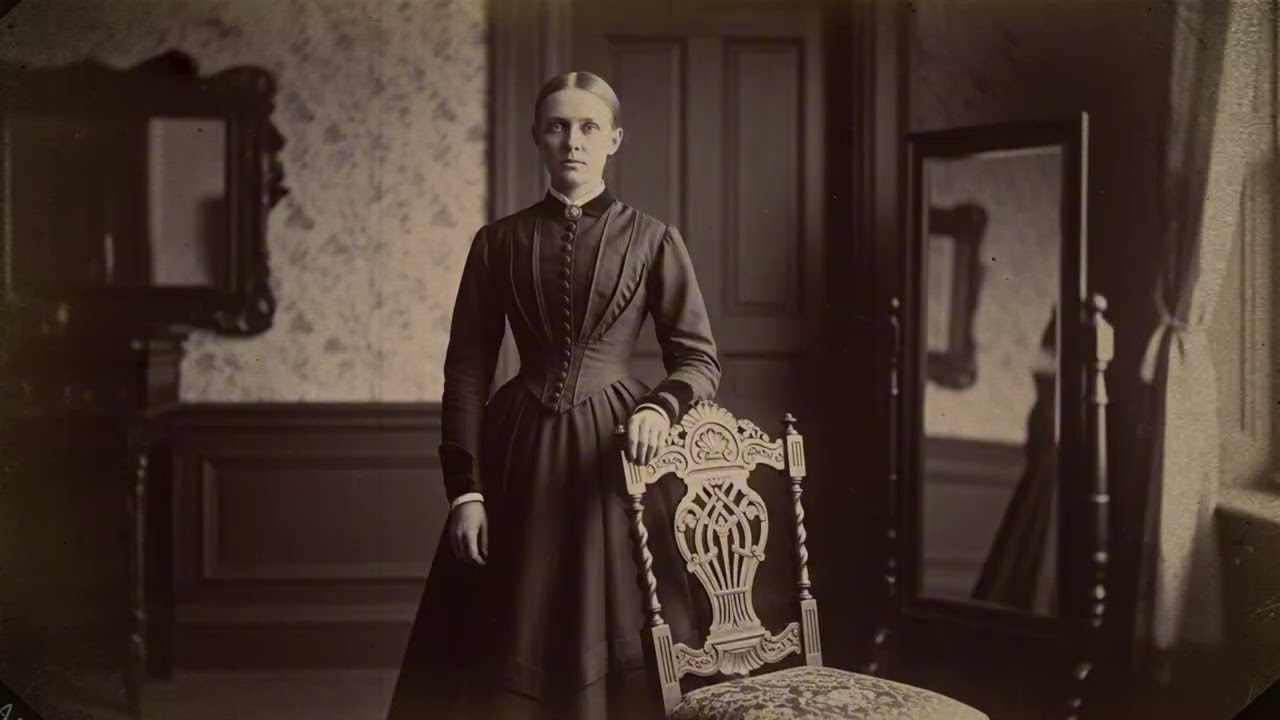
The front door stood partially open. The two men had come out from Cumberland that Sunday afternoon, May 3rd, 1885, because Norah Callahan had not been seen in town since late March. She had missed her monthly visit to the general store, then another, and by the first days of May the matter had become a subject of conversation. Reed had known the widow Callahan only as a reserved but respectable woman, someone seen at the store on the first Monday of each month and at church perhaps once a month, punctual, polite, and utterly unremarkable.
Nothing about her suggested that she would vanish, and nothing about the house they now entered suggested anything so simple as an ordinary disappearance. The interior was immaculate, unnervingly so. Every surface had been recently polished, yet a layer of dust covered the floor, undisturbed save for a single set of footprints that circled the dining table repeatedly and came to an abrupt end in the center of the room. The house was cold, not with the dampness of a dwelling left to the elements, but with a flat, deliberate chill that made Reed’s voice sound strange in his own ears, as if the air itself refused to carry sound properly.
On the dining table, set with military precision, were three place settings with empty plates and glasses. At the center of the table lay a spool of blue thread and a pair of scissors. The property had been noted for its peculiarities long before this day. Norah Callahan was 32 years old, a widow whose husband, Thomas, had reportedly died in a mining accident on November 17th, 1882, his funeral conducted by Reverend Isaiah Thornton of the Cumberland Methodist Church three days later.
But the Miners Association records contained no mention of any fatal accident during that week, and no specific mine was ever named. The couple had purchased the forty-acre parcel in 1878 from the Cumberland Coal and Timber Company for a sum local bankers considered surprisingly generous, as if they had either considerable means or a particular desperation to acquire that specific piece of land. The house itself was unusual for the region, built in the Federal style with symmetrical windows and a center hall, standing apart from the simpler log structures of the valley. Norah’s background before arriving in Cumberland around 1878 remained unknown; census records from 1880 listed only that she was born in Pennsylvania and worked as a housewife.
Elijah Jameson, proprietor of the general store, had provided the most detailed account of her regular visits. She arrived at exactly nine o’clock on the first Monday of each month, regardless of weather, and presented a list written in an unusually precise hand, the items arranged in a sequence that never varied and followed no recognizable logic. She never browsed, never spoke more than necessary, and always wore the same blue dress, a garment that never showed signs of wear or soil and seemed to shift in the light, sometimes appearing almost luminous. Reverend Thornton recalled that during communion, both Callahans politely declined the bread and wine with the same curious phrase: “We sustain ourselves differently.
” When he pressed the matter, Norah replied only that “certain vessels cannot contain ordinary sustenance. ” He attributed the remark to some obscure dietary restriction and did not press further. Reed and Harmon climbed to the second floor of the house that afternoon and found the master bedroom untouched, the bed made with hospital corners, a single hairbrush placed precisely in the center of the vanity. In a sewing room they found dozens of garments in various stages of completion, all made from the same dark blue fabric, each meticulously labeled with dates spanning backward for nearly seven years, none corresponding to any significant events in local history.
Among the items was a peculiar measuring device made of brass and ivory, resembling a tailor’s tape but marked with unfamiliar increments and symbols. Reed took it as evidence. It disappeared from the sheriff’s office within days, along with several other artifacts from the house. The most disturbing discovery was what Harmon called the mirror room.
In what should have been a guest bedroom, all furniture had been removed and replaced with mirrors of various sizes covering every wall from floor to ceiling, each positioned at a precise angle to create an infinite regression of reflections. At the center stood a single wooden chair facing the largest mirror. On the seat lay a pair of sewing scissors and several strands of dark hair. Harmon noted that standing in the room produced an immediate sensation of vertigo and spatial disorientation that compelled them to exit after only a brief inspection.
Reed, years later, added a detail that had stayed with him: when they entered that room, he distinctly saw something move in the reflections that did not correspond to their own movements, a flicker at the corner of his vision, and for an instant the reflection showed not the empty chair but someone seated in it. When he turned to look directly, there was nothing there. The cellar door was secured with an elaborate locking mechanism that required Reed to break it open with an axe from the woodshed. The air that escaped carried an odor Harmon had never encountered, something between the metallic scent of blood and the earthy smell of freshly tilled soil, yet with an underlying sweetness that turned his stomach.
They descended the narrow stairs with a lantern and found the walls covered with pages torn from books, medical texts, biblical passages, and what appeared to be personal correspondence, all arranged in concentric circles around a central point. At the focal point stood a table bearing a leather-bound journal and a collection of small objects. The official report Reed filed described only “evidence of unusual activities not suitable for public record,” and the subsequent pages were later removed from courthouse archives during a reorganization in 1912. Harmon’s journal was more forthcoming but still cryptic: “We found no physical presence, though her absence felt somehow more significant than any bodily remains might have been.
”
Years later, in 1923, an elderly Franklin Reed, long retired from the position of sheriff, gave an interview to a local historian and finally described what they had found on that table. There were thirteen silver thimbles arranged in a circle, each containing a small amount of dried blue powder, and a collection of anatomical drawings unlike any medical illustrations of the time. Reed described the drawings as showing the human form not as a solid entity but as a series of nested spaces, like Russian dolls, with annotations suggesting these spaces could be expanded or rearranged without altering the external form. In the center of the cellar stood an apparatus resembling a loom, constructed of materials Reed could not identify, the frame appearing to be made of bone larger than any animal native to the region could provide.
Threads stretched across it, varying in thickness from hair-fine to rope-substantial, all dyed that same distinctive blue. The most unsettling aspect was that the thread seemed to vibrate slightly, though there was no breeze in the cellar. When Harmon reached out to touch one, Reed later swore he heard a sound like distant voices, though neither of them had spoken. The journal discovered on the table was Norah Callahan’s own.
Reed initially took it into evidence. It disappeared from the sheriff’s office within a week. Fragments of its contents survive only through Harmon’s notes, which indicate that Norah had been documenting what she called “the slow transformation” for several years. The notes include excerpts dated February 12th, 1883: “The process began today.
The first hollowing is always the most difficult as one must remain conscious throughout to maintain the integrity of the outer form. T assures me that the discomfort will pass as the internal spaces expand. ” And June 30th, 1883: “The mirror technique is proving effective. By focusing on the reflection rather than the direct image, I can observe the expansion without experiencing the vertigo that accompanied my early attempts.
The blue fabric continues to be problematic. The weave must be precise or the spaces collapse. ” And November 18th, 1884: “T has completed his transformation. The mining accident provided the perfect cover.
He has moved to the adjacent space and will guide me through the final stages from there. The authorities suspect nothing as the physical form they buried contained all the expected components merely rearranged to occupy the minimal necessary volume. ”
The apparent implication—that Thomas Callahan’s death had been somehow falsified, that the body buried in Cumberland Cemetery was not what it appeared to be—Harmon considered seriously enough to request an exhumation. His request was denied by both county authorities and church officials.
The investigation stalled almost immediately. With no body and no clear evidence of a crime, authorities seemed eager to let the matter rest. The property was locked and a notice placed in the Cumberland Gazette stating that Mrs. Norah Callahan had departed the area; any parties with legitimate claims should present themselves to the county clerk.
None ever did. There were puzzles that remained unexplained. The kitchen showed no spoilage despite the house’s apparent abandonment for at least a month; jars of preserved fruits and vegetables sat neatly labeled, but the perishable items normal to a household—milk, bread, fresh meat—were conspicuously absent, as if deliberately removed or consumed before Norah’s disappearance. The barn contained no livestock but was immaculately maintained, the stalls recently swept, fresh hay stacked along one wall.
On the wooden support beams someone had scratched a series of measurements and calculations, dimensional ratios, along with a repeated phrase: “internal capacity exceeds external dimensions when properly aligned. ”
The story might have ended there, forgotten like so many other frontier mysteries, if not for what happened seven months later. On December 12th, 1885, a severe winter storm isolated Cumberland from neighboring communities for nearly two weeks. When postal service resumed just before Christmas, a package arrived at Dr.
Harmon’s office, wrapped in the same dark blue fabric found in Norah’s sewing room. Inside was a letter in Norah Callahan’s handwriting. “Dear Dr. Harmon, by the time you receive this, I will have completed what I began in that house.
You and the deputy were kind to check on me, though you came too late to witness the initial stages. What you found in my cellar was merely preparation. The real work has always been internal. I write to you specifically because as a medical man you might appreciate the precision required for such a transformation.
We all wear masks, Doctor, mine has simply become permanent. ”
The letter continued for several pages, describing in increasingly disjointed language what Norah referred to as the hollowing process. She claimed to have discovered it through old texts brought from Pennsylvania, texts belonging to a religious sect disbanded in the 1840s after several members disappeared under mysterious circumstances. Most disturbing was her assertion that she was not the first Callahan to undergo this process, but merely the most recent in a lineage dating back to colonial times.
“We have always existed in the spaces between what you perceive. The human form is commonly understood as unnecessarily dense, filled with redundancies and wasted volume. Through careful hollowing and rearrangement, one can create vast internal spaces while maintaining the external appearance. These spaces connect to others that have always existed alongside your world, but remain inaccessible to those who have not undergone the preparation.
Thomas waits for me there, as do generations of Callahans before us. ”
The letter contained detailed instructions for a process Norah called “the initial widening,” involving exercises using mirrors and blue fabric to accustom the mind to perceiving space differently. Harmon attempted some of these exercises out of scientific curiosity, but stopped after experiencing sensations of spatial distortion that persisted for several days. The letter concluded with a troubling assertion: “I leave this record not to alarm you, but because the process requires witnesses, those who observe the transition without understanding it fully.
Your visit to my home that day served this purpose, though you did not realize it. Your presence as observers was the final component needed to complete my transition. For this service, I thank you. In time, others will follow the path I have taken.
You will recognize them by the blue fabric and the mirrors. When you encounter them, remember what you saw in my home, and know that they are not disappearing, but merely relocating to spaces your mind cannot yet comprehend. ”
The package contained something else, wrapped in a separate piece of blue fabric: a small mirror approximately three inches in diameter in a frame of unidentifiable dark wood. Harmon initially placed it on his desk, but soon relocated it to a locked cabinet after noticing that the reflection it produced did not perfectly mimic the objects placed before it.
There was a slight delay, as if the reflection had to consider before responding, and occasionally, viewed from the corner of one’s eye, it showed elements not present in the room. Harmon became obsessed. His journal entries from early 1886 document a journey to Pennsylvania in search of information about the Callahan family and the unnamed sect. In Lancaster County he discovered church records indicating that a family named Callahan had lived in the area from approximately 1795 until 1865, when they abruptly disappeared following a series of unexplained deaths.
The church elder who provided access to the records mentioned that the Callahans had been regarded with suspicion due to their reluctance to participate in community events and their tendency to intermarry with only a select few families. More significantly, Harmon uncovered references to a text called “The Doctrine of Internal Spaces,” reportedly written by the sect’s founder, Gabriel Callahan, in 1802. No copies were known to exist, though references appeared in letters exchanged between church officials. One letter dated 1838 described the sect’s belief that the human form is but a temporary vessel capable of housing something far greater if properly hollowed and prepared.
Court records from 1843 detailed an investigation into several disappearances connected to the sect. Authorities had initially suspected foul play but found no evidence of violence or remains. In each case, the missing person’s home had been found in immaculate condition, personal belongings arranged in strange patterns, all mirrors positioned to face a central point. The case was dismissed for lack of evidence.
Of particular interest to Harmon was a statement from a former member, identified only as JM, describing what he called “the thinning” of another member. “It was not a death as we understand it. She remained conscious and speaking throughout, even as she seemed to fold inward upon herself, occupying less and less space without any apparent distress. The process took several hours during which she recited passages from Callahan’s text and worked continuously with a piece of blue fabric, weaving it into increasingly complex patterns.
When it was complete, she had not vanished entirely, but had somehow compressed herself into a space that should not have been able to contain a human form. She then passed through what appeared to be a solid wall, leaving behind only the blue fabric. ”
Harmon also located property records showing that the Callahan family had owned a textile mill specializing in dyed fabrics, particularly blue fabrics produced through a proprietary process the family guarded closely. The mill had been abandoned in 1865, around the time the family disappeared.
When Harmon visited the site, the building still stood but in a state of disrepair, all equipment removed. The local historical society provided one additional piece of information: the mill had been known for producing a distinctive shade of blue that local women’s journals described as possessing an unusual depth, “as if one could look into it rather than merely at it. ” The fabrics were highly sought after but difficult to obtain, sold only to select customers. All that remained in the mill were fragments of blue fabric caught in the floorboards and a series of mirrors mounted on the walls at carefully calculated angles.
By March 1886, Harmon had returned to Cumberland visibly changed. His housekeeper reported that he rarely left his study, where he spent hours comparing notes and pouring over medical texts. He sent numerous telegrams to colleagues in Philadelphia and Boston inquiring about obscure anatomical theories and historical cases of unusual bodily transformations. Most eventually stopped responding.
He began creating his own versions of the blue fabric, working for hours on a small loom with threads specially ordered from Philadelphia, frustrated by his inability to replicate the exact shade, destroying several attempts he deemed inadequate. In his journal he wrote: “The blue is not merely a color, but appears to be a property of the space between the threads. When viewed under magnification, the individual fibers themselves are not blue, but transparent. The blue appears only in the interstices, as if it is the absence of something rather than the presence of pigment.
”
Strange phenomena increased in his home. “The dimensions of my study appear to shift depending on the time of day and the angle of light. What was once a perfectly square room now seems to contain corners that exceed 90 degrees. Objects placed against the far wall sometimes appear smaller than they should, as if the wall itself has somehow receded without moving.
Most disturbing are the sounds, faint whispers that seem to emanate not from any particular direction, but from the space between spaces, if such a concept makes any sense. They are clearest when I am working with the fabric or gazing into the mirror Norah sent me, but lately they have begun to persist, even when both are locked away. ”
In April 1886, Harmon requested permission to reopen the Callahan homestead. His request was denied, partly due to jurisdictional issues—the property had been sold at auction to cover unpaid taxes—and partly because the sheriff had grown concerned about Harmon’s mental state.
Undeterred, Harmon visited the property on his own in late April. What he found was never officially documented, but a letter discovered among his effects after his death, written to a colleague in New York but never sent, describes the visit. “The house has been altered in ways subtle but significant. The walls appear thinner somehow, as though the interior space has expanded without changing the external dimensions.
In the cellar where we found her journal, the floor has been disturbed. I believe something was buried there and later exhumed. ” He described standing in the center of what had been the mirror room and experiencing what he called a thinning of reality. “The air around me seemed to vibrate, and for a brief moment, I perceived something like a doorway or window where no opening should have been, not in the physical wall, but in the space itself.
Through this aperture, I glimpsed what appeared to be another room identical to the one I stood in, but somehow inverted or reversed, and in that room stood a figure that, despite my rational protests, I can only identify as Norah Callahan herself. She was weaving something on a loom made of materials I could not identify, and though her lips did not move, I distinctly heard her voice say, ‘The space is nearly ready, doctor. Will you join us when the time comes? ‘ The vision lasted only seconds before the aperture closed.
But I am certain of what I saw. ”
His journal entries from this period became increasingly difficult to follow, filled with complex diagrams and mathematical formulas describing spatial relationships impossible in three-dimensional Euclidean geometry. He repeatedly referenced “the angle of intersection” and “the point of transition. ” In one entry he wrote: “I have glimpsed it.
When the mirrors are arranged correctly and the blue fabric is held at precisely the right angle, one can perceive, if only for an instant, the adjacent space, the place where they go. It is not empty, as I had feared, but teeming with forms that bear some resemblance to human figures, though distorted in ways that suggest they occupy more dimensions than our limited perception can process. ”
In late April, Harmon began experimenting on himself, attempting what he called “the initial hollowing. ” His journal describes a process involving fasting, specific breathing exercises, and prolonged sessions of gazing into mirrors arranged in particular configurations.
He noted physical changes. “I have measured carefully, and there is no mistake. My physical dimensions remain unchanged externally, but I can feel the space within expanding. My internal organs seem to have rearranged themselves to accommodate this expansion.
Yet, I experience no discomfort or loss of function. If anything, I feel more capable, as if operating with greater efficiency now that the redundancies have been eliminated. ”
The most troubling development came in May 1886, almost exactly one year after the initial discovery at the Callahan homestead. A woman matching Norah Callahan’s description was reported in Cumberland, seen briefly at dusk near the cemetery where her husband was buried.
The elderly church sexton, Walter McCreary, claimed the woman stood perfectly still beside Thomas Callahan’s grave marker for nearly an hour before walking into the surrounding woods as night fell. When Deputy Reed investigated the following morning, he found the grave undisturbed but the headstone recently cleaned, a fresh bouquet of local wildflowers placed before it. McCreary provided additional details recorded in Harmon’s journal: as the woman stood by the grave, she appeared to be having a conversation, though no one else was present. At certain moments, depending on how the evening light fell, she seemed to become partially transparent, as if only tenuously present in physical reality.
When she turned to leave, she did not walk into the woods in the conventional sense, but seemed to step sideways in a way his eyes could not quite follow, disappearing between one moment and the next. Two days later, Harmon received another package wrapped in blue fabric. Inside was a small leather-bound book, its pages filled with densely written text in what appeared to be Norah’s handwriting—presumably a copy of, or extract from, “The Doctrine of Internal Spaces. ” It disappeared after Harmon’s death three weeks later.
The official cause of death was listed as apoplexy, though rumors persisted that his appearance had changed dramatically in his final days, his housekeeper claiming his skin hung loose, “as if the man inside had somehow shrunk. ” Martha Wilkins described the scene she found: the doctor seated at his desk, perfectly upright, no sign of distress or struggle, his skin pale but not in the way of a corpse—rather, it seemed too large for whatever remained inside it. His eyes were open, focused on a point in the center of the room where there was nothing to see. Mirrors were arranged around his study, all angled toward where he sat.
On his desk lay a swatch of blue fabric and a note that read only: “I understand now. ”
The coroner noted anomalies omitted from the official death certificate. The deceased’s internal organs had reduced in size by approximately thirty percent from what would be expected. Several organs typically found in fixed positions were arranged in an unconventional configuration, as if deliberately repositioned within the body cavity.
There was no evidence of surgical intervention. Most disturbing was the observation regarding Harmon’s brain: the cranial cavity appeared largely empty, the brain itself reduced to approximately one-third its normal size and compressed into the lower portion of the skull. Despite the dramatic reduction in mass, the organ maintained all expected structures, merely scaled down and compacted with extraordinary efficiency. “I cannot explain how such a configuration could support life,” the coroner wrote.
“Yet there is no evidence of a prolonged degenerative condition. It is as if the reduction occurred rapidly, perhaps immediately preceding death. ”
The investigation officially ended with Harmon’s death. Reed was promoted to sheriff and reportedly refused to discuss the matter further.
The Callahan property changed hands several times over the next decade but remained unoccupied, as those who purchased it invariably decided against taking residence after visiting the site. In 1897, the house burned to the ground under unexplained circumstances. The Cumberland Gazette reported only that the property was destroyed by fire, with no mention of causes or investigations. The land remained abandoned until 1923, when it was incorporated into what would eventually become part of the Cumberland Gap National Historical Park.
Between 1886 and 1892, at least three other cases emerged within a hundred-mile radius of Cumberland bearing unsettling similarities to the Callahan incident. In each case, a solitary individual living on the outskirts of a small community disappeared under mysterious circumstances, leaving behind a meticulously maintained home and cryptic documentation of some form of transformation or hollowing. In each case, investigators reported finding blue fabric somewhere on the premises. In each case, the investigation stalled due to missing evidence, reluctant witnesses, or the untimely death of those most closely involved.
The most well-documented was the case of August Wilhelm, a German immigrant watchmaker living near Middlesborough, Kentucky, approximately thirty miles from Cumberland. In September 1889, customers noticed his shop had not opened for several days. When the local constable investigated, the cabin was empty but immaculately maintained. On Wilhelm’s workbench were thirteen pocket watches arranged in a perfect circle.
Each was stopped at a different time, and the hands of each timepiece pointed inward toward the circle’s center, defying the normal mechanics of such devices. Investigators discovered Wilhelm had been in regular correspondence with someone identified only as NC from Cumberland, letters written in a combination of German and English containing references to “the process” and “the blue thread. ” A hidden room behind Wilhelm’s library, accessible only by removing a specific sequence of books, contained mirrors arranged in patterns similar to those in Norah’s home and a loom set up to weave the distinctive blue fabric. Searchers found a journal written partly in German and partly in English describing what he called “die Entleerung,” the emptying.
The journal referenced instructions received from NC—widely believed to refer to Norah Callahan. Most of it was confiscated by federal authorities due to Wilhelm’s status as a foreign national, but fragments survived. One entry read: “The most difficult aspect is maintaining the external dimensions while expanding internally. NC advises focusing on the negative spaces first, the areas between organs, the cavities, the interstices that already exist within the human form.
By gradually expanding these, one creates room for the larger hollowing to follow. I have successfully expanded my thoracic cavity to three times its original volume without altering my external appearance. The sensation is one of lightness, as if gravity has less purchase on a form that contains more space than substance. ”
Wilhelm’s journal contained precise anatomical drawings that one medical examiner described as technically accurate but conceptually impossible, showing configurations of internal organs that could not sustain life, bearing a striking resemblance to illustrations found in obscure 18th century medical texts associated with certain European esoteric societies.
It also contained a crude map of the area around Cumberland with several locations marked by blue X’s. Each corresponded to a site where unusual acoustic phenomena had been reported, places where echoes behaved strangely or sound carried over impossible distances. Wilhelm had visited these locations repeatedly, taking precise measurements and recording observations about what he called “thin points, where the membrane between spaces can be more easily pierced. ”
One location marked on his map was an abandoned coal mine shaft approximately two miles from the Callahan property.
When investigators explored it in October 1889, they reported several anomalies. The shaft appeared to descend approximately sixty feet before terminating in a small chamber. But acoustic tests suggested a spatial configuration that did not match the physical dimensions measured. When a sound was produced in the chamber, the echo returned after a delay that indicated a much larger space than was physically present.
The temperature at the bottom of the shaft was approximately fifteen degrees cooler than expected at that depth, with no discernible source. The third case involved a school teacher named Eleanor Pierce from Bristol, Tennessee, who disappeared in July 1891. An unmarried woman in her forties, she lived alone near the school where she taught. When she failed to appear for the start of the fall term, colleagues visited her home and found an estate similar to the Callahan and Wilhelm residences: meticulously clean, personal belongings arranged in geometric patterns, multiple mirrors positioned to create infinite reflections.
What distinguished the Pierce case was the discovery of what appeared to be a partial success in whatever process she had been attempting. In the attic room, the sheriff’s report stated, “we discovered what can only be described as a partial impression of Miss Pierce, as if she had somehow merged with the wall itself. The impression extends approximately three inches into the solid plaster and wood, showing the clear profile of her face and upper body, frozen in an expression of what might be interpreted as either pain or ecstasy. The remainder of her form is absent.
” Attempts to remove the section of wall resulted in the immediate deterioration of the impression, which crumbled to dust when touched. Before this occurred, one witness noted that the profile appeared to be composed of densely woven blue fibers rather than human tissue. A student of Miss Pierce later told investigators that in the months before her disappearance, the teacher had begun incorporating unusual concepts into her mathematics lessons, asking students to consider what exists between numbers and introducing exercises involving visualizing geometric shapes that could change their internal dimensions without altering their external appearance. “She told us that space itself was like fabric, that it could be folded, stretched, or compressed if one understood its true nature.
” She demonstrated with a piece of blue cloth, showing how it could be manipulated to create shapes that seemed to contain more or less than their outer dimensions would suggest. By 1892, local authorities had begun quietly connecting these cases, though no official investigation linked them publicly. A confidential memo circulated among county sheriffs in eastern Kentucky and neighboring parts of Virginia and Tennessee warned them to be alert for solitary individuals exhibiting certain behaviors: the collection or production of unusual blue fabric, an interest in anatomical modification, references to hollowing or transformation, and connections to Pennsylvania. The memo instructed recipients to report such cases directly to a specific post office box in Washington, DC, bypassing normal jurisdictional protocols.
The federal interest in what came to be called the blue fabric cases suggests the incidents may have been viewed as more than isolated rural mysteries. However, any federal investigation that might have occurred remains classified or, more likely, was deliberately removed from official records. A Freedom of Information Act request filed in 1962 by historian Margaret Keller seeking documents related to the cases was denied on grounds that no such investigation exists in federal records. Between 1893 and 1915, reports of similar cases dwindled, though isolated incidents continued across the Appalachian region, often dismissed as copycat phenomena.
A pattern emerged that is difficult to dismiss: many of these later cases occurred in communities that had recently experienced economic hardship, particularly related to the coal mining industry. In 1916, an anonymous article appeared in the Journal of Anthropological Studies titled “Ritualistic Displacement in Isolated Communities: Case Studies from Appalachia,” later attributed to Dr. Lawrence Withers of the University of Virginia. Withers proposed that the blue fabric cases represented a regional manifestation of a substitution ritual, suggesting that economic distress and social isolation created conditions where such beliefs could take hold, particularly in communities with historical connections to certain European folk traditions.
He mentioned that similar cases had been documented in isolated parts of Pennsylvania dating back to the late 1700s, coinciding with the founding of the sect mentioned in connection with Gabriel Callahan. The article drew little attention, public interest focused on World War I, but it remains one of the few academic attempts to analyze the phenomenon. What Withers’s paper did not address were the physical anomalies consistently reported in these cases: the impossibly positioned mirrors, the structurally unusual blue fabric, the reported spatial distortions in affected buildings, and the strange impressions or partial forms sometimes discovered, like that in Eleanor Pierce’s attic. These physical elements suggest something beyond mere ritualistic behavior or psychological phenomena, something that interacted with material reality in ways that defy conventional explanation.
In 1928, a geology professor from the University of Tennessee published a paper noting unusual magnetic anomalies at several sites connected to the blue fabric cases, including the former location of the Callahan homestead. His instruments detected localized variations in magnetic field strength that fluctuated according to no discernible pattern, as if the normal properties of space itself were somehow distorted in these areas. His requests for funding for more thorough investigations were denied, and his academic career suffered after the publication of what colleagues considered fringe research. In 1935, during construction of a road near the former site of the Callahan homestead, workers uncovered a small metal box buried approximately three feet below ground.
Inside were thirteen blue fabric swatches, each labeled with initials and dates ranging from 1802 to 1883. The box was initially sent to the county historical society but disappeared from their collection within a month. The curator who cataloged the item resigned shortly thereafter and left the state without explanation. A worker present at the excavation later claimed he had removed one of the swatches as a souvenir.
In an interview conducted in 1958, this individual, then elderly and suffering from advanced dementia, claimed that keeping the fabric in his home had caused strange phenomena. “The mirrors don’t work right anymore. Sometimes they don’t show me at all, and sometimes they show too many of me standing in places I’m not standing. The walls are getting thinner.
I can hear them moving on the other side. ”
Analysis conducted in 1952 on a sample of the fabric preserved in Harmon’s effects revealed dye components uncommonly sophisticated for rural Kentucky in the 1880s. The particular shade, described as somewhere between midnight and cobalt with an unusual luster that shifts in different lighting, could not be precisely matched to any known commercial dyes of the period. Microscopic examination showed fibers with an atypical structure, hollow cores that textile experts could not readily explain.
Dr. Richard Latimer, the textile historian who conducted the analysis, noted that the weave pattern incorporated deliberate irregularities at precise intervals, creating a visual pattern apparent only when the fabric was viewed from certain angles, an optical effect that made it difficult to focus on the material for extended periods. Several of his assistants reported feelings of mild disorientation when examining the fabric under magnification. Latimer’s report included one additional observation, redacted from the publicly accessible version but discovered in his private papers after his death: when viewed under certain lighting conditions, the fabric appeared to contain spaces that did not conform to the physical dimensions of the material, depths or recesses that should not be possible in a two-dimensional textile.
The spaces seemed to shift or reconfigure when not directly observed, as if responding to the act of perception itself.
