The Canadian officer did not take the hand. He stood motionless, his eyes fixed not on the German commander’s face but on the situation itself, reading the men behind him, the weapons still held, the nervous glances exchanged between soldiers who understood the reality of their position far better than the man who led them. The outstretched hand was not a gesture of peace. It was a demand for acknowledgment, a last claim to authority, and the Canadian officer saw it for exactly what it was.
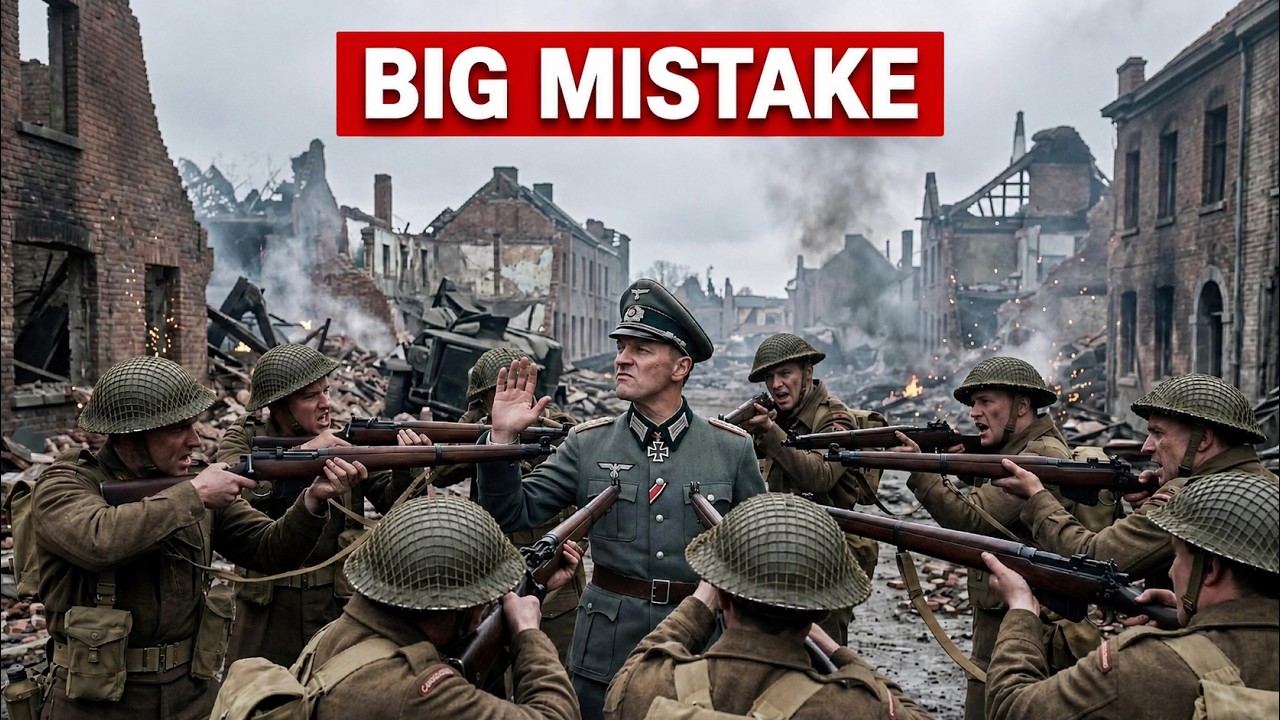
He did not respond to the gesture. Instead, he issued a simple and direct command, telling the German soldiers to drop their weapons. The moment that followed was tense and uncertain. The German officer hesitated, his hand still extended for a brief second before he slowly lowered it.
The silence between the two sides grew heavier. The Canadian soldiers remained ready, their weapons steady, their focus unbroken, while behind their officer the German troops began to shift nervously. They knew the war was over for them. Their officer struggled to accept it.
The difference between leadership and reality became visible in that moment, as one man tried to hold onto authority while the others waited for the inevitable. By early 1945, the war in Europe had turned decisively against Germany. Allied forces were advancing from the west, while Soviet armies closed in from the east. Entire German divisions were retreating, surrendering, or simply disappearing as the structure of command broke down.
Cities lay in ruins. Supply lines were shattered. Fuel and ammunition were scarce, and communication between units had become unreliable. Yet despite all of this, many German officers continued to behave as though discipline and authority still held the same meaning they had held before.
Canadian troops moving through the Netherlands and toward the German border encountered these contradictions daily. One moment they faced desperate resistance, and the next they found organized groups of soldiers waiting, led by officers who still insisted on formalities. These were not simple surrenders. They were controlled performances shaped by pride, training, and denial.
The Canadians had already seen months of intense combat. From difficult urban fighting to open countryside advances under constant threat of ambush, they had learned to expect anything. Hidden snipers. Sudden counterattacks.
Entire villages rigged with explosives. So when they approached a quiet village with no gunfire and no visible defense, it immediately raised suspicion. The silence was not comforting. It was unsettling.
Patrols moved carefully, scanning windows, rooftops, and alleyways. Every step measured. Every movement deliberate. They had seen too many traps to assume safety.
The absence of resistance did not mean the absence of danger. As the Canadian soldiers entered the outskirts of the village, they began to notice movement ahead. A group of German soldiers slowly stepped into view. They were not firing, not running, not hiding.
Instead, they stood in formation, led by a single officer whose uniform was clean and whose posture remained rigid and composed. It was a strange sight in the middle of a war zone. The Canadians immediately raised their weapons, expecting either surrender or deception. But the officer did not raise a white flag.
Instead, he raised his hand in a gesture that suggested he wanted to speak. It was calm, controlled, and completely out of place given the situation. The German officer stepped forward with confidence, his expression serious but not fearful. He looked directly at the Canadian officer in charge and extended his hand as if greeting an equal in a formal meeting, rather than acknowledging defeat on a battlefield.
Behind him, his men stood uncertainly. Some still held their weapons. Others glanced at each other, unsure of what would happen next. The officer spoke in a measured tone, explaining that they were prepared to surrender, but only under certain conditions.
He expected to be treated according to his rank. He expected recognition. And in that moment, he seemed to believe that the rules of military etiquette still applied, even as the war around him collapsed. The Canadian soldiers watched in silence.
Many of them had lost friends in recent battles. They had fought through resistance that cost lives and demanded endurance. And now they stood facing an officer who still acted as though he had the power to negotiate terms. The Canadian officer stepped forward slowly.
The outstretched hand was not a gesture of peace. It was a demand for acknowledgment. And in that moment, the Canadian officer made a decision that would define the encounter. He did not take the hand.
The Canadian officer repeated the order calmly and firmly, making it clear that there would be no negotiation and no recognition of rank beyond the basic process of surrender. This was not a meeting between equals. It was the conclusion of a battle. The German officer paused once more before finally turning to his men and giving the order to disarm.
One by one, weapons were lowered and placed on the ground. Rifles, pistols, and equipment dropped in a sequence that echoed through the empty streets. The sound marked the end of resistance and the beginning of acceptance. And with that single decision, the illusion of control was broken.
What happened in that village was not unique. It represented a pattern repeated across the collapsing front lines, encounters that revealed not just the end of a war but the clash between two completely different mindsets. For years, German officers had operated within a system that emphasized hierarchy, discipline, and unquestioned authority. But as the war ended, those structures lost their power.
The men under their command began to see the situation with brutal clarity. They understood that the war was over for them, that the authority of their officers no longer carried the weight it once did, and that the formalities of rank meant nothing to the soldiers who had fought them. The Canadian soldiers did not respond with anger or disrespect, but they also did not participate in maintaining the illusion. They treated the surrender as it was, a necessary and final step.
Not a negotiation, not a ceremony, but a transition from conflict to control. And in doing so, they demonstrated a different kind of discipline, one rooted in clarity and reality rather than in the trappings of rank. In the final months of World War II, as Allied forces pushed deeper into Europe and the collapse of Germany became inevitable, something unusual and tense began to happen on the front lines. German officers in scattered pockets of resistance refused to surrender in ways that confused and sometimes angered the advancing troops.
Not because they believed they could still win, but because many of them clung to pride, rank, and the illusion of authority. And when these officers came face-to-face with Canadian soldiers, they often expected a level of respect that no longer matched reality. The refusal to shake hands was not an act of disrespect. It was an acknowledgment that the situation had changed completely.
That authority no longer came from rank or uniform, but from reality itself. The war did not end with a shot, but with a simple decision to move forward without illusion. In the end, moments like this reveal a different side of war. Not the chaos of battle or the violence of conflict, but the quiet and often uncomfortable transition when one side must accept defeat.
The German officer in that village, and the many officers like him across the collapsing front, had spent years operating within a system that emphasized hierarchy and unquestioned obedience. They had been trained to command, to expect recognition, to believe that their rank carried meaning no matter the circumstances. But the war had stripped that meaning away, and the encounters with Canadian soldiers forced them to confront a reality they had spent months denying. The Canadian soldiers, for their part, had earned the right to determine how these encounters would proceed.
They had fought through the mud and the ruins, had buried their friends and pushed forward through resistance that tested every limit of endurance. They did not owe the German officers courtesy or ceremony. They owed them only the basic process of surrender, the acceptance of weapons and the transition to prisoner status. And that is exactly what they provided.
The refused handshake was the moment the old world gave way to the new. It was the moment when the German officer understood, perhaps for the first time, that the war was truly over. Not because the Canadians had been cruel or disrespectful, but because they had been clear. The war was concluded, and there was nothing left to negotiate.
As the weapons clattered to the ground and the German soldiers were taken into custody, the Canadian patrol continued its advance. The village was secured. The danger had passed. But the encounter lingered, a small moment in a vast conflict, a single interaction that revealed the entire shape of the war’s end.
The war in Europe was drawing to a close, and the men who had fought it were beginning to understand what that meant. For the German soldiers, it meant surrender, captivity, and the long road home to a country in ruins. For the Canadians, it meant the end of fighting, the end of loss, and the beginning of a return to lives that had been put on hold. The transition was not always smooth, and the encounters on the front lines were often tense, but they were necessary.
They marked the passage from one world to another. The German officer in that village, his uniform clean and his posture rigid, represented a system that had already collapsed. His insistence on formalities, his expectation of recognition, his belief that rank still carried authority, all of it belonged to a past that no longer existed. The Canadian officer, by refusing the handshake and issuing a simple command, represented a different kind of discipline.
One that was not about ceremony or pride, but about clarity and action. One that understood the war was over and that the only task remaining was to move forward. That brief interaction, a refusal to shake hands on a quiet village street, captured the entire transition. The war did not end with a dramatic final battle or a grand ceremony.
It ended with small moments like these, moments of quiet tension and reluctant acceptance, when soldiers on both sides came to terms with what the war had become and what it had taken from them. The refused handshake was not an act of disrespect. It was an acknowledgment that the situation had changed completely, that authority no longer came from rank or uniform but from reality itself. And in that brief interaction between a Canadian officer and a German commander, the war did not end with a shot, but with a simple decision to move forward without illusion.
The soldiers lowered their weapons, the prisoners were gathered, and the patrol moved on. The war was over, and the world was beginning to take its first uncertain steps toward peace.
