At the Hyphasis River in the summer of 326 BC, the Macedonian army had endured seventy days of monsoon rain. The ground had become a brown mud that swallowed boots to the ankle, and the shouting of the king’s order to march east was answered by silence. Ten thousand veterans, men who had not seen their homeland in a decade, stood in the downpour and refused. Soaked and cold, the king looked into the eyes of those who had killed for him, starved for him, and called him the son of Zeus.
He understood that their belief in him had burned out. It was not a mutiny of arms; it was an excommunication. Alexander had spent his entire reign converting the army of Macedon into something more than a military force. He needed to erase their old identities as husband, farmer, and Macedonian, and replace them with a single doctrine: that he was a god and that refusal was heresy.
This story had begun twenty years earlier, in the blood-soaked halls of his own father’s wedding banquet. In October of 337 BC, King Philip II of Macedon, a scarred and battle-hardened conqueror, married a sixteen-year-old named Cleopatra Eurydice. At the third course, the bride’s uncle, General Attalus, rose and prayed that this marriage might produce a legitimate successor to the throne. The word echoed through the hall: legitimate.
A direct insult to Philip’s first son, Alexander, whose mother was the foreign princess Olympias. Alexander hurled his cup across the room, striking Attalus in the mouth. Philip, drunk and enraged, drew his sword, but his war-wounded leg collapsed beneath him. Standing over his fallen father, Alexander mocked him and rode off into the night, taking his mother to safety in Epirus.
He was later allowed to return, but his mother was not. The court was shifting. Philip had announced a war against Persia, had married a new wife, and was grooming a new heir. The threat to Alexander’s future was mortal.
Then came the assassination. In the summer of 336 BC, Philip staged a grand festival in the theater at Aegae, culminating in a procession of statues of the twelve gods of Olympus. A thirteenth statue followed: a golden, ivory throne bearing the image of Philip himself. The message was unmistakable—Philip was a god, or close enough.
He walked into the theater in a white cloak, unprotected, trusting in the love of his people. A young bodyguard, Pausanias of Orestis, stepped from the crowd and drove a dagger under the king’s ribs. Philip dropped dead in the orchestra. Pausanias ran for the gates but was intercepted by three young nobles, close friends of Alexander, who killed him on the spot, sealing the assassin’s mouth before any interrogation could take place.
Alexander became king at twenty. Within ninety days, he had secured the throne. The first assassination order was carried out by messenger in Asia Minor, where Attalus, the bride’s uncle, was killed in his camp. The young queen Cleopatra Eurydice was given a choice by Olympias: a rope, a sword, or a cup of hemlock.
She chose the rope. Rivals to the succession were executed, including two brothers of the Lyncestian house, whose bodies were burned on Philip’s funeral pyre as offerings. The reconstruction of the royal house was complete. Two years later, Alexander made his first great demonstration of power to the Greek world.
Thebes, believing the king had died on campaign in the north, rose against the Macedonian garrison. Alexander marched his army south with incredible speed, covering vast distances in thirteen days to appear before the city walls. He offered terms; the Thebans mocked him. The assault took two hours.
What followed was not a sack but a demolition. The city was razed to the ground, house by house. Six thousand Thebans died in the streets. Thirty thousand survivors were sold into slavery at auction, the proceeds funding the war to come.
The only building spared was the house of the poet Pindar. Every Greek city received the message: the old rules were finished. In the spring of 334 BC, Alexander stood on the shore of the Hellespont. He hurled a spear into the soil of Asia, claiming the entire continent as his by gift of the gods.
His first act was to visit the ruins of Troy, where he anointed himself the spiritual heir of Achilles. His army was small, but his rate of conquest was astonishing. At the Granicus, the first Persian satraps fell. At Issus, Darius III, the Great King of Persia, panicked and fled, leaving his entire family in Alexander’s hands.
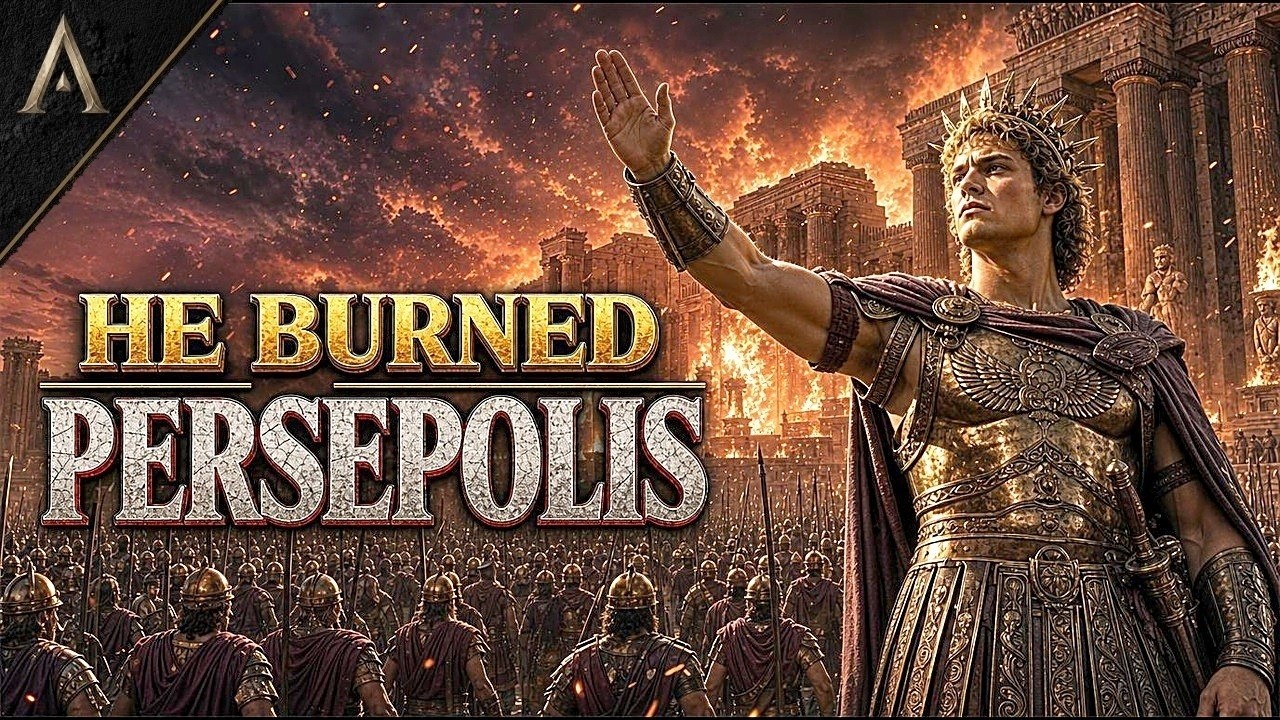
At Gaugamela, Alexander smashed the Persian army on a cleared plain, and Darius ran again, leaving the empire’s heart open. Babylon and Susa surrendered without resistance. Persepolis, the ceremonial capital, was given over to fire. The palace burned, whether by design or at the instigation of a Greek courtesan named Thais, who called for vengeance for the burned temples of Athens.
Alexander then took his army into Egypt, where the priesthood crowned him pharaoh. He made his way to the oracle of Zeus-Ammon at Siwa, deep in the desert. After consulting the god alone, he emerged and never again called Philip his father. He was now, officially, the son of a god.
The army tolerated his divine claims for a time, but the cracks began to show in 328 BC after he crossed into Central Asia. At a banquet in Maracanda, the festival of the sons of Zeus, an aging commander named Cleitus the Black spoke up. Cleitus had saved Alexander’s life at the Granicus. He began to speak of Philip as the true author of the army’s greatness.
The argument escalated. Alexander, enraged, reached for a sword that had been removed from the hall by his bodyguards. He grabbed a spear from a sentry instead. As Cleitus walked toward him in the lamplight, Alexander drove the point through his chest.
The hand that had saved his life was silenced on the stones of the courtyard. Alexander locked himself in his tent for three days, calling out the name of the dead man’s sister, his own nurse, and saying he had made her childless. The philosophers eventually convinced him to eat. The lesson to the army was clear: past service protected no one.
Next, Alexander demanded the Persian court ritual of proskynesis, the act of bowing before the king as before a god. For Persians, it was a secular gesture of rank. For Greeks and Macedonians, it was worship, reserved only for the gods. At a staged banquet, the Greek historian Callisthenes, who had written the official account of Alexander’s divine ancestry, refused to bow.
The king denied him the customary kiss. The policy was withdrawn for the Greeks, but the insult was remembered. Within six months, a conspiracy of royal pages was uncovered, and under torture, the boys named Callisthenes as their philosophical inspiration. The historian was arrested and died in chains in the baggage train.
Aristotle, his uncle, broke off all correspondence with the king. The final obstacle was Parmenion, the king’s most experienced general. He had been left to guard the treasury in Ecbatana while his son, Philotas, commanded the Companion cavalry. Philotas had been overheard mocking Alexander’s divine claims for years, and he had failed to report a plot against the king’s life in time.
He was arrested, tortured, and stoned to death by his own soldiers. Parmenion, his father, was still hundreds of miles away with an army and the empire’s wealth. Riders on racing camels carried a forged letter to him. As the old general read his son’s handwriting, his own lieutenants stabbed him from behind in the rose beds of his garden.
The execution done, Alexander moved on. He turned the army east into India. The kingdom of Porus, which they reached in 326 BC, was defended by two hundred war elephants, a force that terrified the Macedonian horses. At the Battle of the Hydaspes, the phalanx broke against the beasts, and it was only the Thracian javelin men, aiming for the eyes of the elephants and their drivers, that turned the tide.
Porus, wounded nine times, refused to kneel. Asked how he wished to be treated, he answered, “As a king. ” Alexander restored him to power. The army marched deeper into the Indian plains until the monsoon broke over them.
For seventy days, the rain never stopped. Dysentery and disease thinned the ranks. The men, now in their thirties, had been marching for ten years. They reached the Hyphasis River and learned that beyond it lay an empire with three thousand war elephants.
Alexander ordered the crossing. The army refused. For three days, he stayed in his tent, waiting for them to break. They did not.
His seer declared the omens against the march, and Alexander turned back. The escape was a retreat through the Gedrosian Desert, chosen because Cyrus the Great had failed there. It was a punishment march. The army entered with perhaps a hundred thousand people, soldiers and civilians alike.
The guides lost the trail. The water ran out. Men drank the blood of pack animals. When they found a spring, men drank until their stomachs ruptured, and the corpses poisoned the water for those behind.
A flash flood took the women and children in a single night, burying them in wet sand. Men killed each other for water. When a soldier presented Alexander with a helmet of muddy water, he poured it onto the sand in front of the column, a gesture of divine sharing. The army was heartened.
It was also dying for him. Sixty days later, the survivors stumbled out. Perhaps twenty-five thousand of the hundred thousand remained. The Macedonian veterans were halved.
The casualties of that desert exceeded all the battles he had ever fought. At Susa, he staged the mass marriages, forcing ten thousand of his soldiers to take Persian wives, dismantling their Macedonian identity. He took two new Persian brides himself. The empire settled into a fragile peace, but the king was failing.
In Babylon in the spring of 323 BC, he was thirty-two and physically destroyed. His best friend Hephaestion died, and Alexander crucified the doctor. His own death came after a night of heavy drinking. He developed a fever that would not break.
As he lay dying, the veterans filed past his bed, ten thousand men in a column, and he could only move his eyes to acknowledge them. Asked to whom he left his kingdom, he answered, “To the strongest. ” He died in June of 323 BC. He had no acknowledged heir.
His pregnant wife gave him a son, but the generals divided the empire among themselves. Within thirteen years of his death, every member of Alexander’s family had been murdered. His son and his mother were killed. The generals who had served him fought each other for forty-three years, and one by one they died until the empire fractured into successor states that Rome later consumed.
He had demanded the world worship him as a god, and the world obliged him only after he was safely dead. Roman emperors visited his tomb. Julius Caesar wept at his statue. Napoleon carried the history of his campaigns to war.
The dead god proved more useful than the living one—he no longer demanded anything of his worshipers except imitation. He had wanted to be remembered as a god, and he was remembered instead as a template for every man since who decided he was one.
