In February 1895, the United States government stood on the edge of bankruptcy. Gold reserves had fallen below the critical threshold needed to back the nation’s currency, and President Grover Cleveland could not persuade Congress to authorize a public bond sale. Into this standoff stepped a man who did not hold public office, command an army, or answer to voters. He was John Pierpont Morgan, the private banker who controlled a staggering share of America’s railroads, and he walked directly into the White House with a solution.
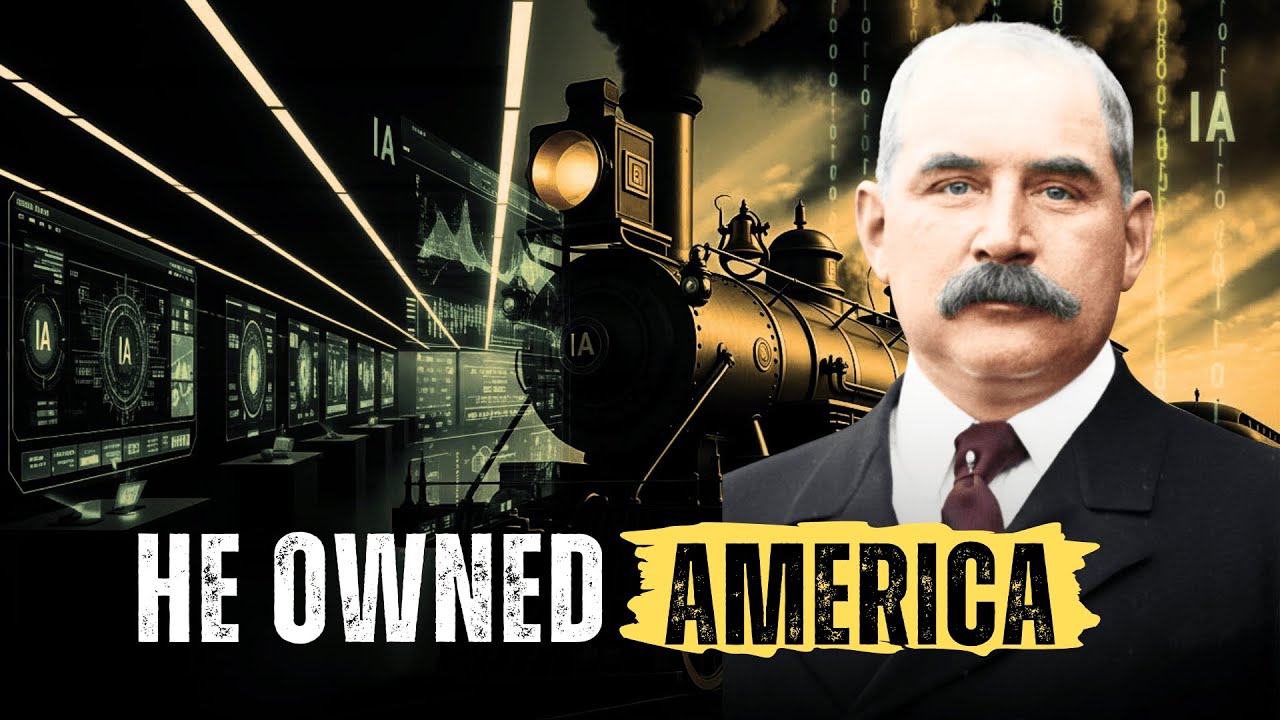
Morgan’s syndicate would supply the Treasury with 3. 5 million ounces of gold in exchange for government bonds, and he promised to manipulate international currency markets to keep the gold from flowing back out. Cleveland, with no better option, accepted a slightly reduced version of the deal. The announcement calmed the markets within hours, and the bonds sold out in just two hours.
Morgan had pulled the United States back from the brink of default. That moment was only the most dramatic episode in a life defined by financial rescue and consolidation. Morgan was born in Hartford, Connecticut, in April 1837, into a family already deeply embedded in banking. His father, Junius Spencer Morgan, had built a formidable transatlantic financial operation, and his grandfather Joseph had amassed wealth through land speculation and early industrial investments.
The year of Morgan’s birth coincided with the Panic of 1837, a severe depression that convinced the family that America desperately needed a strong central bank to regulate markets and ensure a stable currency. That conviction would shape Morgan’s entire career. Young John was a sickly child, plagued by illness throughout his youth, but he was also bright and observant. His father groomed him deliberately for the commercial world, sending him to the Episcopal Academy in Connecticut, then to schools in Boston, and finally to Europe to master French and German.
In 1853, Junius received an extraordinary offer from George Peabody, the most influential American banker in London, who wanted Junius as his junior partner and designated heir. The family’s fortunes rose accordingly, and in 1854 the firm of Peabody, Morgan and Company began trading. By then, Morgan had already demonstrated a natural aptitude for finance, keeping meticulous accounts and studying the workings of maritime commerce during a health recovery in the Azores. The young man entered the banking business in New York in September 1857, working for Duncan, Sherman and Company.
His first years coincided with a severe financial panic caused by the end of the Crimean War and the Bank of England’s decision to raise interest rates, which drained capital from American markets. Peabody’s London firm only survived with emergency credit from the Bank of England, a near catastrophe that reinforced the Morgan family’s belief that the United States needed its own lender of last resort. Morgan spent his early career financing railroad expansion, building connections with powerful executives, and learning the intricacies of an industry growing at breakneck speed. When the Civil War erupted in 1861, Morgan found himself involved in a transaction that would shadow his reputation.
General John C. Frémont, desperate for firearms, agreed to purchase five thousand obsolete Hall carbine rifles through an agent, Simon Stevens. Stevens lacked the funds to buy the weapons from their original purchaser, Arthur Eastman. Morgan stepped in, loaning twenty thousand dollars to finance the deal and taking legal ownership of the rifles until they could be delivered.
When the refurbished weapons were finally sold to the Union command, Morgan walked away with a profit of more than twenty-six thousand dollars, having charged hefty interest and commission. He exited the deal before its complications fully surfaced, a demonstration of both his financial acumen and his willingness to profit from wartime chaos. The same year brought personal tragedy. Morgan married Amelia Sturgis in October 1861, but she was already ill.
During a stopover in Paris, Morgan learned she was dying of tuberculosis. He kept the diagnosis from her and desperately sought a healthier climate, but Amelia died in Nice in February 1862. Morgan was devastated and remained devoted to her memory for the rest of his life. The war years transformed the Morgan family’s business.
Junius remained in London while Morgan built his own operation in New York with his cousin James Goodwin as a partner. The pair exploited wartime fluctuations in government bonds, using coded telegrams to move money across the Atlantic ahead of major battle developments. Morgan, drafted into military service after Gettysburg, paid three hundred dollars for a substitute to serve in his place, a common practice among the wealthy. When George Peabody finally retired in 1864, Junius took full control of the London bank and renamed it J.
S. Morgan and Company. Morgan’s rise accelerated in the postwar years. In 1869, he helped Joseph Ramsey, the founder of the Albany and Susquehanna Railroad, fend off a hostile takeover by the notorious Jay Gould.
Morgan purchased shares, secured a sympathetic judge, and helped Ramsey expel Gould’s appointees. The victory earned Morgan a seat on the board of the combined Delaware and Hudson Railroad and cemented his reputation as a powerful ally in railroad disputes. Two years later, the Philadelphia banker Anthony Drexel joined the family enterprise, creating Drexel, Morgan and Company in New York. When Jay Cooke, the famous Civil War financier, collapsed spectacularly in 1873 after ruinous investments in the Northern Pacific Railroad, the resulting panic closed the New York Stock Exchange for ten days.
Morgan called in his loans, survived the crisis unscathed, and emerged with more than a million dollars in profit. The failure of Cooke left Drexel, Morgan and Company as the most powerful and solvent bank in the nation. Morgan’s methods became increasingly systematic. By 1879, the Vanderbilt family trusted him to sell two hundred fifty thousand shares of New York Central Railroad stock without collapsing its price.
He placed the shares through a carefully selected syndicate, earning a three-million-dollar commission and a seat on the company’s board. In 1885, he brokered a truce between the New York Central and the Pennsylvania Railroad aboard his yacht, the Corsair, ending a ruinous competition over parallel rail lines. He tried repeatedly to impose order on the chaotic railroad industry, forming the Interstate Commerce Railway Association in 1888 and organizing subsequent efforts at self-regulation. Most failed, but the attempts established Morgan as the preeminent mediator and stabilizing force in American business.
When his father died in 1890, Morgan inherited twenty-five million dollars and full command of the family empire. The Panic of 1893 provided fresh opportunities. As hundreds of railroads collapsed into bankruptcy, Morgan used voting trusts to seize effective control of struggling companies without owning them outright. He cut costs, forced creditors to accept lower interest rates, and kept railroads focused on their core operations.
By the end of the decade, he controlled approximately one-sixth of all American railway mileage in a process widely known as Morganization. For his near-omnipotent influence, he earned the nickname Jupiter, the king of the gods. Morgan’s financial power was also directed at industrial consolidation. In 1895, he rescued General Electric from the depths of the panic.
In 1900, he invested in Nikola Tesla’s Wardenclyffe Tower, but withdrew his support when he realized Tesla intended to provide wireless power that could not be metered or sold. Innovation was welcome only if it could be controlled and profitably invoiced. The following year, Morgan orchestrated the creation of United States Steel, the world’s first billion-dollar company. Andrew Carnegie had agreed to sell his steel empire for 480 million dollars, and Morgan assembled three hundred underwriters to finance the deal.
When it launched in April 1901, it dwarfed every company ever listed on a stock exchange. The early years of the new century brought challenges. Morgan’s attempt to dominate North Atlantic shipping through the International Mercantile Marine Company angered the British government, which subsidized rival Cunard liners in response. In 1902, President Theodore Roosevelt ordered antitrust proceedings against Morgan’s railway holdings, and the Supreme Court ruled against Morgan in 1904.
Morgan stepped back from daily management, devoting himself increasingly to art collecting and a public affair with his librarian, Belle da Costa Greene. The Morgan Library, built to house his growing collection, became one of the world’s great cultural treasures. The Panic of 1907 forced Morgan back into the center of American finance. A collapse in copper shares triggered a run on the Knickerbocker Trust, and panic spread quickly to all trust companies.
Morgan, then seventy years old, acted as a de facto central bank for two weeks. He mobilized three million dollars to save the Trust Company of America, compelled the city’s leading bankers to pledge twenty-five million dollars to support struggling brokerages, and lent thirty million dollars to rescue New York City from bankruptcy. When the brokerage Moore and Schley faced collapse because of its enormous holdings in Tennessee Coal, Iron and Railroad Company stock, Morgan engineered a controversial solution: United States Steel would acquire those holdings. He obtained President Roosevelt’s reluctant approval by arguing it was the only way to prevent a national economic catastrophe.
Morgan’s interventions saved the financial system, but they also exposed its fundamental weakness. The United States had no central bank capable of providing liquidity in a crisis, and relying on one private citizen was no longer sustainable. In 1910, Morgan’s partner Henry Davison organized a secret meeting of financiers at Jekyll Island, Georgia, where they drafted the blueprint for what would become the Federal Reserve System. Morgan was not present, but the institution was designed to formalize the role he had temporarily filled.
The Federal Reserve Act became law in December 1913. Morgan did not live to see it. He had spent the final years of his life defending himself before the Pujo Committee, which investigated the concentration of financial power in a so-called money trust. Asked whether credit depended on collateral, Morgan answered that it depended on character, insisting that a man he did not trust could not obtain money from him on all the bonds in Christendom.
He also insisted, to widespread skepticism, that he controlled no companies. Weakened by the hearings, he traveled to Egypt and then to Rome, where he died on March 31, 1913, at the age of seventy-five. His empire endured. The firm he built became J.
P. Morgan and Company and later JPMorgan Chase, one of the largest banks in the world. Morgan Stanley, founded after his death, became a global leader in investment banking. In 2008, JPMorgan Chase, under Jamie Dimon, used its fortress balance sheet to rescue Bear Stearns and Washington Mutual during the subprime crisis.
In 2023, the government again turned to the bank to stabilize the system by acquiring First Republic. The institution that saved American capitalism in 1907 has repeatedly served as the lender of last resort long after the man himself was gone.
