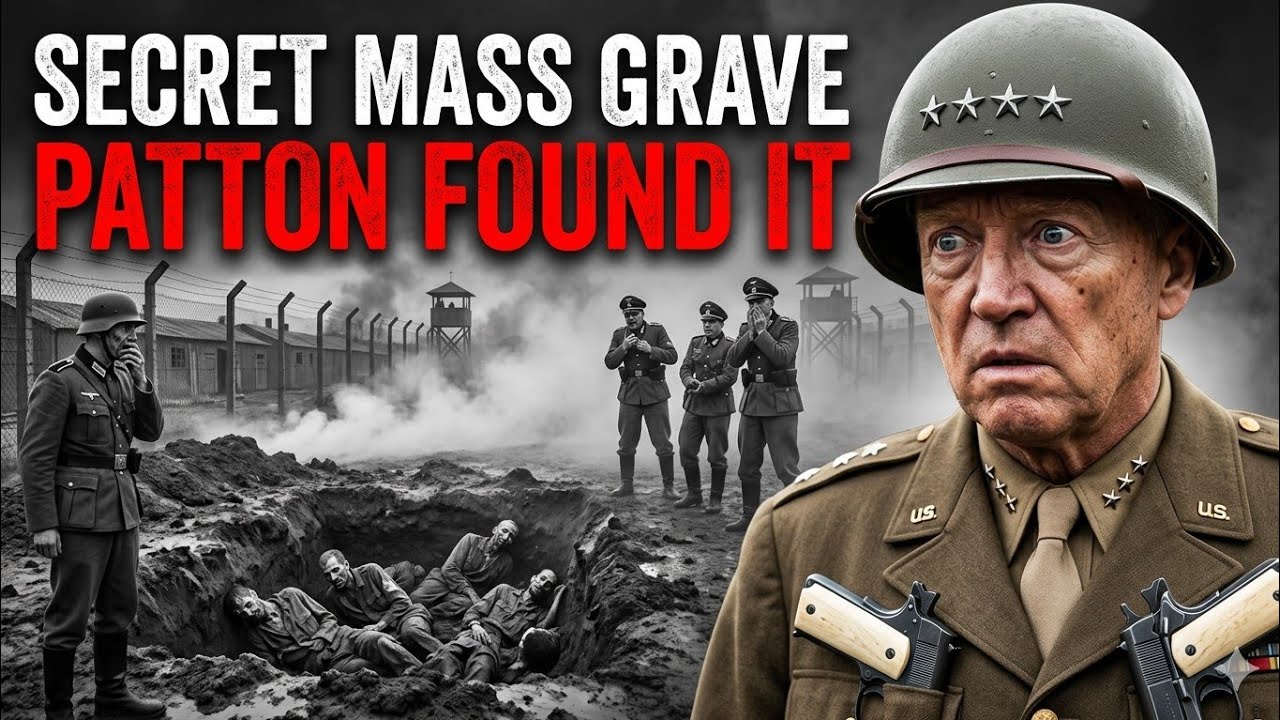
The morning of April 12, 1945, broke cold and gray over the Ohrdruf subcamp of Buchenwald, a cluster of wooden barracks and stone buildings set into the forested hills of Thuringia in central Germany, roughly five kilometers south of the town of Gotha. The United States Army’s 4th Armored Division had reached the outer wire the previous day, April 11th, making Ohrdruf the first Nazi concentration camp to fall into American hands. Soldiers of the 4th Armored had pushed fast and hard across Germany in the final weeks of the war, covering more ground in less time than almost any other formation in the European theater. They were experienced men, most of them.
They had seen the wreckage of the Falaise Pocket, the rubble of Metz, the bodies in the snow at the Bulge. They did not consider themselves naive. They were not prepared for what they found at Ohrdruf. The story of what happened over the following twenty-four hours—what General George S.
Patton, commander of the United States 3rd Army, did when he arrived at this place and walked among the dead—is not simply a story about one general’s reaction to atrocity. It is a story about command, about the calculated use of witness, and about the deliberate decision by men near the top of the American military to ensure that what had been done in Germany would never be dismissed, diminished, or forgotten. To understand the four hours Patton spent at Ohrdruf on April 12th, it is necessary to understand something of how he came to be there, and what the 4th Armored Division had already discovered the day before his arrival. The 4th Armored was part of 12th Corps, itself subordinate to Patton’s 3rd Army.
By the spring of 1945, 3rd Army had become perhaps the most aggressive operational formation in the Western Allied order of battle. Since crossing the Rhine at Oppenheim on the night of March 22nd, 3rd Army had swept eastward at a pace that repeatedly left its supply lines strained and its flanks exposed. Patton accepted those risks deliberately. He believed—and the evidence increasingly supported him—that German resistance in the West was collapsing faster than his superiors fully credited, and that speed was the surest way to end the war and save lives.
The 4th Armored Division, commanded at this point by Brigadier General William Hoge, was the spearhead of that advance. On the afternoon of April 11th, elements of the division’s Combat Command B were moving through the forested terrain south of Gotha when they encountered what appeared to be a labor camp. The wire was still up. There were watchtowers.
There was a gate. Most of the German guards had fled when they heard the American vehicles. What the soldiers found inside was approximately 2,000 prisoners. Most of them were alive, but in extreme states of starvation and disease.
The inmates were skeletal. Many could not stand. Their clothing—striped cotton uniforms, inadequate for the April cold—hung from frames that had been reduced to bone and stretched skin over the course of months or years of deliberate starvation. But it was not the living who stopped the soldiers in their tracks.
It was the dead. Behind one of the main barracks, the soldiers found a low field, perhaps half an acre in extent, that had been used as a burial ground. The bodies had been stacked rather than buried—layers of corpses, some partially covered with lime, some not covered at all. Estimates of the number found in this area alone ranged from thirty to forty bodies in that initial discovery, though subsequent investigation would reveal many more throughout the camp.
Several of the bodies showed evidence of having been shot at close range. Others appeared to have died of starvation or disease. Some bore marks consistent with beating. The camp’s German administration had clearly accelerated killings in the days before the American advance reached them, apparently unwilling to leave living witnesses.
First Lieutenant Irving Kaminsky of the 4th Armored later recalled that when he entered the camp, the smell reached him before he crossed the outer wire. It was unlike anything he had encountered in three years of combat service. Other soldiers described stopping not out of fear, but out of an involuntary inability to process what they were looking at. Some men turned away.
Some did not. Word of the discovery moved up the chain of command quickly. By the evening of April 11th, 12th Corps commander General Manton Eddy had been informed. Eddy sent word to Patton’s headquarters at Hersfeld, approximately one hundred kilometers to the northwest.
Patton’s chief of staff, Brigadier General Hobart Gay, took the report and passed it to Patton directly. Patton’s initial response was not emotional. According to Gay and to Patton’s own diary entries for that period, his first reaction was a set of specific orders. He directed that a full report be prepared.
He directed that army photographers be sent to the site immediately. And he announced that he would go himself in the morning. At 0700 hours on April 12th, 1945, Patton’s convoy departed Hersfeld before first light. He traveled with a small party: Gay, several staff officers, his personal security detail.
The route took them southeast through the pine forests of Thuringia, past the remnants of German military positions that had been swept aside in the previous weeks’ advance. The roads were clogged with the detritus of a collapsing army—abandoned vehicles, discarded equipment, the occasional knot of German soldiers moving west with their hands in the air, looking for someone to surrender to. Patton rode in his staff car, a Dodge command vehicle. He wore his customary uniform: polished helmet liner, three-star insignia, the ivory-handled pistols at his hips.
He was sixty years old that April, though he looked older. Decades of active service, the physical and psychological strain of commanding army-level operations for more than two years, and a personal intensity that he could never entirely set aside had marked him visibly. He did not apparently speak much during the drive. The convoy reached Ohrdruf at approximately 0900 hours.
Hoge met them at the gate. With him were several of the division’s senior officers and a small group of soldiers who had been assigned to manage the camp in the hours since its liberation, distributing what food could be found, attempting to establish some form of order in a situation that resisted order entirely. Patton dismounted from his vehicle and stood for a moment at the gate. The smell—described uniformly by every witness who left an account—was immediate and pervasive: the compound stench of death in various stages of decomposition, of unwashed bodies, of lime and earth and something chemical that no one who experienced it ever managed to describe precisely.
He walked in. What followed over the next several hours has been documented in multiple firsthand accounts, in Patton’s own diary and letters, in Gay’s diary, in the official report prepared by 3rd Army, and in the accounts of numerous soldiers present that day. The sources do not agree on every detail—memory under extreme conditions is imperfect—but they agree on the essential sequence and character of what occurred. Patton moved through the camp methodically.
He did not rush. He went to the barracks where the living prisoners were being held and attended to. He walked among them. He said very little.
The prisoners, most of them too weak to stand, many of them drifting in and out of consciousness, registered his presence without visibly reacting. They were past the point at which the arrival of a general, even a famous one, meant much to them. What they needed was calories and antibiotics and time, and they knew it. He then went to the area behind the barracks where the bodies had been stacked.
This is the moment that virtually every account of Patton at Ohrdruf returns to. What Patton saw when he reached the burial field was not a discovery. The soldiers of the 4th Armored had already cataloged it. Army photographers were already at work.
The facts of what had been done at this place were already being assembled into the record. What Patton’s presence represented was something different. It was the weight of institutional witness. It was the Third United States Army, through the person of its commanding general, formally looking at what had been done.
According to Gay’s diary, Patton stood at the edge of the field for a long time without speaking. He then walked through it. He stopped at several of the bodies individually and examined them—not in the manner of an investigator taking notes, but in the manner of a man forcing himself to see a thing completely. Gay wrote that Patton’s expression was one he had not seen on the general’s face before.
He did not characterize it further. At some point during the inspection—accounts differ slightly on the precise timing—Patton became physically ill. He moved away from the group and was sick against one of the wooden outbuildings. He returned within a few minutes.
He said nothing about it. This detail has sometimes been treated as a humanizing anecdote, a moment of vulnerability from a general famous for projecting absolute toughness. That reading misses something. Patton had seen violent death in enormous quantities since the landing in North Africa in November 1942.
He had driven through the aftermath of tank battles and artillery bombardments. He had visited field hospitals and surgical stations. The physical destruction of the human body was not unfamiliar to him. What was happening at Ohrdruf was not battle damage.
It was something structured and intentional and administrative, and it operated on the body through an entirely different mechanism. That distinction—between the violence of war and the violence of systematic extermination through starvation and organized killing—is what Patton was processing, however imperfectly, in those minutes. What Patton did next is less well known than the moment of his reaction, but it is more historically significant. Before leaving Ohrdruf that morning, Patton issued a series of orders that went beyond anything his operational responsibilities strictly required.
First, he directed that the mayor of Gotha and other prominent local citizens be brought to the camp and compelled to walk through it—all of it, including the burial field—under armed escort. This order was carried out. The mayor of Gotha and his wife toured Ohrdruf on April 15th. According to accounts from soldiers present, the mayor insisted during the tour that he had known nothing of what occurred at the camp.
That evening, the mayor and his wife were found dead in their home. They had hanged themselves. Second, Patton directed that soldiers from nearby American units—men who had not themselves been part of the liberation—be brought to the camp in organized groups to witness what had been found there. This was not a punitive exercise or a morale operation in the conventional sense.
Patton’s stated reasoning, recorded in his diary and confirmed by Gay, was specific. He wanted American soldiers to understand, in concrete terms grounded in direct observation, what the enemy they had been fighting actually was. He believed—and events would to some extent confirm his belief—that soldiers who understood this would fight harder in the weeks remaining and would be less susceptible to any future argument that the German enemy had been fundamentally decent or that the war had been at its core about anything other than what it actually was about. Third, and this is the action with the longest historical resonance, Patton sent a direct communication to General Dwight D.
Eisenhower, Supreme Commander, Allied Expeditionary Force, informing him of what had been found at Ohrdruf and urgently requesting that Eisenhower visit the camp in person. The reasoning Patton offered in this communication, and in subsequent conversations with Eisenhower that Gay and others documented, was characteristically direct. Patton believed, with some justification, that the existence of these camps would eventually be disputed. Not immediately, not while the evidence was fresh and the witnesses were living, but in time.
He told Eisenhower, according to Gay’s account, that it was essential for the most senior American commanders to have seen these places themselves, so that no one could subsequently claim the evidence had been manufactured or exaggerated, and so that their personal testimony could carry weight in whatever legal or historical proceedings followed. Whether Patton foresaw the specific shape that Holocaust denial would eventually take is uncertain. What is clear is that he understood at a fundamental level the way in which atrocity can be erased by time and convenience unless it is formally witnessed and formally recorded by people whose credibility cannot be easily dismissed. On April 12th, 1945, the same day as Patton’s visit, President Franklin D.
Roosevelt died of a cerebral hemorrhage at Warm Springs, Georgia. He was sixty-three years old. News of his death reached the European theater in the late afternoon. Patton was already back at his headquarters when the word arrived.
He wrote in his diary that he considered Roosevelt’s death a national tragedy, but that the war would continue under President Truman and that his own duty was unchanged. The coincidence of dates—Ohrdruf and Roosevelt’s death on the same calendar day—has struck historians ever since. The two events were entirely unconnected, but together they mark April 12th, 1945 as one of the densest single days of the Second World War’s final chapter: a day on which the American nation lost its wartime president and the American army encountered, for the first time in its own direct experience, the physical infrastructure of the Holocaust. On April 15th, 1945, three days after Patton’s visit, Eisenhower arrived at Ohrdruf.
He came with General Omar Bradley, commander of 12th Army Group, and a party of senior officers. By this time, additional investigation had been conducted at the camp and the full picture of its operation was somewhat clearer. Ohrdruf had been established in late 1944 as a forced labor subcamp under the administrative authority of Buchenwald, the major concentration camp located approximately eighty kilometers to the northeast, near Weimar. Its primary function had been the construction of an underground telephone exchange and communications network intended to serve as a command center for the German military high command as the western front collapsed inward toward the German heartland.
The labor force had consisted primarily of Jewish prisoners transferred from camps in Poland and the Baltic states, as well as political prisoners and Soviet prisoners of war. At its peak, the camp held approximately 11,700 prisoners. By the time the 4th Armored arrived, approximately 2,000 remained alive. The others had died of starvation, disease, exhaustion, or direct killing.
In the weeks before liberation, as American forces advanced and the camp administration prepared to evacuate, prisoners too sick or weak to march were systematically shot. Their bodies were added to those already accumulating in the burial field. Others were forced on evacuation marches toward the east, toward Buchenwald and beyond. Many died on these marches.
Eisenhower walked through the camp with Bradley and the assembled officers. Like Patton before him, he examined the burial field. Unlike Patton, he did not become sick, or at least no witness recorded it if he did. What witnesses did record was the set and deliberateness of his expression throughout the inspection, and the fact that he spoke very little until it was over.
When Eisenhower, Bradley, and the other officers had completed their tour, Eisenhower gathered them outside the main gate and spoke to them directly. His words, recorded in several accounts and later confirmed in his own memoir, were essentially as follows. He said that he had made a point of visiting the camp because he wanted to be able to give firsthand testimony about what he had seen, because he foresaw that the day might come when someone would say that these reports were propaganda. He said he wanted every unit in the area that was not currently in contact with the enemy to be brought through the camp.
He said he intended to invite members of the United States Congress and members of the press to come to Germany and see this evidence for themselves. He then sent a message to General George C. Marshall, Army Chief of Staff in Washington, describing what he had seen. His language was precise and unsparing.
He described the evidence of starvation, the bodies, the method of killing. He said that the things he had seen defied his ability to describe them adequately, and that this was itself a reason why independent witnesses of the highest possible credibility needed to be brought to the site without delay. Marshall acted immediately. Within days, a delegation of twelve members of the United States Congress—seven senators and five members of the House of Representatives—was flown to Germany to tour the liberated camps.
A parallel delegation of prominent American journalists and publishers was organized as well, including editors from major newspapers who had the standing and the platform to put what they saw before the American public in terms that could not be dismissed. The congressional delegation visited Ohrdruf and Buchenwald in the third week of April 1945. Their formal report, submitted to Congress on May 15th, 1945, ran to several thousand words. It described in clinical, unsentimental language what its members had witnessed.
Several of the congressmen who signed the report stated that they had initially been skeptical about wartime atrocity claims—that they had assumed, as many Americans had, that some portion of the reported horrors were wartime propaganda. The report stated explicitly that what they had seen at the camps had eliminated any such skepticism. The report was entered into the congressional record. Portions of it were printed in newspapers across the United States.
It was read into the record at Nuremberg. It exists today in the national archives. The photographers Patton had ordered to Ohrdruf on April 11th produced an extensive documentation of what they found. Still photographs and motion picture footage were both taken.
The Army Signal Corps and the newly reorganized Army Pictorial Service worked to ensure that the visual record was as complete as possible. Some of this footage was later incorporated into film evidence presented at the Nuremberg trials. Some of it was screened in German theaters by occupation authorities after the war as part of a systematic effort to confront the German civilian population with documented evidence of what had been done in their name. The German civilian population’s response to this effort was complicated and is itself a substantial historical subject.
What is relevant here is that the documentation effort Patton initiated on April 11th and accelerated with his April 12th visit created a body of evidence that has proven essentially irrefutable across eight decades of subsequent scrutiny. There is another dimension to the story of Patton at Ohrdruf that deserves attention, because it sits in tension with the straightforward narrative of an American general doing the right thing. Patton’s own diary and letters from this period contain passages that historians have found troubling. In a letter to his wife Beatrice written in late April 1945, Patton made remarks about displaced Jewish persons in the camps that were condescending and dehumanizing.
In entries written in subsequent months, he expressed views about the former camp inmates that were strikingly at odds with any simple narrative of righteous indignation at Nazi crimes. This is not a minor footnote. Patton’s personal attitudes toward Jewish people were, by the standards of any serious ethical evaluation, contemptible. The fact that he also ordered the documentation of atrocities at Ohrdruf and demanded that Eisenhower witness them in person does not resolve this contradiction.
It makes the story more complicated and more honest. What his actions at Ohrdruf represent, in the cold light of the historical record, is not evidence of personal moral clarity, but evidence of something more limited and perhaps more interesting: professional judgment. Patton understood that the documentation and witnessing of Ohrdruf mattered strategically and historically, regardless of his own feelings about its victims. Whether this judgment was motivated by genuine outrage, by a commander’s instinct to establish the truth of the battlefield for the historical record, or by some combination of both, it is impossible now to determine with certainty.
His diary entries suggest elements of all three. What is certain is that his actions in those forty-eight hours had consequences that outlasted his own lifetime. The broader context of what the American army found across Germany in April 1945 needs to be understood to appreciate the full weight of the Ohrdruf discovery. In the same week that the 4th Armored reached Ohrdruf, American and British forces were encountering concentration and slave labor camps across a wide arc of territory.
On April 11th, the same day as Ohrdruf’s liberation, the 3rd Armored Division of First Army reached the Dora-Mittelbau complex near Nordhausen, where prisoners had been worked to death building V-2 rockets in underground tunnels. Soldiers there found approximately 1,000 bodies in the main camp and evidence of thousands more deaths in the surrounding area. On April 15th, British forces entered Bergen-Belsen in northwestern Germany. What they found there was more than 60,000 surviving prisoners in conditions of catastrophic disease and starvation, and approximately 13,000 unburied corpses that created an immediate international crisis.
Richard Dimbleby’s BBC radio broadcast from Bergen-Belsen on April 19th, one of the first major media accounts of a liberated concentration camp, caused such shock at the BBC that controllers initially refused to air it, believing it must be an exaggeration. Dimbleby threatened to resign if the broadcast was suppressed. It was aired. Buchenwald itself was liberated on April 11th by elements of the 9th Armored Division, which found approximately 21,000 surviving prisoners in conditions similar to those at Ohrdruf.
Among the survivors was Elie Wiesel, then sixteen years old, who had been transferred to Buchenwald from Auschwitz earlier that year. His account of the liberation and of the weeks and months that followed would become one of the defining documents of Holocaust testimony. Patton’s 3rd Army continued east and in the following weeks liberated additional subcamps and labor installations. At each location, the documentation protocols established after Ohrdruf were applied.
Photographers, medical personnel, and investigation teams moved in behind the combat units. The record compiled during this period forms the core of the physical evidence presented at Nuremberg and remains the evidentiary foundation of Holocaust historiography. On April 18th, 1945, members of the United States Congress were touring Buchenwald. On the same day, Patton’s 3rd Army crossed the Czech border in the opening moves of what would become the final campaign in Central Europe.
The pace of the war’s end was accelerating. Germany surrendered unconditionally on May 8th, 1945. The instrument of surrender was signed at Reims by German General Alfred Jodl and witnessed by American, British, French, and Soviet officers. Patton was not present at the signing.
He was commanding forces in the Czechoslovak theater at the time of the ceremony. He received the news in the field. His diary entry for V-E Day is brief and characteristically unsentimental. He noted the surrender, expressed satisfaction that the war in Europe was over, and observed that there was still fighting to be done in the Pacific.
He would not go to the Pacific. In the weeks and months following V-E Day, his conduct as military governor of Bavaria generated significant controversy, primarily because of his reluctance to remove former Nazi Party members from administrative positions in the occupation government, and because of remarks he made at a press conference in September 1945 in which he appeared to equate membership in the Nazi Party with membership in a political party in a democratic system. These remarks provoked immediate and intense criticism. Eisenhower relieved Patton of command of 3rd Army on October 2nd, 1945, and reassigned him to command of the 15th Army, a paper headquarters with no combat troops, which was in the process of compiling the official history of the European campaign.
Patton died on December 21st, 1945, in Heidelberg, Germany, from complications of injuries sustained in a vehicle accident twelve days earlier. He was sixty years old. He was buried at the Luxembourg American Cemetery in Hamm, Luxembourg, among the graves of soldiers of 3rd Army. At his request, he was placed in the same section as the enlisted men.
The Nuremberg trials began on November 20th, 1945, two months after Patton’s relief and a month before his death. The evidence presented over the following months drew extensively on the documentation gathered at the liberated camps, including the photographs, film footage, and written reports from Ohrdruf, Buchenwald, Dora-Mittelbau, and dozens of other locations. The congressional delegation’s report was entered into evidence. Testimony from survivors, from liberating soldiers, and from German administrative personnel who had operated the camp system was taken and recorded.
Of the twenty-two defendants in the main Nuremberg proceeding, twelve were sentenced to death. Seven received prison sentences. Three were acquitted. The trials established a set of legal precedents for crimes against humanity, for command responsibility, for the criminality of following illegal orders, that shaped international law for the remainder of the twentieth century and beyond.
Ohrdruf itself was not a large camp by the standards of the Nazi concentration camp system. It was not Auschwitz, which processed over a million victims. It was not Treblinka or Sobibor or Belzec, the pure extermination facilities in occupied Poland where the systematic killing of European Jews had been carried out on an industrial scale beginning in 1942. Those camps in the east had been liberated by Soviet forces beginning in the summer of 1944, and their evidence, though substantial, had been absorbed somewhat differently by Western publics who were more skeptical of Soviet reporting.
Ohrdruf was different in one specific consequential way. It was the first camp that American soldiers and American commanders experienced directly. The difference between reading a report and standing in the burial field is not a small one. It is, in fact, the entire point.
What Patton understood—what he acted on, with whatever mixture of professional judgment and personal emotion drove him—is that direct witness has a different epistemic and moral weight than secondhand report. When he became sick at the burial field of Ohrdruf, that physical response was not a weakness. It was the body’s confirmation that the evidence was real. When he demanded that Eisenhower come and see, he was applying that principle at the level of institutional command.
When Eisenhower wrote to Marshall, and Marshall brought the Congress, the same principle was being applied at the level of democratic government. The chain that Patton set in motion at Ohrdruf on the morning of April 12th, 1945, runs in a direct line through the Nuremberg proceedings, through the congressional record, through the archives of the Army Signal Corps, through the testimony of survivors and liberators, and into the historical record that exists today. The photographs taken at Ohrdruf in April 1945 are held in the National Archives in College Park, Maryland. Some are available for public viewing in the archives’ online catalog.
They are difficult to look at. That difficulty is appropriate. It is the correct response. The men who took those photographs, and the general who ordered them taken, understood that the difficulty of looking at the truth is not a reason to look away from it.
There are approximately 60,000 photographs in the Army Signal Corps collection from the liberation of concentration and forced labor camps in the spring of 1945. Each one represents a decision by a soldier with a camera to record what he was seeing, often in conditions of great distress, because someone with authority had decided that the record mattered. The survivors of Ohrdruf were transferred to medical facilities in the Gotha area following liberation. Many of them did not survive the weeks immediately following liberation.
Their bodies, damaged beyond recovery by months or years of starvation, could not tolerate rapid refeeding, and the medical resources available in April 1945 were not adequate to save everyone. Estimates of the number of Ohrdruf survivors who lived to see May 8th, 1945 vary, but they are substantially fewer than the 2,000 found alive on April 11th. Those who did survive were among the witnesses whose testimony was gathered for the Nuremberg proceedings and for the historical record. Their names were documented, and appear in the archives of the International Tracing Service, now housed at the United States Holocaust Memorial Museum in Washington, D.
C. George Patton visited one more liberated camp after Ohrdruf. On April 15th, the same day Eisenhower was at Ohrdruf, Patton drove to the Merkers salt mine in Thuringia, where American forces had discovered the bulk of the German Reichsbank’s gold reserves and a substantial portion of the art looted from occupied Europe. This discovery, significant in its own right, has sometimes been conflated in popular memory with the camp discoveries.
They were separate events, connected only by their location in the same general area and their occurrence in the same extraordinary week. Patton made no more diary entries specifically about Ohrdruf after April 12th. He had seen what he came to see. He had done what he determined needed to be done.
The war continued. In the decades since 1945, the history of the liberation of the Nazi concentration camps by American and British forces has been documented with increasing thoroughness. The work of historians, including Robert Abzug, whose 1985 study *Inside the Vicious Heart* remains the most comprehensive account of American soldiers’ encounter with the camps, has established a detailed record of what was found, how soldiers responded, and what the long-term consequences were for the individuals involved. Many of the soldiers who participated in the liberation suffered what would today be recognized as post-traumatic stress disorder, though that term did not exist in 1945 and the symptoms went largely unaddressed for years or decades.
Some spoke extensively about what they had seen. Others refused to discuss it at all until very late in their lives, if ever. The 4th Armored Division held reunions for decades after the war. At these reunions, the liberation of Ohrdruf was invariably discussed, though the discussions were often brief and painful.
Veterans who had been at the camp have given testimony to various Holocaust memorial institutions over the years, and their accounts are preserved in archives at Yad Vashem in Jerusalem, the United States Holocaust Memorial Museum in Washington, and the Shoah Foundation at the University of Southern California. Several of these veterans have noted in their testimonies that the moment of liberation—the moment when they came through the gate and the full reality of the place became apparent—was a dividing line in their lives. There was who they had been before, and there was who they were after. The division was absolute and permanent.
The site of Ohrdruf today is occupied in part by a German military installation. A memorial has been established at the location of the former camp. It is visited by school groups, by the descendants of survivors and liberators, and by those who come because they believe that physical presence at the site of historical events carries a meaning that cannot be replicated by reading. Patton is buried seven hundred kilometers to the west in Luxembourg.
His grave is visited by tens of thousands of people each year. Most of them come because of the Battle of the Bulge, the Rhine, the race across France. Fewer come knowing the story of what he did on April 12th, 1945, and what that April morning set in motion. But the chain holds.
The photographs are in the archives. The testimony is on record. The report is in the Congressional Record. The bodies in the burial field behind the barracks at Ohrdruf have been given, if not justice—justice was never fully possible then—at least the permanent weight of documented witness, placed there by a general who drove four hours through the ruins of Germany and made himself look at what had been done.
That was not nothing. That was, in its way, the most important thing George Patton did in the final year of his life.
