The button sits on the desk in front of me as I write this, a small brass thing about the size of a nickel, dull with age, the shank on the back bent the way a shank gets bent when a button has been pulled off a coat in a hurry. I have kept it in a small wooden box in the drawer for three years now, ever since a woman named Verbena Thorncastle sent it to me from Pittsburgh along with forty-one pages of her uncle’s handwriting. Before I tell you what Ozias Thorncastle saw on the night of October 17th, 1938, and what he kept seeing in pieces for the next fourteen years, I want you to understand the kind of man he was. He was not the kind of ranger they put on the calendars the National Park Service used to print, the ones with the square jaws and the polished boots and the bears in the background.
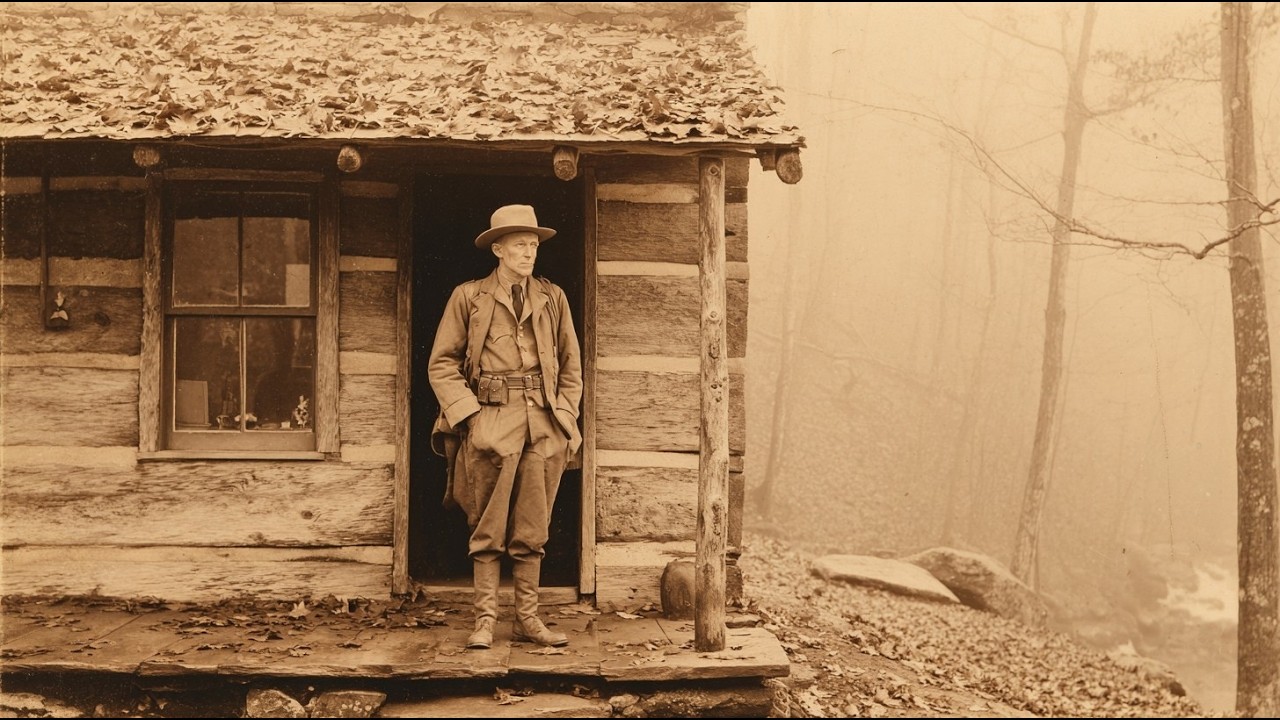
Ozias Thorncastle was a small man, thin in the shoulder, thick in the wrist, fifty-one years old when he finally agreed to write down what happened to him, sitting at a kitchen table in a rented house in Asheville, North Carolina in the spring of 1952. He had been a ranger on a section of the trail in the Pisgah country for nineteen years before he resigned. He resigned the morning after the night in question. He walked out of the woods at first light, drove three counties south without stopping, and put his letter on the supervisor’s desk while the supervisor was still chewing his breakfast.
He did not give a reason. He did not say goodbye to the men he had worked with. He left his uniform folded on the chair with the badge on top of it, and the badge was face down. For fourteen years after that, he did not speak about it.
He did not speak about it to his wife, Marigold, a kind woman and a patient one, who knew not to ask. He did not speak about it to his brother, Halford Thorncastle, who came down from Pittsburgh twice a year to fish the Davidson River, and who would gently raise the subject every time, and every time be answered with silence. He did not speak about it to the doctor in Brevard who came to see him in the winter of 1946, when he could not keep food down for a month and lost so much weight that his wedding ring slipped off his finger one evening into a bowl of broth. He kept it.
That is the part I want you to hold on to. He kept it the way some men keep a bullet in them, because the doctor told them taking it out would do more damage than leaving it in. And then, in the spring of 1952, he started to write. He wrote slowly.
He wrote in pencil on the back of old supply requisition forms he had taken with him when he left the service, because the paper was thick and he liked the way it took the lead. He wrote in the kitchen in the early hours before Marigold came down. He wrote with a glass of water at his elbow and a hand towel folded next to it, because sometimes, his wife would tell me later, his hand would shake so badly that the pencil would skip and he would have to wipe his palm before he could go on. The pages he left behind are what I am working from now.
There are forty-one of them. He was twenty-eight years old when he first walked the section of trail he would come to know better than any man alive. His section ran for a little over fourteen miles north to south through a part of the Pisgah National Forest that the locals called the Cradle, because of the way the ridges folded in on themselves three deep, like a hand cupping water. The trail wound through the middle of it.
There were two shelters on his section, one at the north end and one at the south, and a service cabin in the middle where he was supposed to sleep when his shift required him to stay over. The cabin had been built in 1926. It had a tin roof that the rain played on like a snare drum, a wood stove that smoked when the wind came from the east, and a single window that looked west toward a creek that had no name on any map but that the men of the service called Whisper Creek, because of the sound it made when the leaves were down and the water was low. He loved the cabin.
He told his brother once in a letter that survived that the cabin was the only place in his life where he felt the size he actually was. Not bigger, not smaller, just the right size. A man-shaped thing in a man-shaped room in a country that did not particularly care whether he was there or not. He worked his section through nine summers and nine winters before the first thing happened.
He was not a young man looking for ghosts, not a green ranger spooked by his own shadow. He was a man who had walked those fourteen miles in every kind of weather, who had pulled two bodies out of the ravine below the north shelter, both of them hikers who had misjudged the ice, who had buried a horse with a broken leg on the meadow above Whisper Creek with his own hands and a borrowed shovel. He had spent more nights alone in those woods than most men spend alone in their lives. He was thirty-seven years old when it started.
The first thing he wrote about, on the second page of his pencil-marked papers, was the sound of a door closing. The sound of a door closing does not by itself sound like the beginning of much of anything, but he gave it three pages. Three pages in his small, careful hand. It was the 2nd of October, 1937.
He was in the service cabin. It was just past nine in the evening. He had finished his supper, a can of beans warmed on the stove and a piece of cornbread that Marigold had wrapped in waxed paper for him that morning, and he was sitting at the small table by the window, oiling the action of a rifle he had been issued the year before and did not particularly trust. He heard a door close.
Not the cabin door. The cabin door was four feet from his right elbow, and he would have felt it as much as heard it, the way you feel any door in a small room. This was a door somewhere else. A door, he wrote, that sounded like it was about thirty yards out in the direction of the creek.
There was no door thirty yards out in the direction of the creek. There was no door anywhere on his section of trail except the two shelter doors, which were six miles north and seven miles south of where he sat, and the door of the cabin he was in. He sat very still for a long time. He wrote that he sat still for, in his estimation, the better part of an hour.
He did not get up. He did not look out the window. He kept oiling the rifle. He told himself, the way a man will tell himself, that it had been a tree, a branch falling, a piece of bark coming loose somewhere in the dark and slapping against another piece of bark in a way that from a distance sounded a little like a wooden door fitting into a wooden frame.
The next morning at first light he walked the thirty yards out in the direction of the creek. He found nothing. He found, he wrote, exactly what he expected to find: leaves, a few stones, the path his own boots had worn over nine years of going down to the creek to fill his coffee pot. He stood there for a while listening, the way a man listens when he is trying to talk himself out of something.
And then he went back to the cabin and made coffee and wrote up his report and walked his section. He did not write about it again for almost a year. The second thing happened on the 20th of September, 1938, a month before the night he resigned. He was in the service cabin again.
It was a Tuesday. He had been out walking the south end of his section all day and had come in late after dark, because there had been weather and he had taken shelter under an overhang for two hours waiting for it to pass. He came in wet and tired. He hung his coat on the peg by the door, hung his hat on top of the coat, and turned to the stove to build up the fire.
And he saw, on the floor in front of the stove, a set of boot prints in wet leaves. They were not his. He wrote about this very carefully. He wrote that he stood in the doorway and looked at them for almost a minute before he moved.
He wrote that the prints were of a boot smaller than his own, perhaps a size eight, where he wore an eleven. He wrote that they were sharp, the way prints are sharp when they have been made within the last few hours before the leaves dry and curl. He wrote that they came in through the doorway he was standing in, walked to the stove, stood there for a while, and then walked back out through the same doorway. There was no second set of prints leaving.
Not walking out. Gone. He searched the cabin. He searched it the way a man searches a room when he knows there is nothing there to find and has to do it anyway.
He looked under the bunk. He looked behind the stove. He looked in the small crawl space under the floor that you could only reach by lifting a hatch in the corner. He looked outside, around the perimeter, with his lantern held high.
He looked for half an hour, and he found nothing. He slept that night with the rifle on the bed beside him. He did not sleep well, he wrote, but he slept. In the morning, the boot prints were still there, dried now into the leaves on the floor, and he swept them out before he made his coffee.
He swept them out, he wrote, because he did not want to look at them while he ate. That is the line in his own hand on page eleven. Now, before I go on to the night of October 17th, 1938, I want to ask you something. Have you ever come home to your own house, the house you have lived in for years, and known the moment you put your hand on the door that something inside it was different?
Not wrong, not broken, just different. The air, maybe. The angle of something on a shelf. And you stood there with your hand on the door, and you did not go in for a minute, because you were trying to decide whether you were imagining it.
I think Ozias Thorncastle, on the evening of October 17th, 1938, felt that thing about a place that was not his house. He felt it about fourteen miles of woods. He walked his section that day from south to north. He started before dawn.
He carried his rifle, his lantern, a canteen, a small pack with his lunch and his notebook, a spare pair of socks, and a length of rope that he had been told to bring everywhere ever since he had used a length of rope to bring a man up out of a ravine in 1933. The man had lived. The rope, Ozias wrote, had become the kind of object a man does not go into the woods without. He reached the service cabin at about three in the afternoon.
He had not planned to stay. His shift was supposed to end at the north shelter, where another ranger, a man named Wendelin Holcomb, would meet him at sundown to relieve him. But when he reached the cabin, he wrote, he had a feeling that he should stop. He used those exact words.
He had a feeling that he should stop. He stopped. He put his pack on the table. He sat down on the bunk.
He took off his boots and rubbed his feet, which were sore. And he sat for perhaps ten minutes doing nothing at all, looking at the western wall of the cabin, where the lantern hung on its hook, and listening to the wind in the trees. And he heard, from somewhere out beyond the window, the sound of a man whistling. The man was whistling a tune Ozias knew.
It was a hymn his mother had sung to him when he was small. It was not a tune you would hear in those woods, not a tune anyone he had ever met on that trail had whistled in nine years of meeting people on that trail. It was a tune from a parlor in a town three hundred miles north, in a part of Pennsylvania he had not seen since he was twenty-one. He sat on the bunk and listened.
The whistling went on for perhaps a minute. It moved, the way a man walking moves, slow and steady from somewhere out near the creek, around the back of the cabin, along the side, and then finally to a place very close to the front door. And then the whistling stopped. And then there was a knock.
Three knocks. Slow, spaced out, the way a man knocks when he wants to be sure he is heard. Ozias did not move. He wrote on page seventeen that he did not move because he could not move.
His body, which had carried him through fourteen miles of woods that day, would not lift itself off the bunk. His hand, which was resting on his right knee, would not close. He could feel his breath moving in and out of him, and his heart pushing along behind his ribs, but the rest of him was simply not available to him. He sat there.
And the knocking came again. Three knocks. And a voice said from the other side of the door, “Ozias, it’s getting dark out here. ”
The voice knew his name.
The voice sounded, he wrote, like his father. His father had been dead for sixteen years. He sat on the bunk for a long time without answering. He wrote that the part of him that was thinking, which was a small part of him at that moment but a stubborn one, was very clear on one thing.
His father was dead. His father had died in a town outside Scranton, Pennsylvania, in the autumn of 1922, of a heart that had stopped during a meal of pot roast and potatoes. He had been buried in a churchyard that Ozias visited once a year. Ozias had stood at the grave the previous April.
His father’s voice was a sound he had not heard in sixteen years, but he knew it the way a man knows his own name. It was on the other side of the door. The voice said again, “Ozias, it’s getting dark out here. ” And then it said, “Open up, son.
I’ve come a long way. ”
He wrote that he closed his eyes. He sat there with his eyes closed for what felt like a long time, and tried to think, and the thinking was very hard, because the part of him that wanted to open the door was almost as large as the part of him that did not. The voice on the other side of the door was the voice of a man he had loved.
The voice was warm. The voice was tired, the way a traveler is tired. The voice was the voice of his father coming home for supper after a day at the railyard. He did not open the door.
He sat on the bunk with his eyes closed, and he said out loud in the small cabin, “My father is dead. ” The voice on the other side of the door went quiet. It went quiet for perhaps a count of ten. And then it said, in the same warm, tired voice, “I know I am, son.
Open the door. ”
He wrote that he did not remember moving. The next thing he knew, he was on his knees on the floor of the cabin, and he had crawled, with his eyes still closed, from the bunk to the corner where the hatch was that led to the crawl space, and he had lifted the hatch, and he was holding the edge of it with both hands, and he was waiting. He wrote that he does not know how long he waited.
The next thing he heard, after a long time, was the sound of a door closing. Thirty yards out, in the direction of the creek. He stayed in the crawl space for the rest of the night, on the cold ground, with his eyes open in the dark, listening. He did not hear the whistling again.
He did not hear the knocking again. He did not hear the voice again. He heard twice what might have been footsteps on the cabin floor above him, slow and unhurried, walking from the door to the stove, standing there, and then walking back. He heard once what might have been someone sitting down on the bunk, the way the old springs would creak when a man sat down.
He heard once what sounded like his name being spoken very softly in the dark above him, by a voice that was no longer his father’s voice, and was no longer trying very hard to sound like it. But mostly, he heard the woods. And the woods, he wrote, were the worst part. Because the woods, on the night of October 17th, 1938, did the thing he had never heard them do in nine years.
The woods went quiet. Not the kind of quiet that comes when a deer goes by, or when an owl is hunting, or when the wind drops and the trees stop talking for a minute. A different kind of quiet. A held quiet.
The kind of quiet, he wrote, that you get in a room when everyone is listening for the same thing. The woods, he wrote, were listening with him. He came out of the crawl space at first light. He was stiff.
He was cold. His teeth, he wrote, hurt from being clenched all night. He pushed the hatch open very slowly, and listened, and climbed out, and stood in the middle of the cabin in the gray light coming through the window, and looked around. The cabin was empty.
There were no boot prints in the leaves on the floor. There was no smell of anything that should not have been there. The lantern was on its hook. The rifle was on the bunk where he had left it.
His pack was on the table. His coat was on the peg by the door, and his hat was on top of the coat. And the door was closed and latched the way he had latched it the afternoon before. There was one thing.
On the table next to his pack was a small object that had not been there when he arrived. He wrote about it very carefully. It was a button. A brass button about the size of a nickel with a design pressed into it that he did not at first recognize.
It was old. The brass was dull. The shank on the back was bent the way a shank gets bent when a button has been pulled off a coat in a hurry. He picked it up.
He looked at it. He turned it over. He looked at the design pressed into the front of it. And he recognized it.
It was a button from a coat his father had worn. A coat, he wrote, that had been buried with his father in 1922 in the churchyard outside Scranton, Pennsylvania, in a grave he had stood at the previous April. He put the button in his pocket. He put on his boots.
He put on his coat. He put on his hat. He took his rifle and his pack and his lantern, and he walked out of the cabin, and he walked the seven miles south down to the road where his truck was parked, and he drove three counties to the supervisor’s office, and he put his letter on the desk, and he never went back. That is what he wrote.
That is what is on the forty-one pages he left in a box in a closet in the rented house in Asheville, where his wife Marigold found them after he passed in the autumn of 1958, six years after he wrote them. His wife gave the pages to his brother. Halford kept them for a long time. Halford died in 1971, and the pages went to his daughter, Verbena Thorncastle, who lived in Pittsburgh and who was the one who first contacted me three years ago, when she heard a previous story of mine and recognized the country it was set in.
She sent me the pages. She sent me also the button. I have it on the desk in front of me now. Over the past three years I have identified it.
It is the button of a coat that was sold between the years of 1895 and 1910 by a tailor’s shop in Scranton, Pennsylvania, that catered to railway men. It is the kind of coat that a man who worked in the Scranton rail yards in 1922 would have owned, and might have been buried in. I do not know what to do with it. I keep it in the drawer of the desk in a small wooden box with the pages.
I take it out sometimes when I am writing late, and I turn it over in my hand the way Ozias must have turned it over in his hand on the morning of October 18th, 1938. And I think about what he wrote on the last page, because there is one more thing. He did not write about the button on October 18th. He wrote about it almost fourteen years later, in the spring of 1952, sitting at the kitchen table in the rented house in Asheville.
He wrote about it on the very last page of the forty-one pages he left behind. He wrote it, his wife told me, on the night before the morning he came down with a cough that he never recovered from, although he lived another six years carrying it. What he wrote on the last page was this. He wrote that the button, in the fourteen years he had carried it, had moved.
It had moved from one pocket to another. It had moved from a drawer in a bureau in a house in Asheville to a drawer in a different bureau when they moved to a different house. It had moved from a small wooden box that he kept it in for a while to a tin box that he kept it in for a longer while. And every time it moved, he wrote, it moved by his hand, because he was the one who picked it up and put it somewhere else.
Except once. He wrote that on a certain evening in 1946, the winter when he had been very ill, the winter when his wedding ring had slipped off into the bowl of broth, he had been lying in his bed in the upstairs room of the house in Asheville, and he had not been able to sleep. He had reached over to the small table beside the bed and opened the drawer where the button was kept at that time. The drawer had been empty.
He wrote that he had searched for the button for three days. He had taken apart the bed. He had taken apart the room. He had asked Marigold whether she had moved it, and she had said no, in the patient way she said most things to him, and he had believed her, because she was a woman who did not lie.
He had searched the whole house, with the careful, slow searching of a sick man who has nothing to do but search. He had not found the button. On the fourth day, he wrote, he had given up. On the fifth day he had come downstairs in the morning very early, before Marigold was awake, and he had gone into the kitchen to make himself a cup of tea, because he could not keep coffee down.
He had reached for the kettle on the stove, and he had stopped. Sitting on the lid of the kettle, in the middle of the cold cast iron stove, was the button. He wrote that he picked it up. He wrote that the button was warm.
He wrote that the stove was cold. He wrote that he held the button in his hand for a long time, and that he thought very clearly about a tune his mother had whistled to him when he was small, and a knock on a door, and a voice on the other side of it. And then he wrote, in the last line of the last page, this: “I do not think he ever left. I think he is still in the cabin.
I think he has been in the cabin since the night of October 17th, 1938. And I think sometimes he sends the button out to remind me. ”
That is the end of what Ozias Thorncastle wrote. He died six years later, in the autumn of 1958, in the rented house in Asheville, North Carolina, at the age of fifty-seven.
His wife Marigold told me in a letter that Verbena Thorncastle passed on to me last spring that on the morning of the day he died, he had asked her to bring him the button, and she had brought it in the small wooden box, and she had put it on the bed beside his hand, and he had held it for a while, and then he had closed his eyes and slept, and he had not woken up. She said that when she came back into the room two hours later, the button was no longer in his hand. It was on the window sill. The window had been open, she said, although she did not remember opening it.
There was a cool wind coming in from the west, where the mountains were, very far away, and she could smell faintly on the wind something like wood smoke, although there was no fire anywhere in the house and no fire anywhere on the street. She took the button off the window sill. She closed the window. She put the button back in the small wooden box.
The box came to me three years ago. The button is in it. I have not opened the window in this room since I started writing this story. I want to tell you that because I want to be honest with you.
I do not know what the button does. I do not know whether the cabin is still standing, although I have made inquiries, and the records I can find suggest that the service cabin on that section of the Pisgah Trail was decommissioned in 1963 and torn down sometime in the years that followed. Although the foundation, by some accounts, is still there, half buried, thirty yards from a creek that the older men of the service used to call Whisper Creek. I do not know whether, if I went there, I would hear anything.
I do not know whether, if a man stood in the middle of that foundation in the dark in the month of October and waited, he would hear a door close. I do not particularly want to know. But I think about it sometimes. I think about it more than I would like.
And on certain nights, when the wind is from the west and the house is quiet and I am sitting at this desk with the small wooden box in the drawer beside my hand, I find myself listening for the sound of something thirty yards out. A door closing. A man coming home. On the matter of the button, I have made a decision while telling you this story that I had not made before I started.
I am going to send it back. I am going to put it in a small parcel with a note, and I am going to send it to Verbena Thorncastle in Pittsburgh, and I am going to ask her to do with it what she thinks Ozias would have wanted. I do not think it should be in this house any longer.
