On a weekend night in the 1990s, the last Burger Chef still standing locked its doors for good. A chain that had once run more than a thousand restaurants, that had invented the modern kids’ meal and taken on McDonald’s at its own game, disappeared from the American roadside without ceremony. For decades it had been one of the most recognizable names in fast food. In the end, there was no crowd, no farewell, no final burger sold.
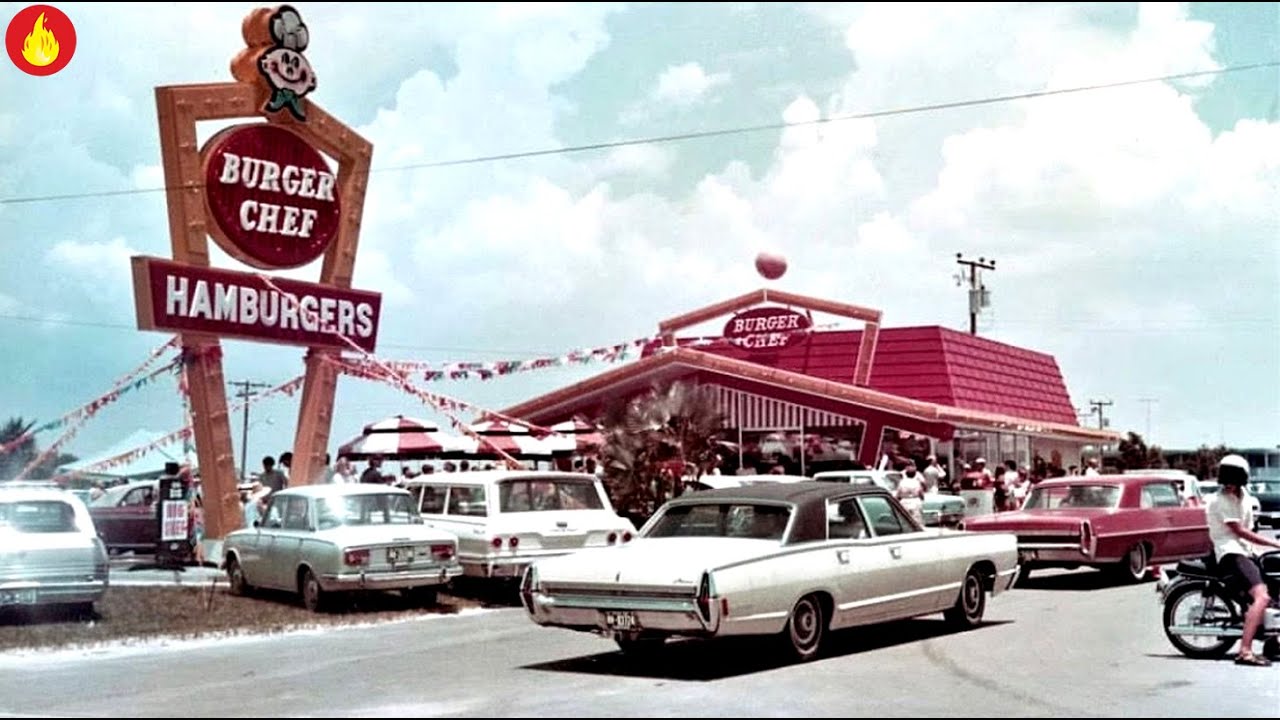
Just a closed door, and the memory of everything that had come before. Burger Chef began in 1954 with an idea that would reshape the industry: the triple threat. For forty-five cents, a customer got a burger, crispy fries, and a cold drink, a bundled deal that seemed almost impossibly cheap at the time. The chain also claimed a quieter but lasting distinction: it introduced the first Happy Meal, putting toys in children’s hands and turning a simple lunch into an event.
At its peak in 1973, Burger Chef boasted over 1,000 locations across the United States, a genuine rival to the golden arches. But competition wore it down. General Foods acquired the company, then Emasco, the parent of Hardee’s, took over and converted dozens of stores into Hardee’s franchises. The decline stretched over decades until the final location closed in 1996, ending a chapter that had once defined American fast food.
Around the same years Burger Chef was rising, another name was becoming inseparable from the open road. Howard Johnson’s started in 1925 and grew into the largest restaurant chain in the country by the 1960s and 1970s, with over 1,000 locations. For families on long drives, it was more than a meal: it was a roadside oasis, a place to rest and refuel after hours behind the wheel. The chain built its reputation on 28 ice cream flavors, a sweet paradise for every age, alongside hamburgers and home-cooked comfort food.
Every meal carried a sense of warmth and familiarity. But McDonald’s and Burger King were changing what Americans expected from a quick meal, and tastes shifted. The chain faded steadily, and in 2022 the last Howard Johnson’s, in Lake George, New York, was forced to close. In Santa Barbara, California, 1957, a different kind of chain was born.
Sambo’s became known for fluffy pancakes, juicy burgers, and the cozy atmosphere of a family meal. Growth was explosive: by 1979 the chain reached 1,117 locations, making it a fixture in millions of American dining lives. But the name, along with decorative wall murals tied to the story of Little Black Sambo, sparked fierce controversy over racial insensitivity. Protests mounted, financial missteps followed, and the damage was severe.
Most stores had closed or changed ownership by 1981. The last original location, in Santa Barbara itself, finally changed its name in 2020 after renewed protests. Sambo’s became a painful lesson in how a single name, even attached to a beloved restaurant, could bring down an empire. Not every fallen chain was a burger joint.
Steak and Ale opened in 1966 in Dallas, Texas, and offered something different: the cozy atmosphere of an English tavern in the middle of America. Diners came for rustic, elegant decor and superb prime rib, and for a concept that was completely new at the time, the unlimited salad bar. The freedom to choose fresh vegetables at will enriched the dining experience in a way no other chain had tried. In its heyday it was the ideal choice for special dinners and intimate gatherings, a place where quality food came at an affordable price.
But tastes changed and competition intensified. The chain struggled through years of decline and closed in 2008. Some chains were born from the world of sports. Gino’s Hamburgers was founded in 1957 by Baltimore Colts legends Gino Marchetti and Alan Ameche.
The chain won quick affection, largely on the strength of the Gino Giant, a massive burger that became a symbol of fullness and flavor. A strategic partnership with Kentucky Fried Chicken allowed many locations to serve the famous fried chicken, diversifying the menu in a way few rivals matched. With more than 300 locations across the Mid-Atlantic, Gino’s became a cultural gathering spot where fans felt connected to the spirit of their favorite players. But market fluctuations took their toll.
In 1982 Marriott Corporation acquired the chain and gradually converted the stores into Roy Rogers Restaurants. The last Gino’s closed in 1986. Other chains were built on a single distinctive idea. Lum’s began as a small hot dog stand in Miami Beach in 1956, and its signature dish was unlike anything else on the market: hot dogs steamed in beer.
The process gave the sausage a special tenderness and an alluring aroma that diners never forgot. The concept spread to more than 400 locations across the country. The owners became so successful that they acquired Caesar’s Palace, the icon of Las Vegas, proof of how far the chain had come. But good fortune did not last.
After being sold to John Y. Brown and then to the Swiss company Wienerwald, Lum’s began to face serious financial difficulties. The chain filed for bankruptcy in 1982. The last Lum’s restaurant, in Bellevue, Nebraska, closed in 2017.
In Springfield, Ohio, 1961, Red Barn made its mark with both appearance and innovation. The chain introduced the Big Barney Burger even before McDonald’s launched the Big Mac, and it was also one of the first restaurants to feature a self-service salad bar. Its distinctive exterior and friendly, family-oriented setting made it a favorite destination. But when City Investing Company acquired the chain in 1978, the new owners focused more on real estate than on the burger business.
The strategic shift led to inevitable decline, and the last Red Barn closed in 1988. One chain gambled on indulgence and lost. Beefsteak Charlie’s began in Manhattan in 1910 and grew to 60 locations by 1976. It was famous for steaks and fresh seafood, but what truly set it apart was more generous than any competitor could match: an unlimited salad bar, and unlimited beer, wine, and sangria.
With reasonable prices, it was a paradise for anyone who wanted a full meal and unlimited drinks in a lively, bustling atmosphere, an ideal place for gatherings of friends and colleagues. But the unlimited beverage offer became a massive financial burden. Profitability became impossible, tastes changed, and competition mounted. The last Beefsteak Charlie’s closed in 2009.
Pup ‘N’ Taco took a different approach entirely. Opening in 1956 in Pasadena, California, it offered a creative mix: crispy tacos, classic burgers, hot dogs, pastrami sandwiches, and icy slush drinks. The blend created a unique dining experience, and the chain expanded to more than 100 locations across Southern California and New Mexico. But soaring real estate prices and fierce competition from McDonald’s and Taco Bell put it in a difficult position.
In 1984, Taco Bell acquired 99 of its locations. The last remaining store, in Albuquerque, closed in 2013. Henry’s Hamburgers was a symbol of affordable quality. Born in Chicago in 1954, it was famous for a cheeseburger priced at just fifteen cents, and for the brown bag special: a combo of burger, fries, and soda packed in a paper bag, offering convenience with a familiar, simple feel.
It was a top choice for families and students looking for quick, economical meals. But competition from McDonald’s grew relentless, and changes in ownership and management caused further difficulties. Today only a single Henry’s Hamburgers remains, in Benton Harbor, Michigan. Some chains built their legend on spectacle.
Farrell’s Ice Cream Parlour, founded in 1963 in Portland, Oregon, was famous for its carnival-like atmosphere and, above all, for a giant sundae called the Zoo, paraded out with blaring sirens and booming drums. It was the ideal place for birthday parties and celebrations, where laughter filled the space. But Marriott acquired the chain in 1972, and under new management it could not maintain its appeal against changing tastes and fierce competition. The final Farrell’s closed in 2019, taking the sirens and drums with it.
Bob’s Big Boy began in 1936 in California and conquered diners with its two-decker Big Boy Burger, along with a classic American diner style of chrome counters and checkered floors. It was a familiar destination for families and for teenagers after school. But after Marriott bought it in 1967 and it passed through various owners with ineffective strategies, the chain declined. Most stores closed, and only a few remained in Southern California.
White Tower Hamburgers rose in 1926 in Milwaukee as a fierce rival of White Castle, with distinctive white fortress architecture and small square burgers. At its peak in the 1950s it reached 230 locations. But the similarity in design and menu led White Castle to sue in 1929, the start of a long legal battle. Intense competition and changing tastes took their toll.
In April 2022, the last location, in Toledo, Ohio, was destroyed by fire, officially closing the era. Some chains came from unexpected places. Wags was launched in 1975 by Walgreens, the drugstore giant, as a 24/7 family restaurant serving convenience food and hearty breakfasts. It became popular in Chicago and Florida, a familiar destination for late-night meals and quick breakfasts in a comfortable, friendly atmosphere.
In 1988 Walgreens sold all 91 locations to Marriott, a decision that led to poor management and lost customers. Wags closed in 1991. Royal Castle, known as the White Castle of the South, was founded in 1938 in Miami. It brought small square burgers, fresh orange juice, and hearty breakfasts to the region, growing to more than 175 locations in the 1960s.
But the rise of McDonald’s and Burger King in the 1970s made competition impossible. After Performance Systems acquired it in 1969, service and food quality declined, eroding customer trust. Royal Castle closed in 1975. Minnie Pearl’s Chicken dared to challenge KFC directly.
Launched in 1966 and named after the famous comedian Minnie Pearl, the chain opened over 100 stores in just a few short years. But chicken quality was inconsistent, sometimes delicious and sometimes terrible, and customers lost trust. Accusations of inflated revenues and stock manipulation created a scandal that pushed the chain to the brink of bankruptcy. Most locations closed in 1973.
Bill Knapp’s was a true family restaurant, founded in 1948 in Battle Creek, Michigan, famous for fried chicken, bean soup, and a legendary chocolate cake. Its unique policy was a birthday and anniversary discount equal to the customer’s age, creating deep loyalty. But older customers dwindled while younger generations sought trendier places. Modernization attempts in 1998 failed, and a listeria outbreak severely damaged the reputation.
The last Bill Knapp’s closed in 2002. Burger Queen started in 1956 in Louisville, Kentucky, serving burgers, fried chicken, and fresh salads. In 1981 it rebranded as Druther’s, hoping for a fresh, modern image, but the change did not yield the desired results. By around 1990, most Druther’s had converted into Dairy Queens, and the chain disappeared from the map.
Doggy Diner operated from 1948 to 1986, serving hot dogs and hamburgers in San Francisco and Oakland. What made it memorable were the giant cartoon dachshund heads on poles at each location, signs that became part of the urban landscape and brought smiles to passersby. The chain was an indispensable part of Bay Area culture until it closed in 1986, leaving nostalgia for the dog heads and the simple food. Little Tavern charmed Washington, D.
C. , Maryland, and Virginia with its blocky brick, castle-like architecture. The tiny stores looked like fairy-tale castles, and inside they served small hot hamburgers perfect for a quick meal for decades of workers, students, and families. But it could not withstand time and competition.
The last Little Tavern closed in 2008. Milligan’s Beefy Burgers was Florida’s first drive-through fast food chain, a modern concept that made it wildly popular in Jacksonville. At its peak it had 10 locations serving thousands daily, a symbol of convenience and speed. But McDonald’s and Burger King, with greater resources and stronger marketing, dominated the market.
Milligan’s closed in 1974. Jerry’s Hamburgers was an Illinois chain founded by a former McDonald’s vice president who brought experience and vision to create a competitor. It shared many similarities with McDonald’s, from menu to operations, and attracted customers with quality burgers and quick service. But it could not overcome market challenges.
The company filed for bankruptcy in 1981, and the last independent store ceased to exist in 1999. D’Lites was ahead of its time with a vision for healthy eating. While other chains focused on high-calorie items, D’Lites pioneered a health-conscious menu with lean beef, high-fiber buns, and low-fat cheese, offering a fresh option for the conscious eater. But despite a good idea, it faced a series of financial problems and filed for bankruptcy in 1987.
Carol’s was founded in the 1960s with a yellow snail mascot and grew to 150 stores across New York and Pennsylvania. It served classic burgers and fries and became a familiar part of daily life. But by the 1980s its locations were outdated and could not compete with modernized rivals. Notably, Carol’s parent company later became the largest Burger King franchisee in the world, a remarkable transformation in the industry.
Chicken George was a small Maryland fried chicken chain that created a sensation with its special flavor and quality, expanding to six stores and becoming a regional phenomenon and a source of community pride. But despite its popularity, it could not avoid financial difficulties. The chain filed for bankruptcy and was dissolved in 1991. Dee’s Drive-In began serving University of Utah students in the 1920s, becoming a familiar spot for young people to enjoy quick, affordable meals over burgers and milkshakes.
In the 1970s, the owner sold all locations to Hardee’s, ending the era of Dee’s Drive-In and integrating it into a larger brand. Heap Big Beef served roast beef sandwiches throughout the 1960s, with tender, juicy meat and unique sauces that created a memorable experience. It had a period of stable operation, but faced bad luck in the 1970s and filed for bankruptcy that decade. La Petite Boulangerie was a fast food bakery chain with a French-inspired style, founded in 1977.
With fresh pastries, coffee, and light meals, it grew to 140 locations, offering croissants and sandwiches in a cozy atmosphere. But it went through multiple changes of ownership, from PepsiCo to Mrs. Fields, each bringing different strategies. It closed in 2000.
Showbiz Pizza Place was famous for its animatronic performers and family entertainment. The Rock-afire Explosion robot band attracted thousands of families, making it an ideal venue for birthday parties. The chain later merged with Chuck E. Cheese, and while the Showbiz brand no longer exists, its spirit lives on in Chuck E.
Cheese, where robots and games continue to bring joy. Sizzler, founded in 1958 in Culver City, California, served quality steaks at affordable prices. Its turning point was the introduction of a self-serve salad bar. Initially a plus, the salad bar became so extravagant and rich that it overshadowed the steaks themselves.
Diners began coming primarily for the salad bar, making brand positioning and cost management difficult. The chain filed for Chapter 11 bankruptcy in 1996, closing over 130 restaurants. Shakey’s Pizza opened in 1954 in Sacramento, California, famous for its pizza, fried chicken, and lively Dixieland jazz. It offered a unique entertainment-and-dining experience ideal for gatherings, but could not compete with the convenience of home delivery and changing tastes.
Most U. S. locations closed, though the chain still operates strongly in some other countries. Wimpy Grills dates back to 1934 in Bloomington, Indiana, once having 25 U.
S. locations and expanding internationally to an impressive 1,500. But all U. S.
locations closed in 1978. Interestingly, while Wimpy disappeared from the United States, it continued to operate strongly abroad, especially in the United Kingdom and Canada. Hot ‘n Now created a sensation in the early 1990s with a bold pricing strategy: every item on the menu cost just thirty-nine cents. It boomed briefly as a symbol of savings and value, but the extremely thin profit margins made it difficult to maintain quality and profitability as competition intensified.
Today, only a few scattered locations remain, very close to disappearing entirely. Naugles was a West Coast chain famous for its tacos, burritos, and other Mexican dishes, building a loyal customer base. In 1988 it was acquired by Del Taco, a larger competitor. Most locations closed or converted by 1995.
Thanks to community affection, a revival effort began in 2015, and two Naugles locations were still open as of 2025. All-Star Cafe was a sports-themed restaurant owned by Planet Hollywood, with spacious interiors decorated with sports memorabilia and large screens showing events. It once had 10 locations, often near stadiums or in major tourist areas. But the themed restaurant model lost appeal, and the last official All-Star Cafe, at Walt Disney World, closed in 2007.
Ameche’s Drive-In was a familiar name in the Baltimore metropolitan area, with five suburban locations serving classic fast food in a friendly, convenient setting where customers could order from their cars. The Training Table was a regional chain in Utah with five locations in the Salt Lake City area, focused on gourmet burgers and elevating the traditional burger into a more premium experience through ingredient quality and creativity. Cindy’s and Debbie’s operated in the mid-to-late 1970s and became an example of the risks of copying a successful formula. They were accused of being blatant copies of Wendy’s, from menu to service style, leading to fierce legal battles.
The lawsuits pushed both chains into difficulty and led to bankruptcy. Winky’s was a Pittsburgh institution in the 1960s and 1970s, famous for burgers, fries, and other classic items. It built a loyal customer base and became a community icon, but could not avoid economic challenges and increasing competition. The chain filed for bankruptcy in 1982.
Finally, CosMc’s was an ambitious spin-off of McDonald’s, designed to experiment with new ideas and expand the market with the backing of one of the world’s largest fast food corporations. It promised unique and innovative experiences. But despite abundant resources and a well-planned strategy, the project failed to launch and could not become operational as expected.
