In the winter of 1141, England had a crowned king, and he was chained in a dungeon in Bristol. Stephen of Blois had been captured on the battlefield at Lincoln in February, his army shattered by the forces of his cousin, the woman who claimed his throne. She had him put in irons. That spring, an ecclesiastical council in Winchester, presided over by Stephen’s own brother, declared her “Lady of the English.
” Royal charters were issued in her name, stamped with her own seal. Arrangements were made for her coronation at Westminster. The crown never touched her head. She was driven from London before the ceremony could take place, and because of that, her name appears in no official list of English monarchs.
Her reign lasted eight months, and history has refused to count it. She was Matilda, daughter of Henry I, and she was not the first woman to be erased from the record, nor the last. Nine royal women lost their stories this way. None of them were victims of chance.
Every erasure has a name attached to it, a motive, and usually a hand writing it down. These were women who ruled, negotiated, financed armies, and in several cases led them. The reputations that reached us were shaped by men who needed to shrink them. Some were cast as monsters.
Others were reduced to the role of wife. Still others were simply deleted from ceremonies, paintings, and official records. The ranking here is not about who suffered most. Suffering is not the measure.
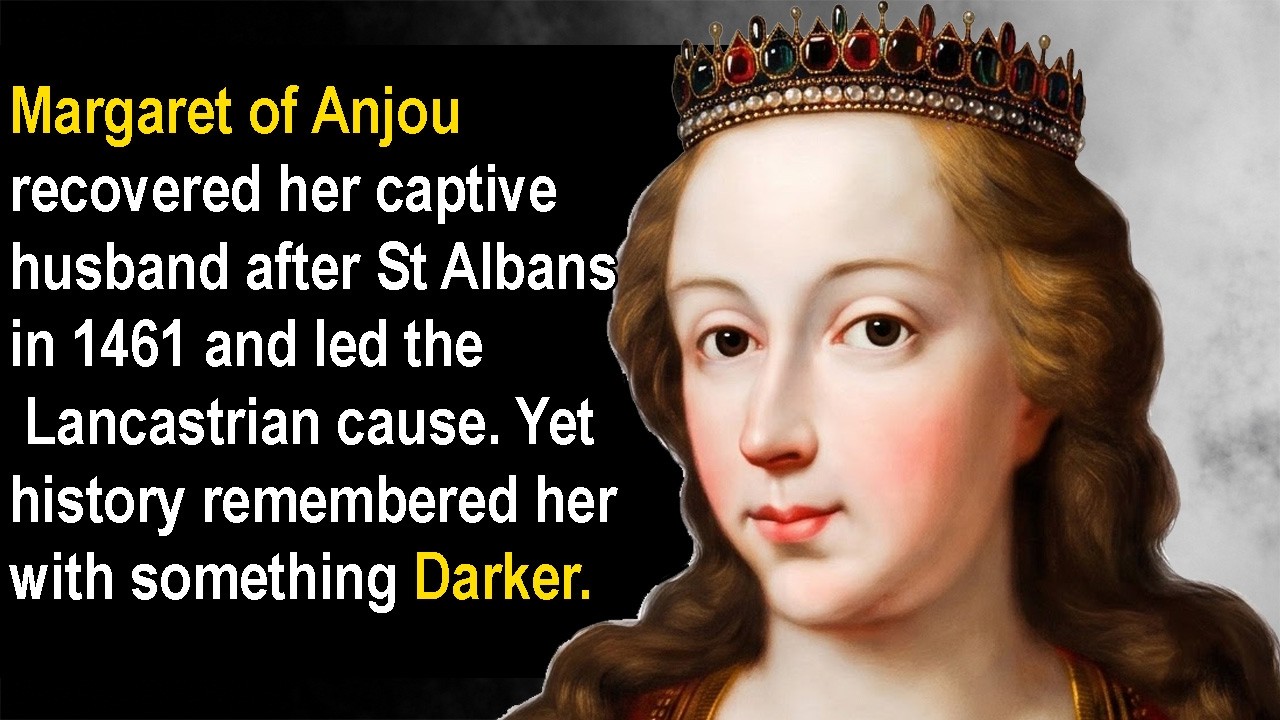
The measure is how much they actually did, how much history refuses to restore to them, and how completely their real lives were replaced with a story about someone else entirely. By that standard, the woman in ninth place was the least erased of the nine. She is also the one history spent four centuries calling a monster. Margaret of Anjou arrived in England in 1445, at the age of fifteen, to marry Henry VI.
The purpose of the match was to buy a truce with France. On paper, she was a decorative bride. That changed in August 1453, when her husband’s mind collapsed. He stopped speaking.
He stopped recognizing faces. He could not even acknowledge his newborn son. So she took control. She held the Lancastrian cause together for more than a decade.
She raised money. She courted the Scots. She negotiated with Louis XI of France for men and ships. In February 1461, at the Second Battle of St.
Albans, her forces defeated the Yorkist army and liberated her husband from their captivity. This is not the role of an observer in a war. This is the role of a war leader with a field record spanning a decade. Almost none of that survived.
What remains is the image of the monster. Yorkist writers turned her into the foreign woman who poisoned the English court, a cruel and unnatural queen who usurped her husband’s role. A century and a half later, Shakespeare finished the job, putting into the mouth of a duke the phrase “she-wolf of France. ” That version outlived every other.
Her story was not deleted. It was replaced with a more marketable one. Becoming a monster, at least, guaranteed a place in the pages of history. The next queen was erased by being made boring.
Blanche of Castile, granddaughter of Eleanor of Aquitaine, was queen of France. When her husband Louis VIII died in November 1226, she became regent for her twelve-year-old son, holding together a kingdom that half the nobility expected to fall apart within a year. It did not. She crushed baronial revolts.
She kept the English at bay. In 1229, she concluded the Treaty of Paris with the Count of Toulouse, ending twenty years of religious wars in the south and attaching Languedoc to the French crown. Then, in 1248, her son sailed for the Holy Land, and she ruled France alone for a second time until her death in November 1252. Two regencies, nearly twelve years, administering the largest kingdom in Western Europe.
Her entire historical record has been condensed to four words: mother of Saint Louis. Her son was canonized in 1297, and the paperwork of that canonization is enormous. None of it mentions the woman who kept the throne warm enough for him to sit on. Joan of Navarre, widow of the Duke of Brittany, became the second wife of Henry IV of England.
After Henry’s death, she was a wealthy dowager queen with an annual income of about ten thousand marks, one of the largest private incomes in the kingdom. Her stepson was Henry V, and he had a war in France to finance. On 29 September 1419, her own confessor, a monk named John Randolph, accused her of trying to kill the king by witchcraft. She was arrested.
Her property was confiscated. Her dower income was seized. She was held at Pevensey and other places for nearly three years. She was never tried.
No hearing, no verdict, no acquittal. The charge that stripped her of everything she owned was never once brought before a court, which was convenient, because the money went directly to fund the war campaign. Then comes the part that is hard to say with a straight face. In 1422, while dying, Henry V ordered her release and the restoration of her property.
Some historians read this as a guilty conscience waking up a little late, but the records show only the order. She got her lands back and walked free while still officially accused of witchcraft, because her exoneration was never on anyone’s list of priorities. That is the frightening detail, not the accusation itself. The fact that no one bothered to withdraw it.
She outlived Henry by fifteen years and was buried beside his father in Canterbury Cathedral. Joan was erased in silence, without trial and without an audience. The next queen was erased before the largest audience in Europe, and it worked just as well. Caroline of Brunswick met her husband three days before their wedding in 1795, and by most contemporary accounts, he was drunk during the ceremony.
Within a year, they were separated. He restricted her access to their only child. That was the mild stage. In 1820, George IV became king, and the new king did not want a divorce.
He wanted to be rid of her. His government introduced the Pains and Penalties Bill into the House of Lords, legislation whose sole purpose was to dissolve the marriage and strip her of the title of queen on grounds of adultery. For eleven weeks, the lords listened to testimony about the queen’s private life with Italian servants who had been shipped across the continent to testify. The bill passed its third reading with a majority of nine votes.
Nine. The government looked at that number, looked at the crowds filling the streets outside, and dropped the whole thing rather than send it to the Commons. She had won, technically. That was when things got worse.
On 19 July 1821, she went to Westminster Abbey for the coronation. She was turned away at the door. She tried a second entrance, then a third. All refused, reportedly because professional wrestlers had been hired as door guards for exactly that purpose.
The queen of England stood outside the coronation of her own husband and was barred from entering. She fell ill that night. She died on 7 August, nineteen days later. She requested that a plaque be placed on her coffin describing her as “Caroline, the injured Queen of England,” and reportedly the authorities did not allow that plaque to accompany her body.
She was not the first queen whose husband tried to end his marriage by legislation. Three centuries earlier, another king had pursued the same method to be rid of his wife, and that woman is remembered for the divorce and almost nothing else. Catherine of Aragon is the expected name. The first wife, the repudiated wife, the woman upon whom the English Reformation was built.
Six years of legal dispute, a shattered church, and a very famous husband. Strip all of that away and you find someone entirely different inside. In June 1513, Henry VIII sailed for France and left her behind as ruler of the kingdom and commander-in-chief of the forces at home. This was not an honorary title.
She had the authority, and that autumn she used it. James IV of Scotland crossed the border with an army that may have numbered thirty thousand men. Catherine organized the English response. She authorized payments.
She ordered the making of banners and standards. She sent troops north and moved herself with a reserve force, pregnant at the time, and reportedly gave a speech to her army commanders on the road. The Earl of Surrey met the Scots at Flodden on 9 September 1513. The Scottish king died on the field.
So did an archbishop, nine earls, and nearly ten thousand men. It remains the most devastating defeat in Scottish history. Catherine’s letter to her husband afterward was almost exultant. She sent him a piece of the dead king’s bloodstained coat and explained that she would have sent the body itself, had English hearts been able to bear it.
She had just delivered the greatest military victory of his reign while he was busy taking a small town in France. Twenty years later, he prosecuted her for having been married to him. Catherine at least stayed in the picture, even if only in the wrong half of it. The next woman ruled an entire kingdom and is still remembered mainly through an object.
Melisende was the eldest daughter of the king of Jerusalem. In 1131, she was crowned ruler in her own right alongside her husband Fulk and their infant son. Three crowns, in a single ceremony. The crusader kingdom was hers by blood, not by marriage.
Fulk spent the early years of the reign trying to push her out of power. It failed. By 1136, he was ruling with her rather than over her. When he died in a hunting accident in November 1143, thrown from his horse and killed by the impact of the saddle, she ruled alone.
She governed the kingdom for more than a decade. Royal decrees went out in her name. She built and endowed. She founded the abbey at Bethany and installed her sister as its abbess.
She managed the Second Crusade when it arrived and collapsed outside Damascus. William of Tyre, writing a generation later and no admirer of women in power, said she ruled the kingdom with the strength of a great ruler. Then, in 1152, her son Baldwin III demanded everything. The kingdom was formally divided between them.
Within weeks he attacked her half and besieged his own mother in the Tower of David. She surrendered. She kept Nablus. She remained active in affairs of state until illness took her in 1161.
The one object most people will ever associate with her name is a psalter. A richly decorated prayer book with carved ivory covers, made in Jerusalem in the 1130s. It is magnificent. It is also, by most scholarly accounts, a gift her husband commissioned for her.
A woman who issued royal decrees for twenty years, remembered through something a man made for her. Melisende at least left documents signed in her own name. The next woman left almost no signature at all, and yet she founded an entire dynasty. Margaret Beaufort was born on 31 May 1443, married at twelve, widowed at twelve, and on 28 January 1457, at the age of thirteen, gave birth to a son at Pembroke Castle in the middle of winter, in a labor that nearly killed them both.
She never bore another child. The son was Henry Tudor. For the next twenty-eight years, everything she did was aimed at him. Here the historical record begins to contradict itself.
Everyone agrees she was the organizing center of the 1483 conspiracy against Richard III. Her physician, a Welshman named Lewis Caerleon, moved between her house and the house of Elizabeth Woodville, the widowed queen resident in sanctuary at Westminster, and the two women agreed on the arrangement that made everything else possible. Henry Tudor would marry Elizabeth of York, merging the two claims to the throne. Margaret then financed and helped coordinate the rebellion of the Duke of Buckingham.
It failed, and Richard’s response measures exactly how dangerous he considered her. He issued a judgment confiscating her property. She was stripped of her lands and titles, which were granted to her husband Lord Stanley, with instructions to isolate her from her servants and cut off her ability to send letters. A king who had just executed a duke decided the right move in her case was complete neutralization.
It did not work. Two years later, the Stanleys stood neutral at the start of the Battle of Bosworth and then turned on Richard, and Margaret’s son left the battlefield as king. Now comes the contested part. There is an ongoing modern argument that Margaret had a hand in the disappearance of the Princes in the Tower, on the grounds that no one benefited more than she did.
It is pure speculation. No contemporary source mentions her name, and historians are divided on whether the theory is worth investigating at all. We will likely never know the truth. But the speculation itself reveals something.
Even the theory that imagines her as the most powerful figure is a theory about a crime, not about the campaign she actually ran. Because that is the essence of historical erasure. Margaret Beaufort spent decades building a claim to the throne, financing a rebellion, negotiating a dynastic marriage across enemy lines, surviving a judgment of forfeiture, and yet the standard narrative credits the rise of the Tudors to a twenty-eight-year-old man who spent fourteen years in exile in Brittany and never fought on English soil. She signed herself “Margaret R.
” for the rest of her life. She outlived her son by only two months. The dynasty she founded ran out of heirs in 1603, and the crown passed sideways to her line in Scotland. One of them was a girl destined to gain two crowns in a single year, and to lose both before the following winter ended.
Elizabeth Stuart was the daughter of James VI of Scotland and I of England. She married Frederick, Elector Palatine, on Valentine’s Day 1613, in a wedding so expensive it disordered her father’s treasury. In 1619, the Protestant nobles of Bohemia offered her husband a crown that already belonged, in name, to a Habsburg emperor. Frederick hesitated.
She did not. They were crowned in Prague in November 1619. Fourteen months later, it was over. On 8 November 1620, at the White Mountain outside the city, the Bohemian army was crushed in roughly two hours.
They fled with what they could carry, she pregnant as they left. Habsburg propaganda gave them a mocking title that stuck: the Winter King and the Winter Queen. A reign that lasted a single season. Then came the second, more catastrophic act.
They lost the Palatinate as well. Her husband’s hereditary lands were overrun. A couple whose gamble had helped ignite a European war now owned nothing at all. She then spent forty years refusing to surrender to the ending.
She settled in The Hague and turned her exile into a political operation. She ran a network of correspondence across Protestant Europe, England, Sweden, the German principalities, the Dutch Republic, lobbying, fundraising, and keeping the Palatine claim alive through decades in which it should have quietly died. When her husband died of fever in 1632, she continued working that claim for her sons. Her house became a gathering point for exiled Protestant intellectuals, and one of her daughters became a philosopher serious enough that Descartes dedicated a book to her.
Thirteen children, four decades of diplomacy, much of it conducted through letters that still exist by the thousands. For centuries she was viewed as a romantic footnote, the charming princess of a failed adventure, the wife of the man who started the Thirty Years’ War. Modern historians have returned to those letters and found something entirely different. A shrewd politician who kept a dynasty stripped of its possessions politically alive through sheer administrative force.
She returned to England in 1661 after nearly half a century away, and died in February 1662. She lies now in Westminster Abbey. Here is the great irony. Elizabeth Stuart lost every crown she ever gained and died owning none of them.
But her youngest daughter, Sophia, married the Elector of Hanover. And in 1714, Sophia’s son was crowned King George I of Great Britain. Every British monarch since, down to the present day, descends from that woman filed away under a failed winter. Historians underestimated Elizabeth because they found her charming.
The last of the nine was underestimated by something far colder. An official record that simply refused to count her. The first woman, who captured a crowned king, was declared ruler by the English church, issued charters as sovereign, and appears in no list of English monarchs, was Matilda, daughter of Henry I. She is usually called Empress Matilda, because before any of the English business, she was already an empress.
She was married at twelve to Henry V, Holy Roman Emperor, and crowned at Mainz. She acted as his deputy in Italy in her early twenties. He died in 1125, leaving her a twenty-three-year-old widow with an imperial title and no kingdom, so her father summoned her home. Then her only legitimate brother drowned in the wreck of the famous White Ship, and Henry I was left with a single legitimate heir.
So he made his barons swear allegiance to her. Not once, but three times. In 1127, again in 1128, and again in 1131. The most powerful men in England lined up and gave their oath to Matilda as their future ruler.
Henry I died on 1 December 1135. Within three weeks, her cousin Stephen of Blois had crossed the Channel, persuaded the citizens of London and Winchester to back him, and been crowned at Westminster Abbey. Three separate oaths sworn by the entire English nobility lasted no more than a fortnight. She refused to accept it, and in 1141 she won.
On 2 February, at Lincoln, her forces broke Stephen’s army and captured the king himself. He was taken to Bristol and put in chains. In April, a church council at Winchester presided over by Stephen’s own brother declared her “Lady of the English. ” Official documents went out in her name.
By every practical measure, she was the ruler of England, and her coronation was arranged. She never received it. In June 1141, the citizens of London rose against her over taxes, her style of government, and Stephen’s queen and the army she had camped across the river. The causes are debated.
The outcome is not. Matilda fled the city, reportedly leaving a meal on the table. Months later, her half-brother and chief commander, Robert of Gloucester, was captured, and she was forced to exchange the king for him. She traded away her captive king because she needed her general more than she needed her prisoner.
The war ground on for twelve more years. The most extraordinary thing she ever did came in December 1142 at Oxford, where Stephen besieged her in the castle through a harsh winter until the garrison was near starvation. She escaped. According to the chroniclers, she climbed down the wall at night dressed in white to blend with the snow, crossed the frozen River Thames on foot, and walked miles through enemy territory to Abingdon before she found horses.
She was forty years old. That is the woman. This is what history did to her. She was never crowned.
In 1148, she left England for good and settled in Normandy, continuing to fight, but not for herself. She ran campaigns, conducted negotiations, funded her son’s claim to the throne instead. In 1153, the Treaty of Wallingford ended the war on exactly the terms she had demanded for eighteen years. Stephen would keep the throne for his lifetime, and then it would pass to her line.
Stephen died the following year. Her son became Henry II. She had won under someone else’s name. The nineteen years of civil war she fought are traditionally known as the reign of King Stephen, or simply the Anarchy, named for a condition, or for the man she defeated.
Never for the rightful claimant. The whole thing comes down to the list of English kings, which reads: Henry I, Stephen, Henry II. There is no gap in it where the Lady of the English once stood. She died on 10 September 1167 and was buried at Bec.
Her tomb bears an epitaph that still survives, and it is the most efficient act of erasure of them all. It called her great by birth, greater by marriage, greatest in her offspring. Then it closed with this line: Here lies the daughter, wife, and mother of Henry. Three men, three Henrys: her father, her first husband, her son.
Not one word about the king she captured, the winter she walked out of Oxford, or the country that was hers for eight months in 1141 and was carefully arranged to look as though it never had been. That is the deepest erasure. To be cut out of the records entirely, as Matilda was, or to remain inside them as a monster, as Margaret of Anjou was, so that everyone assumes they already know who you were.
