In the autumn of 1534, the sister of England’s queen walked into the royal court plainly pregnant by a husband whose existence no one suspected. Within weeks she was exiled, deprived of her inheritance, and struck from her family’s records as though she had never drawn breath. History recalls Mary Boleyn as the foolish sister who bedded two kings and lost it all. Yet that very disgrace is what saved her neck, and her appalling reputation may have been the cruelest deception ever practiced upon her.
She was born around 1499, most probably at Blickling Hall in Norfolk, into a family that made social advancement its permanent business. Her father, Thomas Boleyn, ranked among the most formidable men of the Tudor era: a deft diplomat, fluent in French, charming when it served him, and utterly unyielding. Her mother, Elizabeth Howard, was a daughter of the Earl of Surrey, binding the Boleyns to the mighty Howard line, one of England’s foremost noble houses. On paper, it was a gilded start.
In reality, the Boleyn household operated like a company rather than a family. Children were assets. Daughters especially were capital to be buffed, put on display, and bartered at the instant of greatest return. That harsh truth molded every single year of Mary’s existence.
She was raised chiefly at Hever Castle in Kent, together with her brother George and her sister Anne. No exact records of her birth survive. Parish registers did not yet exist, though most modern historians hold that Mary was the eldest. She got the standard schooling of a girl groomed for court: reading, writing, French, music, dancing, and the thousand little skills of courtly existence.
Past that, her childhood is an utter void. The void matters. Of the three Boleyn children, Anne left letters and poems composed in her praise, a tangible record of her intellect. George left letters and scandals.
Mary left next to nothing, apart from a single consequential letter written in her own voice at the bleakest hour of her life. Nearly everything reported about her issued from other people’s mouths, and most of those mouths were hostile. Many wrote of her long after she was gone. One of them set down a lone sentence so venomous that it condemned her for five hundred years.
In 1514, Thomas Boleyn’s wager on his eldest daughter paid off. Mary, then roughly fifteen, was named a maid of honor to Princess Mary Tudor, Henry VIII’s younger sister, and dispatched to France for the princess’s wedding to King Louis XII. The bride was eighteen. The groom was fifty-two, tormented by gout, and appeared thoroughly delighted.
He lasted eighty-two days as a married man before dying on January 1, 1515. French gossips of the day joked that his teenage bride had danced him into his grave. The widowed princess remarried scandalously, to her companion Charles Brandon, and sailed home. Mary Boleyn remained in France for close to five years.
She served at the French court under Queen Claude, the quiet, endlessly pregnant wife of the dazzling new king, Francis I. It was the most glittering court in Europe and one of the most predatory. Here is what contemporary records reveal about Mary Boleyn’s behavior across those five years. Nothing.
Not one account from the French court. Not one letter from an ambassador. No payment record, no grievance, no hint of scandal between 1514 and 1519 so much as names her. That silence would prove pivotal, for decades afterward someone would stuff it with something foul.
She was back in England by 1520, and on February 4 of that year she wed William Carey in the royal chapel at Greenwich. Carey was a gentleman of the Privy Chamber, an ascending young courtier, distantly kin to the king, comfortably placed and well liked. Henry VIII himself attended the wedding and gave a modest present. It was a respectable, advantageous, thoroughly ordinary marriage.
It did not stay ordinary for long, for at some point over the next two years the king ceased looking at William Carey and started looking at William Carey’s wife. Around 1522, the date most historians settle on, Mary Boleyn became Henry VIII’s mistress. There were no love letters. No court gossip survives from that precise moment.
Unlike Bessie Blount, the mistress before her, Mary was never put on public display. The affair ran in almost complete secrecy, which means its proof comes not from romance but from bookkeeping. Between 1522 and 1526, grants of offices, lands, and pensions poured onto William Carey with suspicious liberality. That was the Tudor manner of saying thank you, paid of course to the husband.
How long the affair ran, and what either party felt, will likely never be known. What is certain is that it occurred, since Henry himself verified it years afterward in the most damning fashion imaginable. When he resolved to marry Mary’s sister Anne, he ran into a legal obstacle. Under church law, sleeping with one sister made him effectively kin to the other.
So in 1527 and 1528, his agents quietly petitioned the pope for a dispensation covering intimacy with the sister of his future bride. To wed Anne, Henry had to formally admit in writing to Rome what he had done with Mary. In 1533, when the courtier George Throckmorton confronted him with rumors that he had dallied with Anne’s sister and mother, Henry shot back, “Never, not with them.” He denied only the charge he could deny.
The other charge he let stand. By then, the affair had left its traces. Mary’s daughter Catherine was born around 1524. Her son Henry arrived on March 4, 1526.
Both children came into the world on a timetable that matched the royal affair exactly. Both were legally legitimate. The whispers started early and never ceased. In 1535, a priest named John Hale confessed that a monk had once singled out young Henry Carey as the king’s bastard son.
The boy’s name, after all, was Henry. Yet the king never acknowledged either child, no title, no penny, nothing like the dukedom he heaped on the son of Bessie Blount. The paternity stays speculation to this day. No test was ever run, no evidence exists.
This yields one of the most staggering ironies of the Tudor age: Henry VIII would soon split England apart, break from Rome, and kill for a legitimate son, while a boy who may have carried his blood grew up under his nose bearing another man’s name. True or not, by 1526 the king was done with Mary. He had discovered someone new seated at the same family dinner table, and Anne Boleyn was everything the court claimed she was. Mary was not quick-witted, or magnetic, or ruthless at the bargaining table.
When Henry chased Anne, she declined to become his mistress, and that refusal by itself redirected the course of European history. Mary had a front-row seat to watch herself replaced. Then in June 1528, the sweating sickness tore across England, a disease so swift that people said a man could be cheerful at lunch and dead by supper. On June 22 or 23, the illness claimed William Carey.
Mary was a widow at twenty-eight in an instant, left with two young children, her husband’s debts, and nothing coming in. It was now that her family revealed just how much she was worth to them. Thomas Boleyn, the man who had gained from her marriage and gained again from her affair with the king, would not support his widowed daughter. Thomas Boleyn, a man who could turn a diplomatic dinner into a land grant, suddenly found he could not afford his own child.
It took the King of England himself to call him out. Henry wrote to Anne, pressing that her father’s honor obligated him to take in Mary, his own daughter as the king called her, in her hour of great need. The pressure worked, up to a point. A yearly pension of one hundred pounds was set up, funneled through her father’s hands, and Anne received the wardship of young Henry Carey.
The whole arrangement was tidy and brutal in what it left unsaid. Mary’s own son belonged, in law, to her sister. Mary had become a dependent within the machine her family was assembling, and that machine was nearing the throne. The Boleyn climb was devastating in how fast it moved.
In 1532, Mary went with the royal household to Calais for Anne’s semi-public debut as Henry’s future queen. In January 1533, Henry and Anne wed in secret. That June, Anne was crowned Queen of England in a ceremony of staggering expense. Thomas Boleyn was now Earl of Wiltshire.
George sat at the center of politics. Anne wore the crown. Mary, the eldest, the first, the one sent to France before Anne was anything at all, waited on her younger sister’s household as a widowed lady-in-waiting drawing a pension. She was thirty-three, unseen, and wholly owned.
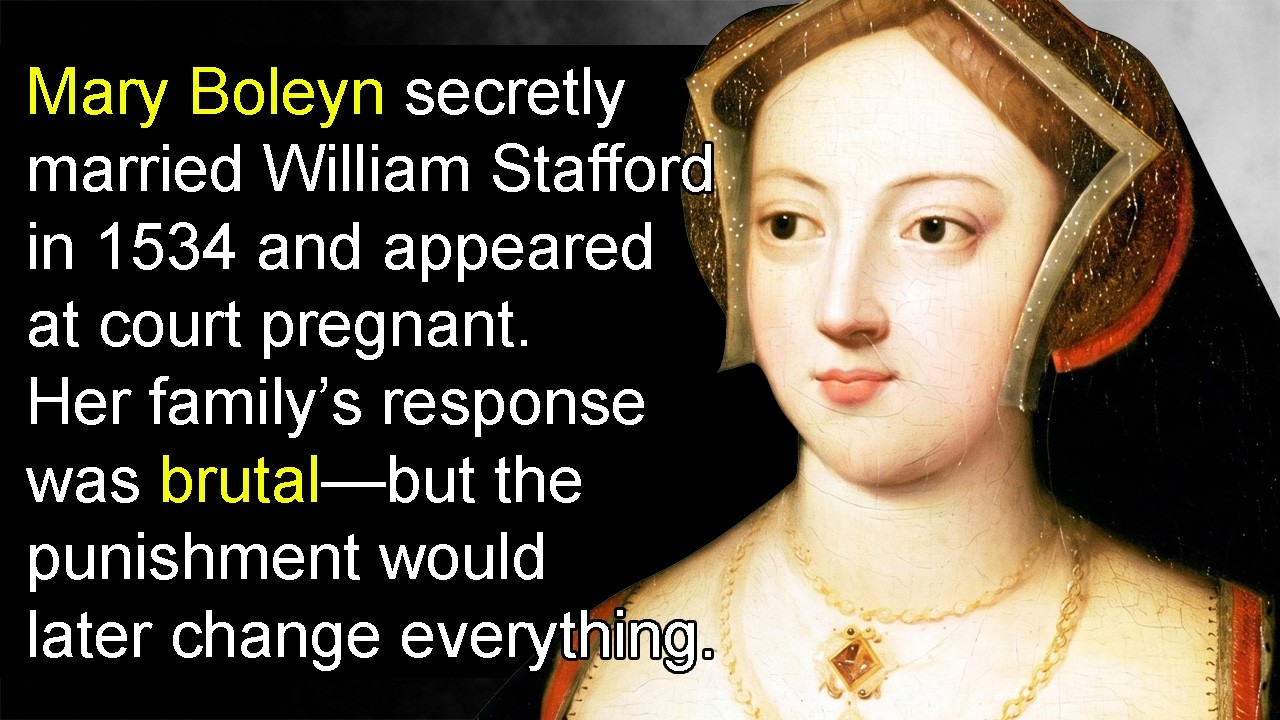
Then in 1534 she did the one thing nobody in her family saw coming, and the one thing not one of them would ever forgive. His name was William Stafford. He was a soldier in the Calais garrison, the younger son of a gentry family, roughly ten years her junior, with no money, no title, no prospects worth speaking of. Sometime that year, Mary married him in secret, without the king’s leave, without the queen’s leave, without her father’s leave.
A threefold insult to the sister of a reigning queen whose marriage was a matter of state. The secret held until it became physically impossible to conceal. Mary turned up at court plainly pregnant. The reaction was explosive.
Henry was enraged. Anne was reported to be even angrier. Ambassador Chapuys set down the aftermath in his dispatches. Mary was banished from court.
Her father stopped her allowance altogether. The family that had built its glory on her body simply erased her. In a dynasty that had spent twenty years converting its daughters into titles and estates, Mary had committed the worst treason. She had given herself away for nothing.
Her answer has survived. The one long document written in her own voice. Exiled and desperate, she wrote to Thomas Cromwell, the king’s chief minister, pleading with him to step in. But the letter was no plea at all.
She defended her husband’s honor. She conceded the marriage looked like madness. Then she wrote that she would sooner beg her bread beside him than be the greatest queen in the world. Read against what was coming, that sentence chills the blood.
Her sister was the greatest queen in the Christian world. Mary was choosing bread. Nothing suggests Cromwell’s help, if it ever came, restored her standing. She and Stafford disappeared into the countryside, into a life of genuine hardship.
Even if later legends overstated her poverty, her exile seemed the close of her story. The losing sister, worn down and at last cast off. Eighteen months on, everything looked utterly different. In the spring of 1536, the Boleyn family was wiped out.
The speed of it still makes the skin crawl. On May 2, Queen Anne was arrested and taken to the Tower, charged with adultery with several men and incest with her brother. The evidence was thin. The verdict was never in question.
On May 17, George Boleyn was beheaded on Tower Hill. Two days later, Anne knelt on the scaffold inside the Tower walls, and a swordsman brought over from Calais ended her life in a single stroke. In under three weeks, a family project of twenty years ended in blood. Thomas Boleyn lived on, but he was stripped of his offices and finished as any kind of force.
Elizabeth Howard died less than two years afterward, in April 1538. Thomas followed in March 1539. Of Mary, nothing. She was not arrested.
Not questioned. Not summoned, not mentioned, not even noticed. No record places her anywhere near London that month. Not a single surviving letter, petition, or recorded reaction.
She never said one word about the slaughter of her sister and brother. That silence reads as heartbreaking or as sheer survival instinct, depending on who is looking. But the mechanics cannot be argued with. The exile of 1534, the shame, the poverty, the exclusion, had carried her clear of the blast zone before it went off.
She was not at court to be accused or interrogated or hauled into the family wreckage. Every Boleyn who stayed at the family table died at it, or was destroyed alongside it. The one thrown out the door was the only one still standing. Anne’s final insult had turned, without meaning to, into a mercy.
Mary’s shame was her shield. Her last years were quiet. The first years of her life that were hers alone. She lived with Stafford far from court.
Some genealogies claim they had children, though the records are thin and disputed. Then the deaths of her parents turned the disowned daughter into something nobody had ever planned: the heiress. As the last surviving Boleyn sibling, Mary in time stood as the sole heir to what remained of the family’s wealth. On May 15, 1543, the crown formally granted Mary and William Stafford the rest of the Boleyn holdings in Essex, Rochford Hall among them.
After a lifetime as an asset owned by others, Mary Boleyn at last held what was left of the family that had once held her. She had only nine weeks to enjoy it. On July 19, 1543, Mary died at forty-three or forty-four, most likely at Rochford. The cause of death was never recorded.
Neither was where she was buried. To this day, nobody knows where Mary Boleyn’s grave lies. The Tudor bureaucracy that handled her estate noted her son’s age with minute precision, seventeen years, fifteen weeks, and five days, yet never troubled to record where her mother was laid in the earth. But the ending carries a strange, luminous tail.
Her daughter Catherine Carey became one of the closest and most trusted women at the court of Elizabeth I, Anne’s daughter. Her son Henry Carey was made Baron Hunsdon and served the queen for decades as a loyal kinsman. The children of the exiled sister prospered in the court of the executed sister’s daughter. The Boleyn blood that endured and thrived into the next reign was Mary’s.
Yet one final debt remained unpaid: her reputation. For history does not recall Mary Boleyn as someone who endured. It recalls her as a whore of two royal courts. The girl who, so the story goes, was seduced and then crudely cast aside by King Francis I of France.
The woman stamped in the conventional translation as “a great and infamous whore.” That phrase underlies every novel, every film, every mocking mention of the other Boleyn girl. So it is worth tracing where that phrase truly originates. It originates in a single letter.
A letter dated March 10, 1536, written by Rodolfo Pio, a papal diplomat stationed in France, a hostile Catholic agent penning it at the height of England’s rupture with Rome, only weeks before Anne’s downfall, passing on a conversation with Francis as hearsay. He wrote it more than two decades after Mary had left France. He never met her. His letter is demonstrably unreliable, riddled with plain errors concerning Anne’s final miscarriage.
Not one source from Mary’s actual years in France, between 1514 and 1519, records any affair with Francis or any scandal whatsoever. The silence surrounding her youth was genuine. The shame was fastened on her decades afterward. And it may be even worse than that.
The notorious English wording was fixed by a nineteenth-century translation in the official State Papers. Alison Weir’s 2011 biography traced the distortion back to Pio’s letter, and in 2026 the historian Sylvia Barbara Soberton re-examined the original Italian text, contending that the passage merely refers to one of Anne’s sisters without naming Mary at all, and that the description was inflated in translation into her identity. Later polemicists like Nicholas Sander piled on further claims in 1585. A best-selling novel finished the job in 2001.
This casts the real Mary Boleyn in a very different light. Not the scandal of two royal courts, but a woman whose reputation was smeared after the fact by her family’s enemies to be wielded as a weapon against her sister. A slander written when she was a worthless outcast, yet one that outlasted her by five centuries. Mary Boleyn was punished in her lifetime for the one thing she actually did: marrying for love.
And history condemned her for something she may never have been at all. So the question splits cleanly in two. Was Mary Boleyn the Boleyn who lost the game, or the only player who understood the price of winning?
