The men who worked the Amethyst Mine understood a silence all their own. It was nothing like the hush of an empty room or a windless night. This was the silence of two thousand feet of continental rock hanging suspended over a man’s head, a silence that leaned in from every side and reminded him precisely how narrow the gap stood between the air in his lungs and the stone wrapping the tunnel that carried it down to him. Still, the miners descended into those shafts each morning, because the silver lay there, and the silver meant money, and money was what kept everything in their world turning.
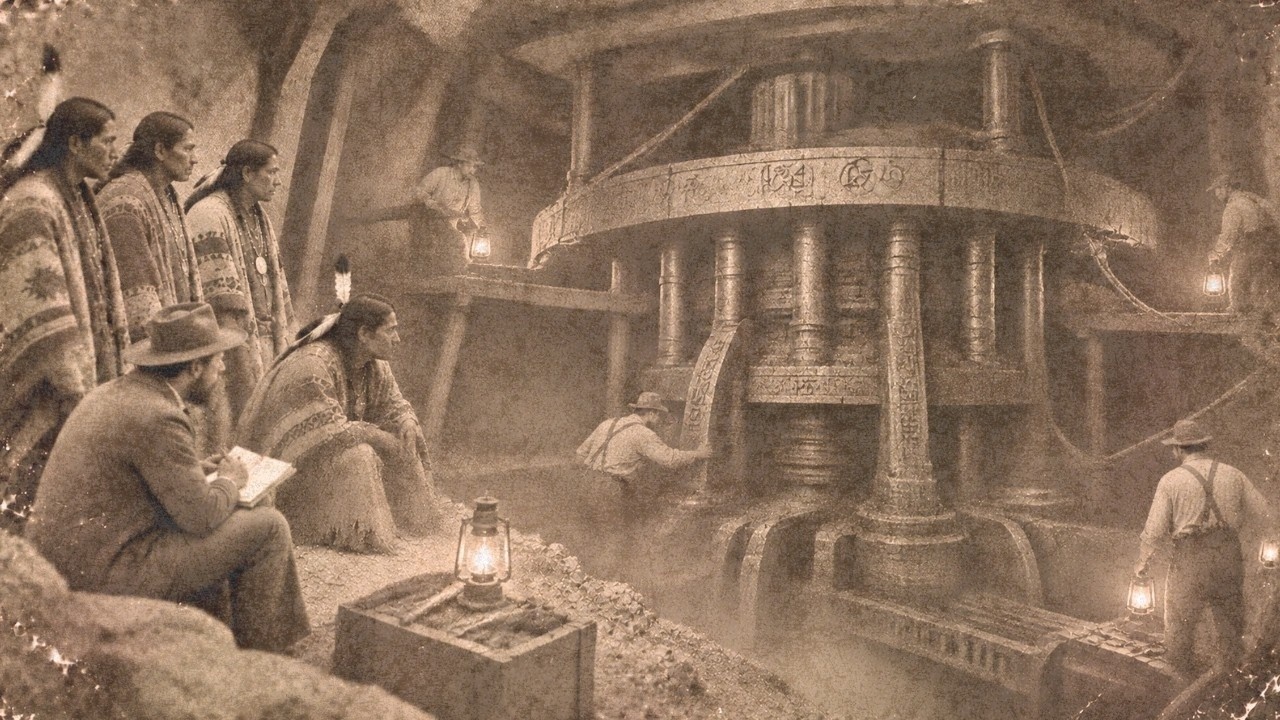
What they could not have known in the autumn of 1903 was what waited at the bottom of the number four shaft, on the south extension of the Amethyst vein. What they uncovered there, and what was done afterward to make sure almost no one would ever hear of it, has drifted about in fragments for over a hundred years. In the mining towns of southern Colorado, in the back rooms of assay offices, in the long silences of men who returned from certain shafts and never discussed what they had witnessed, pieces of it endured. One letter, written by a mineralogist from the Colorado School of Mines to a colleague in Edinburgh and never answered, kept more of it alive than anything else.
A small, cryptic trace survived in the notes of a county surveyor who in 1872 put a mark on a clay map he never explained, and who died the next spring before anyone thought to question him. Pieced together, these fragments describe something that should never have been possible. Creede lies at the northern tip of Mineral County, Colorado, in a canyon so narrow and steep that when the silver rush struck in 1890, the newcomers had nowhere to raise their buildings except in a single row along the creek. The canyon walls crowd in so tightly on either side that come winter the sun touches the valley floor for just a few hours, and the rest of the day the town sits in cold blue shadow at the foot of cliffs that climb almost a thousand feet above the rooflines.
The ore running beneath them was remarkable. The Amethyst load carried silver in concentrations that left assayers drafting careful reports, then nudging their caution upward once a second test backed up the first. In the strongest years of the early nineties, the mines of the Creede district turned out something near ten million ounces of silver a year, placing this narrow canyon alongside Leadville, the Comstock, and Tombstone. Then came the crash of 1893, when Congress repealed the Sherman Silver Purchase Act and the price fell by roughly half overnight.
The big companies endured by trimming wages and driving deeper into the mountain, hunting for ore grades rich enough to make reduced returns worthwhile. By 1903, the number four shaft of the Amethyst had reached deeper than any other working in the district. It had cut through the levels earlier miners had opened, through the stopes where the first generation of Creede men had ripped out the bonanza ore, through intermediate levels where the Denver company had spent five years chasing thin veins, and into ground no human instrument had ever reached. The shift foreman at that depth appears in the surviving accounts only by his initial.
The letter from the Colorado School of Mines mineralogist refers to him as C and says merely that he was a man with thirty years in hard rock mining who had worked shafts in Nevada and Arizona before arriving in the Colorado camps. His name turns up in no company payroll record researchers have managed to find, which is not unusual in itself, since many Creede mining records from the early 1900s were destroyed in the 1910 fire that consumed much of the county courthouse. Yet the absence of his name from every surviving record of that period is something the mineralogist’s letter addresses only indirectly, noting merely that after the autumn of 1903, C was never again seen in any mining camp in Colorado. That vanishing did not come all at once.
It came slowly, over weeks. He quit talking about the lower levels, then quit talking about anything that had happened in the shaft after September. One morning he was not at the cage when the day shift went down, and the boarding house keeper reported that his room had been cleared out, not in haste but with care, as though by a man who had settled on something and taken his time seeing it through. He left nothing behind.
He said farewell to no one. Yet in the weeks before he went, he talked with the mineralogist. To grasp what the discovery meant, one has to grasp where Creede lies in the geology of that region, because the geology is far from ordinary. Under southern Colorado rests not a simple intrusion or a local hotspot but a catastrophic volcanic system, the leftover of supervolcanic eruptions that buried tens of thousands of square miles in ash and left collapsed calderas scattered across a region that dwarfs every volcanic event in recorded human history.
The closest modern parallel is Yellowstone, and the Creede caldera complex makes Yellowstone seem small. The eruptions took place between twenty-six and twenty-eight million years ago. Collapse followed, the crust above the drained magma chambers sinking inward in vast circular depressions. Along the ring structures at the edges of those collapsed calderas, mineral-rich hydrothermal fluids rose and laid down the silver the miners had come to seek.
The Amethyst vein lies within a resurgent ring fracture that runs deep, all the way down to where the ancient heat still lives in the rock. At fourteen hundred feet below the collar of the shaft, deeper than any working in the district had gone before, the fracture widened in a way geologists called anomalous, a zone where the fracture walls spread apart farther than simple thermal expansion could explain. In that widened zone, the silver values that had been falling with depth abruptly reversed. The ore grade climbed instead of dropping, which was odd enough to draw notice.
But what C’s crew noticed first was not the ore grade. It was the form of the widening, because that widening was not random the way fracture widening from tectonic stress usually is. It obeyed a geometry. It opened according to a plan, as though what had widened it was not pressure from below but removal from inside.
As though the space had been made, not discovered. When C’s crew shoved the last broken rock aside and held their lamps into the opening, the walls of that space were dressed. The mineralogist’s letter takes great pains to be exact. He had spoken with three of C’s crew separately, without telling any of them what the others had said.
Every meaningful detail the three men supplied lined up with the others. The room’s walls were not the rough, splintered face that blasting and drilling leave behind. They had been shaped by hand. That shaping came before the mining company ever arrived, before any earlier human presence at the site, and—judging by the mineral buildup on those worked faces—before any contact with human hands within a span of time the mineralogist was uneasy about putting into writing.
The buildup was calcite. Calcite settles on cave and mine walls at rates that can be measured under known conditions. The mineralogist pulled samples from the worked surfaces and matching samples from the raw fracture walls close by, which had formed in the same geological event and sat in the same environment for the same stretch of time. The matching samples carried a thin calcite layer in line with what would be expected over the fracture’s known age.
The samples from the worked surfaces carried a calcite layer whose extra thickness his figures put at a minimum of several times the comparison sample, and at a maximum he would not commit to paper. He ran his calculations three times over and wished his instruments were finer. The room was bigger than any account he had come across before on the subject. From careful pacing, C’s crew judged it to run about forty feet across at its widest and to reach a ceiling at least twenty feet above the floor.
A spirit level placed at three spots on that floor showed the bubble dead center every time. The ceiling was vaulted in a way C could find nothing to compare with, following a geometry that seemed to shift subtly depending on where in the room you stood to look up. The surface was finished to the same standard as the walls, smooth enough to throw lamplight back with a faint sheen, and it carried markings arranged differently from anything the accounts he had heard described, covering more area, done with a fineness that made earlier descriptions sound vague. At the room’s center, on a raised section of floor, stood the platforms.
There were two of them, side by side, split by a channel roughly eighteen inches wide that ran between them and ended in conduits cut into the floor, dropping into the rock beneath the room’s level. Each platform rose about two feet above the level floor and carried on its top a mounting system of recesses and channels built to hold what rested there in exact alignment. The machines resembled what earlier accounts from the San Juan country described, though they were not identical. Cylindrical at their core, made of a metallic substance that changed color with the angle of the light—gray under direct illumination, shading toward blue at the edges, showing something near iridescence at certain angles—and cold to the touch in a way that went a degree or two past what the surrounding rock temperature should have produced.
Where they differed from earlier descriptions was in size. These were bigger, each standing close to eight feet at its highest point, and they were joined not by any fitting a mining man would have recognized, but by a formation of the same material as the machines themselves that spanned the channel between the platforms and linked the two devices at roughly midsection, in a structure that seemed to grow from both at once rather than being fastened to either as a secondary piece. The bridge was thicker where it met the machines and thinner at its center, and its surface carried the same ridges and channels that run across the outer faces of the machines, continuing unbroken from one device across the span and into the other, as though the whole assembly were one object expressed in two forms joined by something between. What set this find apart from the accounts of the first was evidence of use.
In the San Juan stories of what men found in a chamber in the mountains to the south, nothing suggested the machine had ever been run. It sat dormant, intact, seemingly functional, but inactive, waiting. Its surfaces bore no mark of operation, no residue, no thermal change, no sign that whatever it was built to do had ever been done in all the time the mountain held it. The machines in the Creede room were different.
C spotted it first on the second day, once light from several lamps was better spread and the men could study the surfaces more closely. On the outer cylinders of both machines, in zones roughly matching the areas where the internal structure was most densely packed, the surface showed discoloration—not the uniform gray-blue of the rest of the material, but a deepening of the color into something darker and more intricate, with an iridescence stronger here than elsewhere. The mineralogist, who saw it himself the following week, called it the visual signature of sustained thermal exposure, not heat in the ordinary sense, not the blackening or oxidation fire leaves on metal, but something more controlled, more directional, as if whatever caused the thermal change had been focused rather than diffuse, internal rather than applied from outside. The platforms beneath the machines showed it too.
The recesses and channels holding the devices in alignment were darker than the stone around them, in a pattern tracing exactly the edges where the machines met the platform. The calcite sampling the mineralogist did on the platform surfaces showed the same deep accretion as the worked walls of the room. Whatever left those thermal marks had done so in the same deep past that produced everything else in the chamber. The channel between the platforms showed the most striking evidence of all.
The channel floor was darker along its whole length, a shade the mineralogist’s letter called charcoal gray verging toward black in the zones directly beneath where the connecting bridge passed overhead. Its surface was pitted, small uniform pits spread across the channel floor in a pattern dense at both ends, where the conduits went down, and sparser in the middle. The mineralogist took a sample of the channel floor material and spent three days examining it before writing that the pitting matched what he had previously seen in laboratory settings when certain materials were subjected to sustained exposure to a high-energy field. He declined to specify what kind of field.
He said his instruments were not adequate to the question, and that the instruments adequate to it, as far as he knew, did not yet exist. Every surface in the room bore markings—the walls, the ceiling, the platforms, the outer surfaces of the machines, the connecting bridge. Three distinct systems of marking were present, each in different zones of the room, each following its own internal logic. The mineralogist copied every mark he could reach, filling a notebook sent to Edinburgh with the letter.
That notebook has never surfaced in any archive or private collection. One system consisted of geometric figures arranged in a hierarchy, larger shapes enclosing smaller ones, the smallest enclosing smaller still, a nested pattern his charcoal copy could not reproduce because the finest elements were finer than his medium could record. A second system employed notational marks whose arrangement resembled numerical or sequential notation, growing denser toward the floor. The third, appearing only in a narrow band at mid-height that ran continuously around all four walls and across the face of the connecting bridge, he was unable to classify.
He wrote that it resembled nothing he had encountered in any library, museum, or collection of ancient script samples. He described the experience of looking at it as recognizing something you have never seen. He sent the letter on a Tuesday. On Thursday morning, the company superintendent arrived at the mine without prior notice from Denver.
His name survives in the payroll records that outlasted the courthouse fire. He was called Alden Hoy, and before Creede he had managed operations for the same Denver partnership at two other Colorado properties and one in Nevada. He had not visited the Creede operation in fourteen months prior to that Thursday morning. He came by the morning stage from Wagon Wheel Gap and went straight from the stage office to the mine collar, without stopping at the company offices in town.
He spent the rest of that day underground. The mineralogist, who met him at the shaft collar in the late afternoon, said the superintendent’s expression as he came up was one he found hard to describe. Not the look of a man who had been frightened. The look of a man who had expected precisely what he found and was now working out what to do about it.
At supper that evening, the mineralogist asked the superintendent plainly what he meant to do about the room and the machines. Hoy said the question was above his level and that he had sent a telegraph that afternoon to Denver. He then asked how many people the mineralogist had spoken with. The mineralogist said he had spoken with C and three crew members, and his own cook.
Hoy asked whether he had written to anyone. The mineralogist said he had written to a colleague in Edinburgh. Hoy nodded and said nothing more on the subject. In the morning, two men arrived who had not come on the regular stage.
The mineralogist mentions them only in passing, noting their arrival and saying they were not introduced to him by name or position and offered nothing about themselves. They went underground with Hoy that morning and did not come back up until afternoon. One of them carried a leather case of the kind used for surveying instruments. That afternoon, Hoy informed the day shift that the number four shaft would be temporarily suspended pending a review of the lower level structural integrity.
On Friday evening, a man came to the mineralogist’s room at the boarding house and knocked. The mineralogist’s description of this visitor is spare. A man of perhaps fifty, in a dark suit that had seen some travel. He asked whether he might sit down.
They sat across a small table. The visitor said he understood the mineralogist had submitted professional reports on the ore grade anomaly. The mineralogist confirmed this. The visitor then said, with no change in tone, that the mineralogist’s further observations on any other aspects of his time at the mine were a matter of some sensitivity, and that if those observations had been written down, it would be appreciated if he would consider the disposition carefully.
The mineralogist asked who he was speaking for. The visitor said he was speaking for interests that preferred not to be named. The mineralogist asked whether that included the government. The visitor said the interests he represented were of a nature that did not fit neatly into the categories of government and private enterprise as those categories were commonly understood.
The mineralogist asked what specifically the visitor wanted him to do. He said he wanted only to make sure the mineralogist understood that his professional reputation and his continued employment at the Colorado School of Mines were things the interests he represented were in a position to affect. He said this in the same quiet tone as everything else. Then he stood, thanked the mineralogist for his time, and left.
The mineralogist sat at the small table for a while. Then he finished writing the letter to Edinburgh. Within two weeks of Hoy’s arrival, the water management system of the Amethyst Mine was modified. This was done not by the regular maintenance crew but by a team brought in from outside, identified in the single surviving work order as a contractor from Pueblo.
The modification redirected a substantial portion of the mine water being pumped from the lower levels. After the modification, that water instead drained back into the lower levels of the number four shaft. The rate of drainage was calibrated, the work order shows, to fill the lower level at a controlled rate rather than all at once. By the end of November, the water table in the lower shaft had risen to a point that made the room inaccessible without equipment the mine did not possess.
By the spring of 1904, the lower two levels were entirely submerged. They have remained submerged to this day. The county surveyor’s mark is perhaps the most unsettling element of what little evidence this story leaves behind. In the autumn of 1872, when the first prospectors were beginning to work the Creede district in a serious way, a county surveyor named Amos Crane was contracted to establish the legal boundaries of several claims in the area that would eventually become the Amethyst load.
His survey records for the 1872 season are models of the profession—precise, annotated in clear handwriting, the corners well described, the bearings accurately run. On the page covering the south extension of what would become the Amethyst claim, in the section where he describes the subsurface character of the ground as he understood it from surface evidence, Crane made a notation in the margin that does not appear on any other survey he produced. A small cross, drawn in a deliberate and careful hand, with two letters beside it. LD, which in the surveying convention of the period stood for locus depressus, a Latin phrase meaning depressed location or low point.
Surveyors used the notation occasionally to mark surface depressions that had structural significance. There is no surface depression at the location the cross marks. There never has been, so far as any subsequent survey has recorded. The location it marks, plotted against later surveys of the same ground, corresponds to a point on the surface directly above the room in the number four shaft, within a margin of error well within what a skilled surveyor of 1872 could have achieved if he knew exactly where he wanted to place his mark.
Crane passed away in the spring of 1873, six months after setting down that mark, from an ailment the territorial records list as a winter fever. He left behind no papers and no estate worth noting, and nothing is known about his life before he turned up in Colorado. Now step back and weigh what the Creede events suggest when set beside what the San Juan accounts had described four years earlier. Two distinct discoveries in two distinct mountain ranges, each one involving a chamber beneath the worked levels of a mine that no prior human activity had ever reached, each holding machines of unfamiliar material and intricacy, and each trailed by the same rapid suppression.
The men were either silenced or made to vanish. The physical evidence was walled away in one instance with rock, in the other with water. The official record was quietly drained of every trace. The suppression was not clumsy.
It was methodical, carried out swiftly, and evidently coordinated between parties at the mine level and parties higher up—parties holding the authority to reroute mine infrastructure and the means to summon men in dark suits who appeared without introduction and spoke the language of professional consequences. Then there is the matter of the Jesuit. He turned up on a Saturday. Nobody had sent for him.
He arrived on the same stage out of Wagon Wheel Gap that ordinary travelers rode, took a room at the very boarding house where the mineralogist was lodged, and introduced himself as a traveling priest working his way through the mountain parishes of southern Colorado. He carried one bag and a breviary, took his meals in the common room, and chatted amiably with whoever happened to sit nearby. After supper he came over to the mineralogist’s table. He was perhaps sixty, soft-spoken, with a stillness about him that was not passivity.
He remarked, in a tone that was not quite a question, that the mountains of Colorado had a knack for turning up unusual finds in deep rock. He said he had spent thirty years traveling the mountains of the West, serving parishes and passing through mining camps, and in that time had heard, in confession and in private talk, accounts of things discovered deep in the earth that fit no category of ordinary geological discovery. What held constant across all of them, more constant even than the physical descriptions, was what came afterward: the find was suppressed, the men were silenced, and a certain kind of person—one whose relationship to any named institution was always ambiguous—arrived to manage the situation before it could reach public knowledge. The mineralogist asked whether the priest was describing his situation in particular.
The priest said he was describing a pattern observed across thirty years that had led him, after much thought and prayer, to a conclusion he had struggled to square with a theology he had been trained in but could no longer find a way around. He did not say what that conclusion was. Pressed on it, he said only that the earth was older than the church believed, that the things built in the earth before the church existed were older than the church was comfortable with, and that the church’s discomfort was one of several forces that had organized itself over a very long span around keeping those things unknown to the general population. When the hour had passed, the priest said he would be resuming his journey in the morning, and that he hoped the mineralogist’s letter to Edinburgh would find its recipient in good health.
The mineralogist had never mentioned the letter to him. He had told no one in Creede except his cook. By morning the priest was gone, and the boarding house keeper said he had set out on foot before first light, heading north, which was not the direction of the stage road. The mineralogist’s letter does not speculate on who the priest was, or how he had come to know about the letter.
It simply sets down what was said and moves on. In the closing paragraphs, the register shifts from careful professional neutrality to something nearer honest uncertainty. He writes that his professional training has left him resistant to reasoning that leaps from a striking find to a sweeping explanation without establishing every step along the way. He writes that he has tried to find an explanation for what he saw in the number four shaft that stays within the boundaries of what is commonly accepted about the age of human civilization, and that he has been unable to do so.
The thermal evidence on the machines, he writes, is not ambiguous. Something produced and directed heat in a controlled fashion using those devices in that room before a date his calculations placed well outside any era in which any known human civilization could have managed it. The channel between the platforms and the conduits descending from it suggests the process was directional, downward into the rock beneath the chamber. Two machines linked together and oriented downward into rock connected to an active caldera system, with evidence of sustained prior operation, amount to a description of something that was not decorative, not symbolic, not ceremonial.
Whatever the machines were, they were working devices that had worked. He does not finish the next sentence. What keeps him from dismissing it, he writes, is the existence of the channel and the conduit, because a decorative object has no need of a drain, and a drain descending into the deep rock of a caldera region carries an implication he cannot dismiss, however much professional prudence argues for dismissing it. Think about what the deepening shafts were cutting through when they broke into that room.
The ore they were chasing had been deposited by hydrothermal fluids circulating through fractures left by the caldera eruptions of twenty-six to twenty-eight million years ago. By the mineralogist’s calcite calculation, the machines predated any human civilization with a conventionally recognized history. Whether they predated the silver that surrounded them, whether they antedated even the volcanic events that formed the mountains above them, is a question the calcite sampling cannot answer with precision. What the calculation establishes is a minimum age.
The actual age could be considerably greater. If the machines predate the silver, they predate the eruptions. If they predate the eruptions, they predate the mountains in their present form. They were set into ground that was, at the moment of their placement, not the ground it would become, in anticipation of a geological future their makers understood.
Who those entities were, and how they managed to operate so smoothly in two distinct places within four years, is a matter this account leaves open. What the papers collectively demand is that something occurred in the number four shaft substantial enough to summon an unannounced superintendent from Denver, an outside crew from Pueblo, two men carrying surveying instruments, and a man in a dark suit with the standing to intimidate a researcher from the Colorado School of Mines—all inside a single week—and to bring about the intentional flooding of the mine’s deepest level within a month. That is an enormous reaction to a trifling structural irregularity in a silver mine. Disproportion is the evidence that survives once everything else has been explained.
It does not establish the machines. It establishes the response. The response is on record. The Amethyst Mine rests behind its gate in the canyon above Creede.
The water in the lower levels has not stirred in any direction worth measuring for decades. At fourteen hundred feet, the chill of that water is the chill of a place where time runs differently than it does above ground, where a century is so brief an interval that it leaves no trace on the stone containing it. The machines are down there in that cold, if the mineralogist’s report holds true, and the calcite already caked thick on their surfaces when the miners came upon them has gone on accumulating, micron upon micron, sealing the record of what they did a little more thoroughly with each year that passes. The connecting bridge still joins them.
The channel still runs between the platforms. The conduits still drop into the warm fractured rock beneath, linked through fracture systems to a magmatic source that has lain quiet for millions of years yet has not, by any geological reckoning, resolved to stay quiet forever. Whatever the machines were listening for, or building toward, or doing, they possess the patience for an exceedingly long wait. They had it before the mountains above them came into being.
They have shown that patience through everything that followed. The water in the shaft, the silence, the gate, the decades with no one arriving—none of it has altered the problem they pose. None of it has completed the mineralogist’s unfinished sentence. The mountains keep what they keep.
The cold water keeps what the mountains placed in it. And the question that the shift foreman C, the mineralogist from the Colorado School of Mines, and the Jesuit who departed before first light all found themselves unable to answer—the question Amos Crane knew enough to mark on a map in 1872 without ever managing to explain—remains the same question it was when the first lamp entered that room and lit the two machines waiting in the places they had been built to wait in. It is still waiting as well.
