The men who ran the British establishment in the autumn of 1936 did not think of themselves as conspirators. They were courtiers and prime ministers and archbishops and permanent secretaries, men who had spent their entire careers inside the machinery of the most powerful institution on earth, and they shared a fundamental, unsentimental understanding of what that institution required and what it would do to protect itself. They had centuries of practice. They knew how to manage a royal scandal without ever naming it, how to close a door without slamming it, how to construct around an inconvenient person a wall of disapproval so pervasive that the person found themselves isolated not through any single dramatic act, but through the cumulative weight of a thousand small exclusions.
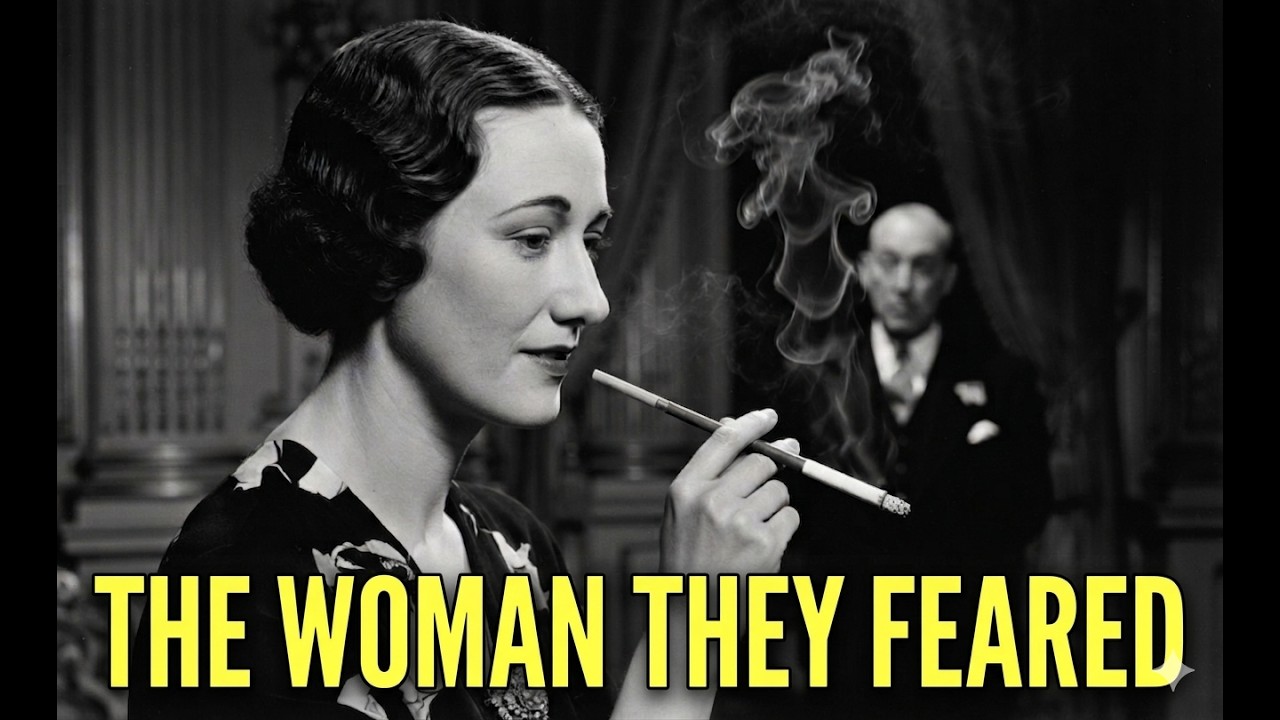
And in that year, they turned the full force of that machinery against one woman. She held no title, no office, no army, no inherited fortune, no institutional power of any description. She was a divorced American from Baltimore, Maryland, and she had brought the most ancient monarchy on earth to the brink of collapse. Her name was Wallis Simpson, and they had already decided, months before the crisis broke into public view, exactly what they were going to do to her.
They called her a schemer, a temptress, a manipulator, a gold digger who had dressed herself in Paris couture and talked her way into rooms she had no business entering. They called her the woman who stole a king. The palace called her dangerous. The Church of England called her utterly and completely unacceptable.
And they worked across three countries—the United States, China, and England—to ensure that certain chapters of her life before Edward Windsor ever knew she existed remained inaccessible, unverifiable, or simply unknown. They sealed documents in courthouses on two continents. They suppressed official records. They destroyed letters and memos and internal communications that would have proved what they had said and what they had done about it.
And they did all of this because the story they needed the world to believe was not the story the evidence told. The story they needed was simple: a predatory woman had seduced a weak and foolish king. The story the evidence told was far more uncomfortable. But no one in all those decades of outrage and judgment ever seriously asked who she was before they had a name for her.
What had she survived? What had been done to her? And what had she done in return? Bessie Wallis Warfield was born on the nineteenth of June, 1896, in a small hotel in Blue Ridge Summit, Pennsylvania, where her mother had gone for the summer air, which was supposed to be healthier than the heat of Baltimore.
Her father, Teackle Wallis Warfield, was a young man from the right family, but he was already seriously ill at the time of her birth. Her mother, Alice Montague, was a woman of considerable charm and beauty and very limited means who had married into the Warfield name with the reasonable expectation that it would provide a stable and comfortable life. The Warfield name was a genuine Maryland name, an old name that carried a specific and recognizable weight in the social world of the city. The problem was that by the time the baby was born, the name was essentially all that was left.
The money, the security, the material substance that should have given the old name its meaning had largely evaporated. What remained was the reputation without the resources to support it, and that precise and painful gap between what your name said you were and what your bank account confirmed you to be was the first great formative fact of her existence. Her father died in November of 1896. She was five months old.
She had no memory of him at all, not even the shadow of a presence. His death left Alice and the infant Wallis in a position that was, by the standards of their social world, deeply precarious. They were not destitute. The extended Warfield family had resources, particularly Teackle’s brother, Solomon Davies Warfield, a successful Baltimore businessman who would eventually become quite wealthy and who was willing to provide support.
But the support came with conditions. It came with an awareness of dependency, with the constant low-level humiliation of needing to be helped, of existing at the suffrance of other people’s generosity in a social world where independence and financial security were the bedrock of respectability. They were the kind of poor that you had to hide, and the effort of concealment was unrelenting. Wallis grew up watching her mother perform this concealment every single day.
Alice moved in the right circles, called on the right people, wore the right clothes, carefully maintained and carefully chosen, presented with a confidence that obscured their true age and their true cost. She navigated the treacherous social waters of a city that was simultaneously watching her with sympathy and with the particular alert judgment that prosperous people reserve for those who are one step below them and trying not to show it. And Wallis watched all of this and absorbed it. She was a small, dark-haired child with large, blue-gray eyes that people consistently described as unusually observant, as though she was cataloging everything around her for future reference.
In a sense, she was. The education she received in those early years in Baltimore, the real education, was an education in how the social world actually operated, how appearances functioned, how performance worked, how intelligence could substitute for resources when resources were unavailable, how a woman with nothing but her wits and her nerve could hold her place in a world designed to exclude her the moment her inadequacy became undeniable. Solomon Warfield paid for her education, which meant that she attended the right private schools, Arundel School in Baltimore and later Oldfields, one of the most prestigious girls’ boarding schools in Maryland. Oldfields existed to turn the daughters of the right families into the right kind of women, trained in the social graces and the domestic expectations that would make them suitable wives.
Its motto was gentleness and courtesy. What it gave Wallis was more practical than that. It gave her access to girls from the best families of the Maryland and Virginia and Pennsylvania social world, the polish and the manners and the specific quality of self-presentation that the world she was determined to inhabit expected as a baseline. And it gave her time to think about what she wanted and how she intended to get it.
What she wanted was always clear. She wanted security, the stability that had been absent from her life since before she was old enough to walk. In the world of Baltimore in 1912 and 1913 and 1914, a woman of her class and background had essentially one legitimate path to that life. She needed to marry the right man.
She was presented to Baltimore society in 1914 at the age of eighteen. She was not the most celebrated debutante of her season. But she made an impression. She always made an impression.
People noticed that focused, attentive, electrically present quality, the capacity for genuine engagement with the world. She listened when people talked. She responded with wit and substance. She asked questions that were interesting rather than merely polite.
She dressed with a care and a deliberateness that managed to look effortless, and she danced very well, light and responsive and attuned to her partners in a way that men consistently found memorable. The man she married was named Earl Winfield Spencer, Jr. He went by Win. He was a United States Navy pilot, which in 1916 was a genuinely glamorous thing to be.
Aviation was new and exciting and carried an aura of modernity and daring. He was handsome, charming in a specific and potent way, an officer and a gentleman in the formal military sense. On every surface the social world could examine, he was a plausible and even impressive candidate. Wallis Warfield, twenty years old, formed entirely by the experience of watching her mother struggle and determined above all else to secure the stability her childhood had denied her, looked at Win Spencer and saw what she needed to see.
She saw the uniform and the charm and the military career that implied a steady income and a defined social position. She was catastrophically, life-alteringly wrong. They were married on the eighth of November, 1916, at Christ Episcopal Church in Baltimore. Wallis wore a blue going-away suit rather than a traditional white gown, a practical choice that people who were there remembered as looking genuinely chic.
What followed was not the stable and secure life she had reached for. Win Spencer was an alcoholic, not the kind of drinker that polite society described as a man who enjoyed his whiskey, but a genuine and serious alcoholic. And whether Wallis knew this before the wedding is a question her memoirs handle with a careful vagueness that is itself informative. She knew he drank.
What she had not seen was the way it transformed him, the way it unlocked something dark and violent and entirely different from the charming man she thought she was marrying. The stability of marriage did not moderate his drinking. It intensified it. The violence came with the drinking, not constant, and that intermittence was in some ways more psychologically destructive than constancy would have been, because the intervals between the worst episodes were just long enough to sustain hope that the worst was over.
But it was real and it escalated over the years in the way that this kind of violence reliably escalates when nothing intervenes to stop it. What Spencer did to Wallis in the years of their marriage has never been fully documented in the public record. This is partly deliberate and partly a consequence of the era’s profound reluctance to engage honestly with domestic violence. It was something that happened behind closed doors, and the women to whom it happened were not encouraged to speak about it.
Wallis was not, by temperament or training, a woman who talked openly about her private suffering. She maintained the exterior of the marriage with the same discipline she had always brought to appearances, continuing to be socially present and functional, and underneath that surface, she endured. The postings moved them across the American South and eventually to the Pacific coast, and each move offered a brief reset, a period when the worst of the dynamic was temporarily suspended by the novelty of a new place. The resets never held.
She began to understand that the marriage was not going to improve, that the man she had married was not going to become the man she had thought she was marrying. And in that understanding, something important happened. She began to develop the interior resources that would eventually make her one of the most formidable women of her era. She read voraciously.
She cultivated friendships with intensity and genuine investment. She traveled when she could, using Spencer’s deployments to breathe. And she watched people, sharpening that skill into something close to a professional competence. She was learning everything she would later need to know about how power operated between people, about vulnerability and how it could be exploited, about what men wanted and what they were willing to do to get it, about how a woman with no institutional power could still exercise influence and maintain agency in situations designed to strip her of both.
By 1920 the marriage was functionally over, though the legal dissolution would take several more years. She spent time in Washington, D. C. , staying with an aunt and navigating the social world of the capital, allowing herself to begin to imagine a future that was not simply the Spencer marriage continued indefinitely.
Divorce in the early twenties carried a substantial social stigma, particularly for women. A divorced woman was a woman who had failed at the primary social assignment she had been given. The calculus Wallis had to perform was therefore not simply the calculus of personal happiness or safety, but the calculus of social survival. That she eventually concluded the cost of staying was greater than the cost of leaving tells you something important about the true state of that marriage in its final years.
The divorce was finalized in 1927, after a legal process that produced records which were subsequently treated with an unusual degree of discretion by the courts involved. What the Spencer years gave her, beyond the scars they inevitably left, was a quality of hardness, not cruelty or callousness, but something structural in the architecture of the self. She had been tested in conditions that would have broken many people and she had not broken. In the early months of 1924, still technically Mrs.
Wallis Spencer, the divorce not yet finalized, she got on a ship and sailed to China. A friend from Washington, Katherine Bigelow, was traveling there with her husband and had invited her to accompany them. The invitation was timely in the specific way invitations are timely when the life you are living has become untenable and the life you want has not yet presented itself. China in the early 1920s was the China of the treaty ports, cities where the Western powers had carved out enclaves of their own jurisdiction, where Western nationals lived and traded under their own legal systems on Chinese soil.
Shanghai in particular was a city of overwhelming vitality, extraordinary wealth and extraordinary poverty in the closest possible proximity, where the normal rules about who you were and where you came from were suspended with a thoroughness that people found either liberating or terrifying. For Wallis Simpson, who had spent the first twenty-seven years of her life operating under rules she had not chosen, Shanghai was liberation in a form she had never experienced. The disadvantages that had shadowed her all her life—the lack of money, the compromised position of the divorcee—were considerably less disabling in Shanghai than they had been at home. What mattered in the treaty port world was not what you had inherited but what you could do, and in that world Wallis Simpson was formidably equipped.
She settled initially in Hong Kong and then moved to Shanghai, the true center of the treaty port universe. She moved in the social world of the foreign concessions, attended the parties and the dinners and the clubs and the races, and she met people. She always met people, and she always met them in a way that made them feel that meeting her was the most interesting thing that had happened to them recently. What she did there, and with whom, became the subject of intense speculation and deliberate distortion that has never entirely stopped.
The rumors were given their most damaging form in a document that became known as the China Dossier, an intelligence report allegedly compiled by the British Secret Services in the 1930s, said to contain detailed and explicit descriptions of her activities during the Shanghai years. The dossier has been one of the most persistently referenced and least reliably sourced documents in the entire historiography of the abdication crisis, and the document itself, in any form that can be definitively authenticated, has never been produced in full. What serious historians have been able to establish from verifiable sources is more nuanced and more interesting than the mythology. She was, by every credible account, one of the most socially successful women in the treaty port world, invited everywhere and remembered by almost everyone who encountered her as a presence that elevated whatever room she was in.
She was not living a life of scandalous dissolution. She was living the life of an intelligent, socially capable, financially limited American woman in one of the most extraordinary cities on earth, navigating the social structures available to her, building relationships, and enjoying, perhaps for the first time in her adult life, a genuine sense of freedom. She encountered in Shanghai men of a type she had not previously met, men who operated at the intersection of commerce and diplomacy and intelligence and the darker forms of the international networks that threaded through the treaty port world. She learned from them about money, about how it really moved in the world, about the relationship between wealth and power in a place where normal institutional constraints were absent.
She learned about men specifically, about what they needed and what they feared and what they would do in pursuit of what they needed, and about how a woman who understood these things could use that understanding to navigate, to maintain her own position and her own agency in situations where the cards were heavily stacked against her. An Italian naval officer named Alberto da Zara, who knew her in Shanghai and wrote about her later in his memoirs, described her as unlike any other American woman he had met, possessed of a quality of directness and intelligence that struck him as almost European in its sophistication, someone who understood the game being played in every room she entered and played it with a skill that made the game look easier than it was. The question of how she supported herself financially during those years is raised by every serious biographer and answered with varying degrees of honesty, and it has given rise to the most lurid of the China rumors, the ones whispered in the back corridors of Buckingham Palace and found their way into intelligence reports. The honest assessment of the historical evidence is that the most extreme versions of those rumors are not supported by any primary source that can be authenticated.
They rest on the China dossier, which cannot be authenticated, and on the accounts of individuals who had significant motivation to damage her reputation. She also, during the China years, became seriously ill, in a way that required medical attention and affected her plans, a reminder that beneath the social performance was a human being dealing with human limitations in a world that offered very little in the way of support for a woman in her position. She left China in 1925 and returned to the United States, and the years between her return and her second marriage were years of further transition. She spent time in Washington again, moved through the social world with a confidence and sophistication that people who had known her before she went to China noticed and remarked upon.
She was recognizably herself, the same sharp intelligence, the same devastating wit, but somehow more complete, more grounded, as though the China years had burned away certain kinds of uncertainty. She had found herself in China, not in the romantic sense, but in the most practical and durable sense, through the sustained experience of having to rely entirely on her own resources and discovering that those resources were more than adequate. It was with this knowledge that she met Ernest Aldridge Simpson. Ernest Simpson was, in almost every outward respect, the opposite of Win Spencer.
Where Spencer had been volatile, Ernest was steady. Where Spencer had been reckless, Ernest was deliberate. He was the son of a British father and an American mother, educated at Sandhurst and then at Harvard, comfortable on both sides of the Atlantic. He was running the American branch of his family’s ship broking business, comfortably if not extravagantly prosperous, and he was cultivated, interested in history and literature and the arts.
He represented the possibility of a life that did not require constant management of crisis, and Wallis, who had not rested in any meaningful sense since the day she married Win Spencer, needed rest desperately. They met in New York through the overlapping social networks of the Anglo-American world. There was a complication in the form of Ernest’s existing marriage to a woman named Dorothea, which was in the process of dissolution. In July of 1928, in a quiet ceremony in Chelsea, London, Wallis Warfield Spencer became Wallis Simpson.
She was thirty-one years old. London in 1928 was a city simultaneously recovering from one catastrophe and moving, though nobody could quite see it yet, toward another. The social world of the upper and upper-middle classes had developed a particular intensity and appetite for novelty that made it, for someone of Wallis’s capabilities, a world of genuine opportunity. She arrived as the wife of a respectable and well-connected man, with a platform and social credibility she had not previously had in Britain.
And she understood, with the instinctive accuracy of someone who had spent her life reading social environments, that the British class system was both more rigid and more permeable than its reputation suggested, and that the upheaval of the war had created spaces at the edges of the traditional hierarchies where clever and capable people could establish themselves. She did not rush. She began at the level appropriate to where she actually was, and she built from there. The Simpsons had a flat in Bryanston Court in Marylebone, a respectable address for a family of their position.
They entertained modestly but well, and Wallis turned out to have a genuine and rather extraordinary gift for it, not the gift of lavish expenditure, but the gift of creating an atmosphere, of turning whatever space she occupied into a space where people wanted to be. She became a genuinely excellent cook and a genuinely inspired host. She had an eye for interior decoration that was distinctively her own, clean and spare and deeply considered. And she dressed with a precision and deliberateness that reflected both her genuine aesthetic sensibility and the practical intelligence of a woman who understood that clothes were communication.
She was not conventionally beautiful. She had established this fact about herself long ago. What she had instead was a quality of presence, of energy, of being more fully alive than the people around her. You noticed Wallis Simpson when she walked into a room, not because she was the most beautiful woman there, but because she was the most alive.
The network she built was built through a combination of natural social talent and deliberate strategic patience, through Ernest’s business connections and the small dinners at Bryanston Court and the informal networks of Americans in London. Among the friends she made, the most significant was a woman named Thelma Furness, an American-born lady of half Spanish descent who was, at the time she and Wallis became close, the acknowledged mistress of Edward, Prince of Wales. Thelma Furness was the door through which Wallis entered the world that would consume the rest of her life. The friendship between them was, by every account that survives, a real friendship, a genuine connection between two women who found each other genuinely interesting and enjoyable.
Wallis met the Prince of Wales for the first time in January of 1931 at a house party at Burrough Court, the Leicestershire home of Thelma Furness and her husband. The meeting was entirely unremarkable. They exchanged a brief conversation, and neither of them recorded that anything consequential had occurred. What is clear is that Wallis made exactly the kind of impression she always made: direct, engaged, funny, entirely unawed by the social status of the man she was talking to.
Edward Windsor had spent his entire adult life surrounded by people who were awed by his status, and Wallis looked at him as though he were a person rather than a prince. This was not a calculated maneuver. It was simply what she did with everyone. She was not, in 1931, in pursuit of the Prince of Wales.
The historical record is clear on this. She was the wife of Ernest Simpson, comfortably settled in a marriage that was giving her the stability she had always needed. She met him. She was herself with him.
And she moved on. The second and third meetings and the gradual accumulation of social occasions through which they began to occupy the same rooms with increasing frequency happened through the natural mechanics of the social world they shared, a world that was simultaneously enormous and quite remarkably small. The transformation of the relationship happened gradually and then suddenly. There was no single moment of declaration.
There was instead a slow and probably unconscious process through which the specific gravity of feeling truly seen by another person drew two people together with a force neither of them was equipped to resist. Wallis understood it before Edward did. She was more self-aware, more analytically clear-eyed, and what she understood when she understood it was simultaneously the most extraordinary thing that had ever happened to her and the most terrifying. She was falling in love with the Prince of Wales, or something was happening between them close enough to love to be functionally indistinguishable from it.
And Edward was falling in love with her with a completeness and a certainty that those who knew him described as unlike anything they had ever observed in him before. The palace would later describe this as evidence of her manipulation. The palace was wrong, and the evidence is clear that it was wrong. Because if Wallis had not manipulated Edward into this love, if Edward had simply and of his own free will fallen in love with her, then the responsibility for everything that followed rested not with the scheming American woman but with the king himself.
And that was a conclusion the palace could not afford to reach. Edward Windsor was, by the time Wallis entered his life, one of the most famous human beings on the surface of the earth. The British Empire still covered approximately a quarter of the earth’s land surface, and the heir to its throne occupied a position in the global imagination that had no precise equivalent in the modern world. He was everywhere.
His face was on the front pages of newspapers in London and New York and Sydney and Bombay and Cape Town. The sustained and breathless attention of his tours of the dominions had made him not merely famous but beloved. And he was, underneath all of that, one of the loneliest and most fundamentally unhappy men in Britain. He had been groomed for kingship since before he could remember, and the effect of that early and total immersion in the requirements of the role was a specific kind of emotional stunting.
He had been trained to perform the public role of the Prince of Wales, and in that performance he was genuinely accomplished. But the private man behind the public performance had been given very little attention and very little opportunity to develop. He was drawn consistently to women who were older than him, who were married or had been married, who had a quality of worldliness and capability and self-possession that the women of his own social circle were unable to provide. He had been in love before, with Freda Dudley Ward and then Thelma Furness.
But what happened with Wallis was different, not in its surface characteristics, but in its depth and its completeness. The women who had preceded her had accommodated themselves to the palace’s version of what his private life should look like. Wallis did not accommodate herself, not because she was calculating or defiant, but because accommodation of that kind was not in her nature. She had spent too long being honest about what she saw and what she thought.
With Edward, she was simply herself. She saw his charm and responded to it genuinely. She saw his emotional neediness and engaged with it honestly, which meant she did not always tell him what he wanted to hear. She pushed back, she challenged, she said with a directness that apparently shocked the people who witnessed it precisely what she thought was true.
Edward found this extraordinary, something close to revelatory. She also made him laugh, genuinely, in a way and with a frequency that people who knew him well described as unprecedented. He laughed with Wallis in a way that was a release from the relentless gravity of who he was, and he came rapidly and completely to depend on it. By 1934, the relationship had deepened to the point where the people closest to Edward were genuinely alarmed, not because it was a sexual relationship, though it was that, but because it was clearly something more, something that was organizing itself as the central fact of his emotional life in a way that left insufficient room for the other things that the central fact of a king’s emotional life was supposed to leave room for.
The courtiers who were responsible for managing the heir to the throne had a sophisticated toolkit for handling a mistress. They had handled mistresses before. What they were not equipped to handle was the specific character of what was developing, a complete emotional reorganization of the most important man in Britain. Fort Belvedere, Edward’s private house in the grounds of Windsor Great Park, was the space where the relationship established itself as the organizing fact of both their lives.
Edward had transformed it into something genuinely and personally his, a home in the most ordinary sense, with gardens he had planted himself. Wallis at Fort Belvedere was Wallis at her best and most complete. She took to the house with genuine enthusiasm, helped with the decoration, contributed to the planning of menus and the management of guests with the easy competence of someone who had been thinking about how to create the perfect social environment since childhood. Guests consistently described the atmosphere of those weekends as unlike anything they had experienced elsewhere in the upper reaches of British social life, more relaxed, more genuine.
Ernest Simpson continued to appear at these gatherings for a while. He came. He behaved correctly, as he always behaved correctly. He watched his wife with a quality of attention that people who were present described variously as resignation or stoicism or a very particular kind of knowing sadness.
He was losing her, and the specific dignity of his behavior during the period of the losing was something the later history of the abdication crisis, which needed him to be either a villain or an irrelevance, was never able to adequately acknowledge. The palace’s awareness of the situation crystallized into something approaching genuine crisis in 1934 and into 1935. The concern was not initially that Edward was having an affair with a married woman. The concern was that this specific woman had a hold on this specific man that went beyond what any previous woman had managed, and that the hold showed no signs of loosening.
George V was in declining health, and the courtiers and senior figures responsible for managing Edward’s transition to kingship began to gather information about Wallis Simpson with a thoroughness that reflected their assessment of the seriousness of the situation. They consulted the intelligence services. They talked among themselves. And what they found was the past she had been carrying with her since before any of them had known she existed.
They found Baltimore and the poverty and what it implied about the distance between who she appeared to be and who she actually was. They found Win Spencer and the marriage and the divorce and the sealed records and what the sealing of those records implied about what they contained. They found China and the treaty port years and the China dossier. And they took everything they found and built from it a picture that served the institutional needs of the people doing the building far better than it served the truth of the woman being described.
An honest assessment would have produced a woman who was intelligent and capable and socially gifted and emotionally complex, who had survived extraordinary difficulties with extraordinary resources, and who was engaged in something that appeared to be genuine rather than calculated. That was not a picture the palace could use. So the picture they built was a different one. It was the picture of a calculating woman who had identified a vulnerable man and exploited that vulnerability for her own advancement, someone whose past demonstrated not resilience but a pattern of using men and situations for personal advantage.
This was the picture that would be deployed with increasing urgency as the situation moved toward the crisis everyone could see coming. George V died in January of 1936. His deathbed comments about Edward, the famous remark reported by multiple sources that the boy would ruin himself within twelve months, have been cited so often that they have lost something of their force. They should not have lost it.
Edward became king on the twentieth of January 1936. He held the title for 326 days. What nobody had fully reckoned with was the specific quality of Edward’s commitment to Wallis. He had made a decision, not a provisional decision, but a final and complete and irreversible decision made in that private part of himself that the palace had never had access to.
He had decided that Wallis was worth whatever it cost. And the cost, as the year progressed and the crisis deepened, was going to be everything. It was going to be the crown itself, the throne and the empire and the title and the role he had been prepared for since before he could speak. It was going to be his country, which he was preparing to leave and would not permanently return to for the rest of his life.
He was going to give it all up for Wallis Simpson. And the question that has haunted this story for nearly a century is whether she wanted him to. Whether the woman who had been building toward security and stability since childhood, who understood better than almost anyone what it cost a person to be without the protection of a solid position in the world, looked back at him with the same certainty he was looking at her with. Or whether what she felt in the months of 1936, when the world was closing in, was not certainty at all, but something much more complicated and much more frightened.
The answer to that question is the answer to the deepest mystery of the whole story, and it is the answer the palace from the very beginning worked hardest to prevent you from finding. The constitutional arguments against the marriage were real. The Church of England’s position on divorce and remarriage was real. The impossibility of the supreme governor of that church marrying a woman who had two living ex-husbands was a genuine institutional problem.
The Prime Minister, Stanley Baldwin, had genuine constitutional responsibilities that required him to advise the king honestly. But these things were not the whole story, and the gap between the real constitutional considerations and the full reality of what was done, and how it was done, and who made which decisions for which reasons, is where the true history of 1936 lives. Baldwin was not, in any simple sense, acting in bad faith. But he had made judgments about Wallis Simpson that went well beyond the constitutional question of her marital history and into the realm of personal and social contempt, and he was not above using the institutional weight of his office to pursue outcomes that aligned with those judgments while presenting them publicly as the dispassionate exercise of constitutional duty.
He met with Edward on multiple occasions and advised him with a firmness that left no room for doubt. The king could not marry Mrs. Simpson. If he insisted, the government would resign.
The logic was airtight in its formal presentation. But the question of whether a morganatic marriage, in which Wallis would become Edward’s wife but not his queen, was genuinely and irreversibly impossible, or whether it was something the government had decided it did not want to be possible, has been raised by serious constitutional historians and never satisfactorily resolved. The speed with which Baldwin foreclosed the option, the manner in which he organized the responses of the dominion governments to make it appear more universally rejected than it actually was, suggest a degree of design that the clean constitutional narrative does not adequately account for. The Archbishop of Canterbury, Cosmo Gordon Lang, was a man of genuine religious conviction and considerable personal vanity and a sometimes startling degree of social snobbery, a man for whom the question of Wallis’s unsuitability was not separable from judgments about her class and her character and her nationality.
His opposition was total and expressed with a certainty that felt to those who observed it more personal than principled. The press blackout that maintained British public ignorance of the relationship throughout most of 1936 was one of the most extraordinary aspects of the entire crisis. The American and foreign press had been reporting on the relationship for months. The British press said nothing, because an understanding existed between the palace and the major newspaper proprietors that the private life of the royal family was not a subject for public discussion.
When the blackout finally broke, it broke not through the action of any of the major British newspapers, but through the unlikely vector of a speech by the Bishop of Bradford, Alfred Blunt, who commented on the need for the king’s awareness of his Christian duty in terms sufficiently specific that the provincial press interpreted it as a reference to the known but unpublished situation and began to report accordingly. Within days, the British public was confronted with a story the rest of the world had been reading for months. The public reaction was complex and contradictory. There was real and genuine hostility to the idea of the king marrying a divorced American woman.
But there was also, in considerable measure, sympathy, sympathy for the king and in some corners more sympathy for Wallis than the palace’s subsequent account was ever willing to acknowledge existed. What Wallis herself experienced during the months of the crisis is something the historical record captures in fragments, in letters she wrote during that period, in the accounts of the small number of people genuinely close to her, in the memoir she eventually wrote years later, which handles the crisis with a combination of honesty and self-protection that is in itself revealing. She was frightened. The historical evidence for this is clear and consistent, and it is something the mythology of the scheming Wallis has always had to work to suppress, because a frightened Wallis is a human Wallis, and a human Wallis complicates the narrative architecture the palace needed to construct.
She was frightened not in a simple or cowardly way, but in the way of a genuinely intelligent person who can see clearly what is happening around her and understands with precision exactly what the possible outcomes look like and what each of them costs. She could see the machinery deployed against her. She could see what it was doing to Edward, the specific and terrible pressure it was generating in a man already not well equipped to withstand institutional assault. And she could see, with a clarity that was perhaps her most consistent and painful quality, that she was not simply a participant in these events but their primary subject, and that her options for affecting the outcome were considerably more limited than anyone outside her situation seemed to understand.
In the end, Edward chose her. He abdicated in December of 1936, and they were married in France in June of 1937, and she became the Duchess of Windsor. It cost him the crown, his country, and his family. She spent the rest of her life as the most celebrated and the most vilified woman of her era, and the palace spent decades after her death still carefully managing and curating and meticulously controlling the public narrative around her.
She died in Paris in April of 1986 at the age of eighty-nine, having spent the last years of her life essentially a prisoner in her own grand house, too frail to move, too isolated to speak, surrounded by people who controlled her affairs and her image and her access to the outside world with a thoroughness that struck the few journalists who managed to get close as something between devoted care and deliberate captivity. And the reason the palace feared her, the reason an institution with a thousand years of practice in controlling what the public knew and believed spent that kind of energy on one American woman’s biography, was never the official story. It was not her scheming. It was her survival.
Not her ambition. Her resilience. Not the fact that she had taken something that didn’t belong to her. The fact that she had built herself from almost nothing into someone they could not ignore and could not control.
She refused, in life and in death, through every year of exile and every social slight and every decade of deliberate and systematic erasure, to disappear. And the reason she refused is the story that begins not in London or Paris, but in Baltimore, in poverty, in the late 1890s, with a little girl who was handed almost nothing by the world into which she was born and who decided, with a clarity and a ferocity that would never leave her, that almost nothing was not going to be enough.
