On the 22nd of June 1941, as German armies surged across the Soviet border and the invasion gathered unstoppable momentum, Russian emigres who had fled after the revolution followed the news with burning anticipation. For years they had watched and waited, convinced that the war against Bolshevism would one day return on a scale they could never achieve alone. Now it had. While millions across the Soviet Union faced invasion and devastation, some exiles saw in Hitler’s campaign a long-awaited opportunity for revenge.
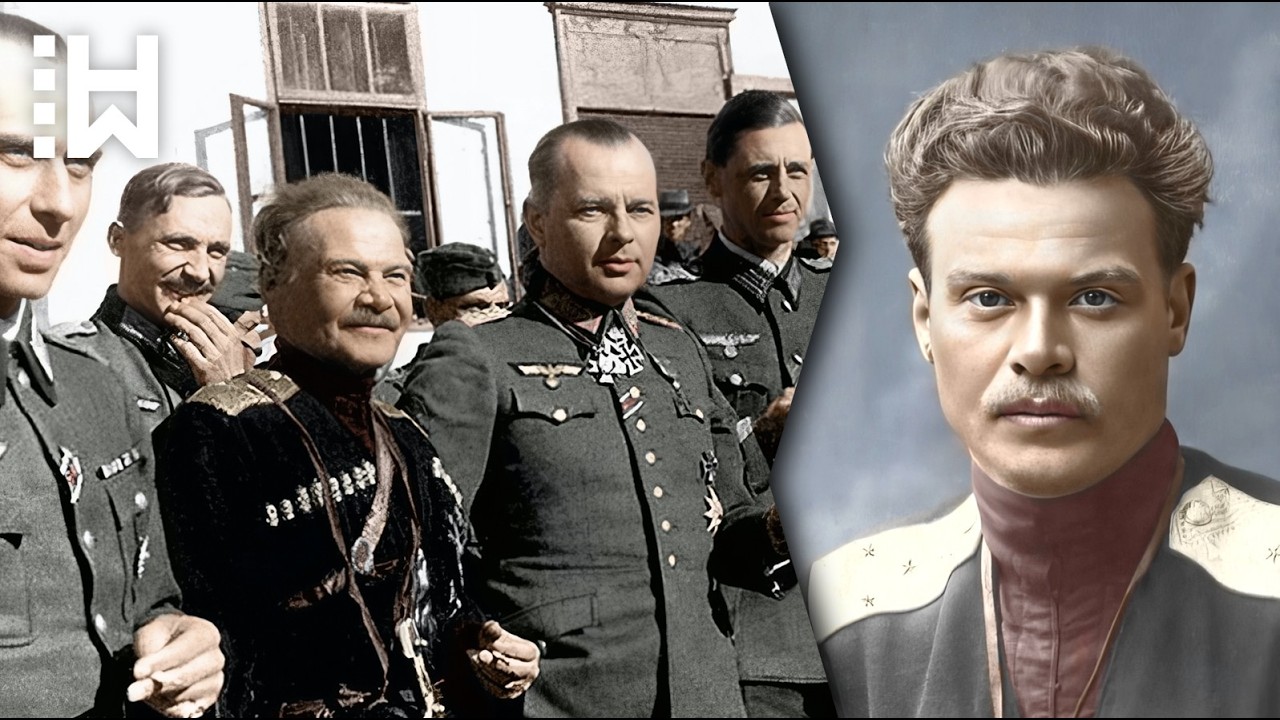
Among the most eager supporters stood a former Cossack commander who had once fought the Red Army and had never forgiven his defeat. He openly welcomed the attack and called for cooperation with Nazi Germany, insisting that the struggle against Soviet power must continue regardless of the cost. He pushed for the creation of Cossack cavalry formations under German command and placed his name and reputation at the service of the Third Reich. By late 1943, those Cossack units were deployed in the Balkans, where anti-partisan operations descended into organized brutality against civilians.
Villages were burned. Families were driven from their homes. Prisoners were executed without trial. And countless numbers of women and girls were raped and murdered.
The man who chose to fight alongside the devil himself to defeat the Soviet Union was Andrei Shkuro. Andrei Grigorievich Shkuro was born on the 19th of January 1887 to a Cossack family in the city of Pashkovskaya, today’s Krasnodar, then part of the Russian Empire. He grew up in a region shaped by Cossack military tradition and unwavering loyalty to the Tsar. In such families, service in uniform was not merely a career choice.
It was an inheritance. From an early age, he was expected to become an officer and to uphold the honor of his community. Shkuro received his formal military education at the Third Moscow Cadet Corps, an institution known for rigid discipline and demanding instruction. The school was designed to produce obedient and capable officers for the Imperial Army.
Shkuro, however, stood out less for discipline than for defiance. Energetic, impulsive, and confrontational, he often challenged authority rather than submitting to it. Years later, he described his behavior with disarming frankness. “We broke desks and benches, smashed lamps, trashed the director’s apartment, and the reason for our dissatisfaction was the unsatisfactory quality of the cutlets served.
”
After completing his studies at the Cadet Corps, Shkuro entered the Nikolaev Cavalry School in St. Petersburg, one of the Empire’s leading institutions for training cavalry officers. The academy trained officers for mounted service in the Imperial Russian Army and placed heavy emphasis on discipline, horsemanship, and tactical command. There, Shkuro refined the skills expected of a cavalry officer and prepared for active duty.
In 1908, he married Tatiana Sergeyevna Potapova, whom he had known since childhood. The couple had no children. Shkuro served in the First World War, which lasted from the 28th of July 1914 until the 11th of November 1918. In December 1914, he was wounded in the leg and spent two months recovering in hospital.
Shortly after returning to the front, he was wounded again, this time in the stomach. The war tested his endurance early, yet he returned to duty despite his injuries. In 1915, now a captain, Shkuro proposed forming a fast-moving mounted detachment to operate behind enemy lines. He did not want to remain tied to trenches and static positions that offered little room for initiative.
He sought speed, surprise, and freedom of action in a war that had become rigid and predictable. His objective was clear: strike supply columns, disrupt rail lines, cut communications, and withdraw before the enemy could respond. The unit that emerged operated with unusual independence and quickly developed a fierce reputation. Its Cossacks trimmed their uniforms with wolf fur and carried a banner marked with a snarling wolf’s head.
Before attacks, Shkuro encouraged them to imitate a wolf’s howl, turning each raid into a display of menace as well as force. Some praised the detachment as bold and effective, claiming it unsettled German forces in the rear. Others within the Russian army saw a more troubling pattern. They spoke of loose discipline and a commander who resisted control.
Throughout the war, Shkuro remained a contradiction. He showed genuine courage in battle, yet he repeatedly ignored orders and exceeded his authority. He was praised for bravery one month and threatened with punishment the next, operating constantly on the edge of court-martial. Soon after the Bolsheviks seized power during the October Revolution of 1917, the Russian Civil War erupted.
The war was fought between the Red Army, loyal to the Bolshevik government, and a loose coalition of anti-Bolshevik forces known as the Whites, who sought to overthrow the new regime. What began as scattered resistance expanded into a vast and brutal struggle across the former Russian Empire. In the spring of 1918, as Bolshevik control spread across southern Russia, Shkuro organized an anti-Bolshevik Cossack unit in the area of Batalpashinsk in the Caucasus. He established himself as one of the more aggressive Cossack commanders in the region, and by May 1919, he held the rank of lieutenant general commanding an entire cavalry corps at a relatively young age.
He was 32. During this period, Shkuro’s name became associated with harsh reprisals and looting, as contemporary reports described his units as ruthless in the territories they controlled. On one occasion in the port city of Rostov in southern Russia, Shkuro entered the ballroom of a large hotel while a dance was underway. Accompanied by several officers and visibly intoxicated, he demanded that guests surrender jewelry and cash.
The music stopped and conversations fell silent as his reputation filled the room. The guests complied without resistance, and by the end of the evening, Shkuro had secured a considerable haul, later reflected in the luxury of his household. When White forces entered the city of Kiev in August 1919, large-scale pogroms erupted almost immediately. Many within the White Movement associated Jewish communities with Bolshevism and regarded them collectively as political enemies.
In this atmosphere of revenge and entrenched anti-Semitic belief, violence spread rapidly through the city, and more than 20,000 Jews were killed in two days. After these events, a representative of the Kharkiv Jewish community approached Shkuro to confront him about the pogroms and demand assurances for the safety of Jewish civilians. Shkuro said to him, “Jews will not receive any mercy because they are all Bolsheviks. ”
Shkuro’s position within the White command weakened as concerns about discipline and control continued to grow.
General Pyotr Wrangel, commander of the armed forces of South Russia, removed him from command during a reorganization of the army. The decision prompted Shkuro’s resignation and revealed the deep divisions that plagued the already fragile White leadership. After leaving Russia in the aftermath of the Civil War, Shkuro began a long period of exile across Europe. He earned money performing in circuses with a Cossack trick riding troop, transforming cavalry skill into spectacle before paying audiences.
He also appeared in minor film roles, living less as a former senior White Army commander and more as a wandering performer. Yet exile did not extinguish his political ambitions, and he continued to believe that the Soviet state would eventually collapse. The Second World War began on the 1st of September 1939, when Germany invaded Poland. In 1941, after Germany invaded the Soviet Union, the 54-year-old Shkuro agreed to help organize anti-Soviet Cossack units made up of White emigres and Soviet prisoners of war.
For Shkuro, cooperation with Germany was a calculated step toward destroying the Soviet state and reclaiming Russia from Bolshevik rule. By 1944, his collaboration had deepened, and German authorities appointed Shkuro commander of the Cossack Reserve units deployed primarily in Yugoslavia. The Cossacks fought in the Balkans against Tito’s partisans on mountain ridges above the Drina River, patrolled the Istrian coast, and later screened the retreat through northern Italy. Their horses could climb goat tracks where lorries stalled, and they often arrived behind a rebellious village before dawn to cut off the escape road for the civilians before a German attack.
They also participated in direct attacks against civilian populations. On the 12th of October 1943, the 1st Cossack Cavalry Division was dispatched against Yugoslav partisans in the Fruška Gora Mountains. In the operation, the Cossacks, aided by 15 tanks and one armored car, captured the Serbian village of Beočin, where a temporary partisan headquarters was located. Many villages were burned, including a monastery on Fruška Gora, and around 300 innocent Serbian villagers were killed.
When this division was deployed in the territory of Croatia, it quickly established a reputation for undisciplined and ruthless behavior, not only towards the partisans, but also the civilian population. Near the town of Brodar, among others, the Cossack cavalry regiments committed rapes and carried out executions. In December 1944, while they were conducting operations against partisans, the Cossacks were accused of mass murders and rapes near the Croatian town of Virovitica. They also stole horses, pigs, and sewing machines.
The Cossacks behaved like bandits and marauders, and their activities caused the intervention of diplomats who brought their complaints to a representative of the German military authorities in Croatia. The German representative later stated that when reading the letter from the diplomats about the Cossacks’ deeds, it made his hair stand on end. The German officers compared the Cossack units to the SS Kaminski Brigade in the Warsaw Uprising. The Cossacks not only raped women and killed people, but also plundered and burned towns suspected of harboring partisans and their supporters.
While some victims, including women and children, were burned alive, the Cossacks used telegraph poles along the railroad tracks for mass hangings as a warning to the partisans and others. The Second World War in Europe ended on the 8th of May 1945. In accordance with Allied agreements reached at the Yalta Conference, British forces interned Cossack officers, including Shkuro, in Austria before handing them over to the Soviet Union. By verdict of the Military Collegium of the Supreme Court of the Soviet Union, Shkuro was sentenced to death by hanging on charges of waging armed warfare against the Soviet Union and carrying out espionage, sabotage, and terrorist acts.
When the words were read, he lowered his eyes. Andrei Shkuro was executed in Moscow on the 17th of January 1947, two days before his 60th birthday. While Russian emigre memoirs depict Shkuro as a very lively man who enjoyed social gatherings with plenty of dancing, singing, drinking, and vivid storytelling about times past, his victims experienced a very different legacy.
One written in terror, fire, and blood.
