The dredge sat in its pond at the end of the 1977 season, and the crew shut it down and walked away. Tools and supplies stayed inside for years afterward, as if the operators had simply gone home after a shift. It still sits there today, a steel ship in a muddy pond inside Yukon-Charley Rivers National Preserve, with a chain of buckets climbing from the ground at one end and a conveyor throwing rock behind it. Around it, ridges of washed gravel stretch for miles — the real footprint of a machine that did not just take gold from a river but rebuilt the valley as it mined.
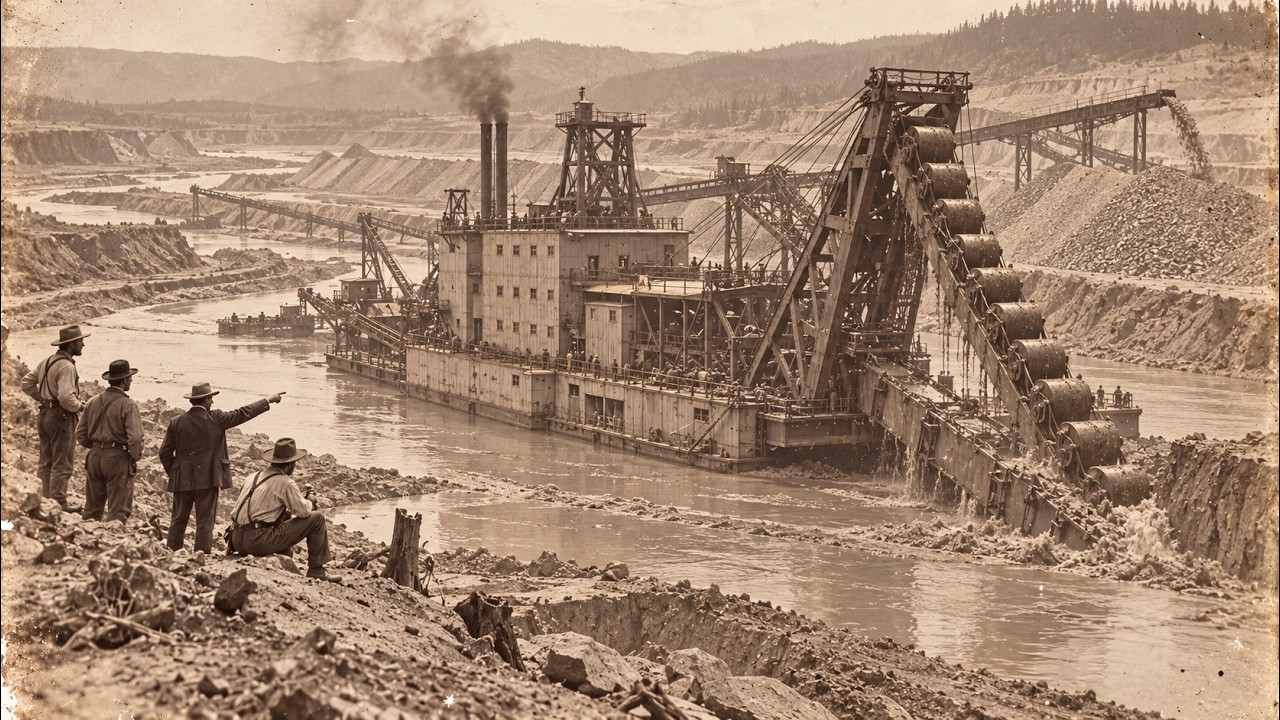
The strangest part of the scene is the pond itself. It moves with the machine. A bucket line dredge could dig ahead, wash the gold on board, dump the waste behind, and slowly carry its floating factory through an entire river valley. That is what made these machines different from almost every image people associate with an American gold rush.
A prospector with a pan searched for a rich spot. A dredge was built for a different economy. It could make money from ground that did not look rich at all, provided there was enough of it and the machine could process it cheaply enough. The principle of placer mining had not changed.
Gold is heavy. Water and gravity can separate it from lighter sand and gravel. A pan does that a few pounds at a time. A sluice box does it faster.
A giant bucket line dredge turned the same idea into continuous industrial production. That shift in scale is the whole story. The United States Bureau of Mines traced the first successful American bucket dredge to Grasshopper Creek in Montana in 1895. Bucyrus built it, and the machine was rebuilt after its early seasons as operators learned what worked.
In 1897, a bucket dredge went to work on California’s Yuba River. That first attempt was wrecked by the river, but another Bucyrus-built dredge began operating on the Feather River at Oroville in 1898. Those early machines were experiments in a field that did not yet know its final form. Dredges had already been used successfully in New Zealand, but American mining districts presented different gravel, different depths, different rivers, and different operating conditions.
The Bureau of Mines later wrote that it took two or three years of experimentation before operators were confident bucket dredging could be profitable under the severe conditions they faced. Once they figured it out, the industry expanded fast. By 1910, a hundred dredges had been built in California alone, and 63 were operating that year. The investment represented about $9 million at the time — an enormous commitment to machines whose business model depended on doing the same simple thing over and over again: move more gravel for less money than men with smaller equipment ever could.
A bucket line dredge was basically a mining plant wrapped around a floating hull. At the digging end, a ladder carried an endless chain of steel buckets. Each bucket bit into the gravel below the water line and carried a load upward. At the top of the ladder, the gravel dumped into the dredge’s washing system.
From there, the material had to be sorted by size. Large rocks could not be allowed to bury the recovery equipment, so the gravel was tumbled and washed. Finer material and water moved into sluices where the heavy gold could settle while lighter sand continued through. Everything that was not gold had to leave the machine again, which is why the tail of a dredge was as important as its mouth.
Waste rock went out the back through a stacker. As the dredge advanced, it left long ridges and piles of washed gravel behind it. Those tailings are still visible in old mining districts today, sometimes covering miles of former stream bed. The dredge therefore performed three jobs at once.
It excavated, it processed, it disposed of waste, and because all three happened continuously, the machine could keep moving instead of waiting for one crew to finish before the next crew began. That movement is what makes old photographs so easy to misunderstand. The dredge did not need a naturally deep lake stretching through the valley. Operators prepared a pond around the hull and worked the machine forward through the deposit.
The bucket line excavated the face in front. The hull remained afloat. The stacker built tailings behind. Cables, winches, and anchors controlled the dredge’s position as it swung across the cut and advanced.
A crew looking down from the winch room was not steering a ship toward a destination. They were steering an excavation plant through the ground. This was the mechanism that changed placer mining from a search for obvious concentrations into a business of volume. If a cubic yard of gravel contained only a small amount of gold, a man with a shovel might ignore it.
If a dredge could process tens of thousands of yards while keeping operating costs below the value recovered, that same low-grade ground became an ore body. The Bureau of Mines numbers from California show just how extreme the volume became. Between 1925 and 1932, roughly 25 dredges were operating in the state in a typical year. Together they handled about 45 to 50 million cubic yards of gravel annually and recovered around $4.
5 million in gold per year at historical prices. Those are not the numbers of a treasure hunt. They are the numbers of an earthmoving industry. From 1898 through 1932, the Bureau of Mines estimated California dredge gold production at about $175 million at the values of that era.
The Yuba River field accounted for roughly $67 million. The American River field around Nome produced about $45 million. The Feather River field contributed about $34 million. The useful part of those totals is not the money by itself.
It is where the money came from. The dredges did not discover a single giant nugget worth $175 million. They earned it by processing enormous quantities of ordinary-looking gravel and recovering tiny amounts of dense metal again and again. That required consistency more than drama.
Buckets had to stay full. The washing plant had to keep flowing. Sluices had to stay in condition. The stacker had to clear waste fast enough that the digging end did not catch it.
Cables had to move the hull. Pumps, engines, generators, bearings, gears, rollers, and bucket pins all had to work together. If one part stopped, the whole production line stopped. The economics also changed what counted as a finished mining district.
The Bureau of Mines described dredging as an end phase of placer mining. Prospectors usually arrived first and took the richest, easiest ground. Hydraulic miners and larger operations followed. A dredge often came later when the obvious gold was gone but an immense quantity of lower grade material remained.
That meant the machine sometimes worked directly through the evidence of the earlier rush. At Coal Creek in Alaska, the National Park Service notes that early miners had spent decades sinking shafts through permafrost and working narrow tunnels near bedrock. Later, a bucket line dredge moved through the same valley. Much of what those first miners built disappeared because the dredge simply processed the ground beneath and around it.
This is why old dredge fields can look less like abandoned mines and more like a landscape made by machinery. Cabins vanished. Creek channels shifted. Gravel ended up in ridges that had never existed before.
At Coal Creek today, the park service says tailings cover seven miles of stream bed. But getting a dredge to Alaska created an entirely different engineering problem. California dredges already dealt with deep gravel and changing ground. Alaska added frozen earth, remote transportation, short seasons, and distances that made replacing a broken part a serious event.
The basic placer gold was still there for the same geological reason. Heavy gold had accumulated in stream and ancient beach deposits. The problem was reaching it when the overburden and pay gravel could remain frozen year round. Early miners attacked permafrost with fire, steam points, and other labor-intensive methods.
Industrial dredging required a much larger solution. The ground ahead of the bucket line had to be stripped and thawed before the dredge reached it. A giant machine capable of processing thousands of cubic yards a day was useless if its buckets met a wall of frozen muck. That bottleneck shaped dredge design and entire mining operations in Alaska.
Nome became one of the important laboratories. Gold had been discovered in the district at the end of the nineteenth century, and by the early twentieth century operators were trying to mechanize extraction on a much larger scale. The Bureau of Mines history shows Alaska becoming one of the two great American dredging regions alongside California. By 1932, about 80 percent of Alaska’s placer gold, valued at roughly $4.
3 million that year, was being mined by 25 dredges. In 1931, the estimated volume dredged across Alaska was about 10. 2 million cubic yards. The average value recovered was only 37 cents per cubic yard at the prices of the period.
Thirty-seven cents is the number that explains the machine better than any photograph. A cubic yard of pay dirt did not need to look spectacular. It needed to be processed cheaply, continuously, and in sufficient volume. This is why designers chased bigger buckets, deeper digging, and higher daily yardage.
In Nome, later engineering records described 9-cubic-foot bucket line dredges capable of moving thousands of cubic yards per day. One Bureau of Mines planning document gives actual production rates of about 9,000 cubic yards per day for one 135-bucket machine and about 7,000 for another 105-bucket machine. The machine could be enormous and still have its production limited by something outside the hull. The same records note that reaching design capacity depended on having enough thawed ground ready in front of the dredge.
An industrial machine can only be as fast as the slowest step feeding it. That is where the image of a gold dredge as a lone monster becomes misleading. The dredge was the center of a system. Crews cleared vegetation.
Other equipment stripped overburden. Water systems helped thaw frozen material. Drills explored the pay streak. Power plants fed electricity or engines.
Shops repaired buckets and pins. Survey crews kept the machine on the deposit. The floating hull got the attention because it was huge, but production depended on everything around it. Nome shows just how much work had to happen before a bucket ever touched pay gravel.
A federal study of the Nome placers records the first dredge there in 1905 and nine operating by 1911. Early machines were mostly confined to naturally thawed ground near stream channels. The deeper coastal plain held much more material, but much of it was locked in permafrost. Bigger dredges alone could not solve that.
J. H. Miles patented a cold water thawing technique in 1920, and that changed the scale of what operators could prepare. Crews drove narrow pipes called thaw points down into frozen ground and circulated water through them.
The water did not need to be hot. It only needed to be warmer than the frozen gravel. Slowly, heat moved from the water into the ground until the bucket line could dig what had previously been a solid mass. At Coal Creek, Ernest Patty later used a similar approach.
The National Park Service describes ten-foot lengths of heavy pipe with hardened chisels at the bottom. Workers drove the points deeper with slide hammers while water under pressure seeped into the gravel. Patty estimated that the water entered at about 45 degrees Fahrenheit and returned from the ground near 35. Ten degrees did not sound like much, but spread through acres of frozen gravel, it could prepare the next season’s work for a fraction of the cost of steaming every cubic yard.
That thawing operation had to stay ahead of the dredge. At Nome, federal engineers noted an awkward seasonal mismatch. Dredges might work around 170 days in a year, but the weather window for efficient cold water thawing could be only 90 to 100 days. The thawing crew therefore had to prepare ground nearly twice as fast as the dredge would later consume it.
If the preparation fell behind in summer, the dredge could run out of diggable ground while the machine itself was still ready to work. Ice created another problem around the hull. The dredge pond froze at the edges. The machine’s swinging motion broke ice in front of it and pushed pieces aside, but those chunks could pile up and refreeze until there was not enough room for the hull to swing properly.
The bucket line might have power, the wash plant might be ready, and gold might be sitting below. Yet a ring of ice around the pond could throttle production. Then there was the question of where to point the dredge. The pay streak was underground.
A machine that moved thousands of cubic yards a day could lose money at an extraordinary rate if it wandered off the deposit. The National Park Service preserves Ernest Patty’s view that prospecting with a dredge was folly. Gold placers used specialized drilling rigs to sample the ground ahead and map the buried band of richer gravel before committing the dredge to it. That meant a successful dredge field was planned in layers.
Drills found the pay. Stripping crews removed surface material. Thawing crews prepared frozen gravel. Surveyors laid out the cut.
Power and water had to be ready. Only then did the bucket line arrive. The huge floating machine was the visible end of a production schedule that might have begun a year earlier. Nome also demonstrates why dredging could disappear even when engineers kept improving the machinery.
Federal records say bucket line operations there continued to become more efficient through the middle of the twentieth century. A jig-equipped dredge began working the submarine beach in 1957 with an advanced recovery plant. The recovery system was efficient, but thawing and digging costs were unexpectedly high. The dredge shut down in 1961, and dredging on the Nome plain ended in 1962.
That is a useful correction to the idea that bigger equipment automatically wins. A dredge can move more ground and still lose money if preparing each cubic yard costs too much. The mine exists on paper only when the value of gold recovered stays above the combined cost of thawing, digging, washing, repairing, fueling, staffing, and moving the operation. Walter Johnson understood that better than almost anyone.
Johnson earned a mechanical engineering degree from the University of Illinois and entered the California dredge-building industry in 1905. By 1910, he had formed the Union Construction Company to design bucket dredges, prospecting drills, and other placer mining equipment. The National Park Service records that his companies produced 58 dredges in total, with 32 sent to Alaska. That northern specialization mattered.
A dredge that worked in California could not simply be dropped into Alaska unchanged and expected to survive. Johnson adapted machinery for cold, ice, permafrost, and remote assembly. He traveled north repeatedly to direct construction near Nome and in interior districts including Ruby, McGrath, Iditarod, Circle, and Fairbanks. One of the clearest examples of that industrial network is the Coal Creek dredge.
In the early 1930s, Canadian investor General A. Alexander McCrae asked mining engineer Ernest Patty to help locate an Alaska gold property suitable for large-scale development. They settled on Coal Creek, a tributary of the Yukon River. Gold Placers Incorporated bought a bucket line dredge from Walter Johnson’s company in Oakland, California, for $156,000.
Buying it was the easy part. The dredge was built, then dismantled and crated. It traveled by steamship to Skagway. From there, the pieces went over the White Pass Railroad to Whitehorse.
Then a paddlewheel steamboat carried them down the Yukon River to Slaven’s Roadhouse near the mouth of Coal Creek. At that point, the company still did not have a dredge. It had 400 tons of steel parts sitting beside a remote Alaska river. Workers unloaded the pieces using pulleys, rollers, ramps, and caterpillar tractors.
Then they moved the entire shipment seven miles up the Coal Creek drainage. Only after that could crews begin reassembling the machine that had already crossed ocean, railroad, river, and wilderness in pieces. That transport story is one reason bucket dredges were so difficult to replace once they reached a remote district. The finished machine looked mobile because it floated and moved through the valley.
In a regional sense, it was almost immovable. Taking it apart and hauling it out could be as complicated as bringing it in. The Coal Creek dredge began production on July 1, 1936. The National Park Service description gives the machine a 62-unit bucket line.
Gravel came aboard through that continuous chain, entered a washing system, was tumbled and sprayed to separate large rocks from finer material, passed across sluices where gold could be trapped, and left the back as waste rock. The dredge was designed to process 3,000 cubic yards of gravel each day. That figure becomes easier to imagine if you stop thinking about gold and think about empty space. Every day the bucket line was supposed to remove a volume of ground large enough to fill a substantial building.
Then the machine had to wash all of it, sort it, keep a tiny fraction, and place almost everything else back onto the valley floor. The gold itself might fit in a small container. The waste rock defined the operation. On the first day of production, Ernest Patty remembered the dredge’s two diesel engines coming to life, the winchmen moving the hull into position, and the bucket line beginning to bite into the gravel.
The park service preserved that account because it captures what the machine was from the operator’s point of view. This was not a ship being launched. It was a factory starting its production line. The winchman had one of the most important jobs.
From the control position, he managed the elaborate system of winches that pulled the dredge across the face. The bucket ladder did not simply dig straight ahead. The hull could be worked back and forth, so the bucket line swept across the deposit. Position determined what ground the buckets reached and how effectively the machine used its cut.
Below him, the bucket chain was a loop of controlled violence. Buckets dug into compact gravel, climbed loaded, dumped, rounded the head end, and descended empty for another bite. Pins and rollers carried repeated shock loads. Abrasive sand and rock worked on every surface.
A bucket dredge did not fail gracefully if the digging machinery stopped. The plant behind it could do nothing without feed. Inside the processing system, the goal was the opposite. The digging end was brute force.
Gold recovery demanded control. Material had to be washed enough to free the dense particles from clay and gravel. Oversized rocks had to be rejected. Fine material had to move across riffles and recovery surfaces at a rate that let heavy gold settle without clogging the plant.
Historically, some dredges used mercury to amalgamate fine gold in recovery systems. That practice belongs to the industrial history of the machines, and it also explains part of their environmental legacy. These were not clean modern processing plants. They were built in an era when the priority was recovering metal from as much ground as possible.
The output proves they could do it. During roughly two decades of operation on Coal Creek, the dredge recovered more than 92,000 ounces of gold. The National Park Service gives the value at the time as more than $3. 2 million.
In the late 1930s, Gold Placers Incorporated, working Coal and Wood Chopper Creeks, became Alaska’s third largest gold producer behind operations at Nome and Fairbanks. The remarkable part is that the dredge accomplished this after individual miners had already worked the drainage for years. It did not need virgin ground in the romantic sense. It needed a deposit large enough that industrial recovery could extract value the earlier methods had left spread through the gravel.
This pattern repeated across dredge fields. In California, dredges prolonged the life of placer districts after the first rush had faded. In Alaska, corporate operators brought capital, drilling, thawing systems, power, transportation, and enormous machines into regions where hand methods could no longer compete at scale. That changed who could participate.
A man with a pan could stake a claim with limited equipment. A bucket line dredge required investors, engineers, construction crews, mechanics, power systems, logistics, and enough proven ground to justify the investment. The second generation of a gold rush looked less like prospecting and more like heavy industry. It also changed what failure looked like.
A prospector could leave a bad claim. A dredging company might have a machine worth a fortune sitting in a pond supported by workshops, power equipment, camps, and miles of prepared ground. If the gold grade fell, thawing lagged, fuel costs rose, or a major mechanical component failed, the whole operation could become uneconomic while the machine was still physically capable of working. That is one reason so many dredges became landmarks instead of scrap.
The Coal Creek machine eventually stopped. Mining shifted between Coal Creek and its sister operation on Wood Chopper Creek, and later companies tried to keep the district working. The park service says the dredge last operated in 1977. At the end of the season, the operators shut it down and walked away.
The tailings around it are the final answer to what a gold dredge actually did. It did not just remove gold from a river. In many districts, it rebuilt the valley as it mined. Vegetation was cleared.
Frozen ground was stripped and thawed. Old stream channels were cut apart. Bucket chains lifted the earth. Processing plants washed it.
Stackers laid it down in new ridges behind the hull. The pond moved forward because yesterday’s ground had become today’s tailings. The National Park Service describes similar changes across Klondike mining country, where dredges left waste gravel in long piles and earlier steam-powered machines consumed enormous amounts of cordwood. Old photographs show creeks stripped, rerouted, and surrounded by ground that no longer resembles a natural drainage.
This is the part that the phrase “floating gold dredge” tends to hide. Floating was not the purpose. Floating was the trick that let an entire excavation and processing plant carry its own weight while it advanced through soft, wet ground. A conventional mine moves ore to a fixed mill.
A bucket dredge moved the mill to the ore. That inversion saved enormous amounts of hauling. Gravel did not need to travel miles to a processing plant. The digging face, wash plant, recovery system, and waste disposal all lived on the same hull.
The machine only had to move itself a short distance to reach the next strip of pay gravel, and because the deposit was usually broad and shallow compared with a hard rock mine, that short movement could continue for years. The design rewarded repetition. The bucket line never needed to know whether the next scoop contained a visible nugget. The sluice did not care whether the gravel looked exciting.
The dredge made its money by being indifferent. Scoop it, wash it, recover whatever heavy metal is there, stack the rest, move forward. That is why the biggest impact of these machines was not a single spectacular discovery. Their achievement was making unimpressive ground worth mining.
By the 1930s, that logic had turned parts of California and Alaska into industrial placer fields. Twenty-five dredges could account for most of Alaska’s placer gold in a year. California machines could process tens of millions of cubic yards annually. A single remote dredge could be shipped north in pieces, hauled inland, reassembled, and then work enough gravel to recover tens of thousands of ounces over its life.
Keeping that chain alive was a maintenance job as much as a mining job. Gravel is abrasive. Every bucket edge, pin, roller, chute, screen, and pump lived in contact with material trying to wear it away. The digging machinery took shock loads whenever a bucket met a buried boulder or compacted layer.
The washing system had its own failure modes if clay blinded screens or oversized rock accumulated where it should not. The stacker could not be treated as an afterthought, because a dredge that could not clear its waste would eventually surround itself with the material it had just mined. That is why preserved dredges feel less like boats once you walk through them. The hull is only the platform.
Inside are machine shops, motors, winches, gears, electrical equipment, pumps, ladders, screens, and miles of practical little fixes added by people whose job was to keep production moving. A remote dredge crew could not call a service truck and wait for a dealer technician. They carried the ability to repair the mine with them. The machine also forced companies to think in terms of flow rather than individual loads.
A truck can stop while another truck is loaded. A bucket line dredge is most valuable when the entire route from digging face to tailings pile stays continuous. The bucket arriving at the top of the ladder assumes the hopper has room. The wash plant assumes water is flowing.
The sluices assume material is being sized correctly. The stacker assumes the tailings path is clear. One jam can turn hundreds of tons of machinery into a very expensive floating building. The people who designed them were solving a chain of problems that had almost nothing to do with the romance of gold.
How large could the buckets be before the ladder became too heavy? How deep could the machine dig? How fast could oversized rock be rejected? How much water would the wash plant need?
How much frozen ground could crews thaw ahead of the cut? How far could the stacker throw waste before the dredge boxed itself in? How could a 400-ton shipment of steel reach a creek with no industrial road? Solve those questions, and the gold followed.
Fail one of them, and an enormous machine sat idle while the ground beneath it remained full of metal it could not reach economically. That is the real reason bucket dredges belong beside America’s great locomotives, draglines, logging machines, and steam shovels. They were not impressive because they were large. They were impressive because every part of the machine existed to keep material moving through one continuous chain.
At the front, untouched gravel. At the center, a floating factory. At the back, tailings where the valley used to be. A prospector could spend a day looking for one rich pocket.
A dredge changed the question. It asked whether a whole valley could be turned into a production line, one bucket at a time.
