On the night of November 7th, 1974, a Ford Corsair with ties to Lord Lucan was discovered deserted on Norman Road in New Haven, blood smeared across its interior and a lead pipe lying in the boot. The vehicle belonged to Richard John Bingham, seventh Earl of Lucan, a man who had just fled a scene of unspeakable brutality in Belgravia and disappeared. Left behind were a nanny beaten to death and crammed into a mail sack, and a wife screaming for her life. What lay ahead was a silence that has stretched across half a century.
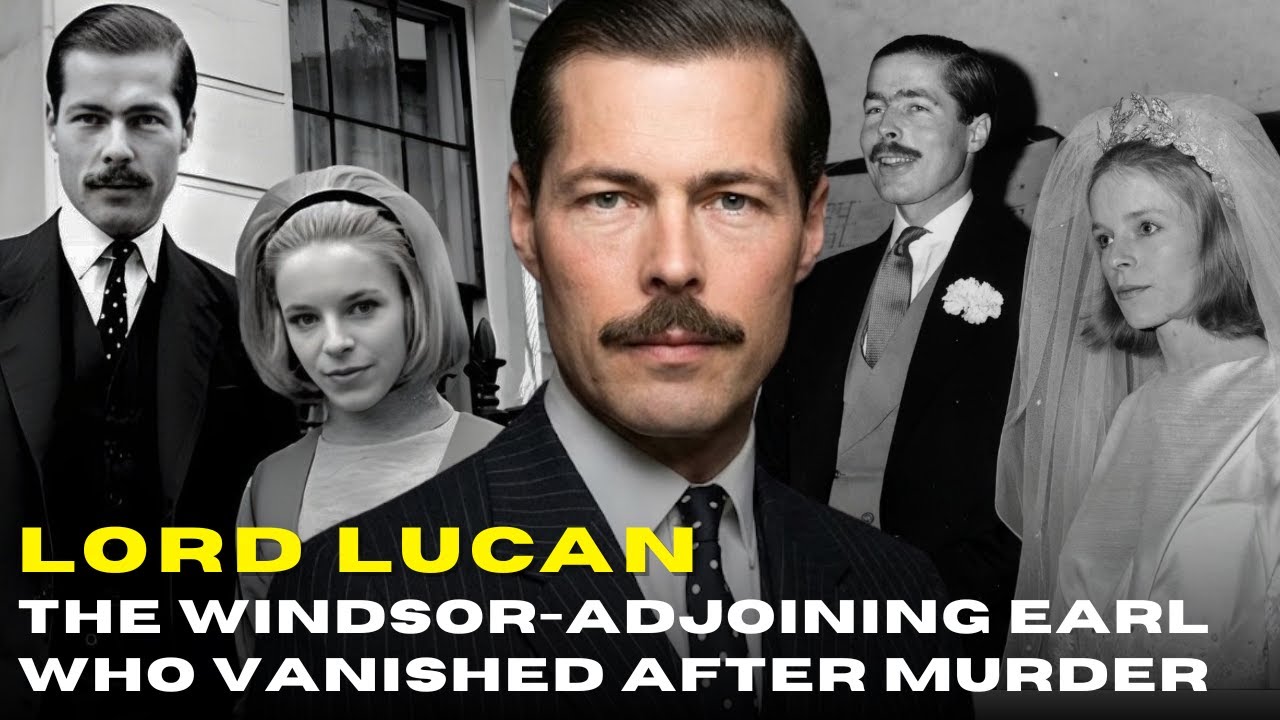
This is the definitive ghost story of the British aristocracy, the account of a man charged with murder, molded by privilege and an ingrained sense of entitlement. Did Lucky Lucan pull off the perfect crime and spend his remaining years beneath an African sun? Or did the icy waters of New Haven at last claim the man who believed himself beyond reach? The tragedy of Richard John Bingham is frequently depicted as a sudden eruption of insanity, yet in reality it was a gradual, calculated unraveling.
It is a tale about the fragility of the British upper class when confronted with the modern era. Lucan was a man fashioned for a century that had already slipped away. He was brought up to believe his will was absolute, that his bloodline granted him a natural exemption from the consequences that caught up with ordinary people. When the modern world, embodied by a divorce court, declined to submit to him, he came apart.
The violence that followed was not a crime of passion in the conventional sense. It was an act of corrective enforcement. Within his distorted logic, he was not plotting a murder. He was plotting the restoration of the natural order.
He saw himself as the wronged party. On the eve of the attack, Lucan circulated among the Clermont set he was famous for. Even as events were already hurtling toward catastrophe, they saw Lucky Lucan, the gracious loser. They did not see the man who had already crossed the line in his own mind from aristocrat to executioner.
They had no idea that the next hand he played would be written in blood. The 7th of November 1974 came to London wrapped in the damp, marrow-chilling greyness that marks a British autumn. It was a Thursday, a day that ought to have been entirely ordinary. In the grand houses of Belgravia, nannies were steering prams through the mist of Eaton Square.
Milk bottles clinked on doorsteps and black cabs carried the masters of the universe into the city. Yet at 46 Lower Belgrave Street, the mood was altogether different. The air within the tall white stucco house hung thick with the unseen static of a family under siege. For Sandra Rivett, the 29-year-old nanny, this Thursday was meant to be an evening of freedom.
It was a night she might otherwise have passed out on the town. She had a boyfriend, John Hankins, a cab driver she was deeply attached to, and Thursday evenings were normally set aside for him. A few drinks at the pub, some laughter, a brief escape from the tension of the Lucan household. But Sandra was exhausted.
She had worked in the household only a short while. The earl’s looming shadow, the hushed phone calls, the countess’s weeping, all of it had worn her down. On impulse, a fatal and tragic impulse, Sandra chose to alter her plans. It was an ordinary decision, the sort we all make countless times in a lifetime.
But for Sandra Rivett, this simple choice to remain at home amounted to a death sentence. Across the city, in the sterile bachelor stillness of his flat at 5 Eaton Row, Lord Lucan was readying himself for a very different sort of evening. He was not a man given to impulse. He was a creature of inflexible routine.
Yet today the routine had been disrupted. He had passed the morning placing phone calls, arranging his affairs with an odd, detached sense of finality. He had taken lunch at the Clermont, but he had not dawdled over the port. He was a man going through the motions of a procedure, cold and deliberate.
He had obtained a car, not his own Mercedes, which was as instantly recognizable in Belgravia as the number 11 bus, but a plain, dirty Ford Corsair, borrowed from a friend, Michael Stoop. He had told Stoop he needed it because his own vehicle was suffering battery trouble. A lie, but a believable one. In the boot sat items later connected to the attack, among them a heavy canvas bag and a length of lead piping wrapped for grip.
The pipe had been bound in tape to improve the grip. A smooth lead pipe turns slippery once wet with blood. The tape gave purchase. It was the reasoning of a practical man, not a lunatic.
As evening descended, darkness engulfed the streets of London. Within number 46, domestic life carried on. The children were tucked into bed. Veronica and Sandra sat in the first-floor drawing room, the television flickering in the corner.
They made an unlikely pair, the aristocrat and the working-class girl, yet they were bound together by the peculiar besieged fortress they inhabited. At about 8:55 p.m., a craving for a cup of tea, the most British of urges, set the tragedy in motion.
“I’ll go down and make it,” Sandra said, rising to her feet. She collected the empty cups. “Would you?” Veronica answered.
“Thank you.” Those were probably the last words Sandra Rivett ever heard. She left the drawing room and started down. The kitchen lay in the basement, reached by a steep, narrow staircase that dropped into the depths of the house.
As she went down, she would have realized the basement was strangely dark. Normally a light was left burning, but tonight it was utterly black. Lucan was waiting. He had let himself in with his key, the very key he had sworn in court that he no longer had.
He stood in the shadows, drawing shallow breaths, the lead pipe heavy in his gloved hand. He was waiting for a woman of a particular height, a particular build. He was waiting for the mother of his children. But in the darkness, shapes can deceive.
Sandra Rivett and Veronica Lucan stood at roughly the same height. Both wore their hair short. As Sandra reached the foot of the stairs and stepped into the kitchen, tray of cups in hand, she was merely a silhouette to the predator in the corner. The violence came instantly and devastatingly.
Lucan struck. He said nothing. He did not falter. He brought the lead pipe down with the full strength of a man driven by years of bottled rage and entitlement.
The blow landed on Sandra’s head. She dropped at once, the cups shattering across the linoleum floor, but he did not relent. The post-mortem recorded multiple blows consistent with a sustained assault. He beat her until she stopped moving, until the only sounds in the basement were his own uneven breathing and the ticking of the kitchen clock.
He moved on to the next stage of the plan. The body had to be dealt with. He seized the canvas mail sack and started folding the broken body of the young nanny into it.
It was a grim and arduous job. Upstairs on the first floor, Veronica Lucan glanced at the clock. Ten minutes had passed, perhaps fifteen. Brewing tea did not take this long.
A cold, sharp prickle of unease travelled down her spine. From below came utter silence. No spoons clinking, no water running. “Sandra,” she called.
Nothing. Veronica rose to her feet. She was dressed in a dress and heels. She walked to the head of the stairs.
“Sandra, are you all right?” Still no answer. The quiet hung thick and heavy, humming with a wrongness she could not put into words. Pulled by a mix of irritation and worry, Veronica started down the stairs.
As she went down into the gloom, she called out once more, “Sandra.”
She came to the foot of the stairs. The dark was complete. She felt movement before she saw anything.
A shadow separated itself from the deeper blackness. “Sandra,” she said, her voice shaking. The shadow sprang. The blow struck her forehead, splitting the skin and sending blood streaming into her eyes.
Veronica screamed. It was a scream of raw, primal dread. She fell back, stunned, but she stayed conscious. The adrenaline of survival surged through her body.
With a horror beyond all reason, she understood that she was being murdered inside her own home. Lucan struck again. “Shut up,” he hissed. It was her husband’s voice.
That recognition must have been more devastating than the blow itself. It was no burglar. It was no stranger. It was John.
It was the father of her children, the man she had holidayed with in Monte Carlo, the man she had loved. He was trying to smash her skull with a pipe. Veronica Lucan fought back. She was small.
She was hurt. She was blinded by blood. But she fought. She clawed at him.
They grappled in the darkness, sliding on the blood-slicked floor. She could smell the sweat and stale tobacco on him. In the frantic, close-quarters struggle, she got her hand between his legs. She seized his genitals and twisted with every bit of strength she had.
Lucan gasped. The pain shattered his frenzy. He drew back, panting. The violence ended as suddenly as it had started.
For a moment they stood there in the dark, two ghosts in a ruined marriage, wrapped in the smell of blood. “John,” she gasped, her voice ragged. “Don’t, don’t hurt me.”
The rage seemed to seep out of him, replaced by a strange, weary pragmatism.
He sounded almost indifferent, or perhaps in shock. “I’m not going to hurt you,” he muttered, though the pipe was still in his hand. Veronica, with a psychological sharpness that saved her life, saw that she could not outrun him. Not yet.
She had to outthink him. She had to calm things down. “Where is Sandra?” she asked.
She’s dead, Lucan said. He said it flatly, as though remarking on the weather. I’ve killed her. She’s in the sack.
The horror of those words surely almost broke her, but she held on. She knew that if she screamed again, she would join Sandra in a sack. She changed tactics. She appealed to his twisted logic.
“I can help you,” she whispered. “We can, we can sort this out, but I need to clean my face. I’m bleeding.”
Lucan wavered.
The adrenaline was ebbing, leaving him confused. The plan had gone wrong. He had killed the wrong woman. The right woman was standing before him, offering to help.
His rigid gambler’s mind could not work out the odds of this new situation fast enough. “All right,” he said. “Go upstairs.”
They went up the stairs together.
It was a macabre procession, the murderer and his victim climbing the carpeted steps of their family home. They entered the ground-floor cloakroom. Veronica looked into the mirror. Her face was a mask of crimson.
The cuts were deep. She needed a towel. “I’ll get a towel from the bedroom,” she said. Lucan stood in the doorway, the pipe still in his hand, watching her.
He was dazed, perhaps weighing the options. Kill her now, but the noise, the neighbours. “Don’t scream,” he warned her. “I won’t,” she promised.
“I’ll just get a towel.”
She walked into the bedroom. She could hear him breathing behind her. She knew this was the only chance she would ever get.
If she let him think, if she let him regain his composure, he would finish the job. He had to kill her. She was the witness. “I’m just going to wet a towel,” she said.
She headed towards the bathroom, pretending she needed to wet a towel, but she did not look in the mirror. Instead, seizing the brief moment apart as he hesitated, she bolted. She turned and ran for the front door with the desperation of a hunted animal. She fumbled with the latch, her blood-slicked fingers slipping on the brass.
Open. Please God, open. The door gave way. The cold night air struck her face.
She burst out onto Lower Belgrave Street. She did not look back. She ran towards the lights of the Plumber’s Arms pub on the corner. She was screaming now, a raw guttural sound that tore through the polite silence of Belgravia.
“Murder! Murder! He’s murdering me!”
Inside the Plumber’s Arms, the regulars were nursing their pints.
The atmosphere was warm, smoky, safe. Then the door crashed open. A woman stood there, her clothes torn, her face a mask of blood, her eyes wide with a terror that no one in that room had ever seen before. “Help me,” she shrieked, collapsing onto the floor.
“My children, save my children. He’s in the house.”
Back at number 46, Lord Lucan stood in the hallway. He heard the door slam.
He heard the screams fading down the street. He knew with the cold certainty of a man who has staked everything on red and watched the ball land on black that it was over. He did not chase her. There was no point.
The police would arrive within minutes. The plan lay in ruins. Sandra Rivett was dead in the basement. Veronica was alive and screaming his name to the world.
He made no move to go upstairs and check on his children, sleeping in their beds, unaware that their father had just become a monster. He did not pack a bag. He simply turned around, walked out of the front door, and climbed into the dirty Ford Corsair parked on the street. He turned the key.
The engine coughed into life. Lord Lucan pulled away from the curb, driving slowly, calmly, away from the wreckage of his life. He drove past the Plumber’s Arms where his wife was at that moment being tended to by shocked strangers. He did not look.
He drove off into the darkness, a man who was no longer an earl but had become a ghost. Amid the turmoil of Lord Lucan’s escape and the media frenzy that would ensue, it’s easy to overlook the body in the basement. Sandra Rivett was no participant in the high-stakes games of the Clermont set. She wasn’t a countess with a title to defend.
She was a young woman who cherished life, who fretted over her son, who looked forward to a future with her boyfriend. She died in the darkness, frightened and alone, beaten to death by a man who didn’t even know her name. Lucan didn’t murder Sandra Rivett out of hatred. He killed her because she stood in his way.
To him, she was incidental damage, a factor he hadn’t considered in his grand scheme. As police sirens started wailing in the distance, rushing toward Belgravia, Sandra lay motionless in the canvas bag, the shattered teacups scattered around her. She was the first casualty of Lord Lucan’s hubris, but she wouldn’t be the last. The tragedy of that Thursday night was complete, yet the mystery was only starting.
The Ford Corsair headed south, carrying a man who was already fading mile by mile into the haze of myth. The journey from Belgravia to the quiet town of Uckfield in East Sussex is about 42 miles. In a modern car on modern roads, it takes roughly an hour. On the night of November 7th, 1974, in a battered Ford Corsair with a sluggish engine, it would have taken the driver longer.
It must have seemed endless. Lord Lucan drove south. He left behind the screaming sirens of London, the blood-drenched basement, and the wife shrieking in the pub. He drove into the black, hushed countryside of the Weald.
The plan, the flawless, rational, essential plan, had crumbled into a bloody disaster. He had killed the wrong woman. He had allowed the witness to get away. He was no longer in control of his fate.
He was a wanted man. Yet as he drove, an odd and frightening calm appeared to come over him. Lucan was a gambler. He understood that when the hand is lost, panic serves no purpose.
You don’t overturn the table. You work out the remaining moves. And as he guided the car through the dark lanes of Sussex, he started to craft the story that would safeguard his legacy, if not his life. He started to construct the lie.
At around 11:30 p.m., the Ford Corsair turned into the driveway of a large, comfortable house called the Grants. This was the residence of Ian and Susan Maxwell-Scott, old friends from the high-society circle.
Ian was absent, but Susan was there. She opened the door to find Lord Lucan standing before her. He was untidy. His hair was dishevelled, which was unlike him, and there was a damp patch on his trousers, probably blood he had attempted to wipe away, but his demeanor was surprisingly ordinary.
“Hello, Susan,” he said. “I’m in a terrible mess.”
Susan Maxwell-Scott invited him inside. She had no idea that a murder had occurred in London.
She didn’t know that every police officer in the capital was at that moment searching for the man standing in her hallway. She only saw a friend in trouble. She escorted him into the drawing room, lit the fire, and poured him a scotch and water. Lucan sat down.
He took a sip, and then with the composure of a man describing a minor car accident, he recounted the story he had fabricated during the drive. “I was walking past the house,” he started. He asserted that he had been passing 46 Lower Belgrave Street and had peeked through the basement window. He said he saw a man assaulting Veronica.
He claimed he had let himself in with his key, hurried down the stairs, and frightened the intruder away. He confessed he had slipped in a pool of blood. He admitted that Veronica was hurt. But then he said the panic set in.
He claimed Veronica in her frenzy had begun shouting that he had done it. Realizing that she would never be believed and that he, the despised husband, would be framed, he had panicked and fled. It was an absurd story. It depended on a string of improbable coincidences.
Why was he walking past the house with a length of lead pipe in his car? Why did the intruder disappear without a trace? Why did he run if he was the hero? But Susan Maxwell-Scott listened.
She was a woman of her class and era, trained to trust the word of a peer of the realm. She didn’t challenge him. She offered him comfort. But Lucan knew the story wouldn’t stand up in court.
He wasn’t telling it to persuade a jury. He was telling it to persuade his world. He was setting the record straight for the Clermont set. He wanted to make sure that when the news broke, his friends would say, “Poor John, he tried to save her, and that mad woman blamed him.”
“
After the story was told, Lucan asked for a pen and paper. He sat at a small writing desk in the Maxwell-Scotts’ drawing room. The house was silent. The fire crackled in the grate.
Outside, the wind was rising. That night, Lucan wrote letters explaining his version of events, including one addressed to his brother-in-law, Bill Shand Kidd. These documents are the most disturbing artifacts of the entire affair. They are not the scribblings of a lunatic.
They are the exact, haughty, and deluded justifications of a man who believes he is the victim of a cosmic injustice. In the first letter, he repeated the intruder lie. But then the hero’s mask slipped and the cold pragmatist appeared. “The circumstantial evidence against me is strong in that V says it was me,” he wrote.
“V has demonstrated her hatred for me in the past and would do anything to see me accused.” He went on, writing the sentence that has haunted investigators for 50 years: “I will lie doggo for a while.”
Lie doggo. It is an old-fashioned public school expression meaning to hide, to stay silent, to go to ground.
It implies a temporary condition. It implies a man who thinks he can wait out a murder charge in a country cottage until the heat subsides. Or perhaps it meant something more lasting. But the most unsettling aspect of the letters is what is absent.
There is no reference to Sandra Rivett. He had just beaten a young woman to death a few hours earlier. He had shoved her body into a sack. Yet in his final correspondence, she does not merit a single word of regret, sympathy, or even recognition.
To Lucan, Sandra Rivett was never a person. She was simply a piece of scenery in the drama of his own existence, an unfortunate wrinkle. His attention stayed fixed on himself, his children, and his loathing of Veronica. In the second letter, the financial wreckage of his life seeped onto the paper.
He described the sale of the family silver at Christie’s. He listed which creditors should be paid. Even at the edge of total ruin, he fretted about his reputation as a gentleman who settles his gambling debts. He asked Bill Shand Kidd to watch over the children, to make sure they were brought up with the correct values.
Values that clearly included the conviction that their mother was a monster. “When they finish with my wife,” he wrote, “I will be condemned.” That sentence unlocks his mind. He was not afraid of justice.
He was afraid of judgment. He understood that a trial would drag the Lucan name through the filth. It would reveal his bankruptcy, his brutality, his failures. He would be robbed of his dignity.
And to a man like Lucan, dignity mattered more than life itself. He finished writing in the small hours of Friday, November 8th. He sealed the envelopes. He rose to his feet.
Susan Maxwell-Scott asked what he meant to do. “I must get back,” he said vaguely. “I must sort things out.” He did not say where he was going.
He stepped out into the cold night. He got back into the Ford Corsair. The engine caught. He drove down the Grants’ driveway and turned onto the road.
Susan Maxwell-Scott watched the tail lights fade into the dark. She was the last credible witness to see Richard John Bingham alive. Lucan drove south once more. He was making for the coast.
He headed toward Newhaven, a ferry port that opened onto France. At some point in the early hours, the Ford Corsair drew into Norman Road in Newhaven. Lucan parked the car. He switched off the engine.
The silence flooded back. He sat there for a moment. In the boot lay the bloodstained lead pipe. The interior was smeared with the evidence of his crime.
He knew the police would find it. Perhaps he wanted them to. He left the car unlocked. What followed is the void into which a thousand theories have been poured.
Did he walk to the ferry terminal and board a boat to France on a false passport supplied by his powerful friends? It is possible. The Clermont had the means. They had private planes, yachts, and connections in high places.
Did he walk to a nearby private airfield where a light aircraft waited to carry him off to Africa, to live out his years on a ranch in Rhodesia or South Africa under the protection of the old colonial network? This is the romantic theory, the great escape. Or did he do the one thing his code of honour required? The most plausible and perhaps the bleakest theory is that Lord Lucan walked away from the car and headed toward the harbour.
The English Channel is cold and unforgiving in November. The currents around Newhaven are strong. If Lucan saw that the lie doggo strategy was a fantasy, if he saw the net closing and the shame of a trial was unavoidable, he may have chosen the gentleman’s way out. He was a man who believed in stoic acceptance of a bad hand.
He had played his ace, the murder of his wife, and he had lost. The game was over. Picture him standing at the edge of the breakwater, the icy wind tearing at his coat, the town lights behind him, the black emptiness of the sea ahead. Did he jump?
Did he weigh himself down with a stone, or perhaps another length of lead pipe, to make sure he never came up? If he did, the sea kept his secret. No body was ever recovered. No item of clothing washed ashore.
He simply ceased to exist. Back in London, the machinery was beginning to turn. The police burst into 46 Lower Belgrave Street. They found the body of Sandra Rivett in the sack.
They found the blood. They found the children upstairs, unharmed, but sleeping in a house of horror. And they found the silence. As soon as the news broke, the Clermont set closed ranks.
The detectives, led by Detective Chief Superintendent Roy Ranson, found themselves hitting a wall of upper-class indifference. When they interviewed Lucan’s friends—Aspinall, Goldsmith, Shand Kidd—they met arrogance and obstruction. “He’s an Earl,” one friend reportedly told a detective. “You can’t just treat him like a common criminal.
” They did not seem horrified by the murder of the nanny. They seemed annoyed by the mess. They described Lucan as a victim of his wife’s hysteria. They repeated the intruder story, even though they must have known it was a lie.
They held private meetings at the club, strategizing, pooling resources. Were they planning his escape, or managing the PR damage to their social circle? The police were outmanoeuvred. They were used to street thugs and professional criminals, not men who played backgammon with MPs and dined with royalty.
Critics later argued the early investigation lost crucial time. By the time they issued a warrant for Lucan’s arrest, he had been gone for days. The Ford Corsair was later found abandoned in Newhaven, but Lucan himself was gone. By the time they dusted it for fingerprints, the trail was freezing cold.
For Roy Ranson and his team of hardened detectives, the hunt for Lord Lucan was unlike any murder inquiry they had ever conducted. They were used to London’s criminal underworld, the Kray twins, the bank robbers, the street thugs. In that world, loyalty was bought and sold, and pressure usually cracked a witness. But as they turned their attention to the Clermont set, they hit a wall of diamond-hard arrogance.
They were not dealing with criminals who feared the law. They were dealing with aristocrats who regarded the police as little more than uniformed servants who had forgotten their place. When the detectives arrived at the Clermont Club to interview Lucan’s inner circle, they were met with a reception that bordered on the surreal. Men like John Aspinall and Sir James Goldsmith did not act like witnesses to a brutal homicide.
They acted like a board of directors managing a minor public relations inconvenience. They were calm, dismissive, and utterly uncooperative. They offered the police tea, but they gave them nothing. The Clermont code was simple: loyalty to one’s class superseded loyalty to the state.
In the days after the killing, as police swept the ports and airports, Lucan’s circle were said to be convening their own private meetings. Aspinall, the zoo proprietor whose worldview romanticized the ruthless strength of the upper class, emerged as the leader of the defence. He told reporters plainly that had Lucan come to him, he would have assisted him. “If a close friend of yours comes to you,” Aspinall famously remarked, “and he’s in a mess, you help him.
You don’t hand him over to the police. That’s the morality of betrayal.” It was an astonishing confession. Here was a well-known public figure all but admitting he would shelter a suspected murderer simply because they had shared a school and belonged to the same club.
Police suspected that a kitty, a pool of money, had been collected by the Clermont set to finance Lucan’s escape. There were whispers of private aircraft chartered to France, of safe houses in the Scottish Highlands, of contacts among the South American junta. But whispers are not proof. The police could not arrest a billionaire for arrogance.
They required evidence, and the Clermont set took care to leave none behind. While detectives threw themselves against that wall of silence, the British legal establishment readied itself for a historic spectacle. In June 1975, seven months after the murder, an inquest opened at the Westminster Coroner’s Court. It was a piece of legal theatre that belonged to the 18th century, yet it was being staged in the disco era.
The courtroom was full to bursting. The world’s press arrived in force, eager for every detail of the aristocrat and the nanny. But the star of this tragedy was the woman who had lived through it. Veronica, the dowager Countess of Lucan, took the witness stand.
It was an act of extraordinary courage. For years, her husband had told the world she was insane. He had told his friends she was a paranoid hysteric. Now she stood before the world, the scars of his assault still showing on her forehead, and told her story.
She spoke softly, recounting the darkness of the basement, the blow to the head, the struggle for her life, and the horrifying realization that the man trying to kill her was her own husband. She was composed, clear-headed, and devastatingly convincing. The mad wife narrative Lucan had so carefully built collapsed beneath the weight of her testimony. The jury heard about the lead pipe.
They heard about the mail sack. They heard from the pathologist who described the savage injuries inflicted on Sandra Rivett. The inquest jury delivered a swift verdict that made legal history. They named Lord Lucan as the killer.
Murder by Lord Lucan. The verdict was striking in its historical weight, naming an aristocrat outright. It was a definitive and damning finding. In the eyes of the law, the mystery was closed.
Richard John Bingham was a killer. But a verdict cannot put handcuffs on a ghost. The naming of Lucan as the murderer did not bring him back. It only deepened the worldwide fascination.
With his guilt legally confirmed, the story shifted from a police investigation into a modern legend. The sightings now began in earnest, turning Lord Lucan into a recurring modern myth, endlessly spotted and never verified. He was seen everywhere. A hiker claimed to have spotted him on a mountain in Colombia.
A tourist caught sight of him in a bar in Mozambique. He was said to be living as a monk in India, a sheep farmer in New Zealand, a waiter in San Francisco. The Metropolitan Police were compelled to investigate thousands of leads, pursuing shadows across five continents. One of the most persistent and credible theories centred on Africa.
Lucan had spent time in South Africa in his youth. He cherished the country, and more importantly, his friends had deep ties there. It was a place where a white man with a posh accent and money could vanish easily into the colonial background. Detectives flew to Cape Town.
They pursued leads in Botswana. They found men who resembled Lucan, tall, moustached, aloof, but they never found the man himself. The press, fed by the silence of the Clermont set, began to spin wilder theories. Had Aspinall, with his private zoo of tigers and gorillas, disposed of the body?
Aspinall himself fed this macabre speculation, once remarking darkly that the best way to dispose of a body was to feed it to his tigers. It was probably a sick joke meant to taunt the police. But it added a layer of gothic horror to the mystery. Was Lucan in Africa?
Or was he nothing more than bone fragments in a tiger cage in Kent? But while the world played a parlour game of Where’s the Earl, a very real and brutal tragedy was still unfolding in London. The true victim of the Clermont set’s protection racket was not the police. It was Veronica Lucan.
In a just world, Veronica would have been treated as a survivor of domestic abuse and attempted murder. She would have been supported. But high society is not a just world. The tribe that shielded Lucan turned its collective fury on his wife.
They blamed her. By their warped logic, Veronica was the architect of the tragedy. If she hadn’t been so difficult, if she hadn’t fought for custody, if she had simply accepted her place, poor John wouldn’t have been driven to snap. She was ostracized.
Friends stopped calling. Invitations dried up. Even her own family, the social circle around the royal family, seemed uneasy about her presence. She was a reminder of the darkness beneath the surface.
The press, at first sympathetic, turned on her as well. She was depicted as cold, strange, reclusive. The final crushing blow came in the courts. In the years after the murder, Veronica’s mental health understandably declined.
The strain of raising three children alone under the glare of the media and the hostility of her husband’s powerful friends was enormous. In a cruel twist of irony, the Lucan family, the same family that had produced the murderer, launched a fresh bid for custody of the children. In 1982, custody was transferred to Lucan’s brother-in-law, Bill Shand Kidd, the very man Lucan had written his letters to. The children were raised in their father’s world, the world of the Clermont set.
Veronica was left alone in the house on Lower Belgrave Street, the house where the murder had happened, surrounded by the ghosts of that Thursday night. She became a recluse, seldom leaving the property, serving out a long, silent sentence for a crime she didn’t commit. Meanwhile, the legend of Lucky Lucan grew more absurd with each passing year. In 2003, a book claimed he was living in Goa, India under the name Barry Halpin, a banjo-playing hippie known as Jungle Barry.
The British press went into a frenzy. Photographs were scrutinized. Facial recognition experts were brought in. It turned out to be exactly what it looked like: a banjo-playing hippie from St Helens who happened to have a moustache.
Yet the very fact that the tale landed on front pages almost three decades after the killing showed how potent the Lucan name remained. He had turned into a figure of the perfect vanishing act. He stood for a shadowy wish, the notion that with sufficient wealth and the right connections a person can genuinely escape the consequences of murder. Still, as the twenty-first century arrived, that wall of silence started to develop fissures.
The men of the Clermont set started to pass away. James Goldsmith was gone. John Aspinall was gone. And with their departures from the scene, the dread they had cast over people simply dissolved.
Fresh witnesses started to speak up quietly. A secretary once employed by Aspinall stepped forward to claim she had been told to arrange flights for Lucan’s children to go to Africa and meet their father in the late 1970s, a journey that was suddenly called off. A retired detective disclosed that the police were aware Lucan had phoned a friend within hours of the murder, a call that was never formally recorded. The inquiry was officially cold, yet the file was never shut.
Every few years, some new lead would surface. Some new dig would be arranged. Some new sighting would be reported. But the man himself stayed out of reach.
Was he enjoying gin and tonics on a veranda in Botswana, mocking the Scotland Yard detectives? Or was he genuinely gone, a skeleton tumbling in the strong currents of the English Channel, the lead pipe still in his pocket? For Sandra Rivett’s family, the guessing was a wound that kept being torn open. Her son, Neil Berriman, who had been surrendered for adoption and only discovered his real identity years afterward, launched his own search for justice.
The Earl and the glamour meant nothing to him. What he wanted was to learn where the man who had killed his mother was concealed. He chased down leads relentlessly, pressing the police, refusing to allow the case to shrink into mere folklore. As the fortieth anniversary of the murder drew near, the pressure built for a definitive legal outcome.
The Lucan family was seeking closure. They wanted the title to pass to the son, George Bingham. For that, they required a death certificate. But granting a death certificate for a man whose body has never been recovered is a tangled legal problem.
It demands a presumption of death. And with Lord Lucan, presumption is a hazardous matter. The story had one last act to unfold in London’s high courts. The moment had come to kill the ghost legally.
But as the lawyers assembled and the judge readied her ruling, the question hanging over the courtroom was not merely legal but moral. Can you pronounce a man dead while the world remains certain he is watching from the shadows? On a grey February morning in 2016, within the stark, wood-panelled walls of the High Court in London, Lord Lucan’s ghost was at last formally put to rest. Yet it was no funeral.
There was no coffin, no corpse, and certainly no weeping. It was instead a dry administrative exercise, a paper battle waged between two middle-aged men tied together by the violence of a night forty-two years before. On one side was George Bingham, son of the fugitive Earl. He was a man in his late forties, dignified, worn down by the shadow that had loomed over his whole life.
He merely wished to move forward. He wanted the death certificate that would let him inherit the title and become the eighth Earl of Lucan. To him, his father had died long ago, a tragic man who had most likely taken his own life in the English Channel hours after the murder. On the other side was Neil Berriman.
He was the son of Sandra Rivett, the nanny beaten to death in the basement. He had been given up for adoption as an infant and had only learned the appalling truth of his birth mother’s fate years afterward. To Neil, granting a death certificate felt like an eraser. It felt as though the establishment was shutting the book before the final chapter could be read.
He believed, and still believes with a fierce, burning certainty, that Lord Lucan got away, that he lived a life of luxury in Africa, protected by his powerful friends. The judge, Mrs Justice Asplin, heard the arguments, but the law is a blunt tool. There had been no proof of life for four decades. The police file lay dormant.
Under the Presumption of Death Act, she had no alternative. She made the ruling. Richard John Bingham was presumed dead. Outside the court, the new eighth Earl addressed the cameras.
“Our family has no idea how our father met his own end,” he said, his voice controlled. “Whether he did so at his own hand or by the hand of others remains a mystery.” It was a courteous, aristocratic closure. But for Neil Berriman, and for the fixation of the British public, a piece of paper altered nothing.
You cannot legislate a legend out of existence. Yet while the lawyers argued over the fate of the man who disappeared, the woman left behind was fighting her own last, lonely battle. The real tragedy of the Lucan affair is not the Earl’s mystery. It is the slow, silent ruin of the countess.
Veronica Lucan had survived the lead pipe, but she did not survive the peace. For more than forty years, she had lived in the house on Lower Belgrave Street, the very house where she had fought for her life in the dark. Most people would have fled that place, with its bloodstained memories and its ghosts. Veronica stayed.
It was an act of stubborn, possibly masochistic defiance. She would not be driven out. But her victory was empty. She became a recluse, a woman in black, glimpsed only occasionally by neighbours.
She was estranged from her children, who had been raised by her husband’s family. She was estranged from her sister. The high society that had once praised her beauty had entirely shunned her, viewing her as the difficult woman who had brought about the downfall of a great man. In 2017, a year after her husband was legally declared dead, police forced entry into the Belgravia house after concerns were raised that she had not been seen for days.
They found Veronica Lucan dead. She had not died of old age. She had taken her own life. Fearing the loss of independence as her health declined, she died by suicide after taking a quantity of pills and alcohol.
She laid herself down to die alone in the house that had been her prison for half a century. It was the final heartbreaking casualty of the night of November 7th, 1974. Veronica Lucan was the one who had told the truth. She was the one who had fought back.
And still she died on her own, dismissed as insane right to the end by the very people who had shielded the man who attacked her. In her last television interview, recorded only months before she passed, she had spoken with an unnerving lucidity. She stated her conviction that her husband had got away. She was certain he had been watching her from a distance.
“I don’t know whether he is dead,” she said. “I never knew.” Even with her gone, the riddle refused to rest. In the years since the death certificate was signed, the search has only grown fiercer.
Neil Berriman, the son of the murdered nanny, has turned himself into an unstoppable one-man investigative force. Over the years, claims cropped up now and then suggesting Lucan might have lived overseas, Australia among them, but none were ever proven, and the police have never confirmed them. The trail went cold once more, yet the appetite for the tale stays ravenous. Why does a tawdry domestic killing from the 1970s still hold the world spellbound?
Because it is far more than a murder mystery. It is a story about the British character. It is about us and them. Lord Lucan’s vanishing laid bare the dark, festering underside of the class system.
It exposed a world in which a circle of rich men regarded themselves as a breed apart, above the laws of God and man alike. The Clermont set showed that with sufficient money and sufficient arrogance, reality itself can be rewritten. They did more than assist a friend. They gaslit an entire nation.
They transformed a savage killer into a folk hero, a dashing rogue fit for a postcard. We gaze at the grainy photograph of Lucky Lucan, the moustache, the tuxedo, the arched eyebrow, and we see a symbol of absolute impunity. He embodies the dread that the game is fixed, that the house always wins. Fifty years have gone by.
The Clermont Club is no more, converted into a different luxury venue. The central figures, Aspinall, Goldsmith, Shand Kidd, Veronica, Sandra, are all gone. The Ford Corsair was reduced to scrap metal decades ago. Yet somewhere, maybe in the deep silt of the English Channel, or maybe in an unmarked grave beneath an African acacia tree, the truth lies hidden.
Richard John Bingham, the seventh Earl of Lucan, pulled off the perfect crime, not through cleverness, but through protection. He staked his life on his friends’ silence, and for 50 years that stake has kept paying out. The water at Newhaven is dark and deep. It guards its secrets well.
And until the sea surrenders its dead, the man who stepped into the night and simply never returned will go on haunting the imagination.
