In the summer of 1943, Italian pilots climbed into their Macchi C205 Veltros and pulled away from Sicilian airfields, expecting a familiar fight. They had dueled Spitfires, P-38 Lightnings, and P-40 Warhawks before, tough opponents, but ones whose behavior they understood. Then the Corsairs arrived, flying in from Allied carriers south of Sicily, and the fight stopped being familiar within minutes. The Veltro, Italy’s pride, could reach nearly 399 mph and carried two 12.
7 mm machine guns plus twin 20 mm cannons. Against the bent-wing American fighter that roared past at over 400 mph, dove faster than the Italian airframe could withstand, and climbed out of reach, those numbers meant nothing. Italian pilots who tried to follow found their engines straining and wings rattling while the Corsair simply vanished above them. The shock was not accidental.
It was the product of two entirely different philosophies of air combat colliding over the Mediterranean, and it would unravel the Regia Aeronautica in the months that followed. In the early years of the war, the skies above the Mediterranean had been a proving ground for Italy’s air force, and Italian pilots were not without skill or courage. The aircraft they flew reflected decades of design focused on agility and elegance. The Fiat G.
50 and Macchi C. 200, though lightly armed, could twist and turn with precision, giving Italian aviators confidence against early Allied types. By 1942, Italy fielded something far more formidable. The Macchi C.
202 Folgore, powered by a license-built Daimler-Benz engine, was fast, graceful, and lethal in the hands of experienced aces. It matched early Spitfires and Kittyhawks blow for blow and, for a time, restored Italian morale in the air. The Folgore was only the beginning. By 1943, Italy introduced the Macchi C.
205 Veltro, the most advanced fighter the nation would field during the war. With a top speed approaching 399 mph and armed with two 12. 7 mm machine guns plus twin 20 mm cannons, the Veltro was hailed by pilots as Italy’s answer to the Allied flood of new machines. In climb and maneuverability, it gave Italy a fighting chance.
On paper, it seemed a worthy rival to whatever the Allies could throw into the Mediterranean skies. Yet beneath the surface, cracks were already showing. Only a few hundred Veltros would ever roll off the production lines. Material shortages meant construction quality varied.
Pilots knew the aircraft performed beautifully at low and medium altitudes, but at higher ceilings, its power dropped sharply, leaving them vulnerable against opponents who could fight vertically. Worse still, Italy’s industry struggled to provide fuel, spare parts, and replacements for veteran airmen lost in battle. Even so, in the summer of 1943, Italian pilots remained confident. They believed their best machines, flown with skill, could at least match the Allies in a fair fight.
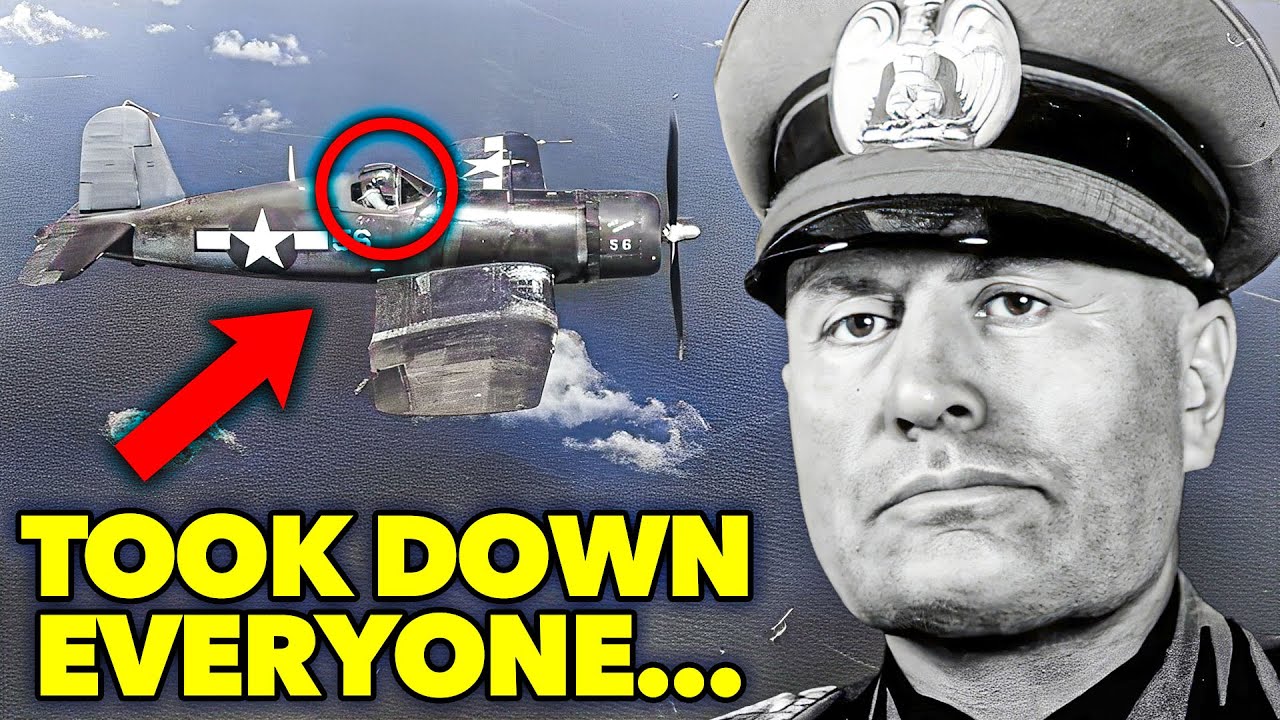
What they could not imagine was that across the sea, a very different kind of fighter, faster, heavier, and far more rugged, was about to enter the same airspace. The F4U Corsair was unlike anything Italian pilots had seen before. Nicknamed the bent-wing bird for its distinctive inverted gull wing, it was powered by the massive Pratt & Whitney R-2800 Double Wasp engine. Delivering over 2,000 horsepower, it pushed the Corsair to speeds above 400 mph, giving it a blistering advantage over most Axis fighters it encountered.
Armed with six . 50 caliber Browning machine guns and capable of carrying bombs or rockets, it was not just a dogfighter. It was a multi-role strike aircraft that could dominate both the skies and the battlefield below. At first, many Italian pilots underestimated it.
Their confidence in the Macchi C. 202 and C. 205 Veltro was not misplaced. Those planes had proven capable of dueling British Spitfires and American P-38 Lightnings.
The Folgore had even earned the respect of Allied pilots for its agility and sleek design. Surely, they thought, this new American machine would be just another adversary to match with skillful maneuvering. But the Corsair fought differently. Italian fighters were designed to excel in tight turning battles, relying on agility and pilot finesse.
The Corsair flipped the script. It did not need to turn tightly to win. It could climb away with ease, dive faster than anything the Italians had in service, and strike with devastating firepower before pulling out of range. Italian tactics that once worked against bombers or less powerful Allied fighters suddenly collapsed.
The Corsair’s ruggedness was another shock. Italian fighters were elegant but fragile, built for performance over protection. In contrast, the Corsair could absorb punishment and still keep flying. Italian pilots who scored hits often watched in disbelief as the American aircraft powered on unfazed, its heavy frame shrugging off damage that would have crippled a Veltro or Folgore.
For Italy’s aviators, the Corsair was more than just another opponent. It was a glimpse of the industrial and technological weight America could bring to bear. The summer of 1943 brought one of the most critical campaigns of World War II, Operation Husky, the Allied invasion of Sicily. For the Italian Air Force, this was a desperate chance to defend their homeland from an unstoppable tide.
Pilots scrambled from airfields at Gerbini, Palermo, and Catania, climbing into their Macchi C. 205 Veltros and C. 202 Folgores, determined to strike back against the incoming waves of American and British aircraft. They had faced tough opponents before, but battles they at least understood.
Then the Corsairs appeared, flying in from Allied carriers stationed south of Sicily. The bent-wing fighters arrived in escort formations alongside American bombers. At first, Italian pilots mistook them for yet another American design they had not seen before. But the truth became clear the moment the dogfights began.
The Corsair could dictate the fight in ways the Italians had never experienced. When Veltro pilots tried to climb for altitude, the Corsair surged higher, leaving them struggling below. When Italians attempted to dive away, the Corsair followed with terrifying speed, its massive frame stable even at velocities that pushed Italian airframes to their limits. The Macchi’s strength, tight turns, and agility at medium altitudes meant little when the Corsair refused to turn at all.
It struck from above, fired with six heavy machine guns, and was gone before the Italians could counter. Reports from surviving Italian pilots described the shock. The Veltro had been their pride, a match they believed could fight Spitfires evenly. Yet against the Corsair, its 399 mph top speed felt inadequate, its light armor a fatal weakness.
Italian ground crews waiting anxiously for their squadrons to return counted fewer aircraft landing after each sortie. Those who did return often spoke in disbelief. It was too fast, too strong. It did not fight like the others.
For the Allies, the battles over Sicily proved the Corsair’s worth outside the Pacific. For the Italians, they were a brutal awakening. The fighter they once thought invincible had met a rival that could outfly, outgun, and outlast it. And worse still, this was only the beginning of what Italy’s pilots would face as the Allies pushed north onto the Italian mainland.
The tactical differences were stark. The Macchi C. 202 and C. 205 were finely tuned machines, fast and agile in turning duels, especially at low and medium altitudes.
Italian pilots relied on tight loops and climbing spirals to force their enemies into contests of pure maneuverability. Against Spitfires or P-40s, this often worked. But the Corsair refused to be drawn into horizontal turns. Instead, it fought vertically, using its monstrous 2,000 horsepower engine to climb faster, dive harder, and accelerate away at will.
Italian pilots who tried to follow discovered their engines straining and their wings rattling, while the Corsair simply vanished above them. Speed was another decisive factor. The C. 205 Veltro could hit nearly 399 mph, but the Corsair could top 415 mph in level flight and exceed that in a dive.
At those speeds, Italian fighters reached their structural limits, while the Corsair’s rugged airframe held together with ease. This dive advantage meant American pilots dictated when to engage and when to break off. Italians were left reacting, always a step behind. Then there was firepower.
Italian fighters often carried a pair of 20 mm cannons and two machine guns, respectable but light compared to the Corsair’s six . 50 caliber Brownings. The Corsair’s guns could shred through thin Italian airframes in seconds, often leaving little chance for survival. And even if the Italians scored hits, the Corsair’s heavy armor and self-sealing fuel tanks let it shrug off damage that would have destroyed a Macchi.
Perhaps the greatest difference, however, was industrial. Italy could only build a few hundred of its best fighters, and fuel shortages limited how much time pilots could spend training. The United States, by contrast, churned out thousands of Corsairs and trained its pilots relentlessly. Every dogfight was not just one plane against another.
It was one nation’s dwindling resources against the full weight of American industry. The Italians had built fighters to duel on equal terms. The Corsair was not interested in equal terms. It was built to dominate.
And in every measurable way, it did. For the Italian pilots, the first encounters with the F4U Corsair were more than just tactical defeats. They were psychological blows that cut deep into their confidence. These men had spent years honing their skills in aircraft designed for agility and finesse.
They had fought duels against British Spitfires and American P-40s where skill and timing still mattered. But when the Corsair appeared, many realized within minutes that their familiar tactics were useless. Imagine being strapped into the cockpit of a Macchi C. 205 Veltro, once considered a marvel of Italian engineering.
You spot the American fighter above you and climb to meet it, expecting a head-on contest of speed and maneuver. But the Corsair roars past, diving like a hawk, firing . 50 caliber guns that light up the sky, then vanishes in a steep climb your engine cannot match. The fight is over before it has even begun.
Italian pilots described this experience as bewildering. An opponent that fought on its own terms, not theirs. The shock spread quickly through squadrons. In ready rooms, young recruits whispered about the bent-wing monster that could outclimb and outgun anything Italy had in the air.
Veteran pilots tried to reassure them, insisting that courage and discipline could still carry the day. But even the veterans knew the truth. Skill could only go so far when the enemy had a machine this powerful. Worse still, losses began to climb.
Each mission saw fewer aircraft return, and those who did often came back with stories of near misses, shredded wings, or watching comrades disappear in fireballs. Italian morale, already fragile after years of attrition and shortages, began to crack. The once proud Regia Aeronautica found itself outclassed in every measurable way, and pilots who had once flown with swagger now entered combat with grim resignation. The Corsair had done more than win dogfights.
It had stolen belief. By the summer of 1943, Italian pilots were not the only ones feeling the impact of the Corsair. Designed as a carrier-borne strike fighter, the F4U could carry bombs, rockets, and even auxiliary fuel tanks, transforming it into a versatile weapon that struck fear into Italy’s ground and naval forces alike. When Corsairs swept in low over Sicily or southern Italy, their silhouette was unmistakable.
The bent wings, the growl of the Double Wasp engine, and the chatter of six heavy Brownings tearing across the landscape. Italian soldiers on the ground, already battered by Allied artillery and bombing campaigns, now faced strafing runs that ripped apart convoys, rail lines, and supply depots. A single pass from a Corsair could shred trucks, destroy communications, and scatter infantry in panic. Naval crews were no safer.
The Mediterranean, once patrolled with confidence by Italy’s Regia Marina, became increasingly hostile. Corsairs swooped in against small vessels, strafing decks and forcing sailors to abandon ship. When fitted with rockets or bombs, the Corsair could hit landing craft, harass destroyers, and deny the Italians freedom of movement along their own coasts. The aircraft’s rugged design allowed it to fly low and absorb punishment from ground fire, something fragile Italian planes could never risk.
For the Regia Aeronautica, this was another devastating shift. Their fighters had been designed primarily for air superiority, not ground attack. Watching the Corsair effortlessly switch roles, dogfighting at altitude one mission, blasting supply lines the next, was demoralizing. The Italian command struggled to respond.
Diverting fighters to defend ground targets only led to more losses against a machine that outperformed them in the sky. The Corsair’s versatility highlighted the larger truth. America could build aircraft that were not just specialized, but dominant across multiple roles. American aviators flying the bent-wing fighter saw the air war from an entirely different angle.
To them, the battles over Sicily and the Italian mainland were not duels of equals. They were confirmation that the Corsair had given them a decisive edge. Corsair pilots often remarked on how quickly Italian fighters folded under pressure. The Macchi C.
202 and C. 205 were fast and agile, but they lacked the durability and firepower that American planes brought into combat. They came at you sharp, but you could feel their planes straining. One Navy pilot later recalled, “If you got a burst on them, they just came apart.
” Allied reports noted that Italian aircraft were beautifully engineered, but often too lightly built to withstand punishment. A two-second burst from . 50 caliber Brownings could rip through a Veltro’s frame, shredding its wings or igniting its fuel tanks. Another point Corsair pilots noticed was tactical predictability.
Italian aviators relied heavily on turning fights, banking into spirals, and hoping to trap opponents in close-quarters duels. Against early P-40s or Hurricanes, this had worked, but Corsair pilots refused to be baited. They used their superior climb rate and dive speed to break away, then re-enter the fight from above, firing in devastating passes before vanishing back into the clouds. The Americans called it boom and zoom.
The Italians called it impossible to counter. What impressed Allied pilots most was not just the Corsair’s raw performance. It was how rugged it felt. Many pilots returned from missions with bullet holes peppering their wings, hydraulic fluid leaking, or chunks of control surfaces missing.
Yet the Corsair kept flying, bringing its pilots home. Italian fighters rarely enjoyed the same luxury. Even small hits often proved fatal. By late 1943, the Regia Aeronautica was unraveling.
The arrival of the Corsair had only accelerated a decline already set in motion by years of attrition, shortages, and the overwhelming industrial might of the Allies. Italian pilots still climbed into their cockpits with courage, but the odds they faced grew more impossible with each passing month. Fuel was the most immediate problem. Italy’s dwindling petroleum reserves meant training flights were slashed to a fraction of what pilots needed.
Recruits often took to the skies with only the bare minimum of hours, far less than their Allied counterparts. Facing a Corsair squadron with pilots who had spent hundreds of hours mastering their machines was a nightmare scenario. Veteran Italian aces tried to make up the difference with experience. But even they admitted that the gap in preparation was becoming insurmountable.
Then came the issue of production. Only a few hundred Macchi C. 205 Veltros were ever built, and of those, many never reached full combat readiness due to shortages of spare parts. Engines ran on poor-quality fuel that reduced performance, and maintenance crews worked with limited supplies, often cannibalizing one aircraft just to keep another in the air.
The Corsair, by contrast, rolled off American assembly lines in the thousands, with logistics chains that ensured constant resupply. Every Italian loss was a crisis. Every American loss was replaced within days. Morale followed the same downward spiral.
Squadrons that had once taken pride in dueling the RAF or the USAAF now found themselves steadily shrinking. Surviving pilots spoke of returning from missions to find empty hangars, comrades gone, and replacements nowhere to be found. Ground crews whispered about Allied planes that seemed indestructible, while Italian aircraft were fragile and few. Even the civilian population, watching dogfights overhead, could see the imbalance.
By the time Italy signed its armistice in September 1943, its air force was a shadow of the one that had entered the war. The Corsair had not defeated Italy alone, but it had become a symbol of Allied dominance, an aircraft that exposed the limits of Italian aviation and the crumbling foundation beneath it. For many pilots, the bent-wing bird was the face of inevitability, proof that the skies no longer belonged to them. When the guns finally fell silent, the memory of the F4U Corsair lingered with Italian pilots long after World War II ended.
For them, the bent-wing fighter had been more than a new enemy. It was a brutal reminder of how far the technological gap had widened. The Macchi C. 202 and C.
205 had been elegant, finely tuned machines. But in the face of the Corsair’s raw speed, firepower, and rugged design, they seemed suddenly fragile, almost outdated the moment they took off. Veterans later admitted that seeing Corsairs in the sky was the moment they realized the war was slipping beyond their reach. The Corsair itself went on to legend.
Its reputation was sealed in the Pacific, where it became a nightmare for Japanese pilots, but its brief and decisive presence in the Mediterranean proved it was more than just a carrier fighter. It was a symbol of American industrial and tactical superiority. Italian squadrons had fought with courage, but courage alone could not replace dwindling fuel supplies, shattered production lines, and aircraft that were built in the hundreds rather than the thousands. For the Allies, the Corsair was proof that their approach to warfare, marrying industrial scale with cutting-edge design, could dominate every theater of combat.
For Italy, it was the painful realization that even their best fighters, flown by their most skilled aces, could not turn back the tide. The shock waves spread far beyond dogfights. Morale collapsed. Tactics became obsolete.
And the myth of Italian air invincibility, once bolstered by victories in Spain and early in the war, was gone forever. The legacy of those encounters is not just about machines. It is about the men who flew them. Young Italians who strapped into Macchis with pride were forced to confront an enemy that stripped away their confidence.
American pilots, meanwhile, left those battles convinced their aircraft was unmatched. Together, they illustrated one of the harshest lessons of World War II, that air wars are not won by bravery alone, but by technology, resources, and the ability to adapt. The Corsair did not just defeat Italian planes.
It reshaped the very way pilots on both sides understood the future of air combat.
