The gate on Charing Cross Road in Holmby Hills never looked like a gate to a house. It looked like a border crossing into a myth. Black iron curved into old shapes, hedges rose like walls, and the driveway disappeared into trees trained to hide what the city most wanted to imagine. Outside, it was one of the quietest corners of Los Angeles, the kind of quiet money buys in distance.
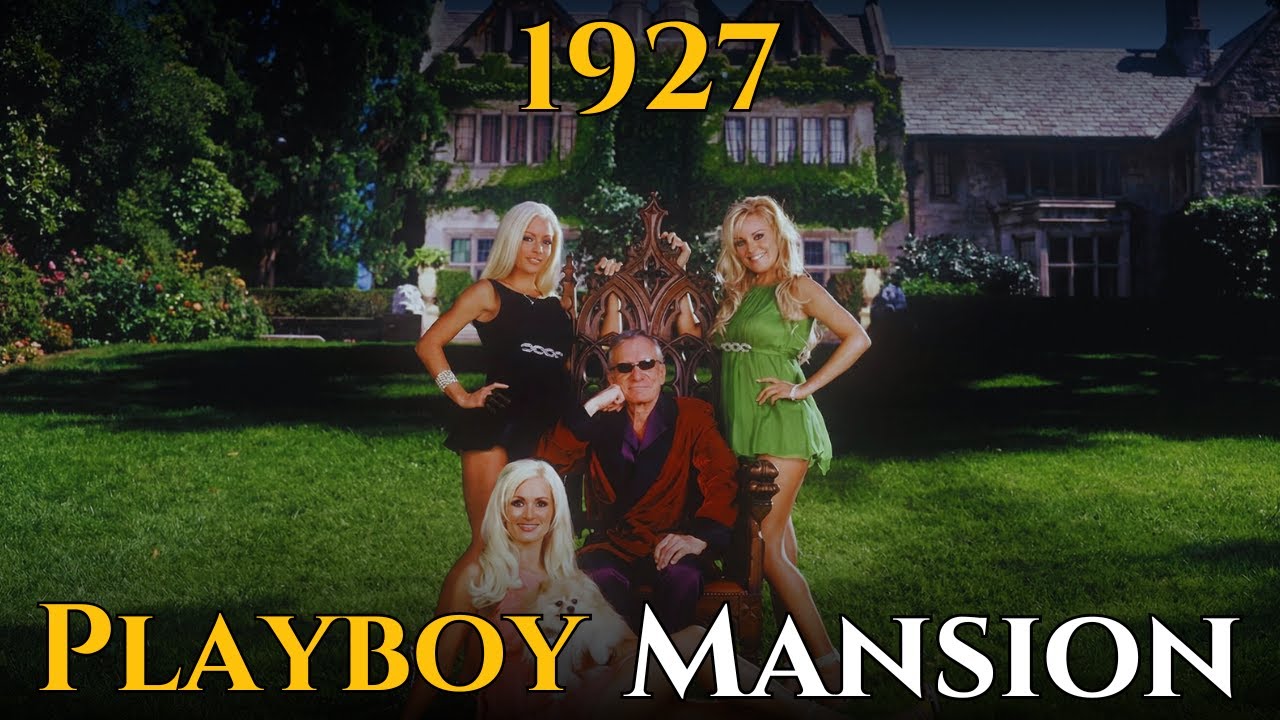
Inside, for decades, it was designed to feel like a permanent night where nobody had to leave, where the party was not a party but a world, where any hallway could become a stage and any smile proof that a fantasy was real. The mansion did not begin as a Playboy artifact. It was built in the late 1920s in the Tudor Revival style, with steep roof lines and decorative details meant to suggest European permanence. Los Angeles was becoming a factory of myths, and the wealthy wanted architecture that implied tradition rather than new money.
For decades, the house passed through owners behind gates and hedges, maintained by staff, living a private life. The world did not attach meaning to its rooms. Then, in the early 1970s, a single purchase changed the building’s destiny. Hugh Hefner did not simply buy a home.
He bought a stage, a symbol, a machine where he could blur the line between business and private life so completely that the public could no longer tell which they were watching. Once that line disappeared, the mansion became something more powerful than property. It became an engine for reputation. Hefner’s story was often presented as a fairy tale of rebellion, a strict Midwestern upbringing followed by a liberation of pleasure and sophistication.
But rebellion can also be a brand, a way to justify control while calling it freedom. When he launched Playboy in the 1950s, he did not just sell nude photography. He sold a lifestyle story, an identity wrapped in jazz, cocktails, and clever writing framed as adult sophistication. The magazine carried interviews and cultural commentary, and it wrapped everything in the promise that a man could be both intellectual and indulgent, that he could be refined while consuming women as part of the lifestyle package.
That framing created a shield. It allowed Hefner to position himself as a cultural progressive even when critics argued the business relied on objectification. And when your private life becomes marketing, your private home becomes a set. That is why the mansion mattered.
Playboy needed a physical place where the fantasy could be staged, photographed, and repeated until it became truth in the public mind. When Hefner acquired the Holmby Hills estate in 1971, Los Angeles had become the capital of celebrity visibility, and the culture was shifting. Old moral rules were weakening, and new freedoms were being sold as modern identity. Hefner understood that the new era would be dominated not by people who simply had power, but by people who knew how to package power as entertainment.
The mansion became that package. It was not just where he lived. It was where the brand lived, where the myth could be filmed, photographed, and whispered about until it spread like a rumor that never dies. From the outside, the mansion offered a simple promise.
If you can get inside, you belong to something. Most exclusive spaces are hidden. The Playboy Mansion was famous for being hidden, which is a different kind of power. It told the public, You cannot come in, but you can watch us from the outside.
In its early years, the mansion became a magnet for the culture’s biggest names. Celebrities came because being seen there signaled membership in the inner circle of modern fame. Musicians came because the night was an industry in itself. Politicians and business figures came because Playboy offered public coolness and media access that could soften an image.
Models and hopefuls came because the mansion looked like a gateway, a shortcut to fame, a place where one night might turn into a career. And Hefner sat at the center of it all because that is what the mansion was built to do. Even the most chaotic-looking party is structured. The mansion ran on schedules, staff, security, and rules because a fantasy that large cannot survive on spontaneity alone.
The lawns had to be perfect. The rooms had to be reset. The gate had to be controlled. The guest list had to be curated.
Someone had to decide who belonged and who did not. Someone had to ensure the right people were seen and the wrong stories stayed inside. The pool was not just a pool. It was a stage where bodies could be photographed in a way that made pleasure look like status.
The grotto was not just a water feature. It was architecture designed to imply secrecy, a private cave inside a private estate. The dark rooms with old furniture suggested tradition, which made indulgence feel legitimate. If the house looks old and grand, the lifestyle inside can be framed as sophisticated rather than desperate.
This is how the mansion built its spell. It made excess look elegant, indulgence look like culture, and pleasure look like a philosophy. And because it was a physical place, the fantasy gained something magazines could not provide. People could walk through it, feel the air, smell the pool, and believe they were inside something real.
Over time, the mansion’s parties became an institution. They were not random nights but rituals, annual events the entertainment world expected. Invitations became currency. Being photographed at the gate became proof you mattered.
And when a place becomes a status symbol, people will do strange things to keep access. They will ignore discomfort, downplay what they saw, and tell themselves it was normal because admitting it was not normal would mean admitting they benefited from something darker than they wanted to believe. The mansion also became a workplace. Security controlled movement not just for safety but for control of the narrative.
Assistants managed schedules. Housekeepers cleaned the evidence of nights the brand wanted to present as effortless. In any large estate, this labor exists. What made the mansion different was that the labor served a myth sold to the entire world.
The staff were not only maintaining a house. They were maintaining an icon. And icons require secrecy. At the center sat Hefner himself, always framed as a relaxed host, a gentleman of pleasure, a man who seemed to have escaped the ordinary rules of aging and responsibility.
His robe became a uniform. His pipe became a prop. His persona made him feel timeless, as if he were not a businessman but a character, and characters are easier to defend than people. Hefner’s defenders pointed to Playboy’s interviews and political stances, to the brand’s role in challenging censorship.
Critics argued the opposite, that the brand’s sophistication was a disguise, a way to sell objectification with a better vocabulary. The mansion held both narratives at once, and that ambiguity was part of its power. But the darker story begins when you stop looking at the mansion as a party venue and start looking at it as a system. Systems create roles.
In the public story, women at the mansion were playmates, girlfriends, glamorous guests. In the private story described by multiple former girlfriends and staff across different eras, the house had rules, curfews, expectations, rewards, punishments, and a hierarchy that determined who was close to the center and who was not. The details vary depending on the era and who is telling the story, but the shape of the system remains consistent in many accounts. If you wanted access, you followed the rules.
A fantasy sells freedom, but freedom has no curfew. A fantasy sells choice, but choice looks different when one person holds the money, the status, the gate, and the narrative. A fantasy sells fun, but fun becomes complicated when the cost of leaving is losing your place in a world that promised to change your life. In the early 2000s, the mansion’s image shifted again when reality television brought it into living rooms.
The show framed the mansion as bright and quirky, filled with shopping trips, themed parties, domestic comedy, and a strange kind of family life. It was edited to feel light, and that lightness was not accidental. Reality television is not raw reality. It is a narrative shaped for emotion.
The mansion’s public narrative needed to remain charming because charm is the coating that makes people swallow complexity. The darker implications were still there even in the bright scenes. A household structured around a much older man and much younger women is an imbalance even if everyone smiles for the camera. Later, as some former insiders spoke publicly, the bright narrative began to crack.
Accounts described curfews and allowance systems, expectations about appearance and participation, and social dynamics that could feel competitive and isolating. Some described emotional manipulation and the way young women could be drawn in by the promise of glamour only to find their independence shrinking. The mansion’s darker reputation is also tied to the broader culture of Hollywood nightlife, where drugs and excess often live alongside fame. Some who attended mansion parties described a scene where substances were part of the environment, where boundaries softened, where consent and memory could become complicated.
The point is not that a party had drugs. Plenty of parties do. The point is that a party house that depends on secrecy and imbalance creates a setting where harm can hide more easily, because the environment itself discourages accountability. When stories surfaced that challenged the myth, the defense often sounded the same.
People said it was a different era. People said everyone chose to be there. People said it was consensual. Those defenses can be true for some experiences and still incomplete for others.
Consent is not just a word. It depends on context, on power, on whether someone can say no without losing their stability, their home, their social circle, their access to opportunity. The mansion’s structure created a context where the consequences of saying no could be huge. The Playboy brand itself began to weaken over the decades.
Print media declined. The internet turned what Playboy once sold as rare into something common. Cultural values shifted, and conversations about exploitation became louder. What once looked daring began to look outdated.
The mansion did not change overnight. The culture changed, and that change revealed how long a myth can survive when the audience wants it to survive. The most public sign that the mansion’s era was ending came in the 2010s, when the property was sold. Yet Hefner remained living there under an arrangement that allowed him to stay for life.
The buyer did not just buy land and walls. He bought a symbol, and one of the rules of that symbol was that the icon could not be removed while he was still alive. When Hefner died in 2017, the mansion entered a new phase. The public reaction split into familiar camps.
Some mourned a figure they saw as a champion of sexual openness and free expression. Some celebrated what they viewed as the end of a predatory era. Many felt a more complicated mix of fascination and discomfort, because icons rarely die cleanly. After his death, the story grew louder.
Former insiders spoke more. Documentaries explored the darker allegations. The mansion became a subject in broader conversations about power and exploitation in entertainment industries. And the reason it remains so compelling is that it sits at an intersection modern audiences cannot resist: a glamorous surface with a hidden underside, a well-known symbol with secrets, a fantasy that now looks like a case study in how control can be disguised as pleasure.
The mansion did not simply offer pleasure. It offered proximity to power, and proximity to power can be intoxicating enough to make people accept conditions they never would have accepted in a normal relationship. The mansion’s darker stories also include the way it normalized a particular imbalance. A very powerful older man surrounded by young women became the brand’s signature image.
When a brand makes imbalance look normal, it does not just reflect culture. It shapes culture. The mansion shaped what people thought was glamorous, what they thought was acceptable, what they thought a powerful man could look like. It normalized a certain image of male entitlement, and it did so with a smile.
It told men, This is what success looks like. It told women, This is what being chosen looks like. It told the public, This is what modern life can be. When you tell a society that a private kingdom is the reward for success, you create a world where people chase access rather than building freedom.
There were nights at the mansion when famous people likely had genuine fun. It is possible for a place to be fun and harmful at the same time. That is what makes the story unsettling. If the mansion were purely cruel, it would be easy to reject.
If it were purely harmless, it would be easy to celebrate. It was neither. The mansion’s darkness is not a single act. It is the atmosphere created when glamour, secrecy, and imbalance combine.
The final picture of the mansion, when all the myths are peeled back, is not the pool crowded with bodies. It is the driveway after the party, empty and still. It is the gate closed, the perfect lawn, the house sitting in silence, holding decades of laughter and bargaining and pressure and secrets in its walls. The gate is still there.
The hedges still hide the view. But the cultural spell is broken enough that you can finally ask the question that would have sounded strange in the mansion’s peak years. What really happened in that house when the cameras stopped, when the guests left, when the fantasy demanded its price and the people inside had to live with the rules the public never saw? Because the truth about the Playboy Mansion is that it was never only a party.
It was a system. It was a set. It was a brand. It was a private court with a public audience, a place where desire was packaged as culture and glamour could be used to soften control.
It is gone as a dominant cultural force now, but the pattern it represents is still alive in every private space where power hides behind entertainment and every myth that asks you not to look too closely at the cost.
