In 1971, sixty-one percent of American adults belonged to the middle class—the highest share ever recorded. Today, that number is about fifty percent. A man who came across his late father’s 1996 tax return saw the entire story on a single line: $42,000 a year. On that income, his father purchased a three-bedroom house in a good school district, raised two children, drove a used Buick for eleven years, paid off the mortgage in twenty, and set a little aside each month.
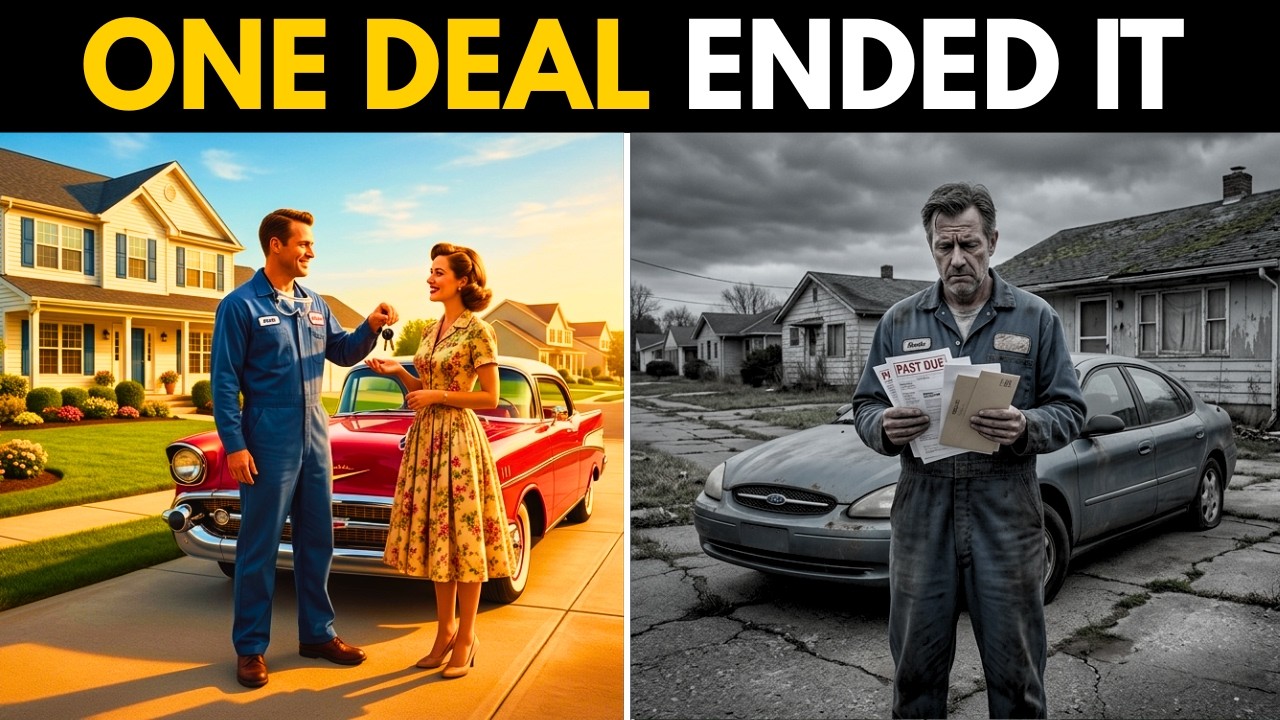
He never once lay awake worrying about keeping the lights on. That was a comfortable middle-class existence. The son now earns three times what his father did. A friend of his, bringing in $95,000 a year, shares a two-bedroom apartment with a roommate at age thirty-nine.
A couple he knows, with a combined income of $160,000, has put off having children for four consecutive years because they cannot manage daycare and a mortgage at the same time. If the father were starting out today on the same salary adjusted for inflation, he would not qualify for the mortgage on the house he already paid off. The life he built, in the very building where he built it, would be beyond his reach. To grasp what has been lost, consider what ordinary family life actually looked like in the 1960s and 1970s.
A new Chevrolet Impala cost around $3,200. Household income hovered between $10,000 and $18,000 throughout the decade. A new home went for roughly $30,000—a price-to-income ratio of about two to one. Two years of work could buy a house.
That was the arithmetic. One person recalled growing up in that era. His father was a college professor, a solid income, yet the family never had air conditioning. They did not get a second car until high school.
They never owned a color television until he left for college. They never took an overseas vacation. Dining out happened only on special occasions. The crucial fact about that era was not how high the standard of living was, but that it was rising—and that made everything seem possible.
Families did not spend the way they do now. Going to a nice restaurant was something wealthy people did. Even ordering pizza was an event. Kitchens were small and functional.
Basements had low ceilings. Many homes were heated by a single space heater in the living room. Vacations meant piling into a station wagon with a cooler of sandwiches, chips, and Kool-Aid. Motels cost twenty to thirty dollars a night.
Fast food was a treat, not a routine. Camping was the budget vacation of the decade: a tent, a Coleman stove, sleeping bags, folding chairs, mosquito spray, and cans of SpaghettiOs. Kids had paper routes and mowed lawns for pocket change. Families gathered around one television for shared evening rituals.
Nobody touched the dials without asking first. You did not need much, and that was the point. The essentials were affordable. Job security was solid; it was common to spend an entire career with one employer.
The possibility of moving up was real. Companies invested in their workers. Unions negotiated fair wages. Productivity gains were shared.
The CEO-to-worker pay ratio stood at twenty-one to one. Manufacturing employed 19.5 million Americans. Towns were built around a single factory that sustained entire communities for generations.
A steelworker could buy a home, raise a family, put his children through a state college on a few hundred dollars a year in tuition, and retire at sixty with a full pension. For about twenty-five years, the machine worked. Productivity went up. Wages went up.
From 1948 to 1973, productivity and wages rose in lockstep, both roughly doubling. If you made more for the company, you got paid more. After 1973, they divorced. Productivity kept climbing—up 64.
7 percent from 1979 to 2019. Hourly compensation rose just 17.3 percent in the same period. Workers kept producing more.
They just stopped getting paid for it. That split did not happen by accident. It had a blueprint. On August 23, 1971, a corporate lawyer named Lewis Powell sat down and wrote a memo.
Addressed to the United States Chamber of Commerce and marked confidential, it was never meant to be public. Powell argued that the American free enterprise system was, in his words, under broad attack from labor unions, consumer advocates, regulators, and universities. He laid out a step-by-step plan for a coordinated corporate counteroffensive—not just in business, but in media, the courts, schools, and politics. One memo became the playbook for everything that followed.
Two months later, Richard Nixon nominated Powell to the Supreme Court, and he was confirmed. That same month, Nixon made another decision that would reshape the economy for the next fifty years: he suspended the dollar’s convertibility to gold. The Bretton Woods system was over. Fiscal policy was untethered from any physical constraint.
The door to deficit spending, financialization, and the slow migration of the economy from making things to trading things swung wide open. The memo was the match, but the fire needed fuel, and in the 1980s it got everything it needed. Ronald Reagan took office in January 1981, and within months the rules that had built the middle class began to be systematically dismantled. The top marginal tax rate was slashed from 70 percent to 28 percent.
Corporate tax rates dropped. The theory was simple: cut taxes at the top, and wealth would trickle down. It did not. In 1978, the top one percent held seven percent of the nation’s wealth.
Today, they hold 38 percent. The money did not trickle; it flooded upward. Then came the unions. In August 1981, the Professional Air Traffic Controllers Organization went on strike.
Their members were working mandatory overtime in high-stress conditions and wanted better pay, a shorter work week, and updated equipment. Reagan gave them forty-eight hours on national television, then fired them all—11,345 workers, gone, with lifetime bans from federal employment. Within five years, strike activity collapsed. Union membership plummeted from 35 percent to roughly ten percent.
It has never recovered. Reagan did not just fire air traffic controllers; he fired the entire idea that workers had leverage. Then came deregulation. Banking rules loosened.
Wall Street grew. The economy’s center of gravity shifted from making things to trading things. CEO pay attached itself to stock price, creating every incentive to cut workers, offshore production, and chase quarterly returns. The idea that a corporation owed something to its workers, its community, its town was replaced by a single metric: shareholder value.
The nineties enforced those rules with one deal that sent jobs overseas and left entire towns to die. NAFTA was signed in 1993, sold with grand promises of 200,000 new American jobs a year. Instead, it gave corporations a green light to move production to countries with cheap labor and sell the products back into the United States. After NAFTA, 62 percent of union drives faced employer threats to relocate abroad.
Some companies literally loaded machinery onto trucks during wage negotiations. The message was clear: the equipment is headed for Mexico. Then the factories started closing—not one or two, but thousands. In Danville, Virginia, the Dan River Mill had operated since 1882.
Four generations of the same families put in time there. In 1993, it had 6,500 workers on the payroll. Layoffs started the moment NAFTA took effect. By 2001, not a single job remained.
In Celina, Tennessee—population 1,400—an OshKosh B’gosh plant was the engine keeping the whole town alive. When NAFTA closed it, everything else went down with it: the video store, the diner, the little shops. Up in Greenville, Michigan, Electrolux ran a factory with 2,700 employees. The company shut it down and opened another in Juarez, Mexico, cutting labor costs by a factor of ten.
One worker, the third generation of her family to labor there, was handed $1,500 in severance. That job, she said, had been her way out—and losing it more or less wrecked her. Manufacturing employment dropped from 19.5 million to 11.
5 million. Then China entered the World Trade Organization, and the losses picked up speed. Americans clung to their standard of living the only way still open to them: borrowing. Credit cards, student loans, home equity lines.
The middle-class way of life didn’t vanish—it was bought on credit and paid for later. In 1960, 68 of every 100 Americans could afford a home. By 2019, just 43 could. Wages rose fourfold, but houses rose tenfold, cars ninefold, gas ninefold, bread elevenfold.
What the middle class lost wasn’t only money. It lost the bargain: the belief that hard work and following the rules would leave you fine, and your children better off than you. A factory job meant more than a paycheck—it meant who you were, your community, your purpose. When the plants shut, men lost more than their income.
They lost the reason to get out of bed. The towns left behind have never recovered. Churches, bowling leagues, Little League—all of it hung on one thing: steady jobs. Once those were gone, the social fabric came apart entirely.
The house from the start of this story, bought for $127,000 on a $42,000 salary, is now assessed at $385,000. The house still stands. The life it stood for does not. Part of the shrinkage is people moving up—the upper middle class has almost doubled.
Technology has made life better in ways nobody in the 1970s could have dreamed of. But try telling any family working two jobs to afford what one job paid for in 1970 that this feels like progress. Consider that factory worker in 1971: the house, the car, the pension waiting at the end. He had no idea what was coming.
Not one of them did. They followed every rule, and the rules were rewritten beneath their feet. None of it was inevitable. It was a string of decisions made by those holding power, at the cost of those who held none.
America built the mightiest middle class the world had ever known—and then struck a deal that let the whole thing slip away.
