On November 28, 2002, at three in the afternoon, a wheel builder named Barry Wheat completed the final bicycle component ever produced in Nottingham. It was no celebrated racer, no sleek chopper. It was a 20-inch wheel for a child’s bike, a Little Max, and with it ended more than a hundred years of British bicycle manufacturing. No television cameras were there to record it.
A reporter from the local evening paper watched the last 280 employees wander off toward a pub crawl through the streets of Radford, and observed that the vast factory now resembled the Marie Celeste, stripped of its thousands, going silent in the November darkness. The site that died that day had once been the biggest bicycle factory the world had ever known, a self-sufficient industrial town on Nottingham’s western fringe where 7,000 workers had built machines that carried the Raleigh name to 140 countries. The story had started with a dying man. Frank Bowden, born in Exeter in 1848, had grown rich on the Hong Kong stock market, but the strain had destroyed his health.
By his late thirties he was a ruin, and the doctors gave him roughly six months to live. They recommended rest and fresh air, and, during a visit to the spa town of Harrogate, urged him to take up cycling. The bicycle of the late 1880s was still a faintly disreputable contraption, hardly the machine of a dying financier. But Bowden had spotted a safety bicycle in a London shop window, two equal wheels, chain-driven, stamped with the name of the street where it had been built: Raleigh.
He bought one. Rather than gently pedaling about a spa town, he rode through France, Italy, and back across England. The man given six months rode himself back to health, and somewhere along those miles he became convinced that this simple machine would transform how ordinary people lived. In the autumn of 1888 he set out to find the workshop that had built it.
He discovered a tiny operation on Raleigh Street, a dozen men producing three bicycles a week. Bowden had money, and he had certainty. In December 1888 he founded the Raleigh Cycle Company, and within a few years he had taken full control. His timing was remarkable.
The 1890s brought a national bicycle boom, a sudden craving for a machine that did not eat, did not tire, and gave ordinary people a freedom they had never experienced. Bowden grasped that the future belonged not to the man who made the finest bicycle by hand, but to the man who could make a good bicycle by the thousand and stand behind it. He borrowed, gambled on scale, and by 1896 the little workshop was employing some 850 people and producing 30,000 cycles a year, already described as the largest bicycle maker in the world. Then came the invention that made Raleigh unstoppable.
In 1902 the Sturmey-Archer three-speed hub gear appeared, a mechanism sealed neatly inside the rear wheel that let a rider change gear without external chains and cogs. Over 80 million of them would be sold around the world, and Raleigh made everything itself, from raw steel to finished bicycle, under its own roofs. By 1913 it was once again unambiguously the largest bicycle manufacturer on the planet, and when the world went to war, the factory turned to munitions, as British factories did. It survived the First World War, survived the depression that broke half its rivals under Frank’s son Harold, and by 1938 was turning out nearly half a million bicycles a year.
The best was still to come. When the Second War ended, a battered Britain found it still possessed the greatest bicycle factory that had ever existed, and the world was hungry for bicycles. In 1946 Raleigh accounted for 95 percent of all bicycles imported into the United States. In 1951 annual production passed one million machines, as much as 70 percent of them sent overseas.
The heartland of the empire was Africa, where the heavy, nearly indestructible Raleigh roadster held around 85 percent of the East African market. At home, the factory reshaped the city around it in ways that mattered beyond bicycles. When the Windrush generation brought Caribbean workers to Britain, Raleigh changed its hiring policy after local campaigning, becoming the largest employer of black workers in Nottingham, and for a generation of Caribbean families the Lenton works was where a life in Britain was built. In 1960 came the decision that looked like a crowning triumph.
The conglomerate Tube Investments bought Raleigh and folded into it the whole British Cycle Corporation, absorbing Phillips, Hercules, Norman, and Sun. Overnight, TI Raleigh controlled roughly 75 percent of the entire British bicycle market. There was nowhere left to climb. And that, precisely, was the danger.
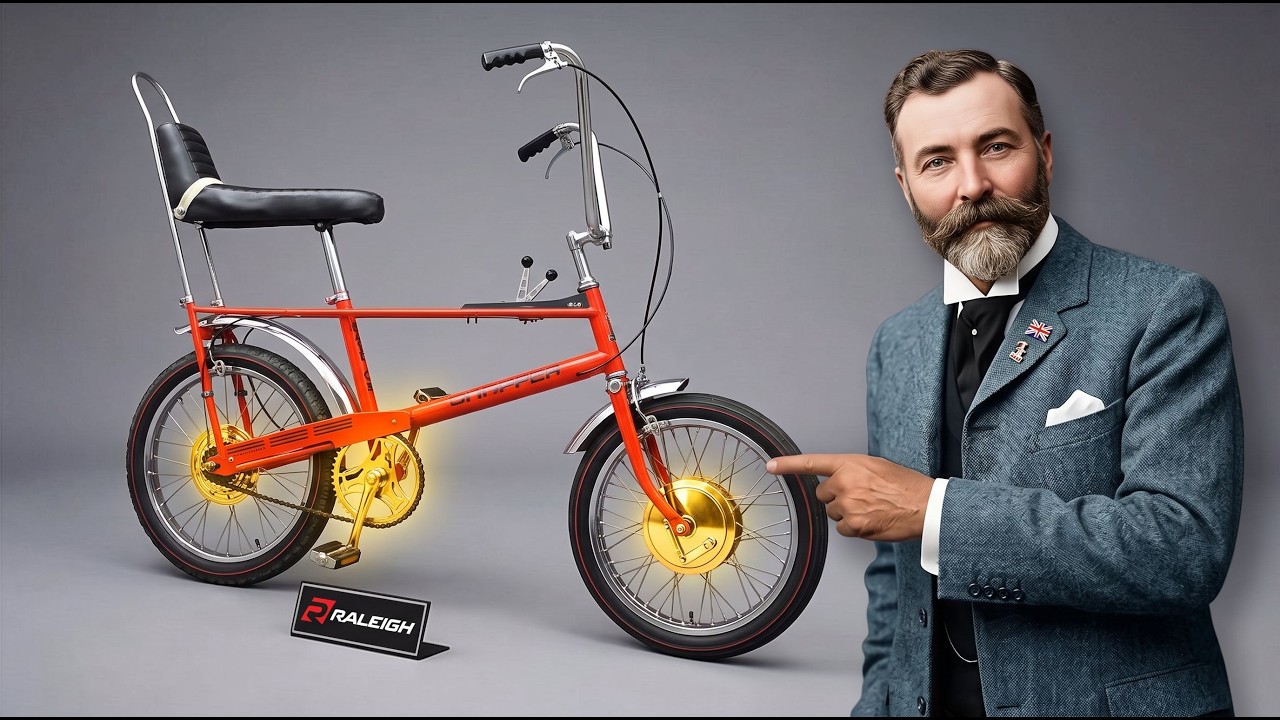
The 1970s brought the Chopper, a heavy, slightly impractical bicycle styled like a chopped American motorbike, and the most desirable object in Britain. It sold about a million and a half machines in the United Kingdom alone. Then came the Grifter and the Burner, which helped drive Raleigh back to roughly half the entire British market. In 1980 the TI Raleigh racing team won the Tour de France, and that TI Raleigh machine remains the only British-built bicycle ever to win it.
But the youth boom was a sugar rush, spectacular and short, and the shadows were already there. Between 1950 and 1962 British bicycle sales roughly halved, as the motor car took the working man off his bike and out of the factory gates. The newly independent nations of Africa and Asia raised tariff walls and wanted their own industries. And Tube Investments, the owner that had bought the company, declined to invest in it.
In 1973 Sturmey-Archer engineers designed a seven-speed hub, a working, ready successor to the greatest hub gear ever made. TI would not fund it. It sat in a drawer for more than twenty years, until the world had moved on and the makers who owned that ground were German and Japanese. By 1981, for the first time in Raleigh’s long history, imports of foreign bicycles into Britain overtook exports.
Under TI’s stewardship, Raleigh’s share of the British market fell from 75 percent to 36. In the hills of Marin County, California, in the mid-1970s, a handful of young men had been racing old balloon-tired clunkers down a mountain, burning the grease out of their hubs. Out of that came the mountain bike, and in 1981 a woman named Yvonne Rix, who had risen through Raleigh from secretary to the chief designer, came home from America certain that mountain bikes would come down off the hills and onto the streets. The board asked who needed mountain bikes in England, where there were few mountains.
She told them you did not need a four-wheel drive to drive in London either, and yet you saw plenty of Range Rovers in Chelsea. She was right. Raleigh did not launch a mountain bike in Britain until 1985, and it did not sell well. But the mountain bike refusal was not the single blow that felled the giant.
It was a sign of a business that no longer knew how to put its faith in tomorrow. Raleigh was late to the party, but that alone was not fatal. After the company changed hands in 1987, it plunged into mountain bikes and shifted more than three million of them. The real illness was older and slower to kill: long years under an owner who thought bicycles were dull, a seven-speed hub that was never built, a factory site sold off with no replacement secured, and a price no British worker could be paid little enough to match.
Ownership kept changing hands. Tube Investments sold Raleigh in 1987 to a company put together by a tax lawyer, and for a time it flourished, riding the mountain bike boom and swelling into the biggest cycle group in the world. But manufacturing was drifting eastward, first to Japan, then Taiwan, then China, and with every shift the price of a bicycle slipped a little lower. In 1999 the new owners sold the factory site to the University of Nottingham without first securing anywhere else to build bicycles.
That December, the frame-making machinery went under the auctioneer’s hammer. In December 2000 the assets and trademarks of Sturmey-Archer were sold off, and the finest name in British cycle engineering turned into a Taiwanese brand. In August 2001 Derby Cycle sought bankruptcy protection. A management buyout saved the name, and in 2012 it was purchased by the Dutch Accell Group, which still holds it.
The name lives on. The factory did not. The final hope had been a scheme to shift production to a new plant on allotment land at Bulwell. It was stopped in part by a small band of allotment holders who refused to surrender their ground, and in part by protected wildlife living on the site.
One local MP described it as the straw that broke the camel’s back. Another put it more truly: this was less a factory closure than a bereavement. The buildings were demolished in 2003. In their place rose the University of Nottingham’s Jubilee Campus, laid out around a long, winding lake.
Where 7,000 workers once streamed through the gates in the gray of a winter morning, undergraduates now walk a footbridge over ornamental water. The Howitt building, the handsome old headquarters, still remains, listed and protected, one lone fragment of the empire. The works themselves have vanished as if they had never existed. No chimney, no gate, no hooter to announce the shift.
A lake where the foundry once stood. What is left is memory, and the people who took the trouble to preserve it: the recorded interviews with the men and women who worked those lathes and laced those wheels, the voices of the Caribbean families who built their British lives inside those gates. The last thing the factory ever produced was a wheel for a child’s bicycle. A company that began with a dying man riding himself back to life ended with a small wheel made by hand for someone just learning to ride.
Frank Bowden had been told he had six months to live, and he built something that stood in Nottingham for 114 years. It was not murdered. It was outlived by the world that had made it a giant.
