The photograph showed a handsome couple with their son, but the boy’s hand was wrong. Dr. Marcus Webb adjusted his reading glasses and leaned closer to his computer screen on the gray November afternoon of 2024. As a historian specializing in the post-Civil War American South at Charleston College, he had examined thousands of late-nineteenth-century photographs.
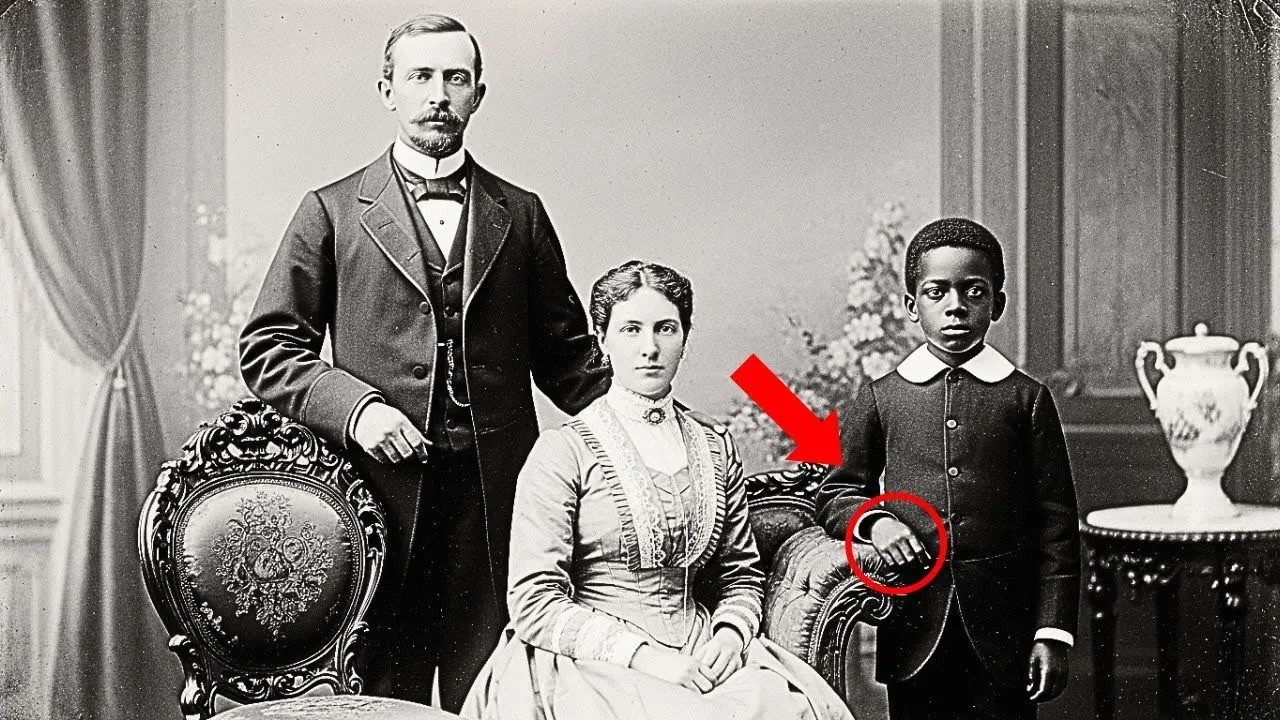
Most told familiar stories of that era: wealthy families shining in their finest clothes, stern-faced grandparents frozen in time by the limitations of early photographic techniques. This particular image had arrived three days earlier as part of a donation from the estate of Eleanor Whitmore, a 97-year-old Charleston resident who had died leaving behind decades of accumulated family documents and photographs. Marcus had been cataloguing the collection meticulously when this photograph caught his attention. The image showed an elegant parlor dating to about 1895, based on the furniture and decor.
A white couple in their forties sat in a formal arrangement, the man standing with his hand on an ornate chair, the woman seated gracefully beside him. Between them stood a Black boy who appeared to be about ten years old, wearing a fine suit with a crisp white collar. On the back of the photograph, in faded handwriting, were the words: “Mr. and Mrs.
Robert Whitmore with their son Thomas, Charleston, South Carolina, March 1895. ”
At first glance, the photograph appeared to be a family portrait, likely depicting the adoption of a child by a white family in an era when such arrangements were uncommon but not unheard of. Marcus had seen similar photographs before, although they were rare enough to warrant careful examination. But something about this image troubled him.
He could not identify what it was at first, just a nagging sense that something was not right. The boy’s expression was carefully neutral, almost expressionless. His posture was stiff in a way that went beyond the usual rigidity required by long exposure times. Marcus zoomed in on the digital image, examining each face carefully.
Robert Whitmore looked wealthy and confident, with the bearing of a successful businessman. His wife, Constance, appeared elegant and composed, her hands folded neatly in her lap. Then Marcus focused on the boy. Thomas stood between his supposed parents, but there was no physical contact, no hand on his shoulder, no indication of affection or connection.
His eyes stared directly into the camera with a sharpness that seemed unusual for a child. Marcus saved the photograph to his priority research folder and made a note to continue investigating. The name Whitmore was familiar; they were a prominent Charleston family involved in textiles and real estate during the late nineteenth century. Finding information about them would be easy.
What he did not yet realize was that this photograph would reveal a story deliberately hidden for 129 years, a story of theft and deception, and a desperate attempt by a child to leave a message for the future. Marcus began his investigation the next morning by searching Charleston’s historical records. Robert Whitmore was indeed a successful fabric merchant, owning several properties in the downtown area. He had married his wife, Constance, in 1882, but according to birth records, they had no biological children.
The first thing Marcus noticed was the absence of any formal adoption record for Thomas Whitmore. In the 1890s, adoptions were often informal, but families of high social standing like the Whitmores would typically prepare legal documentation for such matters, especially when inheritance was involved. Marcus expanded his search, examining newspaper archives from 1895. He found several references to the Whitmore family in society pages, charitable events, business advertisements, and church functions.
One article published in April 1895 contained a brief mention: “Mr. and Mrs. Robert Whitmore were accompanied by their adopted son, young Thomas, at Easter services at St. Philip’s Church.
” The word “adopted” carried significance. Marcus contacted Dr. Jennifer Cole, a colleague specializing in digital restoration and forensic analysis of historical photographs. When Jennifer arrived at his office two days later with her scanner equipment, Marcus showed her the Whitmore family photograph.
“I want you to analyze this image at the highest possible resolution,” Marcus explained. “There is something about this photograph that does not seem right, but I cannot identify what it is. ”
Jennifer set up her equipment and began the careful scanning process. The sophisticated scanner captured the image in sections, creating a composite at a resolution far exceeding what the naked eye could perceive.
When she loaded the enhanced file onto her laptop, the two historians leaned in to examine it. “Let me increase the contrast and adjust the sharpness,” Jennifer said, her fingers moving quickly across the keyboard. As the image grew clearer on the screen, Marcus suddenly drew a sharp breath. “Jennifer, zoom in on the boy’s right hand.
” The hand was partially hidden in the photograph, positioned near the side of Thomas’s body, his fingers pressing against the fabric of his dark trousers. In the original version, the details were nearly invisible, but with digital enhancement, the position became unmistakable. Thomas’s fingers were arranged in a highly specific configuration: his thumb and little finger extended, with the three middle fingers folded down, held at a precise angle against his thigh. Jennifer observed, “That is not a natural resting position.
It is deliberate. He is sending some kind of signal. ” Marcus felt his heart rate quicken. “Can you sharpen it further?
I want to see every detail of his hand position. ”
Marcus spent the following week researching hand signals and gestures used in the late nineteenth century. He consulted experts in sign language history, examined military signals from that era, and searched archives documenting communication methods used by various communities. The breakthrough came from an unexpected source.
Dr. Patricia Harrison, a professor of African American history at the University of South Carolina, responded to Marcus’s inquiry with intriguing information. “What you are describing appears similar to danger signals that were taught in some free Black communities in the South during the post-Reconstruction period,” Patricia explained during a video call. After the Civil War, free Black families, especially those who owned property or businesses, faced significant threats.
Some families developed their own signals to express danger or distress in situations where verbal communication was impossible or risky. Patricia sent Marcus several historical documents, including testimonies from descendants of free Black families who had lived in South Carolina during the 1890s. One account, recorded in an oral history project from the 1930s, described a hand signal used by the Thompson family of Charleston. The testimony read: “My grandfather taught all his children a special signal.
If any of us got into trouble and could not speak freely, or if we were near dangerous people or forced to do something against our will, we were to make this signal with our hands. Thumb and little finger out, the other three fingers down, placed on the leg where it might not be too obvious. That was our family’s way of saying ‘I need help’ without words. ”
Marcus stared at the description, then looked again at the enhanced photograph of Thomas Whitmore.
The hand position matched exactly. He immediately began searching for any records of Black families named Thompson in Charleston during the 1890s. What he found sent a chill through him. In January 1885, a man named Samuel Thompson, a free Black carpenter and landowner, had been reported missing by his sister, Ada Thompson.
Samuel owned a modest but valuable plot of land on the outskirts of Charleston, where he ran a successful carpentry business. He had a ten-year-old son named Thomas. The missing person report had been filed with the Charleston police, but the investigation appeared to have gone nowhere. The last entry in the file, dated March 1895, simply read: “No leads.
Case suspended. ”
Marcus reviewed the Whitmore family photograph again, examining Thomas’s face with new understanding. This was not Robert and Constance Whitmore’s adopted son. This was Samuel Thompson’s kidnapped child, standing in a stranger’s parlor, making a desperate signal his father had taught him.
A silent cry for help frozen in a photograph and preserved for 129 years. Marcus realized he needed concrete evidence to support his theory. He spent the following days in the Charleston County archives, pulling property records from the 1890s. What he discovered formed a damning pattern.
Samuel Thompson had purchased his land in 1888, a five-acre parcel on Meeting Street that included a workshop and a small residence. Property records showed he had paid for it in full, a remarkable achievement at that time. His carpentry business appeared to have thrived, serving both Black and white clients. Then, in February 1895, only one month after Samuel’s disappearance, the property had been transferred to Robert Whitmore.
The transfer document cited settlement of outstanding debts as the reason, claiming Samuel Thompson owed Whitmore a substantial sum and had signed over the property as payment. Marcus examined the signature on the transfer document. He was not a handwriting expert, but even with his untrained eye, something seemed suspicious. He requested copies of other documents bearing Samuel Thompson’s signature: business contracts, a loan application from 1890, and a letter to the city council regarding road maintenance.
Comparing the signatures, the forgery became apparent. Samuel’s original signature had a distinctive flourish on the final letter of “Thompson” and a particular way of forming the letter “T. ” The signature on the property transfer lacked these characteristics entirely. Marcus documented everything carefully, photographing each document and creating a detailed timeline.
In February 1895, Samuel Thompson disappeared. That same month, his property was fraudulently transferred to Robert Whitmore. In March 1895, a boy named Thomas appeared in the Whitmore home, described as being under their guardianship. But where was Samuel Thompson himself?
Marcus expanded his search to death records, burial records, and cemetery registers. He found nothing under Samuel’s name in Charleston for 1895 or the years immediately following. But he found something else. In the records of the Charleston Police Department, he discovered a note from April 1895.
Robert Whitmore had reported an attempted burglary at his home on Meeting Street. The intruder had fled upon being discovered. Nothing was stolen, and no suspects were identified. The Meeting Street house was Samuel Thompson’s former property.
Marcus felt that this attempted burglary was something else entirely. Perhaps Ada Thompson or someone from the Black community had been trying to investigate Samuel’s disappearance and the suspicious property transfer. Marcus contacted genealogical researchers specializing in African American family history. He needed to find descendants of Samuel Thompson or his sister Ada, someone who might possess family documents, stories, or information not recorded in official records.
The breakthrough came through a genealogy website. Marcus had posted his inquiry about the Thompson family on several forums dedicated to African American genealogy in Charleston and South Carolina. After three weeks, he received a message from James Thompson, a 71-year-old retired man living in Atlanta. James wrote: “I believe Samuel Thompson was my great-great-grandfather.
My grandmother told me stories about him when I was young. She said he was a skilled carpenter who disappeared under mysterious circumstances, and that his son was taken from the family. I have some documents that belonged to my great-aunt Ada. Would you like to see them?
”
Marcus immediately arranged a video call. When they connected, James showed him a leather bag that had belonged to Ada Thompson. Inside were letters, business documents, newspaper clippings, and most importantly, a handwritten narrative by Ada written in 1896 entitled “The Truth About My Brother Samuel. ” James began to read aloud, his voice trembling with emotion.
“My brother Samuel was a good man, a skilled craftsman, and a loving father. In January 1895, he told me he had been approached by a white businessman named Robert Whitmore who wanted to buy his land. Samuel refused. That land represented everything he had worked for: his independence, his son’s future.
Mr. Whitmore was not satisfied. Two weeks later, Samuel went to deliver a custom-made cabinet to a client outside the city. He never returned.
I went to the police, but they showed little interest in searching for a missing Black man. I went to the property and found Samuel’s workshop locked. I tried to enter, but I was told I was trespassing. Within a month, I learned the property had been transferred to Mr.
Whitmore, supposedly to settle debts Samuel never owed. I protested to anyone who would listen, but no one helped me. Then I learned something more horrifying. Mr.
Whitmore was keeping my nephew Thomas in his home, claiming to be his guardian. I tried to see Thomas and speak with him, but I was turned away. I went to the authorities, and they told me Mr. Whitmore had adopted the boy as an act of charity after his father had abandoned him.
That was a lie. Samuel would never have abandoned Thomas. My brother is dead. I know this in my heart, and the man who killed him has stolen his son.
”
Ada’s narrative continued, describing her desperate attempts to rescue Thomas. She tried to petition the courts, but without evidence of a crime and without legal standing as a single Black woman against a wealthy white businessman, her efforts failed. She tried to reach Thomas at church, but the Whitmores began attending a different congregation. She even tried to speak directly with Constance Whitmore, appealing to her as a woman, but was threatened with arrest for harassment.
“I write this account because I fear the truth will die with me,” Ada concluded. “Thomas is living with his father’s murderers. He knows what happened. He is a clever boy, and he loved his father deeply.
I pray that someone will one day discover the truth, and that Thomas will receive justice. ”
Marcus sat in stunned silence after James finished reading. Suddenly, the photograph took on an even more painful significance. Thomas was not just sending a distress signal; he was doing so while forced to pretend to be the son of the people who had destroyed his life.
James said quietly, “There is more. ” He produced another document, a yellowed piece of paper with delicate handwriting. “This is a letter Ada received in 1897, two years after Samuel’s disappearance. It was delivered to her anonymously, slipped under her door one night.
She kept it all her life. ” The letter read: “Dear Aunt Ada, I cannot write much or they will find this letter. I am constantly watched. They force me to call them Mother and Father.
They burned everything I had from my real father except one thing I have hidden. I remember the signal my father taught me. I used it when they forced me to sit for the photograph. I pray that someone will one day see it and understand.
I have not forgotten who I am. I have not forgotten what happened to my father. I saw where they took him that night. When I am older and stronger, I will find a way to make them pay for what they did.
Do not try to rescue me. They are watching you. Stay safe. I will survive this.
Your nephew, Thomas. ”
Marcus felt tears burning in his eyes. “Did he ever escape? Do you know what happened to him?
” James nodded slowly. “Here is where the story gets complicated. Let me show you something else. ” He held up a photograph, a formal portrait from around 1910.
It showed a young Black man in his mid-twenties wearing a suit and standing calmly. His face was dignified but determined. “This is Thomas Thompson, photographed in Chicago in 1910. Family records indicate he left Charleston in 1902 when he was seventeen.
He headed north during the Great Migration, changed his surname back to Thompson, and started a new life. He became a skilled carpenter like his father and eventually owned his own contracting business. ” Marcus asked, “Did he ever speak about what happened to him? ” James replied, “Not much.
The trauma was too deep. But he told his children one thing. He knew exactly what had happened to his father, and he knew where Robert Whitmore had hidden the evidence. But by the time Thomas was of legal age and settled enough to pursue justice, Robert Whitmore had died in 1904, and Constance had moved to Virginia.
Thomas decided that building a good life and honoring his father’s memory mattered more than revenge. ”
James paused for a moment, then added, “But Thomas left something behind. A sealed letter that his descendants were to open when the time was right. ” James’s father had opened the letter in 1995, on the hundredth anniversary of Samuel’s disappearance.
In it, Thomas had written in detail about what happened the night his father died, and where evidence might be found. James sent Marcus a scanned copy of Thomas’s letter, written in 1958 when Thomas was an elderly man. Marcus read it with a mixture of horror and admiration for the boy who had survived this trauma and grown into a strong, principled man. Thomas had written: “I am now seventy-three years old.
I have lived a good life, raised a family, and achieved success through honest work as my father taught me. But there are truths I must record before I leave this world. Truths about what happened in Charleston in 1895. Robert Whitmore approached my father, Samuel Thompson, in January of that year.
Mr. Whitmore wanted to buy our land, but my father refused. The land was ours, bought with my father’s hard work, and it represented our independence and security. Mr.
Whitmore became angry and threatened, but my father remained firm. On the twenty-fourth of January 1895, Mr. Whitmore came to our house in the evening. I was upstairs, but I heard raised voices.
I crept to the top of the stairs and listened. Mr. Whitmore told my father that if he would not sell the land voluntarily, he would lose it anyway. My father asked him to leave our property.
Later that night, two men came to our house. I recognized one of them; he was Mr. Whitmore’s business partner. They forced my father to go with them.
My father told me to hide and to stay silent no matter what I heard. I hid in a closet my father had built that contained a secret compartment. He had shown it to me once as a joke, never imagining I would need it. Through a crack in the wood, I watched them force my father out of the house.
I heard my father resist, and I heard him scream, and then there was silence. I stayed hidden until morning. When I came out, the house was empty. I ran to my Aunt Ada, but before we could go to the police, Mr.
Whitmore arrived with a policeman. He claimed my father had sold him the property to settle debts and had abandoned me. The policeman believed him. I was taken to the Whitmore house, where I lived for seven years.
They changed my clothes, my name in public records, my entire identity. They told people I was under their guardianship, that I had been taken from an orphanage. Mrs. Whitmore was not cruel to me, but she was weak and afraid of her husband.
Mr. Whitmore made clear that if I ever spoke the truth, my Aunt Ada would be harmed. I endured it by remembering my father’s teachings. He taught me a hand signal for danger, a way to express distress silently.
When they forced me to stand for a family photograph in March 1895, I made that signal. I placed my hand on my thigh where it was barely visible, but clear enough. I hoped that someone would one day see it and understand. As for my father’s body, I learned where it was by chance in 1897.
I overheard Mr. Whitmore and his partner talking when they thought I was asleep. My father was buried on our land, the land Mr. Whitmore had stolen.
There is a plot near the old workshop, beneath what was once a great oak tree. The tree is likely gone now, but the location would be about thirty feet north of the western wall of the workshop. ”
Marcus immediately contacted the cold case unit of the Charleston Police Department. Detective Sarah Martinez listened to his presentation with growing interest.
Although the crimes had occurred beyond any statute of limitations, their historical significance and the possibility of recovering Samuel Thompson’s remains made it a matter of public importance. Detective Martinez explained, after searching land records, that the property was now owned by the city. It was part of a public park created in the 1950s. “The original buildings were demolished, but we can use ground-penetrating radar to search the area Thomas described.
”
Marcus also contacted James Thompson, who agreed to come to Charleston to participate in the investigation. James said, “My family deserves to know the truth, and Samuel Thompson deserves to be buried properly under his real name and have his story told honestly. ”
The search was scheduled for a cold morning in late November 2024. A team from the county medical examiner’s office arrived with ground-penetrating radar equipment.
Marcus had identified the approximate location based on Thomas’s description and old maps of the property showing the original position of the workshop. Patricia Harrison, the African American history professor who had helped Marcus identify the hand signal, attended as a consultant. News of the investigation had reached local news crews, who stood at an appropriate distance with their cameras ready. The radar operator moved slowly across the designated area, examining the readings on her screen.
After nearly an hour, she stopped and marked a spot with a flag. “There is definitely something here,” she announced. “An anomaly in the soil consistent with a burial site. ” The excavation team began carefully removing soil.
Marcus stood beside James Thompson, both silent and tense. After two hours of painstaking work, one of the excavators shouted, “We found something! ” As the team carefully cleared away the dirt, skeletal remains began to emerge. Alongside the bones were remarkably well-preserved fragments of clothing in the clay soil, and a leather tool belt of the type used by carpenters in the late nineteenth century.
One of the excavators lifted a metal object found near the remains. It was a brass nameplate, tarnished but still legible. “S. Thompson, Fine Carpentry.
”
James Thompson’s knees buckled, and Marcus caught him. Tears streamed down the elderly man’s face. He whispered, “My great-great-grandfather. We found you.
Finally, we found you. ”
The forensic examination confirmed what everyone suspected. The remains were those of an African American man, approximately thirty-five to forty years old at the time of death. The bones showed evidence of severe trauma to the skull, indicating violent death, not an accident or natural causes.
Carbon dating and analysis of the clothing fragments and artifacts confirmed the remains dated to the 1890s. DNA testing would take several weeks, but James Thompson agreed to provide a sample for comparison. As the scientific process continued, Marcus compiled his research into a comprehensive report. He documented everything: the property fraud, Ada’s testimony, Thomas’s letter, the photograph with its hidden signal, and now the discovery of Samuel’s remains.
Local and national media picked up the story. Headlines read: “129-Year-Old Murder Solved by a Child’s Secret Signal in Photograph” and “Hidden Hand Gesture Finally Brings Justice to a Forgotten Victim. ”
The Charleston Historical Society, where Marcus worked, organized a public presentation of the discovery. The hall filled with more than three hundred people: historians, community members, descendants of Charleston’s free Black community, and members of the press.
Marcus stood before the assembled crowd, with the enhanced photograph of Thomas displayed on a large screen behind him. He walked through the investigation step by step, explaining how each piece of evidence had led to the next. “This photograph was taken in March 1895,” Marcus explained, pointing to the image. “To everyone who saw it at the time, it appeared to show a respectable white family with their Black adopted child.
An arrangement that seemed charitable on the surface in an era of strict segregation. But Thomas Thompson, the ten-year-old boy in this photograph, was not an adopted son. He was a kidnapping victim, forced to live with the men who had killed his father and stolen his property. ” Marcus zoomed in on Thomas’s hand.
“This signal, barely visible in the original version, hidden between his legs, was Thomas’s way of asking for help in the only way available to him. His father had taught him the signal for exactly this situation: when he was in danger but could not speak freely. ” Marcus continued, describing how the signal had gone unnoticed for 129 years until modern digital enhancement technology made it visible. “Thomas Thompson survived seven years in that house.
He never forgot who he was or what had happened to his father. In 1902, at age seventeen, he escaped to Chicago, reclaimed his true surname, and built a successful life as a carpenter, carrying on his father’s trade and memory. ”
Patricia Harrison then spoke, providing historical context about the dangers faced by free Black landowners in the post-Reconstruction South. She explained that Samuel Thompson’s story was not unique; many African American landowners and businessmen had been targeted by white supremacists who used violence, fraud, and intimidation to steal their property.
What made this case remarkable was the clear documentation of what had happened, and that Thomas Thompson’s courage in making that signal had ultimately led to the truth being revealed. The DNA results came back six weeks later, confirming that the remains were indeed those of Samuel Thompson, James Thompson’s great-great-grandfather. The Charleston coroner officially ruled the death a homicide, closing a case that had remained open and largely forgotten for more than a century. Samuel Thompson’s remains were released to his family for proper burial.
On a bright January morning in 2025, exactly 130 years after his murder, Samuel Thompson was laid to rest in a historic African American cemetery in Charleston. His headstone bore his name, his dates of birth and death, and a phrase chosen by his descendants: “Skilled craftsman, devoted father, taken from his son, but never forgotten. ” Beside Samuel’s grave, the family placed a smaller memorial stone for Thomas Thompson, who had died in Chicago in 1962 and was buried there. It read: “Thomas Thompson, 1885-1962, beloved son of Samuel Thompson.
His courage across time revealed the truth. ”
More than five hundred people attended the ceremony. James Thompson spoke with a strong voice despite his obvious emotion: “My great-great-grandfather was killed for refusing to give up what he had rightfully earned. His son was kidnapped and forced to live with his father’s killers, but Thomas never forgot the truth.
He left us a message that endured for 129 years. ” Standing among the mourners, Marcus watched James place a carpenter’s square on Samuel’s grave, a symbol of his trade and integrity. The photograph that had sparked the entire investigation was framed on an easel beside the grave. In the enlarged image, Thomas’s hand signal was clearly visible, a silent cry for help finally heard.
The story did not end with the burial. The city of Charleston formally apologized for the police department’s failure to properly investigate Samuel’s disappearance in 1895. The park that occupied Samuel’s stolen land was renamed Thompson Memorial Park, with signage explaining the property’s history and the injustice that occurred there. The land that had been fraudulently transferred to Robert Whitmore was symbolically returned to the Thompson family through the opening of a community center on the park grounds.
The Thomas Thompson Community Center would provide educational programs, vocational training, and resources for young people, with a particular focus on carpentry and trades. Marcus’s research was published in several academic journals. The photograph became the foundation of an exhibition at the Charleston Historical Society titled “Hidden Voices: How One Photograph Revealed a 129-Year-Old Crime. ” The exhibition explored not only the Thompson case but also the broader pattern of violence and property theft targeting African American families in the post-Reconstruction South.
The photograph itself was the centerpiece of the exhibition, accompanied by detailed explanations of Thomas’s hand signal, the investigation that followed, and the eventual discovery of the truth. Thousands of visitors passed through the exhibition, many moved to tears by Thomas’s courage and his long journey toward justice. One day, several months after the exhibition opened, Marcus stood in the gallery watching visitors examine the photograph. A teacher had brought a group of middle school students, explaining the historical context and the importance of bearing witness to difficult truths.
A young girl raised her hand and asked, “Did Thomas ever find happiness? After everything that happened to him? ” Marcus smiled gently. “Thomas Thompson lived to be seventy-seven years old.
He married, had children and grandchildren, and built a successful business. He survived. A terrible trauma, but he did not let it destroy him. He honored his father’s memory by living with integrity and by making sure the truth would eventually come to light.
In his final letter, he wrote that he found peace in building things, just as his father had taught him, and in knowing that the truth eventually emerges, even after generations of silence. ” The girl nodded thoughtfully, looking at the photograph with new understanding. As visitors continued to stream through the exhibition, Marcus reflected on the strange journey that had begun with a routine cataloguing task in a dusty storage room. One photograph, ignored for over a century, had carried a message powerful enough to cross time itself.
Thomas Thompson’s hand, carefully placed on his leg in a gesture only his father could have taught him, had spoken across 129 years. It had told a story of murder, theft, and injustice. But it had also told a story of resilience and courage, and of the unbreakable bond between a father and his son. The signal had finally been seen.
The truth had finally been told. And Samuel and Thomas Thompson, separated by violence but reunited in memory, had finally received the justice they had been denied for so long.
