The shot hit him once, in the abdomen. He made it to a chair, the accounts disagree on which chair, in which part of the room, and sat down heavily. The white of his shirt darkened in a spreading circle. A waiter who had been hiding behind the bar came out and called for an ambulance.
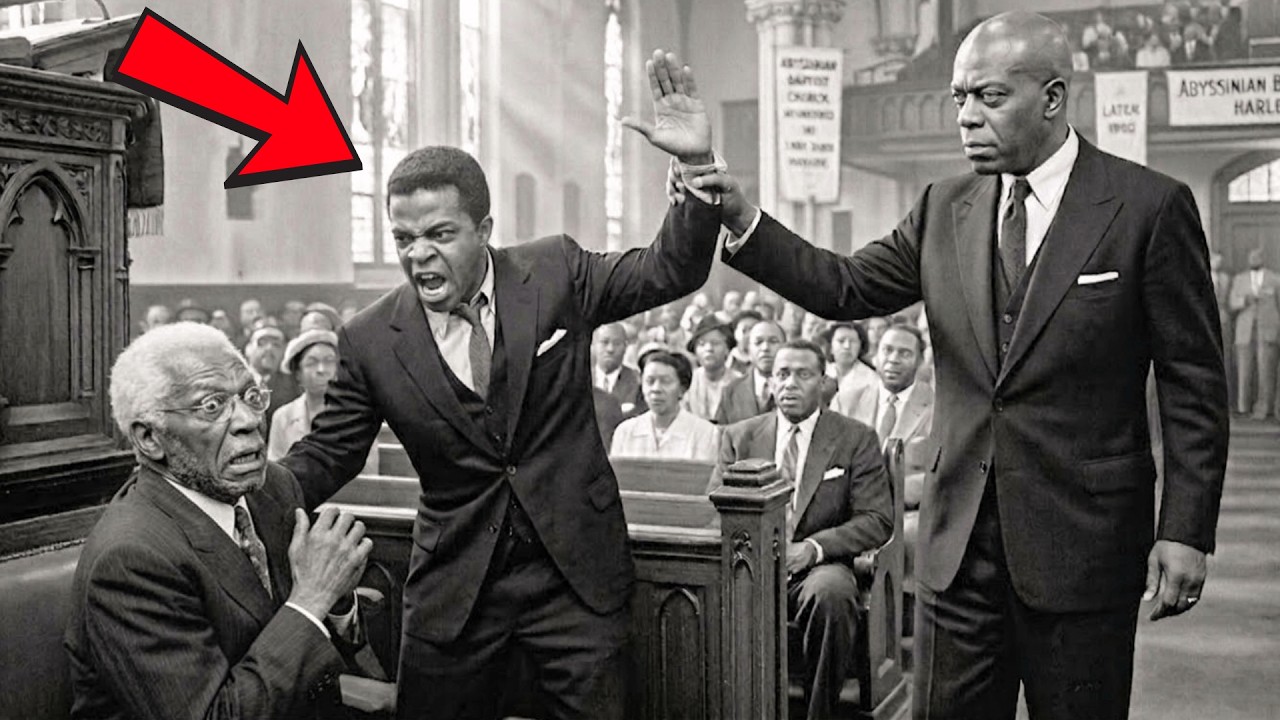
And Dutch Schultz looked at the ceiling of the Palace Chop House on East Park Street in Newark and understood, with whatever clarity was still available to him, that the answer Luciano had promised had finally arrived. Five days earlier, the light came through the stained glass windows of Mount Olivet Baptist Church in long colored stripes, red, gold, and amber falling across the wooden pews. It was a Tuesday, the kind that starts quiet and ends with people whispering for years. Elder Raymond Clay was arranging hymnals at the front of the church when the door opened.
Visitors came often. Harlem was a neighborhood that still believed in God even when God seemed to look the other way. This visitor didn’t smell like the congregation. He smelled like cigarette smoke and cold leather and something underneath, something metallic, like the inside of a gun barrel on a winter morning.
Dutch Schultz walked in alone. No bodyguards, no weapons visible. Just a man in a charcoal suit with his hat tilted slightly to the left, moving down the center aisle like he owned the building, the block, and every soul inside it. He was 32 years old.
He had already killed more men than most soldiers, and he had learned through years of climbing over bodies in the New York underworld that the most effective kind of power never had to announce itself. Elder Clay finally looked up. He was 61, a former schoolteacher who had spent four decades building something decent in a neighborhood the rest of the city preferred to forget. He had shaken hands with Marcus Garvey.
He had fed families during the Depression. He had buried children who died too young and consoled mothers who never recovered. He was not a man who scared easily. But when Dutch Schultz stopped two feet in front of him and smiled, Elder Clay felt something shift in his chest.
Not fear, exactly. Something older than fear. The instinct that tells you, before your brain can process it, that the thing standing in front of you does not see you as a person. “Beautiful place,” Schultz said.
His voice was flat, Midwestern, stripped of warmth, the way a knife is stripped of everything except its edge. He reached out and placed his hand on Elder Clay’s shoulder. The hand was cold, even through the fabric of the jacket. The fingers settled with practiced casualness, not gripping, not threatening in any way a photograph could capture, but present, heavy, deliberate.
“You know what I do for this neighborhood? ” Schultz continued, his eyes moving slowly around the church like a landlord inspecting property he already owned. “I keep the wrong people out. I make sure the lights stay on.
I make sure men like you can stand in a place like this without somebody burning it down. ”
Elder Clay said nothing. He gripped the hymnal tighter without realizing it. “Harlem’s a complicated place,” Schultz said.
“Lot of moving parts. Lot of things that could go wrong real fast if the right people stopped paying attention. I pay attention. That’s what I do.
” He leaned slightly forward, not enough to be called threatening, just enough to make the distance between them feel smaller than it was. “Your congregation ought to understand that. They ought to wake up every Sunday, walk through that door, and feel grateful. Because gratitude”—he said the word slowly, like he was tasting it—“is what keeps a neighborhood like this from becoming something nobody wants to live in.
”
Elder Clay looked at him straight in the eyes and said, quietly, the only thing a man with any dignity left could say in that moment: “We are grateful to God, Mr. Schultz. Only to God. ”
Schultz looked at him for a long moment.
The smile didn’t leave his face, but something behind it changed, shifted the way ice shifts before it cracks. “Sure,” he said. “Sure you are. ” He removed his hand, straightened his jacket, turned, and walked back up the aisle without looking back.
His footsteps echoed against the wooden floor until the door swung shut behind him and the church fell silent. Elder Clay stood completely still for a long time. The colored light from the stained glass fell across the empty pew in front of him. Outside, 125th Street moved and breathed and honked and shouted, completely unaware that something had just changed inside that building.
The cold from Schultz’s hand didn’t leave. That was the thing Clay could never explain properly afterward. It stayed in his shoulder like something had been pressed into the muscle and left there on purpose. He walked to the back office, picked up the telephone, and made the only call that made sense.
Night came to Harlem the way it always did in winter, fast and without ceremony. The streetlights on Lenox Avenue buzzed to life and cast their pale yellow glow across sidewalks where men stood in doorways and women walked quickly and children were called inside by mothers who understood instinctively that the night had a different set of rules. Ellsworth Bumpy Johnson heard about the church visit at 9:14 in the evening. He was sitting in the back room of a numbers operation on 133rd Street reviewing the day’s receipts when a young man named Curtis came in and stood by the door with his hat in his hands and his eyes slightly too wide.
The way eyes get when a person has been carrying a piece of news that frightened them every step of the way. Bumpy looked up from the ledger. He didn’t say anything. He just looked at Curtis and waited.
That was the thing about Bumpy Johnson that people who knew him only by reputation always got wrong. They expected rage, a man who moved fast and loud. What they found instead was stillness, a quality of attention so complete and unhurried that it made people want to fill the silence immediately. Curtis told him everything.
The church, Elder Clay, the hand on the shoulder, the words “your congregation ought to be grateful,” and the smile that came with them. Bumpy listened without moving. When Curtis finished, he asked one question. Did Clay say anything back?
Curtis nodded. Said they were grateful to God. Only to God. Bumpy was quiet for a moment.
Then something moved across his face, not a smile exactly, but the shadow of one. “Good man,” he said. “Finally. ” Like that was the only verdict that mattered.
Then he asked Curtis to start again from the beginning and tell him every detail, including the ones Curtis thought were too small to matter. The color of Schultz’s suit. The direction he came from. Whether he was alone.
How long he stayed. Curtis told him everything again. Bumpy listened to all of it. Then he closed the ledger, capped his pen, and set it parallel to the edge of the table.
“Nobody wrote this down,” he said. Nobody needed to. “Go home,” Bumpy told Curtis. “Don’t stop anywhere.
Don’t talk to anyone. ”
Curtis left. The room was quiet. The men outside, the ones who worked for Bumpy, who understood his moods the way sailors understand weather, felt the atmosphere in the building change without anyone saying a word.
By ten o’clock, three conversations had happened in Harlem. None of them were loud. None of them happened over the telephone. All three were brief, the kind of brief that means everything has been understood and nothing more needs to be said.
The next morning, the businesses on 126th Street began closing early. The barber shop on the corner first. Then the dry goods store two doors down. Then the pharmacy.
The tailor. The woman who sold sweet potato pies from a cart every morning without fail, rain or shine, going back eleven years, packed up her cart at ten in the morning and was gone before the lunch crowd arrived. By noon, six storefronts were dark. By two in the afternoon, eleven.
No picket lines, no speeches, no declarations of any kind. Just doors closing quietly in the middle of a Wednesday and the specific silence of a neighborhood that had made a collective decision without holding a single meeting. Dutch Schultz had walked into a church and called it protection. Harlem had decided, without a vote or a spoken word, that it was not interested in that kind of protection.
And Bumpy Johnson had not told a single person to do any of this. He had listened, closed the ledger, and said two words to a young man standing by a door. The rest happened on its own. Dutch Schultz noticed the numbers first.
He always noticed the numbers first. It was the thing that kept him alive and ahead of every competitor for a decade, his ability to read a financial situation before anyone else in the room registered the shift. The weekly collection from the Harlem numbers operations came in Thursday morning. His accountant, a thick-necked man named Ferris who had run the count for three years without a single error, laid the ledger on the desk and stepped back.
Schultz opened it, looked at the total for thirty seconds. “Run it again,” he said. Ferris had already run it twice. He ran it a third time while Schultz watched.
The number didn’t change. The Harlem operation was down. Not dramatically, not the kind of collapse that suggested robbery or mass defection. Just down, quietly, incrementally, the way a tire goes flat when the leak is too small to find but too consistent to ignore.
Schultz turned to the previous week’s figures, then the week before that. The decline had started six days ago. The day after Elder Clay made his phone call. He closed the ledger, lit a cigarette, walked to the window.
“Raise the collections,” he said. “Across the board, ten percent starting Monday. ”
Ferris wrote it down. He didn’t ask questions.
Men who asked questions in that room tended to find themselves reassigned to locations with worse climates and shorter futures. The increase went into effect the following Monday. By Thursday, the numbers came back lower than the week before. Schultz called his street captain, a man named Draper, into the office.
“Tell me what’s happening up there,” he said. Draper chose his words carefully. “The shops are paying. Most of them.
But the volume’s down. The players aren’t playing like they were. It’s like…” He stopped. “Like what?
”
“Like they decided to spend their money somewhere else. All at the same time. ”
Schultz looked at him. “People don’t do that.
People don’t just decide. ”
Draper said nothing. Because the honest answer, the one sitting right there in the room between them, was that apparently sometimes they did. This was not how it was supposed to work.
When you raised the price of protection, people paid more. That was the fundamental logic that had held since the first man with muscle decided to charge the first merchant for the privilege of not being robbed. Except it wasn’t working. And Dutch Schultz, staring at a ledger that kept lying to him, was beginning to understand something he didn’t have the vocabulary to articulate.
He had walked into a church, placed his hand on a man’s shoulder, said the word “grateful” like a threat. And Harlem had looked at all of that, at everything he was and everything he represented, and had made a quiet, collective, devastating judgment. Not with guns. Not with words.
With money. Disappearing dollar by dollar, week by week. Forty blocks south, in a room above a numbers operation on 133rd Street, a man with a closed ledger and a capped pen already knew exactly where those dollars had gone. And he was not finished.
The meeting happened on a Thursday evening in the back room of a barber shop on 131st Street that had been closed to customers since noon. Bumpy Johnson arrived first. He always arrived first. It was a habit he had developed over years of surviving in a business where the man who arrived second sometimes didn’t get to leave.
He sat in the barber’s chair closest to the back wall, facing the door, and waited with the particular stillness that had become his signature. Elder Clay arrived twelve minutes later. He came alone, wearing his Sunday coat on a Thursday, which told Bumpy everything he needed to know about how seriously the old man was taking this conversation. Clay sat down across from him.
The barbershop smelled like pomade and old wood and the faint chemical bite of hair relaxer. A single bulb hung from the ceiling. Outside, Harlem moved through its Thursday evening laughter, a radio playing through a cracked window, the distant sound of a woman calling a name into the dark. “You wanted to talk,” Bumpy said.
Not a question. Clay folded his hands in his lap. He was a man who had spent sixty-one years building a reputation for honesty, and what he was about to say was going to cost him something he could never get back. “Before Schultz,” Clay began, then stopped.
Started again. “Before any of this, there were others. ”
Bumpy looked at him. Said nothing.
The Italians, Clay said. Three years ago, a man came to the church, polite, well-dressed, very respectful, and explained that the neighborhood was changing and certain organizations were offering what he called community stability contributions. Clay paused, his hands tightening around each other. “He left an envelope.
I didn’t send it back. ”
The room was quiet enough that Bumpy could hear the bulb buzzing overhead. “How many envelopes? ” Bumpy asked.
“Eleven months,” Clay said. “One each month. Then they stopped coming and nobody explained why, and I told myself it was over, and I never spoke about it to anyone. ” He looked at Bumpy directly when he said the last part.
“Why are you telling me this now? ” Bumpy asked. “Because you’re going to find out anyway,” Clay said. “And I would rather you heard it from me than from someone who doesn’t understand why it happened.
”
Bumpy was quiet. Then, almost to himself: “You know, the men who actually lived through those years, they rarely wrote things down. Too dangerous. But they talked late at night in rooms like this one.
And the things they said stayed with the people who heard them. ” He let that sit for a moment. Then he looked at Clay directly. “So tell me the rest.
All of it. The way it actually happened. ”
Clay told him everything. The first envelope, the man who delivered it, the way he had rationalized it: the church needed a new furnace that winter, three families in the congregation were going to lose their apartments.
The money was already dirty before it reached him, and cleaning it through something good seemed, at the time, like a kind of justice. Bumpy listened without expression. “You know what Schultz’s problem is? ” he finally said.
Clay shook his head. “He thinks this neighborhood is something he can own. ” Bumpy’s voice was even, almost gentle. “The Italians, they understood something different.
They understood that a neighborhood like this one doesn’t get owned. It gets maintained. You take their money. You keep the church open.
You keep feeding families. You keep burying children. The structure holds. Schultz walked in here and tried to make the structure afraid.
That’s not business. That’s stupidity wearing a suit. ” He stood up, straightened his jacket. “The envelopes,” he said without turning around.
“How much total? ”
Clay told him the number. Bumpy nodded slowly, like the number confirmed something he had already suspected about the way money moved through this city, connecting institutions that were supposed to be separate, binding together things that were supposed to be clean. “Go home, Elder,” he said.
“Preach on Sunday. Keep the doors open. ” He paused at the door frame, one hand resting on the wood. “And the next time someone leaves an envelope, any color, any language, any reason, you call me before you touch it.
”
He walked out into the Harlem night. Behind him, Elder Clay sat alone in a barbershop that smelled like pomade and old secrets, holding a confession that was no longer entirely his burden to carry. Bumpy walked three blocks before he stopped under a streetlight. The cold air came off the river, sharp and clean.
He stood still for a moment, breathing it in, thinking not about Clay or the Italians or their eleven months of envelopes, but about the thing underneath all of it. Power wasn’t about clean hands. He had known that for years. But what he understood now was something sharper.
Power was about who understood the structure well enough to keep it standing when everything around it was trying to make it fall. Dutch Schultz had walked into a church and tried to make it afraid. That was not a man who understood structure. That was a man running out of time.
Bumpy pulled his coat against the cold and kept walking. There were four more days before Newark. By the third day, Dutch Schultz had stopped being strategic. That was the tell.
The moment when a man who has built his entire operation on calculated intimidation abandons calculation and starts operating on pure heat is the moment everyone around him begins to quietly calculate their own exits. It started at seven in the morning when Schultz arrived unannounced at the wholesale grocery operation on 128th Street owned by a man named Harold Greer, who had been running numbers for Schultz’s organization for four years and who had, over the past week, been running them slightly less efficiently than usual. Schultz came in through the back door, two men with him. Greer was in the middle of inventory when the door opened.
He turned around and saw Dutch Schultz standing in his stockroom surrounded by canned goods and flour sacks, wearing the expression of a man who had not slept in two days and had stopped caring who noticed. “You’re short,” Schultz said. No greeting. No preamble.
Greer set down his clipboard. He was a careful man, fifty-three years old, a family man, a man who had survived in this business precisely because he understood when to speak and when to let the other person fill the silence. “Numbers have been soft,” he said. “Across the board.
It’s not just my operation. ”
“I know it’s not just you. ” Schultz moved deeper into the stockroom, picked up a can of peaches, looked at it like it had personally offended him, set it back down hard enough that the shelf shook. “That’s exactly what I’m trying to understand.
How does an entire neighborhood go soft at exactly the same time? ”
Greer said nothing. “You know what I think? ” Schultz continued, his voice dropping lower, which was somehow worse than when it was loud.
“I think somebody’s been moving through this neighborhood talking to people, telling them it’s safe to hold back. And I think the people who know who that somebody is have made a decision to keep that information to themselves. ” He stopped directly in front of Greer, close, the same practiced invasion of space he had used in the church. “I need names,” Schultz said.
“Who’s talking? Who’s listening? Who’s moving the money sideways? And I need it by Friday.
”
Greer looked at him. His voice, when he spoke, was so quiet and steady that it took Schultz a moment to process what he was hearing. “Mr. Schultz, I move groceries.
I move numbers. I don’t move information about other people’s business. ”
Schultz stared at him for three full seconds. Then he turned and swept an entire shelf of canned goods onto the floor.
The crash was enormous in the small stockroom, metal on concrete, cans rolling and colliding, one splitting open and sending a spray of peach syrup across the floor in a wide arc that caught the light like something organic, something alive. The two men Schultz had brought with him stood very still near the door. “Friday,” Schultz said, and walked out. Behind him, Harold Greer stood in his stockroom surrounded by scattered cans and the sweet, cloying smell of spilled peaches.
He waited until he heard the back door close, then another thirty seconds listening to the footsteps fade. Then he walked to the telephone on the wall and dialed a number he had memorized months ago against exactly this kind of day. Schultz’s street captain, Draper, found him back at the office by mid-afternoon. Draper was a former boxer, broad-shouldered, careful with words, a man who understood that in this business the ability to read a room was more valuable than the ability to throw a punch.
He had spent the day moving through Harlem quietly, listening, and what he had heard had settled in his chest like cold water. “Tell me,” Schultz said without looking up from the desk. Draper sat down and chose his words. “I talked to people today, carefully.
What I’m hearing…” He stopped. Started again. “There are some notes, some written things that went back and forth this week between some of your collectors and certain parties. Nothing I can put in front of you officially.
But the pattern…”
“What pattern? ”
“The pattern of men who’ve already decided which way they’re falling,” Draper said. “And it’s not toward us. ”
Schultz was quiet for a long moment.
“Who? ” he said. Draper looked at him steadily. “That’s the thing, Mr.
Schultz. It’s not one person. It’s not a conspiracy you can cut the head off. It’s more like…” He paused, searching for the right word.
“It’s more like the neighborhood just collectively decided to believe in something else. Something they trust more than they trust us right now. ”
“They trust Bumpy Johnson,” Schultz said. Flat.
Final. “They trust that he understands them,” Draper said carefully. “Which is a different thing. And harder to fight.
”
Schultz stood up abruptly, chair scraping across the floor. He walked to the window. The city outside was moving through its afternoon, indifferent, continuous, utterly unconcerned with the particular crisis happening in this particular office. Fear, he had always believed, was permanent.
Once you made a man afraid of you, he stayed afraid. That was the foundation everything else was built on. Except that Harold Greer had looked him in the eye this morning in a stockroom full of scattered cans and peach syrup and had not been afraid. Not in any way that mattered.
He had been careful, precise. But underneath it all there had been something else: a man who had already chosen his side. And Dutch Schultz, standing at his window watching the afternoon light fade over the city he thought he controlled, was beginning to understand that fear without respect was just noise. And Harlem had stopped listening to the noise.
The first sign was the rings. In the world Dutch Schultz operated in, telephone calls were answered quickly. Promptness was loyalty, a signal that you were available, attentive, aligned. When a man of Schultz’s position called, you picked up on the second ring if you were smart, the first if you were eager, and never under any circumstances did you let it ring four, five, six times before lifting the receiver.
On the fourth day, Schultz’s calls started ringing longer. Not every call. Not always. Just enough, the way you notice when a room’s temperature drops two degrees—not enough to name immediately, but enough that something in your body registers the change before your mind has finished processing it.
He called Mickey Burke at eleven in the morning. Seven rings before Burke picked up, slightly out of breath, as if he had walked to the telephone from some considerable distance rather than been sitting next to it the way he usually was. “Mickey,” Schultz said. “I need a sit-down.
Today. ”
Burke was quiet for a moment. In that silence Schultz heard something he had not heard in years of dealing with Mickey Burke: the sound of a man constructing an excuse in real time. “Today’s complicated,” Burke said.
“I’ve got a situation in Brooklyn that needs personal attention. Something I can’t hand off. ”
“Mickey,” Schultz said again. Just the name.
The way you say a word when you want the other person to understand you know exactly what they’re doing and you’re giving them one opportunity to stop. A pause, shorter than the first, but more meaningful. “I’ll see what I can move around,” Burke said, and hung up. Burke never called back.
Schultz called three more men that afternoon and reached two. Both conversations had the same texture: cooperative on the surface, slightly too smooth underneath. The specific quality of dialogue between a man who needs something urgently and men who have already decided they are not going to provide it but haven’t yet located the exact words to deliver that conclusion cleanly. The meeting Schultz finally arranged happened that evening in a private dining room above a restaurant on the Lower East Side.
Four men were supposed to be there. Two chairs were empty when Schultz arrived. He sat at the head of the table and looked at those chairs for a long moment before he looked at the two men who had come: Caruso, heavyset and Sicilian, with the careful face of a man who would very much rather be somewhere else, and a younger man named Feld, who worked for Anastasia and had the specific posture of someone sent to observe rather than participate. “Where’s Luciano?
” Schultz asked. Caruso picked up his wine glass and studied it. “Charlie had a prior commitment that couldn’t be moved. ”
“And Anastasia?
”
“Family matter,” Feld said from the far end of the table. Schultz looked at the empty chairs, then at Caruso. “You know what’s interesting about this organization? ” His voice was controlled, careful, the voice of a man holding something very tightly.
“We don’t keep official records. No minutes. No transcripts. No paper trail of who said what and who voted which way and who showed up and who didn’t.
Which means the only record of what happens in a room like this one is the memory of the men sitting in it. And memory is a very selective thing. ”
Caruso set down his wine glass and met Schultz’s eyes directly. “Arthur,” he said, using the name almost nobody used anymore, “what exactly are you asking for tonight?
”
“I’m asking for what I’m owed,” Schultz said. “I have a problem in Harlem. My operation is being systematically dismantled by a man who understands that if he moves slowly enough, nobody will be able to point to the exact moment it happened. I need the commission to make clear, publicly, unambiguously, that my arrangement in that territory is backed.
”
Caruso was quiet for a moment. “That kind of statement requires a full table. ”
“Then call a full table. ”
“It takes time to…”
“I don’t have time,” Schultz said.
And for the first time that evening, the control slipped. Just slightly. Just enough. The word came out with an edge underneath it.
Not anger exactly, but the thing that lives just below anger, the specific frequency of a man who is beginning to understand that the walls are closer than he thought. Caruso and Feld exchanged a glance. Less than a second. But in that fraction of a second, an entire conversation occurred, a conversation that had almost certainly already happened somewhere else, in a room Schultz hadn’t been invited to, between men who had already reached their conclusion and were now managing only the question of delivery.
“We’ll bring it to the table,” Caruso said. “That’s the best I can offer you tonight. ”
Schultz stood up, buttoned his jacket with slow, precise movements. “Tell Charlie,” he said quietly, “that I’ll remember who was in this room tonight.
”
He walked out. The door closed behind him. On the sidewalk, the night air hit him cold and indifferent. He looked up at the orange-gray sky, the sky that never got fully dark because the lights never went fully out.
Inside the dining room, Caruso waited until he was certain Schultz was gone. Then he reached for the telephone on the wall and dialed a number from memory. When the line connected, he said four words: “It’s time. Newark.
”
And forty blocks north, in a Harlem that had already stopped bleeding money into Dutch Schultz’s ledgers, Bumpy Johnson set down his cup of coffee, looked out the window at the street below, and allowed himself, for just a moment, the smallest and most private of smiles. The room was on the third floor of a building on Mulberry Street that had no sign on the door and no name on the lease. It smelled like cigarette smoke and wood polish and the specific kind of tension that collects in a space where powerful men have been making irreversible decisions for years. A single chandelier hung over the center table, casting light just bright enough to see faces and just dim enough to make expressions difficult to read.
Eight men sat around the table. Schultz sat at one end, not the head. That was important. In this room, nobody sat at the head.
He had been talking for eleven minutes, counting the minutes the way a man counts when he understands he has a finite amount of time to change the direction of something very large already moving against him. He laid out the case methodically: the Harlem operation, the bleeding revenue, the systematic withdrawal of cooperation spreading through the neighborhood like something contagious. He named Bumpy Johnson directly, a choice that signals either confidence or desperation, and the men around the table were experienced enough to know which one they were looking at. Then he got to the prosecutor.
“Thomas Dewey,” Schultz said. He let the name sit there for a moment. “He’s been building a case for eight months. He has witnesses.
He has records. He has a grand jury six weeks from returning an indictment that will put me in a courtroom for the better part of two years. ” The room was very quiet. “I want permission to remove him.
”
Nobody moved. Nobody spoke. The silence was so complete that Schultz could hear the man to his left breathing slow, controlled breaths. Luciano, who had said almost nothing since Schultz sat down, looked at his hands on the table.
He had the hands of a man who had done physical work at some point in his life, broad, scarred at the knuckles, oddly still. He looked at them for a long moment, as if consulting something written there that only he could read. “You want to kill a federal prosecutor,” Luciano said. Not a question.
A recitation, so that everyone in the room could hear exactly what was being proposed and could not later claim they had misunderstood. “I want to solve my problem,” Schultz said, “before it becomes everyone’s problem. ”
Caruso leaned back slightly in his chair, the small movement of a man creating distance between himself and a conversation he does not want to be associated with. “Arthur,” he said carefully, “you kill a federal prosecutor in New York City in 1935, and every agency in this country points itself at this table.
Not at you. At this table. At every name associated with this organization. You understand what I’m telling you?
”
“I understand that Dewey doesn’t stop at me,” Schultz said. “I understand that if he gets his indictment and I go to trial, the pressure that comes out of that courtroom lands on everyone in this room eventually. I’m not asking you to solve my problem. I’m asking you to understand that my problem is already your problem, and that I have a solution.
”
Luciano looked up from his hands and looked at Schultz directly, the first time he had made full eye contact since the meeting began. His expression was unreadable in the way very dangerous things are often unreadable, not blank, but so completely controlled that nothing useful could be extracted from it. “We’ll discuss it,” Luciano said. “Now,” Schultz said.
“I need an answer now. ”
The silence that followed was different from the silence before. The first silence had been shock, the sharp intake of breath that a room takes when something unexpected has been placed on the table. This silence was deliberative, the silence of men who have already begun to reach a conclusion and are simply moving through the remaining steps of reaching it formally.
Schultz looked around the table at Luciano, at Caruso, at Anastasia, who had said nothing at all and whose stillness was somehow more eloquent than anything anyone else had said, at the four other men whose faces gave him nothing. “You know,” Anastasia said, the first words he had spoken all evening, “the thing about decisions made in rooms like this one is that the men who make them rarely agree afterward on exactly what was decided. Memory is a strange thing, especially when what was decided is something nobody wants to have decided. ” He looked at Schultz.
“You understand what I mean? ”
Schultz understood. It was a warning delivered in the language of this room, oblique, deniable, unmistakable to anyone who had spent enough years learning to hear what was said underneath what was said. “Take the night,” Luciano said finally.
“We’ll have an answer for you tomorrow. ”
Schultz stood up, looked around the table one more time, picked up his hat, and walked out, his footsteps loud on the wooden floor, the door closing behind him with the sound of a period at the end of a very long sentence. The room was quiet for a moment after he left. Then Luciano looked at Anastasia.
Anastasia looked at Caruso. Caruso looked at the clock on the wall. Nobody called for a formal vote. In this organization, formal votes were for decisions that needed to be defended later.
For decisions that needed to disappear, there was a different process, slower, quieter, conducted in the language of glances and silences and the specific weight of a room after a particular man has left it. By the time the chandelier was turned off and the men filed out through their separate exits into the Mulberry Street night, Dutch Schultz’s fate had been decided without a single vote cast, without a single word recorded, without a single person in that room ever needing to admit what had happened there. The answer Luciano promised never came. It didn’t need to.
The Palace Chop House on East Park Street in Newark was the kind of restaurant Dutch Schultz felt comfortable in. Not elegant. Not the kind of place where you needed to know which fork to use. A workingman’s steak house, dark wood paneling, heavy tables, the smell of grilled meat and cigarette smoke and spilled beer soaked into forty years of floorboards.
The kind of place where a man could sit with his back to the wall, eat a real meal, and talk business without worrying about who was listening at the next table. Schultz arrived on the evening of October 23rd with three associates: his accountant Abba “Abba Dabba” Berman, his lieutenant Lulu Rosenkrantz, and a man named Landau. They had been there since early evening, working through the financial restructuring that Schultz had convinced himself would solve the Harlem problem. The restaurant was quiet, a Tuesday evening in Newark, a few other tables occupied, nobody paying attention to the group of men in the back, exactly how Schultz preferred it.
He was eating a steak when the door opened. He didn’t look up immediately. The door had opened a dozen times since they arrived. But Rosenkrantz looked up.
And something in the way Rosenkrantz’s body changed, the specific stiffening that moves through a man when his eyes register a threat before his brain finishes processing it, made Schultz put down his fork. The men who came through the door moved quickly and without hesitation, the way men move when they have rehearsed the geography of a room in advance and know exactly where they need to be and in what sequence. What happened in the next forty-five seconds has been reconstructed from police reports, witness statements, and forensic evidence—accounts that contradict each other in their details but agree completely on their outcome. The first shot was loud enough to make the bartender drop a glass.
The second came so close after it that several witnesses later said they thought it was one sound, not two. Rosenkrantz went down first, then Landau. Berman tried to get under the table and didn’t make it. He died twenty-two hours later in Newark City Hospital, in a room with a police stenographer at his bedside transcribing his final words, a long, delirious monologue that the newspapers printed in full and that made no sense to anyone who read it.
Full of names and numbers and fragments of sentences that connected to nothing identifiable. Except one sentence, delivered near the end, in a voice the stenographer described as surprisingly calm. “I don’t want harmony,” Schultz said. “I want harmony.
”
Nobody has ever agreed on what he meant. In Harlem, the news arrived the way news always arrived, through the network of voices and telephones and men standing in doorways that moved information through the neighborhood faster than any newspaper. By midnight the barbershops knew. By one in the morning the numbers runners knew.
By two the churches knew. Nobody celebrated. Not openly. Not in any way that could be seen from the street or recorded in any document.
But on 126th Street in the morning, the storefronts that had been closing early opened at their regular time. The woman with the sweet potato pie cart was back at her corner by 7:30. The barber shop on the corner had its lights on before eight. And Harlem breathed, differently than it had breathed for five days.
Not relieved exactly. Not victorious. But settled, the way a structure settles when the thing pushing against it has been removed and the walls can return to holding only their own weight. Bumpy Johnson heard the news about Newark from a man named Dellwood, who called at 11:45 at night and said three words and hung up.
Bumpy set the receiver back in its cradle. He was sitting at the desk in his apartment on Edgecombe Avenue, the desk where he read, where he wrote the letters he was known for, where he kept the books that surprised people who expected a different kind of man. He sat for a moment with his hand still resting on the telephone. Then he stood, walked to the window, and looked out at Harlem.
It was almost midnight. The street below was quiet in the way Harlem got quiet late at night, reduced to its essential self. A man walking with his collar up against the cold. A light on in a second-floor apartment.
The distant sound of music, low and continuous, like the neighborhood breathing. He did not smile. He did not pour a drink. He did not call anyone.
He stood at the window for seven minutes. Then he went to bed. “The ones who last,” Bumpy once told a younger man who asked him about it years later, “are the ones who understand that the work is never finished. You don’t celebrate the end of something.
You make sure the next thing starts correctly. ”
The younger man asked what the next thing after Newark was. Bumpy looked at him for a moment. “The same thing it always is,” he said.
“Making sure Harlem stays Harlem. ”
In the weeks that followed, the numbers operations ran cleanly, the collection schedules normalized, the businesses on 126th Street settled back into their rhythms. Elder Clay preached on Sunday. His sermon that week was about the difference between justice and vengeance, a distinction he drew carefully, theologically, with the precision of a man who had spent a week living very close to both and understood the line between them was thinner than he had previously believed.
Nobody in the congregation mentioned Dutch Schultz by name. Nobody needed to. The envelopes from the Italians never came back either. That particular arrangement concluded itself quietly, the way certain arrangements do when the landscape shifts enough that their original purpose becomes irrelevant.
Bumpy never raised the subject with Elder Clay again. Clay never raised it with Bumpy. Some things are best maintained through the specific courtesy of not being examined too closely. What happened in those five days was not a war.
No casualties could be attributed to any decision Bumpy had made or any order he had given, because he had not given orders. He had listened, closed a ledger, said careful things to careful people, and let the structure of a neighborhood that understood itself do what it was going to do anyway, once it had been given permission to move. You don’t control a neighborhood. You serve it well enough that it chooses to move with you.
And when something threatens it, when a man in a charcoal suit walks into a church and lays a cold hand on a good man’s shoulder and calls it protection, the neighborhood doesn’t need to be told what to do. It already knows. Bumpy Johnson lived thirty-three more years after Newark. He was arrested, tried, imprisoned, released, and returned to Harlem each time like a man returning to the only place that had ever made complete sense to him.
He read voraciously. He wrote poetry that the newspapers occasionally mentioned with the kind of surprised condescension reserved for men who don’t fit the categories assigned to them. He was beloved in ways difficult to quantify and impossible to fabricate, the kind of beloved that comes from decades of small, consistent decisions adding up over time to something a neighborhood recognizes as its own. He died on July 7th, 1968, of a heart attack, sitting in a Harlem card room.
He was 62 years old. The people who were there said the room went very quiet when it happened, and the quiet spread, the way it had spread on the morning after a certain Tuesday in 1935, moving through Harlem in that particular way Harlem had of communicating the things that mattered most, not through newspapers or announcements or official declarations, but through the specific weighted silence of a neighborhood that understood what it had lost. He had never declared victory. He had simply kept the structure standing.
And in the end, that was the only victory that had ever mattered. The old order didn’t end with a gunshot. It ended with a cold, collective understanding that a man who cannot control himself will always eventually collapse the system he built. Harlem wasn’t cleaner after those five days, just stable again, breathing again.
Schultz believed power lived in fear. Bumpy understood something quieter and more permanent: that real power lives in patience, in timing, in knowing that the most devastating response is sometimes the one that never makes a sound. History doesn’t record every room, every handshake, every telephone call that changed everything. But the gaps in the record are their own kind of testimony.
And the men who understood that, who operated in the spaces between what was written and what was done—those are the men Harlem still remembers.
