On the morning of November 3, 1952, a concrete worker standing in the fabrication yard at the Tarrytown waterfront looked west across the Hudson River and saw nothing but water. The river at that point, from the Westchester County shore where the yard was built to the Rockland County bank at South Nyack on the far side, was roughly three miles wide. In the November light at that latitude, the far bank appeared as a low, dark line of trees above the surface. The distance between the man and that line of trees was about 15,000 feet.
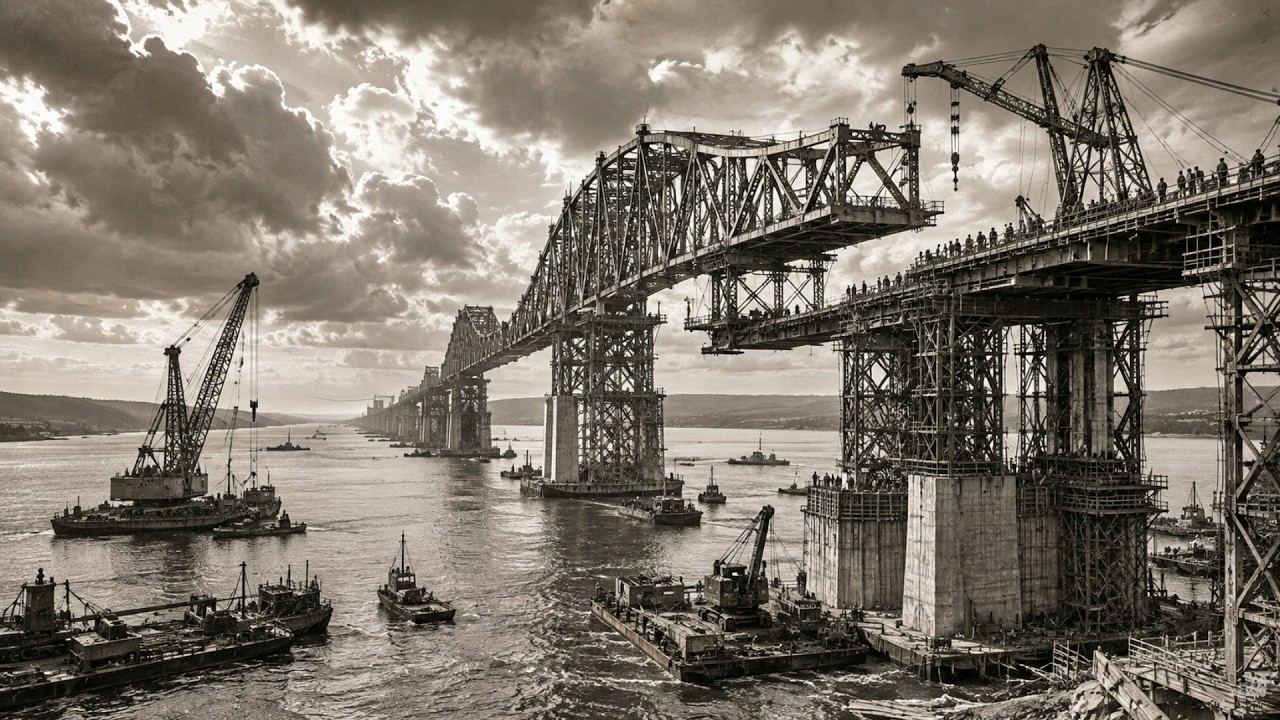
That was the distance the structure he was helping to build would have to cross. He was working on a concrete caisson. Not the whole caisson—part of it. Caissons were hollow concrete boxes built in sections at the waterfront yard, floated out to their position in the river when complete, and sunk to the riverbed by controlled flooding.
They were meant to rest on the bottom of the Hudson in the main navigation channel and carry the weight of the bridge deck above them without being connected to the bedrock far below. The caisson he was working on did not yet look like part of a bridge. It was a process of form and pour and cure, then another form on top and another pour. That process would continue until the caisson reached the size specified in the engineering drawings and the concrete reached the strength those drawings required.
This is the story of how the State of New York built a three-mile bridge across the widest navigable point of the Hudson River at a site engineering did not recommend and politics demanded, using foundation methods no structure of that length had ever used in a tidal estuary, built in three years by a maritime workforce that left the Tarrytown waterfront before the opening ceremonies, their names appearing only in the payroll records of the contractors who hired them. The bridge was the Tappan Zee. It opened on December 15, 1955. It was 3.
1 miles long. You can drive across the river there today on the structure that replaced it. The men who built the original crossing exist in the payroll records. The Hudson River between New York Harbor and the federal dam at Troy is not uniform in width.
It narrows and widens according to the geology of the valley it carved through the bedrock of New York State as the glaciers retreated roughly 12,000 years ago. In the Hudson Highlands, north of West Point, the river passes through a gorge where pre-Cambrian granite rises hundreds of feet above the water on both banks, and the river itself is barely a quarter-mile wide. South of the Highlands, the valley opens. The river widens gradually.
In the stretch between Tarrytown in Westchester County and South Nyack in Rockland County, the river reaches its greatest width along its entire navigable course: about three miles, or nearly 15,000 feet from bank to bank. That section has a name. The Dutch sailors who explored and charted the Hudson in the seventeenth century named its features in the language they brought from Holland. The word “Zee” in Dutch means sea.
They called the widest part the “Tappan Zee,” after the Tappan band of the Lenape people who lived on the western shore, and because of the open water created by the river’s breadth. The name was accurate. Three miles of open water at latitude 41 degrees north, with the full length of the Hudson Valley running downwind, and no island, reef, or terrain break between the shores, creates surface conditions resembling those of open water. In a sustained northwest wind, the Tappan Zee builds waves.
A construction vessel working mid-Zee in a sustained northwest wind in November is a vessel working in open water. The river around it does not behave like a river. It behaves like a lake. No fixed crossing had ever been built over the Hudson at this site.
The reasons were clear to every engineer who had studied the Hudson crossing problem in previous decades. The gorge sections in the Highlands were superior in every relevant engineering respect: shorter distance, bedrock near the surface, less exposure to open-water wave conditions, and lower cost per foot of bridge. The engineering calculations consistently pointed to the Highlands. The decision that was made was not an engineering decision.
The New York State Thruway was authorized by the state legislature in 1944, and actual construction began in the late 1940s. It was to run from the New York City line in the Bronx to the western state line with Ohio near Buffalo, part of the toll-road network the postwar American economy was building across the industrial Northeast. Between New York City and Albany, the Thruway would pass through Westchester County on the east side of the Hudson. At some point before Albany, it had to cross the Hudson.
The crossing required was a fixed one, capable of carrying the traffic volumes the American automobile economy was producing in the early 1950s, which Thruway Authority projections indicated would continue to grow. The Port of New York Authority had been created by a bi-state compact between New York and New Jersey in 1921 to manage the infrastructure of the bistate port district. By 1950, the Authority operated the George Washington Bridge, the Lincoln Tunnel, the Holland Tunnel, the Goethals Bridge, the Outerbridge Crossing, and the Bayonne Bridge. It financed these facilities with revenue bonds backed by pooled toll revenues and ran them as a system whose cash flows supported shared debt obligations.
Any new Hudson crossing south of a defined line fell, by the terms of the compact and the geopolitics of the bistate region, within the Port Authority’s jurisdiction. The Port Authority’s legal and institutional structure gave it the right to claim any Hudson crossing below that line. Robert Moses was chairman of the Triborough Bridge and Tunnel Authority. The Triborough Authority operated the Triborough Bridge, the Bronx-Whitestone Bridge, the Throgs Neck Bridge, and the tunnel links between the boroughs.
Moses had built these facilities and the parkway system connecting them over twenty years of institutional maneuvering that kept control in his hands, away from the Port Authority, whose governing structure was a bi-state compact Moses did not control. He was not prepared to build a Hudson crossing under the Port Authority. He was not prepared to build anything under the Port Authority. The institutional conflict between the Triborough Authority and the Port Authority was not mere personal friction.
It was a structural feature of New York infrastructure politics. Moses wanted crossings he operated. The Port Authority wanted crossings it operated. The boundary between their spheres was disputed territory.
The Tappan Zee section of the Hudson was outside the Port Authority’s accepted territorial range, far enough from the city and from the Authority’s existing infrastructure that a crossing at Tappan would fall under the Thruway Authority, which Moses could influence in ways he could not influence the bi-state compact. That made Tappan, from Moses’s perspective, the right location for the crossing. The engineering preference for the Highlands sections was acknowledged and set aside. The crossing would be at the widest point in the river.
The engineers would find a way to make it work. The Thruway Authority commissioned Madigan-Hyland, the engineering firm, to design the crossing. The engineers came to the river and did what engineers must do before designing anything across a body of water: they determined the nature of what they were working with. The Hudson River at Tappan is not a river in the sense the word implies.
Below the federal dam at Troy, the Hudson is a tidal estuary. The tide from the Atlantic Ocean moves up the river twice a day, reaching Tappan with a range of two to four feet, depending on the phases of the lunar cycle and the volume of fresh water coming down from the Adirondack watershed above. During flood tide, the surface current at Tappan runs north. During ebb, it runs south.
The river flows in both directions. And the water it carries is not fresh. It is a mix of fresh water flowing down from the watershed and salt water pushing up from the harbor below—a brackish mixture whose salinity changes with the tide cycle and the seasonal balance between fresh and salt sources. In wet years, when discharge from the uplands is strong, the river at Tappan is less saline.
In drought years, the salt-water influence extends north from the harbor and the river at Tappan grows more saline. The chemical composition is not stable. It varies within a range. Any material that must remain in the Hudson at Tappan permanently must be designed to withstand the full range of salinity, not the average.
Beneath the water lay the sediment. The Hudson Valley is a channel carved by glaciers and fed by its watershed’s discharge for 12,000 years. The sediment in the Tappan stretch is soft and compressible, of varying depths down to the bedrock below. In the shallow parts near the Westchester shore, where the river has deposited less over the tidal shelf, bedrock was within reach of conventional foundation methods.
In the main navigation channel mid-river, the sediment extended far down beneath the riverbed. The borings the engineers took in 1951, lowering core pipes through water and sediment and logging what the samples revealed, showed the top of bedrock in the navigation channel at depths ranging from 60 to more than 100 feet below the riverbed. One hundred feet of soft, compressible glacial sediment above bedrock, with fifteen feet of tidal brackish water above that. The bedrock was there.
But it was not reachable at a cost the project budget would allow. The solution the engineers devised was a bridge that was not one bridge. The Tappan Zee design used sixteen different types of foundations, each applied to the part of the river where conditions allowed. Near the Tarrytown shore, where bedrock was at practical depth and sediment thinner, conventional driven piles could reach the bearing layer.
In the transition zones approaching the main channel, where sediment thickened without reaching the extreme depths at the center, modified pile arrangements could find bearing materials at accessible depths. In the main navigation channel itself, where bedrock was beyond the reach of pile-driving technology and the available budget of 1952, the engineers designed hollow concrete caissons. These caissons were the answer to a question that 1952 engineering could not solve any other way at the cost imposed by the Thruway Authority’s bond obligations. A hollow concrete box, built to the dimensions set by the structural design, floated to its position in the river, then lowered to the riverbed by controlled flooding.
The boxes were fixed in place by sand pumped into their internal chambers, resting on the soft bottom of a Hudson River navigation channel, with no mechanical connection to the bedrock that driven piles reach in the shallower sections, held in place by their own weight, the weight of the ballasting sand, and the friction of the riverbed against their bases. They carried the weight of the bridge above them by transferring the load to the soft riverbed through their bearing area, not by transferring it to bedrock below. The engineers who specified this foundation type understood the difference between a caisson on soft bottom and a pile driven to rock. The exploratory borings had determined the bearing capacity of the soft sediment with precision.
Calculations proved that the caisson’s dimensions and ballast weight would generate bearing pressure within that sediment’s capacity under design loads. The factor of safety in those calculations was the margin between design load and failure load. The engineers calculated it. The caissons built in 1953 and 1954 were built on those calculations.
The Thruway Authority financed the Tappan Zee through revenue bonds backed by the future toll revenues of a bridge that did not yet exist when the bonds were issued. This mechanism was the same one that had financed toll-road infrastructure across the northeastern United States since the late 1930s. The Authority issued bonds. Investors bought them and received interest payments funded by the tolls drivers paid to cross the bridge.
The bond buyers were not lending money to the State of New York. They were lending to a specific revenue-generating facility whose cash flows were accounted for separately. If traffic projections proved too optimistic and tolls did not cover debt service, the bondholders bore the risk. New York State did not guarantee the bonds with its general revenues.
For this mechanism to work, the traffic projections had to be credible, and the engineering plan had to be credible. Bond buyers would not purchase securities backed by a bridge the engineers could not design and the contractors could not build. The engineers produced the design. The contractors who bid on the project produced a schedule.
The Thruway Authority presented both to the bond market. The bonds sold. Construction began in 1952. The bond obligations contained no provision for extending construction schedules or exceeding costs.
The bridge had to be built on the schedule the bond market financed. The schedule was not merely a goal. It was a financial obligation. The workers who built the Tappan Zee between 1952 and 1955 were drawn from the construction labor markets of the Hudson Valley and the greater New York area.
They were not a homogeneous workforce. They were an assemblage formed by the employment patterns of large New York-area construction projects in the early 1950s. The ironworkers who built the main span came from the ironworking traditions of the northeastern United States, which in the postwar period included significant representation from the Mohawk communities of Kahnawake in Quebec and Akwesasne on the New York-Ontario border. The men of these communities had worked in high structural steel since the building of the St.
Lawrence River railway bridge in the 1880s. Three generations of history produced a workforce with accumulated craft knowledge transmitted through families and communities in the way trades are transmitted when the work is physically demanding enough to select for that knowledge over time. The ironworkers who walked the exposed steel of the Tappan Zee’s main span were not walking it for the first time. They were walking it because their fathers and grandfathers had walked similar steel on similar bridges, passing the knowledge through the channels available to them.
The equipment operators and riggers who worked the barge-mounted cranes and the supply fleet came from a more dispersed population: men who had spent years running barge cranes and driving piles on waterway and harbor projects across the metropolitan area and the Hudson Valley. The New York waterfront workforce was organized in that period by unions that controlled access to skilled classifications through apprenticeship systems and hiring halls. An equipment operator carried a union card representing years of accumulated qualifications. A rigger carried a different card.
The common laborer carried no card restricting who could fill that classification, because the “laborer” classification was the residual category left after skilled classifications were defined and assigned. Many of the workers on the Tappan Zee construction were Black men. New York construction trades in 1952 were not formally segregated the way the deep South’s construction industry operated under explicit racial laws, but they were organized through union training programs whose admission practices, enrollment rates, and geographic distribution of training opportunities produced results that were not racially neutral. Skilled classifications—ironworkers, operating engineers, carpenters, cement finishers—were predominantly held by white men because the apprenticeship pathways into those classifications were disproportionately available to white men within the specific institutional structure of New York’s construction trades as they existed in 1952.
The laborer classification, requiring no apprenticeship and no union-controlled access record, was the classification through which Black men entered the industry in proportions reflecting the disparity in access. The common labor on the Tappan Zee—moving materials, tending equipment, performing the physical tasks construction requires without a distinct skilled rating—was performed disproportionately by Black men. Their wages reflected their position in the trades structure of 1952 New York construction: below the crafts holding distinct ratings, above the agricultural and domestic labor markets many had left to enter construction. Whether the wage differential between the skilled trades and common labor on the Tappan Zee adequately compensated for the differential in risk between the two categories of work is a question the payroll records allow one to ask, but cannot fully answer, because the risks of the work were not disclosed in the payroll records.
They were disclosed in the working conditions. Working on the Hudson at Tappan in the fall and winter of 1952 and 1953 was working on a tidal estuary at the start of a harsh northeastern winter. The Hudson at Tappan is not a sheltered waterway. It is an open body of water three miles wide, exposed to the prevailing northwest winds that come down the valley from the Catskills and Adirondacks from October through March.
The fetch of those winds across the three-mile width at Tappan is not an ordinary river wind fetch. It is a fetch across a body of water three miles wide, and the waves it produces are not confined-channel waves. A sustained northwest wind at 25 miles per hour across three miles of open tidal water in November produces waves on the Tappan Zee that move barges, push floating equipment sideways against the tugs holding it in place, and make precise positioning operations impractical until the wind dies. Work stopped when the wind exceeded the threshold at which the cost of holding position—fuel, equipment wear—exceeded what production justified.
The contracts did not include a weather exclusion for the completion date. The bond obligations ran on their own schedule. The wind ran on its own schedule as well. When the two schedules conflicted, the construction log recorded a weather delay, and the crew waited.
Average January air temperature at Tappan is between 20 and 28 degrees Fahrenheit, while water temperature stays in the low 30s, just above freezing. Anyone who fell into the Hudson at Tappan in January faced water cold enough to initiate the physiological response to immersion within minutes. The hypothermia timeline in the Hudson in winter is entirely different from that of summer incidents. It is a timeline measured in minutes between immersion and loss of functional capacity, and the time available for rescue boats to reach a person in the river from the moment of entry is whatever the water temperature and river surface conditions allowed.
The rescue boats were in position. They were required equipment for marine construction of this type. Their response time depended on boat speed, current, and the distance separating them from the person in the water. Fog on the Hudson at Tappan differed in nature from wind and cold.
Hudson Valley fog is a morning phenomenon of transition seasons, when the river retains the warmth of the previous season and the air above it cools to the dew point in the hours before sunrise. In October and early spring, crews starting the morning shift found on some days that the far bank was invisible, that the near bank was only a dark shape in the whiteness, and that barges and other workboats within a mile were invisible, audible but not precisely locatable by sound, because the valley walls and moving water reflected and distorted the direction of any sound source on the river surface. Commercial river traffic—tankers moving between the harbor and river anchorages to the north, tow fleets moving aggregate and bulk materials on the same river where construction was under way—did not stop for construction fog. Construction did not stop for commercial traffic either.
They shared the three miles of the Tappan Zee under morning fog conditions, managing collision risk through the sound signals the Coast Guard regulations required and the caution developed by those who worked the river in fog, aware of what that fog could do to a river in constant use. The tidal current was a constant condition, not an occasional one. The Hudson at Tappan reverses direction twice in each tidal cycle, running north on flood and south on ebb. At maximum tide, surface current speed is sufficient to push a loaded barge sideways against the thrust of the tug holding it in position.
Precision operations—placing a caisson over a survey marker, guiding a steel section onto a connection—required the tug to work against the current to hold the barge in the specified position within the permitted margin of error. As current speed increased through the tidal cycle, the effort required increased as well. As effort increased, fuel costs rose and mechanical stress on the tug’s propulsion system mounted. Slack water periods—the intervals around high and low tide when current speed approaches zero—were the opportunities for conducting the most position-sensitive operations with the least corrective effort.
The construction schedule was organized partly around these periods, and crews worked the river on a timetable set by the moon, not by the Thruway Authority. The caissons were built in sections at the Tarrytown waterfront. The fabrication yard occupied a stretch of the riverbank where a platform of timber and fill had been built to support forming and pouring operations near the water’s edge. The concrete for each section was mixed in the yard’s mixer and placed into the forms by workers operating in whatever weather November in the Hudson Valley imposed.
Below about 40 degrees Fahrenheit, fresh concrete does not gain strength naturally. It gains strength slowly, and if it freezes before reaching a minimum strength, the ice crystals formed within the paste destroy the bond between cement and aggregate, and the cured concrete is structurally insufficient. During the winter months of the fabrication program, freshly poured concrete was kept above freezing by wrapping the forms in waxed covers and burning propane heaters inside that enclosure. Workers tended the heaters, their task to keep the temperature inside the enclosure within the specified range, monitoring fuel supplies and combustion equipment, staying present as required—a continuous demand in a yard by the river in a January northwest wind.
The concrete poured under those conditions and cured under those covers in that wind formed part of the foundations of the Tappan Zee Bridge. Or it did, until the original structure was demolished in 2017 and 2018. The specifications required a curing temperature. The workers maintained it.
The proof they maintained it is the concrete that hardened and reached its specified strength. When a caisson reached its final dimensions and had cured to the required strength, it was floated off the construction platform into the river. Launching a completed caisson into the Hudson was a planned operation requiring the river to be at a state of tide that allowed sufficient water depth at the launching platform for the structure to float without striking bottom, and a tidal current speed that allowed the tugs to tow it to the installation site. The caisson, floating at a draft determined by the density of the river’s brackish water and its own weight, was towed by one or more tugs to the designated position on the alignment where it would be sunk to the bottom.
Positioning the caisson over the survey marker required holding it against the tidal current while survey crews aboard the barge and from shore control points confirmed the caisson lay within the tolerance permitted for its target position. That tolerance was extremely tight. A caisson placed outside the tolerance resulted in a foundation whose column cap was at an elevation offset from the design alignment, transmitting that offset into the geometry of the bridge deck resting on those columns. Every subsequent element of the structure erected above it would reflect that error.
The accuracy required in placing a hollow concrete structure weighing several hundred tons on the bottom of a river with a current of varying speed demanded that the tugs hold their position while survey readings were taken and rechecked, and that the flooding crew be ready to begin the sinking sequence as soon as survey confirmed the caisson’s arrival at position. The sinking operation was managed by opening valves in the caisson’s structure that admitted river water into internal chambers. The caisson had multiple chambers, and the flooding rate in each was controlled independently to maintain the structure’s balance during descent. If the bow flooded faster than the stern, the caisson tilted forward.
A tilting caisson in 40 feet of tidal water was not easy for the tug holding it to recover, because the tug was trying to hold position against the current while the caisson was no longer floating evenly, and the mechanical connection between the tug’s line and the tilting structure applied forces that were not part of the towing plan. The men responsible for the flooding valves worked from the caisson’s deck as it descended, watching level indicators in each chamber and adjusting valve settings to maintain a uniform descent rate across all chambers. As the deck sank toward the water surface, the time available for the crew to finish their work and evacuate the structure before it went completely under diminished at the same rate. The crew evacuated by boat when the deck reached water level.
The caisson continued down under the controlled flooding the engineers had calculated to maintain its balance through the remaining distance to the riverbed. Once the caisson settled on the bottom, the surface boat crews could no longer see it. Fifteen feet of brackish, sediment-laden Hudson water is not clear. A concrete structure the size of a small building settling into the Hudson’s bed in November was not visible from a workboat on the surface.
Its position was known from survey markers recorded while it was afloat and confirmed against the design alignment. Whether it had settled level was known from the leveling instruments that had been on the caisson during descent, and from measurements divers made when they went down to inspect the settled structure. Sand ballast was pumped into the internal chambers through pipes that ran from a supply barge on the surface down through the water column into the submerged structure. The sand traveled through the pipes as a uniform water mixture at a density that allowed the pump to move it against the water pressure at the top and the pipe length resistance at the bottom.
Inside the chambers, the sand settled while the water was displaced upward and out. Fill levels were monitored through measuring pipes built into the caisson design. The divers who went down to inspect the settled caissons and monitor the filling operations worked in the Hudson at Tappan, at the depths and visibility the river offered in the fall. Diving in the Hudson at Tappan in the 1950s meant diving in cold, dark, salty, tide-driven water, visibility zero below a few feet, current varying with the tide stage, and a soft, unstable bottom that might shift underfoot.
The divers who worked on the Tappan Zee construction were professional divers using the hard-hat equipment common in marine construction of the period. They went into the water on a schedule set by the work’s requirements, and came out when the work was done or when conditions made continuing inadvisable. The conditions in the Hudson at Tappan in November were the conditions the river itself imposed. They were not conditions the divers preferred.
The work on the main truss span above the navigation channel differed from the caisson work below the waterline. The ironworkers who built it worked in the open air above the river, not in the water, but the river beneath them was the same, and the consequences of falling from the truss into the river, from a height of 40 feet, were governed by the same water temperature and response time that governed the caisson work. The truss was erected by the cantilever method, with steel extended from each pier toward the center of the bridge. Each new section was added at the open end of the projecting cantilever and connected to it before the weight of the next section was added.
The steel pieces were lifted from the barge cranes below by a crane and swung toward the connection point at the end of the cantilever. Each piece weighed tons. The crane held the piece from the hook while ironworkers received it at the connection point and placed it for bolting to the structure. The ironworker at the end of an open steel cantilever is a man standing on a surface—usually an edge or beam a few inches wide—at a height above the river with no scaffolding below and no safety net over the water beneath.
He receives the steel piece, controlling its swing on the crane hook with a tag line, and guides it to match the connection holes using a drift pin: a steel rod about 18 inches long with a tapered end, inserted into a partially aligned hole and rotated to pry the heavy piece into position until all the holes line up and the first bolt can be driven. The holes of the new piece had to match the holes of the existing structure to within a fraction of an inch before the first bolt was inserted. The piece weighed tons. The crane held it.
The river was 40 feet below. The men who made those connections on the Tappan Zee main span did their work in the conditions the Hudson generates at Tappan from October through December. The wind from the northwest at the height of the top chord was the wind the river’s open fetch produced, uninterrupted by the terrain that would have broken it in narrower parts of the Hudson. The November sun at latitude 41 degrees north sits about 20 degrees above the horizon at noon, and the steel in the bridge’s top chord under direct November sun is heated by the sun’s radiation and the reflected heat from the river below from both directions, while the northwest wind cools it from the side.
The ironworker is the element at the intersection of these conditions. He wears what ironworkers wore on bridge structures in 1952 under such conditions—clothing not designed for comfort in those conditions, because high-steel bridge construction in November over an open river was not among the challenges early-1950s work-clothing designs took into account. No complete documentation of the deaths that occurred during the Tappan Zee construction exists in any widely available public record. New York State labor law in the early 1950s required reporting of fatal accidents at construction sites and investigation of serious injuries, but the coverage and follow-through in the administrative records of that era did not match what later contracts and regulatory frameworks produced.
The Hudson adds complications a land-based construction site does not face. A person who falls into the Hudson from a construction barge falls into tidal water whose temperature compresses the available response time in a way a fall on a land site does not. He falls into water with a current that carries him away from the barge from which the rescue boat departs. He falls into water with zero visibility below the surface, meaning a rescue, if he goes under, is conducted without seeing the person being rescued.
Written accounts of the Tappan Zee construction confirm that the work was completed to specification. They do not specify the full number of lives the work cost the men who did it. The two facts are not contradictory. The work was done.
Cost records exist in whatever form the administrative records and payroll ledgers of the construction contractors survived. The bridge was essentially complete by the fall of 1955. The opening ceremony was held on December 15, 1955. Governor Averell Harriman led the opening motorcade across the three-mile bridge from the Westchester toll plaza to the Rockland County approach.
Ceremonies were held at both ends. Photographs of the opening show the governor, Thruway Authority officials, and senior engineers at the ceremony sites. The bridge itself appears clearly in the photographs. The officials appearing in those photographs were identified in contemporary press coverage.
The construction workers who built the bridge were not present at Tarrytown on December 15, 1955. A marine construction workforce in the Hudson Valley does not remain at a job site after the contract is complete. The caisson fabrication yard at the Tarrytown waterfront had been cleared. Barges, tugs, and crane equipment had been towed away and moved to the next marine construction contract.
The ironworkers had moved to the next structure being erected somewhere in the metropolitan area. The equipment operators, riggers, and common laborers had moved to the next project where their classifications were needed. What remained in the Hudson was the bridge. The survey stakes that had marked the alignment across three miles of tidal estuary were removed.
The temporary work platforms that had maintained survey accuracy across open water disappeared. The sixteen foundation types distributed across 3 miles of varying riverbed lay submerged and invisible from the bridge deck above. The navigation span stood in December light over the Hudson. The stringers the ironworkers had bolted piece by piece in November winds crossed the navigation channel at the height the engineers set to provide the clearance the Coast Guard had required for the commercial vessels using the river.
The toll at opening was 35 cents for a passenger car. The crossing took about eight minutes at the posted speed limit. First-year traffic volumes matched the projections the Thruway Authority had presented to the bond buyers. Debt service was covered in full.
The bonds were retired on the schedule presented to the bond buyers. The bridge paid for its construction out of the tolls paid by the people who used it. The caissons settled on the soft bottom of the Hudson navigation channel held because the engineers calculated the bearing capacity of the soft sediment under design loads correctly. The workers who operated the flooding valves and monitored the sand filling placed the caissons at the positions and elevations the design specified.
The tidal current that pushed the barges holding the caissons in place during installation still pushes against the sides of the caissons that settled in 1953 and 1954. The current never succeeded in moving them. The ice floes the Hudson produces in hard winters exerted lateral force on the piers above the caissons. The structure transferred that force downward, and the caissons discharged it into the riverbed.
The riverbed held. The inspection divers who examined the caissons on their scheduled cycles over the decades after the bridge’s opening found concrete in the condition of concrete structures in a saline estuary environment after years, then decades, of service. Chloride ions in the brackish Hudson water penetrate concrete at a rate set by the water’s chemistry, the concrete mix design, and the thickness of the concrete cover over the reinforcing steel. The concrete cover specified in 1952 was thinner than the cover later design standards would require for the same exposure environment, because the understanding of chloride-ion penetration into concrete and its effect on embedded reinforcing steel was less complete in 1952 than it became in later decades of research into marine concrete deterioration.
The Tappan Zee maintenance program throughout its service life addressed deterioration as it occurred, repairing sections where concrete had degraded to the point of affecting structural adequacy. The maintenance crews performing those repairs worked on the Hudson at Tappan, on the same river where the original construction crews worked in 1952 and 1953. The river had not changed. The decision to replace the structure came from engineering assessments accumulated over decades and the growth of traffic volumes on the Thruway that the two-lane structure could no longer carry efficiently.
The Thruway Authority commissioned replacement studies beginning in the 1990s. The studies confirmed what the engineering logic underlying the original construction had always indicated. The caissons on the soft bottom of the Hudson were adequate foundations for the structure they carried. They would remain adequate with proper maintenance for a further defined service life.
But they were not the equivalent of foundations driven or drilled to bedrock. A replacement structure with foundations in the bedrock the original project could not reach would be a more durable structure than the original. The bedrock was where it had been in 1951. It had not moved.
Twenty-first-century drilling equipment would reach it through the same soft sediment the 1951 drill rigs measured and the 1952 designers concluded could not be economically penetrated. Construction of the Mario M. Cuomo Bridge began in 2013. The new crossing was built at the same site.
The foundations were drilled to bedrock. The original Tappan Zee was demolished in stages as the new bridge opened from 2017 through 2018. The caissons that had rested on the Hudson’s bottom since 1953 were removed by floating equipment working from the same kind of barge platforms that had placed them there 65 years earlier. The concrete was broken up, the steel cut, and the pieces loaded on barges and carried out of the river.
The riverbed where the caissons had rested was exposed to the tidal current that has moved through the Tappan Zee since before Dutch sailors gave this stretch a name. At the site where 1952 crews operated flooding valves, watched level gauges, and held concrete caissons straight through forty feet of brackish Hudson water to the soft bottom, there is now open water above new foundations drilled to the bedrock the 1952 project could not reach. The men who operated those valves exist in the payroll records of the contractors who hired them, in whatever form those records have survived across the intervening decades. Their names are not on any commemorative marker at the crossing.
The commemorative record at the Tappan Zee bears the names of governors and authority officials who appear in the opening photographs. It bears the names of the engineers whose designs are archived by the Thruway Authority. It does not bear the names of the men who lowered the caissons into the tidal bottom of the Hudson in November of 1952 and 1953, nor the names of the men who bolted the main span in the northwest wind above the river, nor the names of the divers who went down through tide-driven, zero-visibility water to inspect settled structures and clear blocked fill pipes. The Hudson remains tidal at Tappan.
The northwest wind still blows down the valley in November. The soft sediment still covers the riverbed above the bedrock the 1951 borings measured and the 2013 drillings confirmed. The new bridge rests on bedrock. The tidal current moves beneath it twice a day on the moon’s schedule.
The river that created the conditions in which the 1952 construction crews worked—building the caissons, driving the piles, walking the exposed steel—has not changed. The river is the Hudson. The tide is the Atlantic. The soft sediment is the product of 12,000 years of glacial retreat.
The men who worked those conditions exist in the payroll records. The river is still the river.






