In September 1993, a queen attended the funeral of her servant. Elizabeth II did not send a representative. She went herself, to the Queen’s Chapel at St. James’s Palace, to mourn Margaret Macdonald, the woman who had dressed her each morning for sixty-seven years.
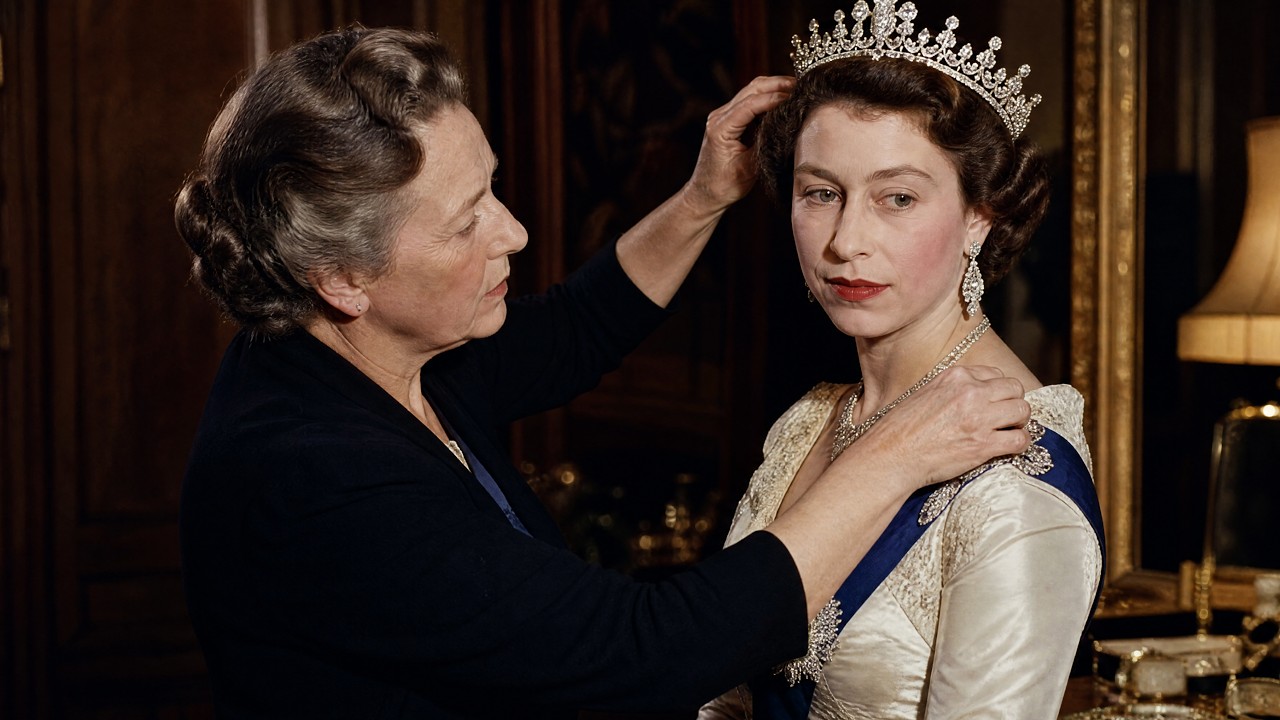
It was a final public acknowledgement of a bond that had always been private, and it marked the end of one of the most extraordinary lives ever lived in the shadows of the British monarchy. Margaret Macdonald was born in 1904 on the Black Isle, a green peninsula in the Scottish Highlands, where her father worked on the railway. The family lived in a cottage of three rooms, held from the railway company for as long as the father kept his place on the line. It was a world of hard weather and harder virtues, where duty was everything and display was suspect.
Her beginnings gave no hint of what was to come. She entered service as an apprentice chambermaid at a modest hotel, the lowest rung of the domestic ladder, making beds, carrying water, and cleaning rooms for guests she would never be introduced to. In 1926, a baby was born who would change the course of her life. Princess Elizabeth of York was third in line to a throne no one expected her to reach, and the household needed nursery staff.
Margaret Macdonald, then about twenty-two, was taken on as an under nurse beneath the head nanny, Clara Knight. The position was the most junior imaginable, but it placed her in the same rooms as the child from the beginning. In the gardens, she played hiding games with the toddler, and out of the child’s mangling of that simple game came a name that would last a lifetime. The little girl called her Bobo.
When a second princess, Margaret, was born in 1930, the household reshaped itself. Bobo took particular charge of Elizabeth, moving into her room to give the elder girl a sense of security. Elizabeth would share that room with Bobo until she was thirteen years old. For those formative years, the face beside the future queen at night and in the morning belonged to a railway worker’s daughter.
In the same year, Margaret’s sister Ruby entered royal service and would eventually become dresser to Princess Margaret, creating a symmetry no one had planned. Two Highland sisters from the same plain beginnings ended up dressing the two most watched sisters in Britain. In December 1936, the abdication of Edward VIII transformed the family. Elizabeth’s father became King George VI, and the ten-year-old girl became heir presumptive to the throne.
Bobo’s role grew with her, changing its name to dresser. She was no longer just a nursery maid but the person who managed the clothing and jewels of a future queen. Through every political change that followed, one figure remained fixed at the most intimate point of Elizabeth’s daily life. The word dresser concealed more than it revealed.
A queen does not dress for herself. She dresses for a public that reads every choice as a message, and the wardrobe of a reigning monarch is an instrument of state. From the 1950s onward, the daily management of that instrument lay in Bobo’s hands. She chose the outfits, the jewels, the decorations, planning months ahead and packing across continents.
The grandest names in British fashion, Norman Hartnell, Hardy Amies, Ian Thomas, all had to satisfy her judgment. She gave plain, blunt opinions and would reject an outfit no matter who had designed it. There was no appeal above her because the queen trusted her dresser’s eye over their own. Her authority extended throughout the household.
New servants were given one warning above all others: do not upset Miss Macdonald, or you will ruin the queen’s day. The staff reportedly called her the third Queen Elizabeth, a jest that was also a plain statement of fact. She was not a bully but a hard taskmistress who demanded of others only what she demanded of herself. In the finely graded world below stairs, her position derived not from any office but from who she was to the queen, and that made her a category of one.
The truest measure of her standing was what she could say to the queen herself. On a tour of Canada, the queen refused to wear a tiara that the occasion required. Bobo chided her in plain Highland words, telling her that she was being spoiled. The queen wore the tiara and went out looking, in the phrase that survives, a million dollars.
No minister, no courtier, no member of the family could have spoken so freely. Bobo could because she wanted nothing. Every other person around the queen sought something, but Bobo sought nothing but the queen’s own good, and that freedom allowed her to speak the truth cleanly. The same faithfulness was proved at the greatest turning point of the queen’s life.
On the sixth of February 1952, Elizabeth was in a hunting lodge in Kenya when her father died. She went to bed a princess and woke a queen. Bobo was there, as she was always there. While the world turned over, she attended to what she had always attended to, cabling London so that suitable dark mourning clothes could be made ready.
She had been present at every gate through which Elizabeth passed, and she would go on being present for the coronation and the long reign that followed. The meaning of Bobo’s silence is sharpened by the fate of another woman. Marian Crawford, the governess to the princesses, had written a book about their childhood in 1950. It was gentle and affectionate, but it violated the family’s absolute rule of discretion.
Crawford was cast out completely, banished from the circle she had served. The episode became a byword for betrayal. Bobo had far more to tell than Crawford ever did. She had known Elizabeth from the cradle and shared her most private hours across an entire lifetime.
The knowledge she carried would have been worth a fortune. She never wrote a word, never gave an interview, and never let a single secret slip. Into her eighties, she still woke the queen each morning with tea, ran her bath, and laid out her clothes. On her own birthday, the queen would carry the tea to her.
A sovereign of the United Kingdom would serve her elderly servant once a year in a small, private act that no camera recorded. When age finally forced Bobo back from her duties, the queen did not pension her off. She kept her in her own suite at Buckingham Palace, cared for and honored with no duties at all. The usefulness that had been the basis of every servant’s place had ended, but her place did not end with it.
Margaret Macdonald died on the twenty-second of September 1993 at the age of eighty-nine, reportedly in her sleep, in the rooms where she had been kept. The queen attended her funeral, and in that attendance told the world exactly how much the servant had meant. The woman best placed in the world to tell the story of the queen’s private life was the one person who never told any of it. She carried the entire private history of Elizabeth II out of the world with her and left not a trace behind.
That silence was her achievement. It was the deepest form of power in the palace, the power of the one person who knew everything and said nothing, and it could never be taken away or turned against its holder.
