In the darkness of an April night in 1970, a team of KGB officers stood beside a small river in East Germany, holding a secret map and five wooden boxes. Their orders came directly from the head of the Soviet intelligence service itself. The instruction was simple: make what remained of this woman disappear forever. She had never given a speech.
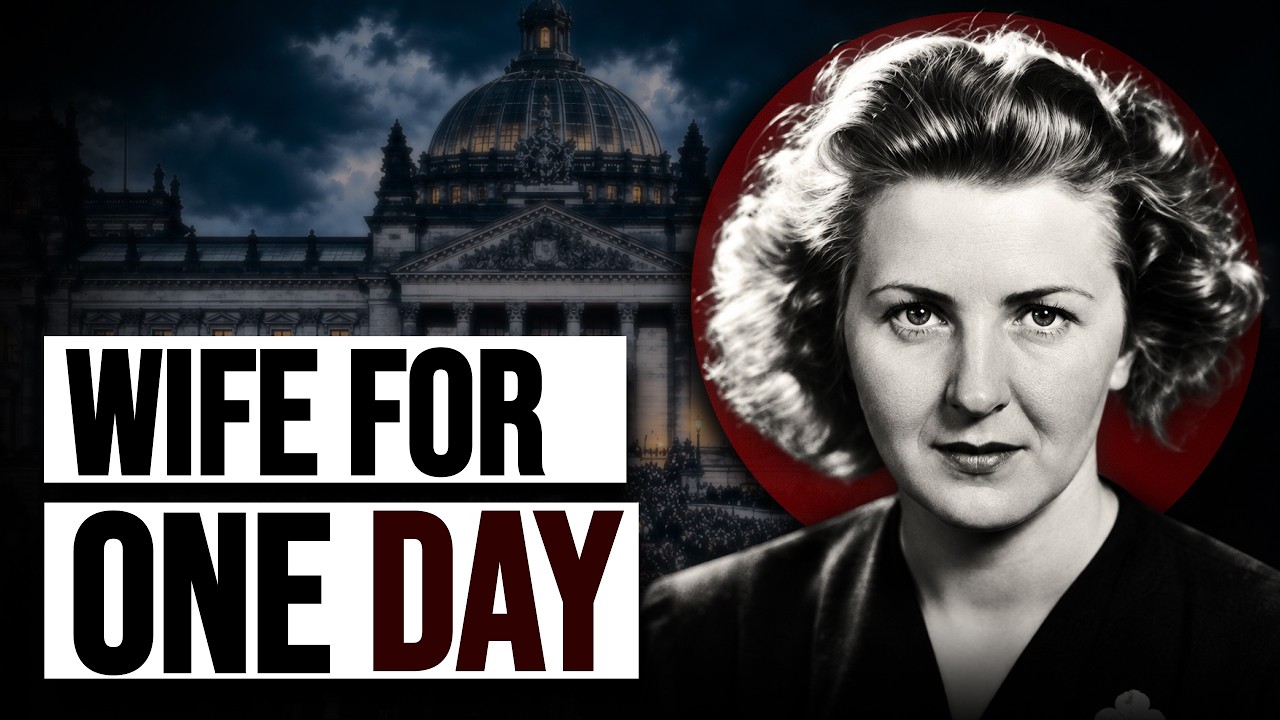
She had never signed a single order. Yet twenty-five years after her death, Moscow still feared her grave. To understand why, one must first understand who Eva Braun was, and how she became a woman the KGB dreaded long after she was gone. Eva Braun was born in Munich on February 6, 1912.
Her father, Fritz, was a schoolteacher. Her mother, Franziska, worked as a seamstress. Eva was the middle of three sisters, with Ilse the eldest and Gretl the youngest. After finishing school, she spent a year at a convent-run business school, then worked a few months as a doctor’s assistant.
In 1929, at the age of seventeen, she found a job in a photography shop in Munich. The owner, Heinrich Hoffmann, was Adolf Hitler’s personal photographer. Eva sold film and learned how to develop pictures. That October, a man walked into the shop.
She was told his name was Herr Wolf. He was forty years old. She was seventeen. Whether she knew who he really was, no one can say for certain.
The first books about her claimed she knew nothing, but that author mixed factual details with invented scenes, so those accounts must be read with caution. What can be said is what happened next, and that part was no fiction. Two years later, in September 1931, Geli Raubal, Hitler’s young niece, died in his Munich apartment. The death sparked enormous gossip, and Hitler was shaken by it.
Records from the German Historical Museum indicate that after her death, he began spending more time with Eva. But he gave her little. He would disappear for weeks. He did not write to her.
In November 1932, Eva, not yet twenty-one, attempted to harm herself in a desperate bid for his attention. She survived. Hitler did not pull away. He drew closer.
But the pattern did not change; it worsened. In 1935, Eva kept a diary. A short, twenty-two-page version of it still exists in the United States National Archives. It covers February through May of that year.
In it, a twenty-three-year-old woman writes about waiting, waiting for a call, a visit, a sign. She writes that she was alone at Easter. She writes about crying at night. On May 28, she wrote that she had just sent him a letter that was decisive for her.
In May 1935, she tried again, for the second time. She survived. One more note about those diaries. There was a second, much longer diary attributed to Eva Braun, printed in books for years.
In 1948, a Munich court ruled it a forgery. So if one reads a famous line from her diary, one should check its source. After the second attempt, Hitler changed. He gave her a house in Munich, then a villa, then a place at his mountain home, the Berghof, in the Bavarian Alps.
Her mother had written to him before, asking about his plans for her daughter. He never answered the letter. But he gave Eva a monthly allowance, and in an earlier will, he set aside money for her for life. So she had a villa, money, and a place in his home.
Yet she remained entirely absent from public life. That was deliberate. Hitler wanted Germans to see him as a man who belonged to the country alone. A wife, or even a known companion, would have shattered that image.
So Eva stayed hidden. She never joined the Nazi Party. She stayed away from political conversation. When ministers came to the Berghof, she left the room.
Even most of Hitler’s own generals never saw her. The outside world received its first small glimpse in December 1939. The American magazine The Saturday Evening Post published a short piece about a blonde Bavarian young woman. Time magazine picked up the story.
Germans saw none of it. Her friend said she was bored, lonely, and often unhappy. She spent her days swimming, hiking, changing clothes, and chatting with the same small circle of people. But she had one skill that mattered more than anyone knew.
Eva loved photography. She shot home movies in color at the Berghof with a 16mm camera: Hitler sipping tea, guests on the terrace, children, dogs, mountain vistas. Nearly every color film we have of that private life came from her hands. Some of those films are in the United States National Archives today.
Her only known intervention in any public matter concerned makeup. In 1943, Germany was cutting civilian luxuries for the war effort, and she heard that cosmetics might be banned. She stormed in, furious. Hitler quietly asked his armaments minister, Albert Speer, to hold off.
That is the complete list of her influence on the state, according to those close to her. Speer later said she would be a great disappointment to historians. He may have been wrong, but to understand why, one must return to April 1945. First, there is another important figure: her younger sister, Gretl.
On June 3, 1944, Gretl married an SS general named Hermann Fegelein. He was Himmler’s liaison officer at Hitler’s headquarters. This marriage did something for Eva. Now she could attend official events as Fegelein’s sister-in-law, without anyone needing to reveal her true identity.
Keep Fegelein in mind. His next step is what put him before a firing squad. By April 1945, Berlin was besieged. Soviet forces were closing in.
Hitler moved into the bunker beneath the Reich Chancellery. Eva was in Bavaria, safe in the mountains. Hitler asked her to stay there. She came anyway.
People begged her to leave. Her friend Henriette von Schirach urged her to go into hiding after the war. Eva answered with a single question: do you think I will let him die alone? On April 22, she wrote to her closest friend, Herta.
She told her she was dying the way she had lived, and that it was not hard for her. That same day, something else happened, and only one man ever told the story. His name was Gottlob Berger, an SS general responsible for prisoner-of-war camps. In 1948, in Nuremberg, he told an American judge about Hitler’s plan for tens of thousands of Allied prisoners.
According to Berger, about thirty-five thousand of them were to be held as hostages in a redoubt in the Bavarian mountains. Berger said Hitler signed orders regarding those prisoners on April 22, and that it was Eva Braun who handed him the papers. He said he chose to stall and did not carry out the orders. Berger was a man on trial, and he had every reason to make himself look good.
No one can prove his story, but some historians who have studied her life believe this may be the only moment Eva Braun substantively influenced events. If true, she carried a paper that could have cost thousands of lives, and it reached a man who ignored it. One day later, she wrote her second letter, the one addressed to Gretl. It was not a farewell.
It was a list of instructions. She told Gretl to gather every letter Hitler had ever written her and every copy of her own replies. Put them in a waterproof bundle. Hide them.
Bury them if necessary. But do not destroy them. She wanted the trace of her life to remain. Then came another instruction: make sure no one sees her dressmaker’s bills.
Those letters have never been found. If they still exist, they are somewhere in Germany now, and no one knows where. But at the moment she was writing, her brother-in-law was about to make the worst decision of his life. Fegelein was in the bunker too.
On April 26, he slipped out. Guards found him at his Berlin apartment in civilian clothes, ready to flee to Sweden or Switzerland. At the same time, Hitler learned that Himmler was trying to negotiate a secret deal with the Allies. Hitler flew into a rage.
He ordered Fegelein shot. Gretl was pregnant. Her sister Ilse later said Eva begged Hitler to spare him, but Fegelein was executed in the garden on April 28. A few hours later, in the early morning of April 29, Eva received what she had waited fourteen years for.
The wedding ceremony took only minutes. A minor local official was summoned from nearby to conduct it. Joseph Goebbels and Martin Bormann signed as witnesses. A small breakfast was served.
That same night, Hitler dictated his final will to his secretary, Traudl Junge. In it, he wrote that Eva had come to the besieged city of her own free will to share his fate. Here the letter “B” was crossed out. The next day, it was all over.
On April 30, shortly after 1 PM, Hitler and Eva said goodbye to the people still in the bunker. At around 3:30 PM, those nearby heard a single loud report. A few minutes later, his valet and an SS adjutant opened the study door. Both were dead.
Eva was thirty-three years old. Hitler had left orders. He did not want to be found. Their bodies were carried into the garden and burned while Soviet shells fell all around.
But the Soviets were already near. On May 4, Soviet soldiers found burned remains in a crater in that garden. They did not know who these people were, but they knew who they wanted. Five days later, they arrested a woman named Käthe Heusermann, who had been Hitler’s dentist’s assistant.
They also took the dental technician, Fritz Echtmann. The Soviets placed pieces of jawbone before them. Both confirmed that the teeth matched Hitler’s. Then came a golden bridge.
They said it belonged to Eva Braun. Both were held in Soviet prisons for years, nearly a decade by some accounts. Years later, a dental expert raised doubts about that bridge. There were no clear dental records for Eva before her death.
One expert said Heusermann told him a bridge had been made for Eva’s teeth, but it was never fitted. Consider that. The identification of the most talked-about woman on earth rested on a few pieces of teeth and the memories of two prisoners. And the Soviets said nothing.
In June 1945, a Soviet marshal told journalists they had not found Hitler’s body and that he might have escaped. Stalin remained suspicious for a long time. A year later, soldiers dug in the same crater again and found part of a skull. For decades, the Soviets kept it as if it were Hitler’s.
In 2009, an American scientist from the University of Connecticut examined it. The skull turned out to belong to a woman between twenty and forty years old. Eva was thirty-three. But the scientist said the damage did not match the way she died, and the Russians said they had never claimed it was hers.
So no one knows whose skull that is. While all this was happening in Berlin, her family was far away in the mountains, about to face their own troubles. On May 5, 1945, Gretl gave birth to a daughter at Obersalzberg. She named her Eva Barbara, after the sister she had just lost.
Gretl’s husband was dead. Her sister was dead. But she came through the war nearly unscathed. She remarried in 1954, moved to Munich, and lived until 1987.
One account says that in her mother’s house, Fegelein’s name was never spoken again. Her daughter Eva Barbara died in 1971 at just twenty-five, after losing her lover in a car accident. Eva’s parents had a harder time. Her father, Fritz, lost his teaching job.
In 1947, a German court classified him and his wife as “offenders,” a category for people who had profited from the Nazi system. They faced the risk of prison and losing their pension. In court, Fritz said he first heard of his daughter’s relationship in 1937, from a Czech newspaper. He said he had always believed she was just Hitler’s secretary.
A historian who studied the case did not believe it. The family had a private telephone line installed in 1934. Fritz met Hitler in person, and immediately after that meeting, Eva received a house and a monthly allowance. Fritz died in 1964.
His wife, Franziska, lived into her nineties and died on a Bavarian farm in the mid-1970s. Ilse died in 1979. None of them had a grave one could visit. Because the strangest part of this story was still waiting in a town called Magdeburg.
By 1946, the Soviets had moved the remains several times. On February 21, they buried five wooden boxes in a courtyard in Magdeburg, East Germany. Eva’s remains were said to be in one of them, next to Joseph and Magda Goebbels and their six children. No one touched them for twenty-four years.
Then in 1970, the Soviets had to return that ground to East Germany. Moscow faced a problem. On March 13, 1970, the head of the KGB, Yuri Andropov, issued an order: destroy the remains. On the night of April 4, a Soviet intelligence team arrived with a secret map.
They exhumed the five boxes and transported them to a field near Schönebeck. They burned what they found, crushed it, and threw the ashes into a small river called the Biederitz. A Russian general later explained why. They feared the grave would become a gathering place for Hitler supporters.
And so that was the end. But even this story has a gap. Some historians now believe the Soviets found little of Eva’s remains in that garden, only a few pieces of teeth. So what did she leave behind?
Her films, hours of color footage that shaped the world’s view of that era, now preserved in an American archive. Some letters that survived, including that last note to Herta. And one story about a pile of papers, told by a man who had every reason to lie. Albert Speer said historians would be disappointed in her.
She never gave speeches. She never signed orders. She never made a single public decision. But for fourteen years, she stood near enormous power and said nothing.
And when she had every chance to leave, she went back inside. In her final week, she wrote letters and begged her sister to preserve them, so the world would know she had been there. Those letters are lost. Her grave is gone.
All that remains of Eva Braun is a marriage certificate with the first letter of her old name crossed out.
