On a summer morning in 1896, the Commonwealth of Massachusetts did something no American state had ever done before. It declared a mile and a half of Atlantic shoreline the property of the public, not of the hotel owners and railroad men who had fenced most of it off for a generation. Crews working for the new Metropolitan Park Commission tore down roughly three hundred structures along that stretch of sand in under a year, and moved the railroad tracks themselves back from the water. On opening day, forty-five thousand people walked onto the cleared sand before most of Boston had finished breakfast.
The man the state had chosen to shape that shore was Charles Elliot, a thirty-five-year-old landscape architect trained under Frederick Law Olmsted. In the spring of 1895 he rode out to the beach with a satchel of survey stakes and a single question from the commissioners who had just hired him: how do you design a shoreline so it doesn’t look designed at all? The beach was still full of pilings from the hotels that had just been cleared off it. Elliot’s answer, delivered within months, was a wide boulevard laid along the beach’s own natural curve rather than cut straight across it—pavement that followed the water instead of correcting it.
He never saw the crowds. Elliot died in 1897, thirty-seven years old, less than a year after the beach opened to the public, quietly enough that most of the people who walked onto that sand on opening day never learned his name. His boulevard outlived him by more than a century. Everything that came after—the coasters, the ballrooms, the mock city block set on fire twice a day for paying crowds—was built along a curve he drew from a satchel of stakes.
Long before Elliot sketched that boulevard, the Boston, Revere Beach and Lynn Railroad had already staked its own claim to the shore. The line had been running since 1875, a narrow-gauge train charging ten cents for the ride out from Lynn and fifteen cents for the round trip—cheap enough that a dockworker’s family could manage it on a single day’s pay. By 1914 it was carrying seven million riders a year, the busiest railroad of its kind anywhere in the country. Most of those riders came from directly across the harbor mouth: from the tenements of the North End, from the crowded blocks of East Boston, from streets where a family of six might share two rooms and no window facing the water.
They came for a nickel fare on the one day a week the mills let them keep, to stand on the first stretch of open ocean anyone had ever allowed them to reach. In 1906, an entrepreneur named Alfus P. Blake broke ground a few hundred yards inland from that sand and built something Elliot’s Boulevard had never anticipated: an amusement park modeled on the world’s fairs, which he called Wonderland. Its centerpiece was Fighting the Flames, a mock city block that burned to the ground twice daily in front of a 3,500-seat grandstand, rebuilt overnight for the next show.
Around it Blake raised a scenic railway coaster, a tower of light strung with electric bulbs, a Japanese village complete with a miniature Mount Fuji, and stranger than any of it, an incubator exhibit run with physician Martin Coney—premature infants kept alive in glass cases with a full-time nursing staff on call, the whole display attached to what amounted to a working hospital ward. Newspapers took to calling it the million-dollar amusement park. For a while the name fit. The Panic of 1907 did not spare it.
Attendance fell, creditors circled, and by 1909 the incubator exhibit, one of the park’s few reliably profitable draws, had closed under bankruptcy proceedings. It reopened briefly in 1910. It did not survive 1911. Five seasons after Blake broke ground, Wonderland shut its gates for good, undone less by the panic itself than by geography: it had been built a few hundred yards back from the water, and the water, as it turned out, was where the money was already going next.
Beginning in 1900, a full decade before Blake’s park went under, a new class of promoter had started raising dance pavilions directly on Revere Beach Boulevard, close enough to the tide line that the surf carried into the room between numbers. The Ocean Pier ballroom went up first, built out over pilings driven straight into the sand. The Beachcroft followed, then Nautical Gardens, then the Frolic, the Ocean View Ballroom, and Crescent Gardens. Six halls inside two decades, each one competing for the same summer-night crowd, and each one, unlike Wonderland, standing exactly where the crowd already was.
None of them needed a scenic railway or a burning city block to draw a line at the door. They needed a floor, a band, and a view of the water. By the mid-1910s the pavilions had strung the length of the boulevard with electric bulbs—thousands of them, wired along roof lines and boardwalk railings—until the entire mile and a half glowed after dark, the way no stretch of New England coastline had glowed before. Postcard printers gave the strip a name that stuck: the Great White Way, borrowed without apology from Broadway’s own nickname and sold by the thousand to visitors who wanted proof they had stood under it.
Beneath those lights, the concrete boardwalk carried dance floors, shooting galleries, photo booths, popcorn stands, and fortune tellers’ tents packed shoulder-to-shoulder in a strip barely wide enough for two men to pass without touching sleeves. On the hottest Saturdays of the 1910s, as many as one hundred thousand people crowded onto that boulevard in a single evening. Newspapers in Boston started calling the place the Coney Island of Boston. The crowds that filled the pavilions after dark brought something else to the boulevard in the years just after the First World War.
Thousands of servicemen on leave from the naval and army installations ringing Boston Harbor pulled toward Revere the way every sailor and soldier on the eastern seaboard was pulled toward whichever strip of lights and liquor sat nearest his barracks. By the summer of 1920, Prohibition was seven months old. The dance halls along the Great White Way were as full as they had ever been. And the Metropolitan Police detail assigned to a mile and a half of boulevard on a Saturday night numbered only a few dozen men.
One of those nights, officers arrested a sailor on the boulevard for public drunkenness and started walking him toward the Metropolitan Police Station a few hundred yards inland from the pavilions. Word of the arrest moved through the dance halls faster than the officers could reach the station door. Sailors and soldiers began stepping out of the ballrooms in twos and threes, then in loose crowds, converging on the same stretch of pavement. By the time the arresting officers reached the station steps, the crowd following behind them had already passed a hundred men.
Within the hour, it would number four times that. It was not going to disperse quietly. By the time the four hundred reached the station steps, the building had already gone dark inside, its dozen officers pulling shutters and barring the front door against a crowd that outnumbered them by more than thirty to one. The first rocks came from the boulevard itself, torn loose from the seawall and the unpaved lots behind the pavilions, thrown hard enough to take out every ground-floor window within the first few minutes.
Somewhere in the crowd, men broke into the shooting galleries that lined the Great White Way and came back out carrying the rifles bolted to the counters for a dime a round—carnival guns, underpowered and imprecise, but guns pointed now at a police station instead of a row of tin ducks. Officers inside returned fire through the shattered windows. Nobody outside the building that night ever produced an official count of how many rounds were exchanged, and no official count was ever published. Word reached the Massachusetts State Guard within the hour, and by midnight companies were moving into Revere on trucks with their headlights cut.
What followed was not called martial law in any proclamation; no governor signed an order using that phrase. But it functioned as martial law in every particular that mattered. Armed guardsmen took the boulevard block by block, clearing the crowd from the station steps first, then the pavilions, then the beach itself, until the strip that had held a hundred thousand dancers on its best nights stood empty under electric bulbs nobody had bothered to switch off. Federal troops arrived before dawn to relieve the guard.
For the rest of that night they patrolled the mile and a half of sand and concrete with bayonets fixed, in formation past ballrooms still playing to nobody. No one was killed in the siege. No one was publicly charged with a crime worth the state’s trouble to prosecute. No one at the Metropolitan Police Station ever explained on the record how a drunk sailor’s arrest had produced an occupying force on an American beach.
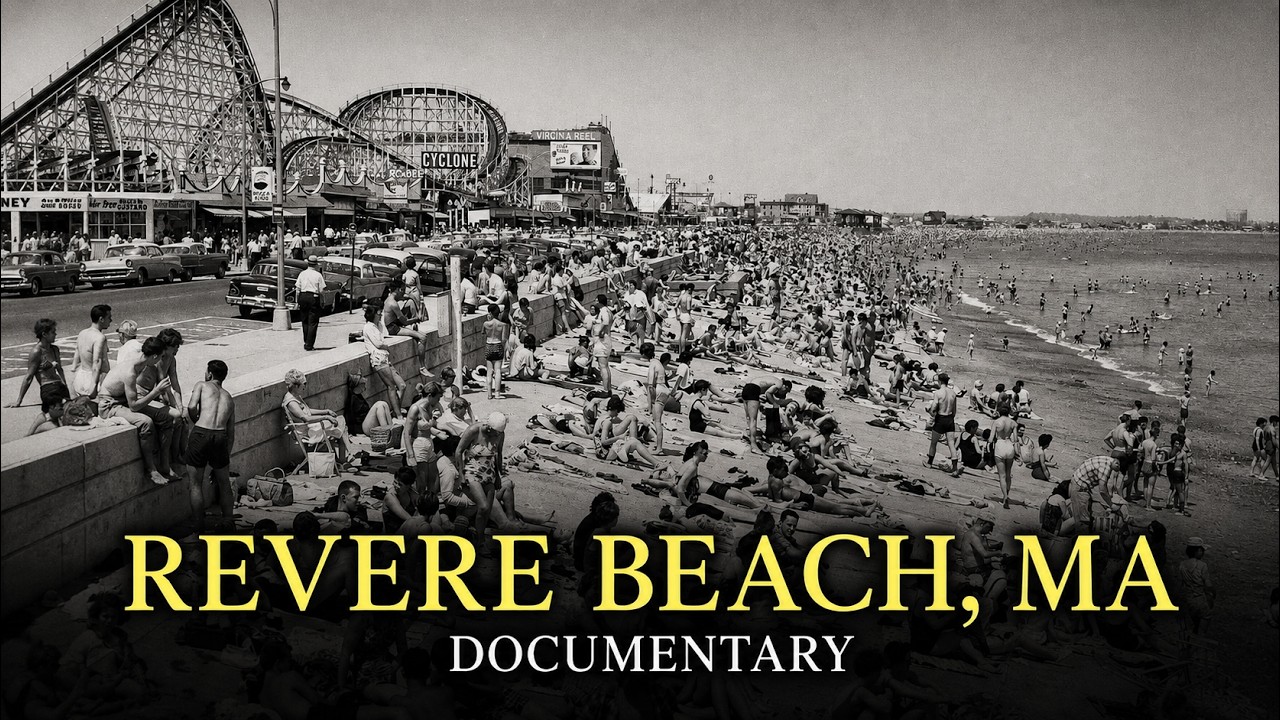
By morning the guard had gone home, and the shooting gallery counters—most of them, anyway—stood empty of rifles for good. For five years after that, the boulevard behaved. Then in 1925, the same strip of sand that had needed federal bayonets to keep it quiet got something else entirely. An engineer named Harry Traver, who had spent the years since the war building wooden coasters for parks across the Northeast, arrived with a contract to build the tallest one anyone had yet put up.
What he raised on the boulevard that year was not simply another coaster among dozens up and down the eastern seaboard. It was a machine engineered specifically to terrify: a wooden trestle climbing in tight banked turns instead of the long open drops most coasters favored, designed so that riders lost sight of the ground and the horizon at the same moment. The track ran 3,600 feet, long enough to wrap the site twice over. Traver’s crews built it to send cars down its steepest drop at forty-five miles an hour, a speed no wooden coaster on the eastern seaboard had reached before.
The bill came to $125,000—nearly $1. 7 million today—paid by boulevard operators who had watched Wonderland go bankrupt fourteen years earlier for building too far from the water, and who had built this one deliberately right on top of it. They called it the Cyclone. For the next thirty-nine years, nothing built anywhere on Earth, not in Coney Island, not in Chicago, stood taller.
The record would not fall until 1964. Two years after the Cyclone opened, Traver came back to the boulevard with a second contract, and this time he wanted to build the whole thing out of steel. It came due in 1927. He called the new ride the Lightning.
It ran lower and faster than its wooden predecessor—riveted joints instead of lumber, arc lamps catching the metal at night the way they never could catch bare wood. It was structurally a different order of gamble: a ride built for a beach that had already proven it would pay for spectacle, going up in a material nobody had tested on that stretch of sand before. It lasted six years. By 1933, four years into the Depression, with boulevard operators counting nickels the way they had once counted crowds, the insurance on a high-speed steel coaster running above a boardwalk full of paying customers became a cost nobody could keep writing off as overhead.
The Lightning came down in pieces that year—the same steel driven into the sand in 1927 hauled back out of it, sold or scrapped. Six years of construction and six years of thrill rides closed out in the end as a bad bet. The boulevard’s answer to the Depression was not caution. It was more of everything else.
Through the back half of the same decade that killed the Lightning, two new ballrooms rose within a few hundred feet of where the coaster had stood: the Spanish Gables, its stucco arches and red tile roof built to look like nothing else on the Atlantic coast, and the Moorish Castle, its onion domes lit up over a dance floor advertised as the largest between Boston and Coney Island. Every summer from June to October, promoters filled those floors with dance marathons—hundreds of hours of continuous motion sold as entertainment to a public that could not always afford much else. Couples danced forty-five minutes of every hour for weeks, sometimes for months, sleeping in shifts against the walls during the fifteen-minute breaks, disqualified the moment a knee touched the floor. Not entertainment for its own sake, not a spectacle staged for tourists, not a curiosity dreamed up by a promoter with an empty hall to fill: a way for a couple with nothing left to sell to eat and sleep indoors for as long as their legs held out.
The marathons ran under live orchestras, and the orchestras were not local acts filling time between real bookings. Paul Whiteman brought his full band to the boulevard’s ballrooms more than once that decade. Tommy and Jimmy Dorsey, still playing together before the split that would later end the partnership, worked the same rooms. Guy Lombardo’s Royal Canadians came back summer after summer.
Louis Prima, years away from Las Vegas and the name he would eventually make there, played sets at Crescent Gardens for a beach crowd with no idea how far that name would travel. Picture the boulevard on a Saturday night in August 1935: the Spanish Gables and the Moorish Castle lit end to end, arc lamps and strings of bulbs turning stucco and onion domes gold against the dark water; the trolleys of the Boston, Revere Beach and Lynn line running full every ten minutes, unloading couples in their one good outfit onto pavement still warm from the day; inside, a marathon in its third week still turning on its forty-five-minute cycle; two blocks down, Lombardo’s band playing to a floor with no empty inch left on it. A strip of sand that had been fenced private property forty years earlier was now, on this one night, the loudest half mile in New England. None of it needed a war or a storm to end.
It needed only what every American boomtown eventually needs: someone, somewhere, deciding the upkeep could wait another season. Through the rest of the 1930s the crowds kept coming back to the boulevard exactly as they always had. The buildings that held them did not. Nothing announced the end of the ballroom years.
There was no closing night at the Spanish Gables, no farewell set from Guy Lombardo’s band, no headline marking the evening the marathon stopped filling the floor. The years between that Saturday in August 1935 and the middle of the century passed the way most declines pass on a beach that has stopped being new: a booking a little smaller, a crowd a little thinner on a Tuesday that used to be packed solid by nine. The boulevard did not fall. It coasted.
By the early 1950s it was still a working strip of amusements, dance halls, and rooming houses, still drawing families off the trolley on a Saturday. It was no longer the loudest half mile in New England, and nobody could point to the day that had become true. Then on June 19, 1954, the Massachusetts Bay Transportation Authority opened a subway station at Revere Beach, extending Boston’s rapid transit line the final stretch to the sand itself. It was the payoff of nearly eighty years of railroad money aimed at this exact half mile of coast.
It was, by any measure of civil engineering, a triumph. It arrived at a beach that had already had its best afternoon. A station is not a crowd; it is only the promise of one. The trains that pulled into Revere Beach that June carried the same riders the trolleys had always carried in roughly the same numbers, at a moment when the ballrooms they were riding toward had less to offer them each summer than the one before.
Decades of investment, decades of engineering, decades of public money spent on getting people to a beach faster at the exact point in its history when the beach no longer needed to be reached faster. It needed something else entirely. And nobody on the Metropolitan District Commission’s payroll was building that. Ten weeks later, the coast found out what it needed to survive.
On August 31, 1954, Hurricane Carol came ashore in New England with sustained winds near 110 miles an hour—the most powerful storm to strike the region since 1938. It moved fast, the way the worst Atlantic hurricanes move once they clear the Carolinas and pick up speed over open water, and it did not weaken the way forecasters of the period expected a storm to weaken this far north. Revere Beach took the storm directly. The reservation that Charles Elliot had designed to hold back the Atlantic with a seawall and a graded beach absorbed a surge that came in on top of a high tide, and the two together did what neither could have done alone.
Sections of the seawall gave way. Sand that had been replenished and graded for half a century washed back into the harbor in a single afternoon. Pavilions and boardwalk sections that had survived the Depression, survived the closing of the Lightning, survived nineteen quiet years of declining bookings, did not survive Hurricane Carol. The storm did not care that a subway station had opened there ten weeks earlier.
By the time the wind eased on the morning of September 1, engineers from the Metropolitan District Commission were already walking the length of the seawall, counting the breaches. The next full tide was six hours away. The boulevard came back from Hurricane Carol the way it had come back from every storm before it: sand trucked in, pavilions rebuilt board by board, the seawall patched at its breaches before the next full-moon tide could find them. By the summer of 1955 there was little on the surface to tell a visitor the coast had drowned the year before.
What could not be trucked in, rebuilt, or patched was appetite. The Metropolitan District Commission had spent nearly sixty years proving what it could do to Revere Beach when it wanted something built. It was about to spend two decades proving what happened when it stopped wanting anything at all. Through the 1950s and into the 1960s, the commission simply stopped—not with an announcement, not with a vote anyone remembers, but with a maintenance budget that shrank a little further each year.
The ballrooms filled a little less. The Spanish Gables needed a new roof and did not get one. The Ocean View needed rewiring it never received. Paint and foundation work were needed up and down the boulevard, and for the better part of two decades none of it came.
By the early 1970s, the strip that had once pulled one hundred thousand visitors through a single Saturday night looked, in the words of the local chroniclers who still bothered to write about it, like a corridor of honky-tonk bars and abandoned buildings. Some of the decline was the commission’s doing. Some of it was the country changing around the beach faster than the beach could follow: cheap jet travel was pulling the same families who once filled the boulevard toward Florida and the Caribbean instead, at fares a millworker’s family could now stretch to cover. Revere Beach had built its fortune on being twenty minutes from Boston by trolley.
It had no answer for a country where everywhere else was suddenly closer than it used to be. The Cyclone went first. Harry Traver’s coaster had opened in 1925, holding the world height record until 1964, and in 1969, forty-four years and no major rebuild later, it closed. No ceremony was recorded for its last run.
No one thought to save a photograph of the final car coming down the lift hill. The structure sat empty at the edge of the boulevard for two years, its wood going gray, and then in 1971 it burned. The fire did not finish it. Enough of the frame survived that the ruin stayed standing for three more years, a skeleton with weeds growing up through the ties, until March 1974, when it burned again—worse this time, or simply more completely.
The following month, what the two fires had left was pulled down. Forty-nine years after Harry Traver built the tallest roller coaster on Earth on this half mile of sand, there was no roller coaster on it at all. One way or the other, the ocean was still owed its turn. It would take that turn on a Monday morning in February, less than four years after the Cyclone’s ashes were cleared away, and it would not need fire.
It would need three tides in thirty-two hours. The storm arrived on Monday, February 6, 1978, and it did not announce itself gradually the way New England nor’easters usually did. It arrived already at hurricane force, and it arrived at the worst possible hour on the tide table. Dead low had passed.
The moon was near perigee, and the storm’s surge stacked itself on top of an astronomical high tide that would have been serious on its own. Meteorologists would later count three separate tide cycles moving through the coast in thirty-two hours, each one higher than the one before, none of them given enough time between crests to recede fully before the next arrived. In Beachmont, the residential block set back from the boulevard on Revere Beach’s northern flank, the water did not stop at the seawall or the sand or the street. It came through the neighborhood in the dark hours of the storm’s second tide and lifted houses off their foundations—not flooded them, not damaged them: lifted them, moved them, left them standing at angles their builders had never intended, blocks from where they had been bolted down.
Families who had ridden out Hurricane Carol in 1954 without leaving their homes left this one. Some did not have the option of staying, because by the second high tide there was no longer a foundation under the house to stay in. On the boulevard itself, the storm did the arithmetic that two decades of deferred maintenance had been quietly setting up. Nothing still standing survived it: not the Spanish Gables, gutted already by disuse but still upright; not the Ocean View’s remaining structure; not the arcades, the shooting galleries, the fortune machines, the shuttered ballroom fronts that had been boarded rather than torn down because nobody had budgeted for demolition either.
The seawall itself, the wall the Metropolitan Park Commission had poured to make this stretch of coast livable in the first place, came apart in long sections, undermined from beneath by three tides that had nowhere else to put their weight. By the time the water receded for good, there was very little left to argue about. Local historians would later call the storm the final death knell of the old Revere Beach. For a while, nothing happened.
The wreckage sat through the rest of the 1970s the way wreckage does when no one has agreed yet whose job it is to clear it. But by the early 1980s, the state of Massachusetts and the city of Revere had reached the agreement the Metropolitan District Commission had failed to reach with itself for twenty years: they would fund the reconstruction jointly. New sand was trucked in to replace what three tides had carried out to sea. Pavilions went back up, plainer than the ones the storm had taken, built to a public works budget rather than a showman’s.
The work ran through most of the decade. The rebuilt reservation reopened to the public in May 1992, fourteen years after the storm and ninety-six years after Charles Elliot’s Boulevard first opened to the crowds from the North End. What reopened in 1992 carried the beach’s original geography and almost nothing else. Revere today has roughly sixty thousand residents, and 43.
8 percent of them were born outside the United States—Salvadoran, Cambodian, Moroccan, Brazilian. A roster that has almost nothing in common with the North End dockworkers and East Boston tenement families who once rode the narrow-gauge line out from Lynn for a nickel fare. The mills that sent those earlier crowds to the water are gone. The people who replaced them came for the same reason the first ones did: because this was still the nearest stretch of open ocean anyone would let them stand on for free.
What has not stayed the same is what stands between the boulevard and the sand. Where Wonderland’s midway once ran, and where the Cyclone’s timber tracks once climbed ninety feet over the crowd, condominium towers now rise instead—glass-faced and set back just far enough from the water to advertise the view. Studios in the newer buildings list from around $2,300 a month. The city’s own housing plan, drafted by the same municipal government that owns the boulevard, describes this wave of waterfront construction in a phrase blunter than most planning documents allow: it is displacing longtime lower-income residents.
Blake built Wonderland to bring poor families to the beach for a dime. The buildings that replaced it price most of those same families a mile inland. Only one entertainment institution from the golden age is still standing. It is not a ballroom, not a coaster, not a midway attraction of any kind.
It is a sandcastle contest. The Revere Beach International Sand Sculpting Festival is now in its third decade, drawing several hundred thousand people to the boulevard over a single weekend in July, billed as the largest free event in Massachusetts. No orchestra plays. No incubator ward operates behind glass.
Sculptors with trowels and buckets of seawater build something that will wash away within days. It is the only piece of the old entertainment economy that outlasted the entertainment. In 2026, the nonprofit Save the Harbor rates the water off Revere Beach at 95 percent clean, among the best of any public beach in the state. That number settles a question the previous decades have circled without quite answering.
The sand was never the liability. The water was never what drove Boston’s wealthier families north to Nahant and Swampscott, and it was never what emptied the boulevard after 1978. What failed every time was what got built on top of it: the wiring, the wood, the financing, the maintenance budgets nobody funded. What is gone in the end is a long list.
The Great White Way’s one hundred thousand electric bulbs. The ballrooms where Guy Lombardo’s orchestra played to a packed floor. The world’s tallest roller coaster, and the one that burned after it. Wonderland’s incubator ward, its mock city block that burned twice a day, its miniature Mount Fuji built for a crowd that had never seen the real one.
The arcades, the Spanish Gables, the Ocean View, the seawall the Metropolitan Park Commission poured in 1896. All of it demolished or burned or carried into the harbor by three tides in thirty-two hours, or simply left standing long enough to rot and then condemned. None of it needed to be sand. That was always the one part of the inventory nobody could repossess, defund, or fail to maintain.
The beach is there this morning, the way it is most mornings, curved along the same line Charles Elliot staked out with a satchel of survey stakes in 1895—not the coast corrected into a straight edge, but the coast left to keep its own shape. The tide is going out. Gulls work the wet sand where the water pulled back an hour ago. A few hundred yards north, past where the midway used to stand, a crew from the festival is smoothing a fresh block of packed sand for a sculpture that will not survive the week.
Above it, glass towers hold the morning light the way the Tower of Light once held four thousand bulbs. Below it, the same water that Elliot promised the public in 1896 keeps arriving. Unbuilt on, unbranded—still there.
