The archivist could not stop looking at the top of the boy’s head. The photograph was a cabinet card, roughly four by six inches, mounted on thick card stock with the photographer’s name pressed in gold script along the bottom edge. At first glance, it was a gentle image: a woman in a dark silk gown, her hair parted in the middle and pulled back in the style of the early 1870s, seated in a carved wooden chair. Her left arm circled a young boy standing beside her, leaning into the curve of her body.
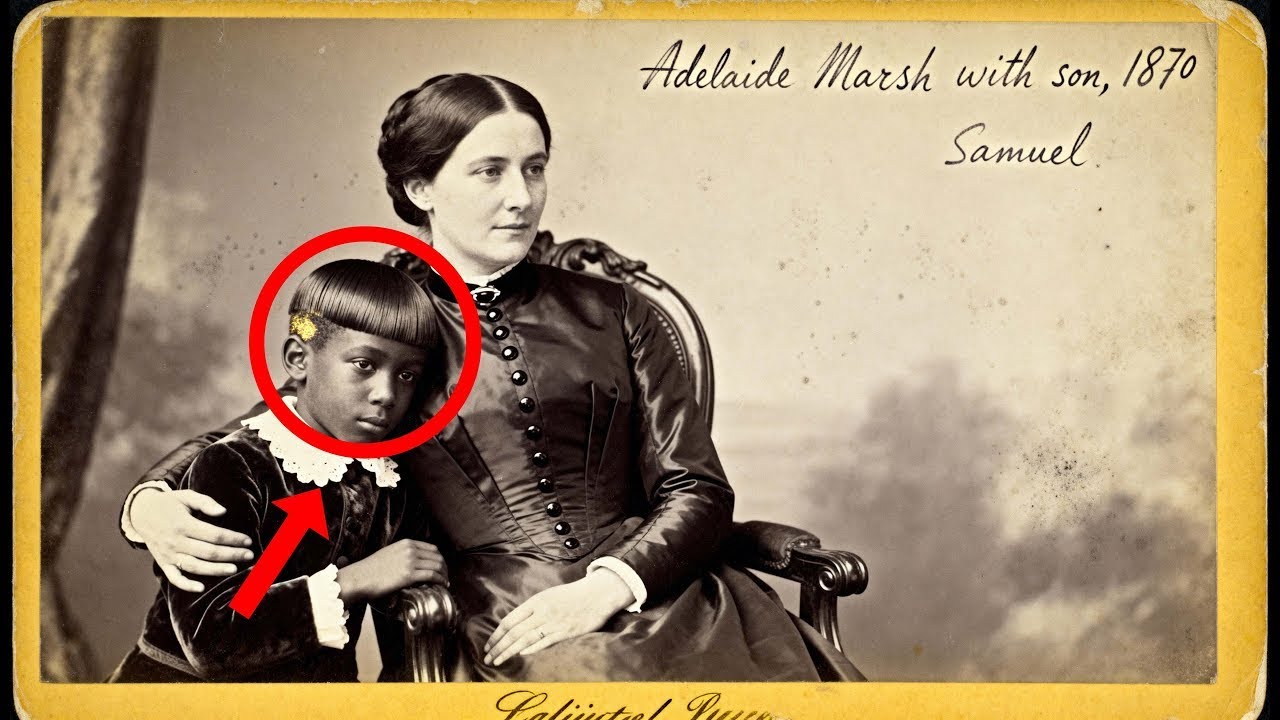
The boy was dressed in a fine velvet suit with a white lace collar, the kind of outfit a wealthy family might put on a beloved child for a special occasion. His skin was brown, his features suggesting African ancestry, and his head leaned slightly toward the woman’s shoulder in what first looked like a natural sign of affection. It had felt like love for more than 150 years. Until Elellanar Vance could not stop looking at the hair.
Vance had been cataloging photographs at a historical society in Richmond for eleven years. She had handled thousands of images from the antebellum and Reconstruction eras—daguerreotypes of Confederate officers, cabinet cards of newly freed families standing stiff and proud in front of the first homes they owned. She knew how to read a nineteenth-century studio portrait the way other people read books. Every detail was intentional: the backdrops, the furniture, the placement of hands and bodies, all arranged to communicate wealth, morality, family harmony, respectability.
Nothing was random. When something did not match the expected pattern, it usually meant there was a story the photograph was not telling openly. She had seen images where a pair of manacles was partly hidden behind a chair leg. She had seen portraits where a servant standing behind a white family was positioned so that, on closer inspection, an iron collar could be seen around the neck.
She had trained herself to look for what did not belong. She had never seen anything quite like this boy’s hair. It was straight and flat, pressed close to his scalp in a way that looked uncomfortable, almost painful. Along the hairline above his left ear, she noticed a faint discoloration—possibly a chemical burn, or the trace of something worse.
It did not look like the hair had grown that way. It looked forced. The photograph had come from a donated estate collection in the spring of 2019. Vance slid the card out of its protective sleeve and turned it over.
On the back, written in faded pencil, was a name and a date: *Adelaide Marsh with son, 1870*. Below that, in a different handwriting, was a single word that had been partially rubbed away but was still readable if held at the right angle. The word was *Samuel*. Two names, mother and son, according to the note.
But the erasing of Samuel’s name—the clear effort to remove it—suggested that someone at some point had wanted to undo whatever claim this photograph made about their relationship. The photographer’s stamp read *Whitmore and Company, Richmond*. Vance began her search there, pulling city directories from the 1860s and 1870s. The studio was listed on Broad Street from 1858 to 1879, operated by a man named Thomas Whitmore, who advertised “portraits of distinction for families of quality.
” The wording was typical for the time, meant to signal that the studio served wealthy white clients. But a deeper look into Whitmore’s business records, donated to a university archive in the 1990s, revealed something more revealing. Whitmore had kept a separate ledger for what he called “special commissions. ” These were portraits made for clients who did not want their names entered in the main appointment book.
The entries were brief, usually just initials, dates, and occasional notes about payment. One entry from March 1870 caught Vance’s eye: *A. M. portrait with ward, hair preparation required extra fee.
*
Ward, not son. And hair preparation. Vance reached out to a colleague in Washington, a historian named Dr. Lorraine Okonquo, who specialized in the post-emancipation period and the legal methods white families used to maintain control over black children after slavery officially ended.
Dr. Okonquo had spent years documenting the practice of apprenticing black children to their former enslavers, a system that allowed white families to keep black minors as unpaid labor under the claim of training and care. She had also written about “companion children”: black children kept in white households not for work but for company, dressed well and displayed as proof of the family’s kindness. When Vance sent her a high-resolution scan of the photograph, Dr.
Okonquo replied within hours. She wrote that she had seen images like this before. The clothing, the pose, the closeness to the white woman—all matched known patterns. But the hair made this case different.
Most companion children were photographed with their natural hair, often styled in ways that highlighted their difference from white family members. Straightening a black child’s hair like this would have been painful and uncommon for the time. It suggested the family wanted to remove visible signs of his race to make him appear more like a biological child. That was a different kind of violence.
It was an act of erasure. Vance began looking for more information about Adelaide Marsh. The name appeared in Richmond city directories from 1865 through 1882, listed at a large address in the Church Hill neighborhood. Census records from 1870 showed the household as Adelaide Marsh, age 32, listed as head of household; her widowed mother, Margaret Marsh, age 58; and one servant, a black woman named Celia, age 45.
No child was listed at all. The absence was not unusual for the era. Black children living in white households were often left out of official records or described with vague terms that hid their true status. But the lack of any child in a census taken the same year as the photograph raised troubling questions.
If Samuel was Adelaide’s son, legally or otherwise, why was he not counted? And if he was not her son, then who was he? Vance dug further into the Marsh family history. Adelaide’s husband, Walter Marsh, a cotton merchant, had died in 1864 during the final year of the Civil War.
His will, filed with the Richmond Probate Court, provided for his wife and specifically listed all servants and their children held by the estate. The Marsh family had been enslavers, and according to the will, those enslaved people were not freed at Walter’s death but transferred to Adelaide’s ownership. In an inventory attached to the will, Vance found a woman named Celia, aged 39 at the time, and her daughter, unnamed, age four. There was no mention of a son.
Yet four years later, the census showed Celia still in the household at age 45, with no daughter listed. And the photograph showed a boy of about six or seven, dressed in velvet, leaning into Adelaide Marsh’s shoulder as if she were his mother. Vance shared these findings with Dr. Okonquo, whose reply was calm but grim.
The pattern matched dozens of similar cases, she said. After emancipation, some white families kept black children even when the adults in those families left or were pushed out. Children were easier to control. In some cases, white families claimed legal guardianship through the apprenticeship system.
But the most disturbing cases were those with no legal process at all—the white family simply kept the child. Sometimes they claimed the child was an orphan. Sometimes they presented the child as adopted. And sometimes, as this photograph suggested, they tried to pass the child off as their own.
The hair straightening fit that final category. It was an attempt to make the child’s race less visible. Dr. Okonquo explained the wider conditions that allowed such situations to exist.
After the Civil War, Virginia and other former Confederate states passed laws known as the Black Codes. These laws restricted the freedom of newly emancipated people and forced them back into labor arrangements that were slavery in everything but name. One of the most harmful provisions allowed courts to apprentice black children to white employers, often their former enslavers, if the children were judged to be orphans or without proper support. White judges often decided that black parents struggling in the ruined post-war economy were unfit to raise their own children.
But even this system did not explain all cases. Some children remained in white homes through informal deals, spoken threats, or simple pressure. A black mother working as a domestic servant might be told that if she wanted to keep her job, her child would have to stay in the house as well. The child might be introduced to visitors as a ward, a companion, or something intentionally unclear.
The practice was so common it had its own terms: yard children, house children, pet children. Words that made the situation sound gentle while hiding its deep cruelty. “The hair is what makes this case especially disturbing,” Dr. Okonquo said during a follow-up call.
“Hair straightening for black people at that time was rare and extremely painful. The most common method used lye-based chemicals that could cause serious burns. For a child of six or seven to endure that process again and again to keep his hair straight would have been traumatic. It suggests the family was not just keeping him as a companion or servant, but trying to turn him into something else.
They were trying to undo who he was. ”
Vance found herself returning to the photograph again and again, studying the boy’s face for any sign of what he might have felt. His expression was hard to read. Long exposure times meant people had to remain still for several seconds, often leaving faces blank or tense.
But there was something in the tight set of his mouth that suggested discomfort, or perhaps something deeper. She wondered if his scalp was still burning from whatever chemical had been used. She wondered if he understood why he was dressed in velvet and posed beside this woman. She wondered if he remembered his mother, and whether his mother had any choice in letting him go.
The next step led her to Richmond, to the church the Marsh family had attended. Vance made the trip in early summer, driving from her office in the Shenandoah Valley to meet the archivist at St. Paul’s Episcopal Church, one of the oldest and wealthiest congregations in the city. The church stood prominently on Grace Street, its white steeple visible from blocks away.
During the Civil War, Jefferson Davis had worshiped there, and the pews still bore small brass plaques with the names of families who had purchased them long ago. The Marsh name appeared on one plaque, third row from the front. The church had kept careful records of births, deaths, marriages, and baptisms going back to the eighteenth century. In the antebellum era, these records served two purposes: they documented the spiritual lives of white members, and they sometimes recorded the baptisms of enslaved people owned by the congregation.
These entries were usually brief and often lacked surnames, listing only a first name, the owner’s name, and the date. They were, in a sense, property records hidden inside religious books. If Samuel had been baptized there, or if any official note had ever been made about his connection to Adelaide Marsh, it would appear in those ledgers. The archivist, a retired schoolteacher named Mrs.
Dorothy Hail, was doubtful at first about Vance’s questions. “The Marsh family were generous supporters of this church for generations,” she said, guiding Vance down a hallway lined with portraits of former rectors. “I’m not sure what you expect to find that would really matter to history. ”
But when Vance showed her the photograph, Mrs.
Hail’s face changed. She studied it carefully for a long moment, then looked up with what seemed like recognition. “I’ve seen this boy before,” she said softly. “Not in real life, of course, but there’s another photograph of him in our collection.
”
The second photograph, which Mrs. Hail brought up from a storage room in the church basement, showed the same boy about ten years older. He wore a plain dark suit like a household servant and stood behind a seated group of white women at what looked like a church gathering. The women smiled and held fans against what must have been the summer heat, their light dresses loose and comfortable.
Behind them, Samuel stood stiff and straight. His hair was cut short now, natural curls clearly visible even in the faded image. He was not looking at the camera. His eyes were lowered to the floor, his hands folded tightly in front of him, his posture rigid.
There was no velvet, no lace collar, no gentle leaning into anyone’s shoulder. The companion child had become something else. Vance studied the two photographs side by side. The boy in velvet and the servant in dark wool.
The hair painfully pressed flat against a young head, and later the natural curls of a teenager finally allowed to look like himself. The possessive arm around a child, and later the clear space between bodies. It felt like looking at two different people, except the face was clearly the same. The same eyes, the same jawline.
But something in his expression had changed. Whatever softness had once been there, whether real or staged, was gone. In its place was something cautious, alert—aware of the camera and what it could be used to show or hide. The church records confirmed what Vance had already begun to believe.
Samuel had never been legally adopted by Adelaide Marsh. He had never been baptized as her son. Instead, there was a single entry dated 1876 that noted the return of “a colored ward named Samuel to his people, at the request of his mother, Celia. ”
Celia had remained in the Marsh household as a domestic servant during the years her son was being presented as Adelaide’s companion.
The entry was short and formal, almost cold, but what it meant was devastating. For six years, Celia had watched her child dressed up and displayed as another woman’s son. She had watched his hair burned straight. She had watched him posed in portraits that erased her completely.
And then, at last, she had found a way to bring him back. Dr. Okonquo helped Vance locate records from a black church in Richmond founded by formerly enslaved people in 1866. In its early days, it was known simply as the Colored Baptist Church of Richmond.
It began in the basement of an old warehouse just months after the war ended. Its founders were men and women who had spent their lives enslaved, who had been forbidden to learn to read or write, who had been denied legal marriage and the right to keep their children. One of the first things they did with their freedom was build a place that would record their lives in their own words. The church kept its membership rolls separate from white churches that either refused black worshippers entirely or forced them into segregated balconies where they could listen but not fully take part.
These rolls were more than lists of names. They recorded marriages that slavery had refused to recognize. They recorded the births of children who would not be sold away. They recorded deaths and honored lives, however short they were.
And sometimes, they recorded reunions. In those pages, Vance found Celia listed as a founding member, with a note stating that she had been reunited with her son Samuel in 1876. The wording mattered. It said *reunited*, not “received” or “acquired,” or any of the terms white recordkeepers often used.
*Reunited* meant a separation that had been wrong. It meant a bond that had always existed and was finally restored. It meant Celia had always been Samuel’s mother, even during the years when a white woman dressed him in velvet and called him son. Another entry from 1879 recorded Samuel’s marriage to a woman named Hannah.
A third, dated 1882, noted the birth of their first child, a daughter named Elellaner. Learning that the boy in the photograph had survived, had reclaimed his life, had built a family beyond the Marsh household, brought both relief and new questions. The story did not end with his erasure. But it raised the issue of how to tell that story now, more than a century later, when descendants of everyone involved might still be alive.
Vance presented her findings to the director of the historical society, Richard Townsend, who had hired her ten years earlier and usually trusted her judgment. She spread out the photographs, the church records, and her correspondence with Dr. Okonquo, and explained what the evidence suggested. The 1870 image was not a portrait of a mother and son.
It was a photograph of a white woman and a black child she kept as a companion, a living doll whose hair had been chemically straightened to make him look more like her own child. The inscription on the back, *Adelaide Marsh with son*, was not proof of family but a claim of control wrapped in affection. Townsend listened closely, studied the materials, then leaned back with a sigh. “This is going to be difficult,” he said.
The Marsh family had been major donors for generations. Their descendants were still connected to the board. Reframing the photograph this way would upset people. “Some people have already been unhappy for a long time,” Elellaner replied.
“They’re the descendants of Samuel and Celia, not the descendants of Adelaide Marsh. Their pain has been ignored for 150 years. ”
The board meeting happened three weeks later. Vance presented her research to a room where people shifted uncomfortably as she showed the two photographs side by side: the velvet-clad companion child of 1870 and the servant of 1880.
She explained the hair straightening, the missing census records, the church entries that documented Celia’s long struggle to reclaim her son. She quoted Dr. Okonquo’s work on companion children and how these practices were part of larger systems of racial control that lasted long after emancipation. When she finished, the room was silent.
Then a woman near the back, someone Vance recognized as a Marsh descendant, raised her hand. “I don’t understand what you expect us to do with this,” she said, her voice calm but sharp. “You’re asking us to accuse my ancestors of stealing a child based on a photograph and some church notes. ”
“I’m not accusing anyone,” Vance answered carefully.
“I’m asking us to tell the truth about what this image shows. For years, it has been displayed as a portrait of a mother and son. That isn’t true. The boy was not Adelaide Marsh’s child.
He was the son of a woman named Celia who worked in her household and fought for years to get him back. If we keep the old caption, we are repeating the same erasure that happened to Celia and Samuel in their own time. ”
The discussion went on for more than an hour. Some board members said the evidence was indirect and open to interpretation.
Others worried about the reaction to correcting the story of a well-known local family. But a few, including a newer member who taught African-American history at a nearby college, argued that the society had a duty to tell accurate stories, even when they were uncomfortable. In the end, they reached a compromise. The photograph would be recaptioned with a longer description explaining the uncertainty of the relationship and giving context about companion children in the post-Civil War South.
A small exhibit would be built around the image, showing both photographs and excerpts from church records that documented Samuel’s return to his mother. The society would also try to contact descendants of Samuel and Celia, if any could be found, and invite them to take part in telling the full story. Finding those descendants took another six months. Vance worked with a genealogist named Marcus Webb, who specialized in tracing African-American family histories.
It was slow and difficult work, made harder by destroyed records and the way black families had been separated and scattered over generations. Webb explained that tracing Samuel’s line meant working forward and backward at the same time, using whatever fragments remained: marriage records, death certificates, land deeds, school lists, church books from many congregations, since families often moved in search of work or safety. The task was complicated further by the Great Migration, when millions of black Americans left the South for northern and western cities in the early twentieth century. Their descendants could be anywhere.
Webb followed Samuel’s son through census records to Baltimore in 1910, then to Philadelphia by 1920. After that, the trail became clearer. Samuel’s granddaughter had married a steel worker named Holland. Their children stayed in Philadelphia.
Eventually, Webb located Patricia Holland in the Germantown neighborhood, a retired nurse whose family Bible listed Samuel as Hannah’s husband, with a note that read: *“Born in bondage, stolen as a child, returned to his mother by the grace of God. ”*
Patricia Holland came to Richmond for the exhibit opening. She stood in front of the 1870 photograph for a long time, silent, her hand resting against the glass as if she could touch the boy inside. When she finally turned to Vance, tears were on her face, but she was smiling.
“My grandmother used to talk about him,” she said. “She called him the stolen son. She said he never spoke about those years, but his mother, Celia, always said the white woman dressed him like a doll and burned his hair to make him look like something he wasn’t. We thought it was just a family story.
We never knew there was a photograph. ”
The exhibit ran for four months and drew more visitors than any show the society had hosted before. Local newspapers covered it, and academic journals published articles about companion children using the Marsh photograph as a key example. Dr.
Okonquo gave a lecture to a packed audience explaining how Samuel’s experience fit into the wider pattern of white families holding on to black children through legal and illegal means after emancipation. She showed images from Alabama, South Carolina, and Mississippi—all showing well-dressed black children posed beside white women who were not their mothers. The exhibit also led the society to re-examine its own collection. Staff began reviewing items added decades earlier with little context or misleading labels.
They found photographs called “family servant” that showed children far too young to work. They found portraits labeled “nurse in charge” where the supposed nurse was barely older than the baby she held. They found images of black people with no names at all, described only as “domestic scene” or “household group. ” Each item was now being researched, recontextualized, and when possible, connected to descendants who might have their own stories.
Richard Townsend later told Vance that the exhibit had changed his understanding of the society’s role. “We treated these photographs as objects,” he said, “things to preserve and display. But they’re not just objects. They’re evidence.
And for a long time, we presented that evidence in a way that supported one version of history while silencing another. I don’t know how to fix all of that, but we have to begin somewhere. ”
For Vance, the most meaningful moment came near the end of the exhibit, when Patricia Holland returned with her daughter and two grandchildren. They stood together before the photograph—four generations of Samuel’s family looking at the image of a boy who had been erased and then reclaimed.
The youngest child, a girl about seven, the same age Samuel had been when the picture was taken, pointed at the image and asked who the people were. Patricia knelt beside her. “That’s your great-great-great grandmother’s son,” she said. “His name was Samuel.
The woman next to him is not his mother. His real mother was a woman named Celia who loved him so much she spent years fighting to get him back. And she did. ”
The girl looked again at the photograph.
“Why is his hair like that? ” she asked. Patricia was quiet for a moment. “Because they were trying to turn him into something he wasn’t,” she said.
“But it didn’t work. He always knew who he was, and now we do, too. ”
Photographs lie. A camera captures a moment, but that moment is staged, framed, and shaped to show what the subjects and the photographer want us to believe.
A white woman in silk, a black child in velvet, a gentle lean that suggests love and family. But the details tell another story: the burned hairline, the missing census record, the separate ledger for special commissions, the church note about a return that never should have been needed. Samuel’s photograph is not unique. Archives, attics, and museum storage rooms across the country hold thousands like it—portraits meant to show kindness and care that actually record something far darker.
Children dressed as companions to display an enslaver’s generosity. Families posed to hide the violence beneath them. Hair straightened, skin lightened, identities erased to keep the lie alive. Every one of those photographs is a crime scene.
And every one is also a record, if we learn how to read it, of people who survived. Samuel survived. Celia survived. Their descendants survived and carried the story forward even when the image tried to erase it.
The next time you see an old portrait and feel warmth toward the past, look closer. Look at the hands, the hair, the edges of the frame. Look for what does not belong.
Look for the story the image is trying not to tell—because that story belongs to someone, and they have been waiting a very long time for someone to notice.
